A bird coming into your house most often means one simple thing: the bird got confused. Reflections in glass, artificial lighting, an open door or window, seasonal migration disorientation, or a search for food and shelter are the most common causes. That said, across cultures and centuries, an unexpected bird indoors has also been treated as a message, a sign of change, a warning, or a visitation from something beyond the everyday.
Bird Coming Into House Meaning: Causes, Symbols, and What to Do

Maya Hartwell
12 May 2026
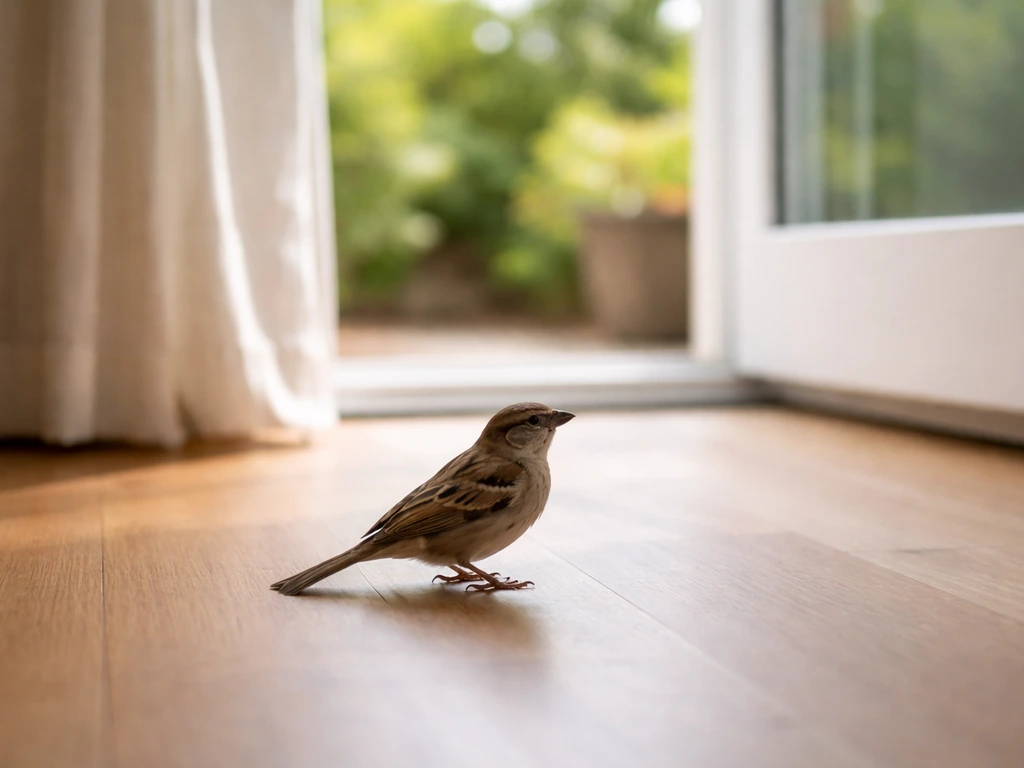
It can also be helpful to compare that idea with the broader meaning of finding a bird in your house, since many readings treat the indoor encounter as a specific life-message theme. Many people ask about the bird enters your home meaning, and the answer usually depends on context like timing, the bird’s behavior, and what felt most relevant to you. Both things can be true at once.
This guide covers what's actually happening, what different traditions say it might mean, and exactly what you should do right now to help the bird and take care of your space.
Why birds get inside: the quick, real-world answer
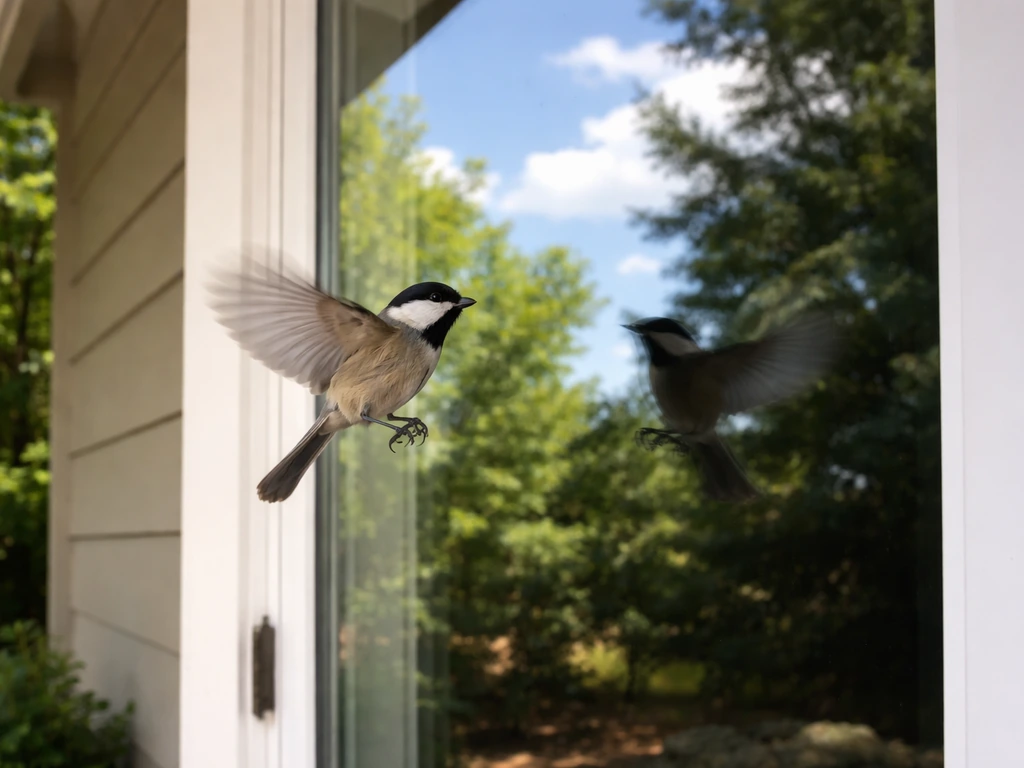
Most bird entries come down to a handful of predictable, natural causes. During the day, birds frequently fly toward windows because the glass reflects trees, sky, or the potted plants sitting on the other side. They aren't being reckless; they genuinely see what looks like open airspace. At night, it's almost always about light. Artificial lighting disrupts birds' navigational instincts during spring and fall migration, drawing them toward buildings and increasing the chance they end up inside through an open gap. The U.S. Fish and Wildlife Service specifically flags nighttime lighting as one of the biggest threats to migratory birds, and research from Utah State University Extension confirms that low-light periods make birds especially vulnerable to glass collisions.
Nesting season adds another layer. In late winter through early summer, birds are actively looking for shelter, and a gap in your roofline, an open chimney, or a door left ajar for ten minutes can look like an ideal nesting cavity. Young birds that have recently fledged are also more likely to wander into unfamiliar spaces because they haven't learned to read human environments yet. So the first honest question to ask yourself is: what season is it, which direction did the bird come from, and was there an obvious open entry point? The answers will usually tell you most of what you need to know about the practical side of the event.
What it means spiritually: messages, omens, and symbols
Once you're satisfied the bird is safe (or on its way out), it's completely natural to wonder if there's more to the story. Bird symbolism is one of the oldest and most universal threads in human spiritual life, and an unexpected indoor visit is among the most commonly interpreted bird encounters across cultures.
Change and news are the most common themes
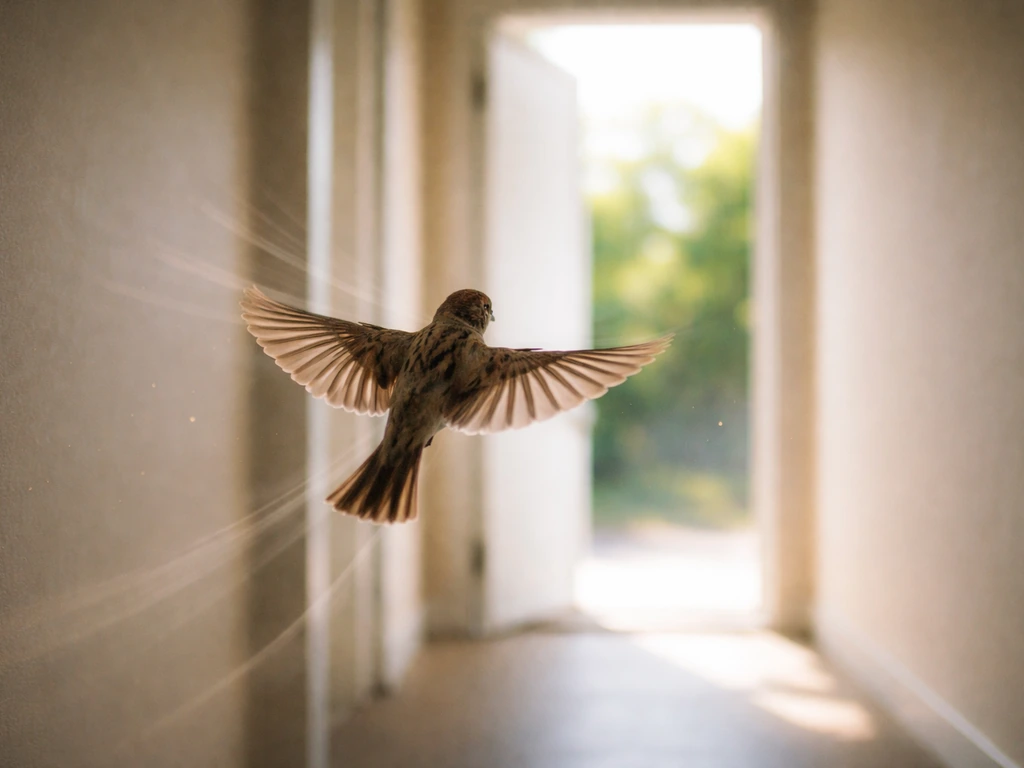
In general folklore, a bird flying indoors is most often associated with incoming change, news, or a transition in your life. The direction of the bird's flight, the type of bird, and whether it exits safely or not all color the interpretation. A bird that flies in freely and finds its way out on its own is widely read as a good omen, a message delivered and received.
A bird that panics, circles, and can't find the exit is sometimes read as a sign of confusion or a warning to pay closer attention to something unresolved. The death omen interpretation (which Snopes documents as a well-known folk superstition) is the one that gets the most attention online, but it's worth noting it's just one thread among many, not a universal truth.
Transformation, guidance, and protection
In many metaphysical and New Age frameworks, birds crossing the threshold into your home are seen as messengers from a higher consciousness or from loved ones who have passed. The threshold itself matters here: the home is considered a protected, private energetic space, so something entering it carries more weight than a bird simply sitting on your porch railing. Celtic traditions associated birds with the soul and the passage between worlds, making an indoor visit particularly significant.
In some Indigenous North American traditions, birds are considered active spiritual messengers, and their behavior, not just their presence, tells the story. A bird that lands calmly and looks at you directly is often read very differently from one that frantically beats against the glass.
Eastern and cross-cultural perspectives
In Chinese tradition, birds entering the home are frequently regarded as lucky, particularly swallows or sparrows, which are associated with good fortune and prosperity. In Hindu tradition, the type of bird matters enormously: an owl indoors may signal wisdom or (in some regional traditions) an inauspicious event, while a peacock or parrot is considered a favorable sign. Japanese folklore has nuanced readings depending on the species, the time, and the room the bird enters. The consistent thread across Eastern traditions is that the bird is intentional, carrying something, even if humans can't always decode it immediately.
What the Bible and religious traditions say
Christian readers often turn to Matthew 10:29, where Jesus says not one sparrow falls to the ground apart from the Father's will. This verse is a cornerstone of Christian perspectives on birds as part of God's active providence. From this viewpoint, a bird entering your home isn't random: even something as small as a sparrow's movement happens within divine awareness. That doesn't necessarily mean the event is a warning or a prophecy, but it does invite a posture of reflection: what might this moment be drawing your attention toward?
Psalm 84:3 adds another layer, describing a bird finding a home and a nest near God's altar, a metaphor for refuge, belonging, and protection. Some Christian readers interpret an unexpected bird arrival as a reminder of that kind of shelter and care. The turtledove appears repeatedly in biblical texts, including Song of Solomon 2:14 and Jeremiah 8:7, in contexts of love, seasonal change, and the rhythms of creation. These associations color how many people of faith receive a bird encounter: not necessarily as an omen, but as an invitation to pay attention.
In Islamic tradition, birds are recognized as creatures that glorify God and are treated with reverence. Finding one inside the home would generally be addressed with care and practical action first, while remaining open to the event as part of God's design. Many religious traditions ultimately point in the same direction: the bird deserves respect and safety, and the encounter is worth a moment of reflection.
Does the species, season, or time of day change the meaning?
Yes, and significantly. Species carry their own symbolic weight that layers on top of the general "bird indoors" reading. A black bird (often a crow or raven) flying into a house carries different folklore associations than a robin, a sparrow, or an owl. Crows and ravens are widely linked to intelligence, magic, and the thinning of the veil between worlds. Robins frequently appear in grief-and-connection traditions, especially in British and Celtic cultures, as signs from those who have died. Sparrows lean toward themes of simplicity, community, and God's care. Owls, appearing indoors at night especially, are the most common "warning" bird across global traditions, though they're equally associated with wisdom and hidden knowledge.
Timing matters too. A bird arriving at dawn is often associated with new beginnings and positive news. A nocturnal entry, especially by a bird that doesn't normally fly at night, tends to carry more weight in folk traditions as something requiring attention. Spring and fall entries are much easier to explain naturally (migration, nesting), which can make it harder to decide if the event feels spiritually significant. A midsummer or midwinter visit with no obvious practical explanation is what tends to stop people in their tracks and prompt a deeper look at what's going on in their lives.
What to do right now: getting the bird out safely
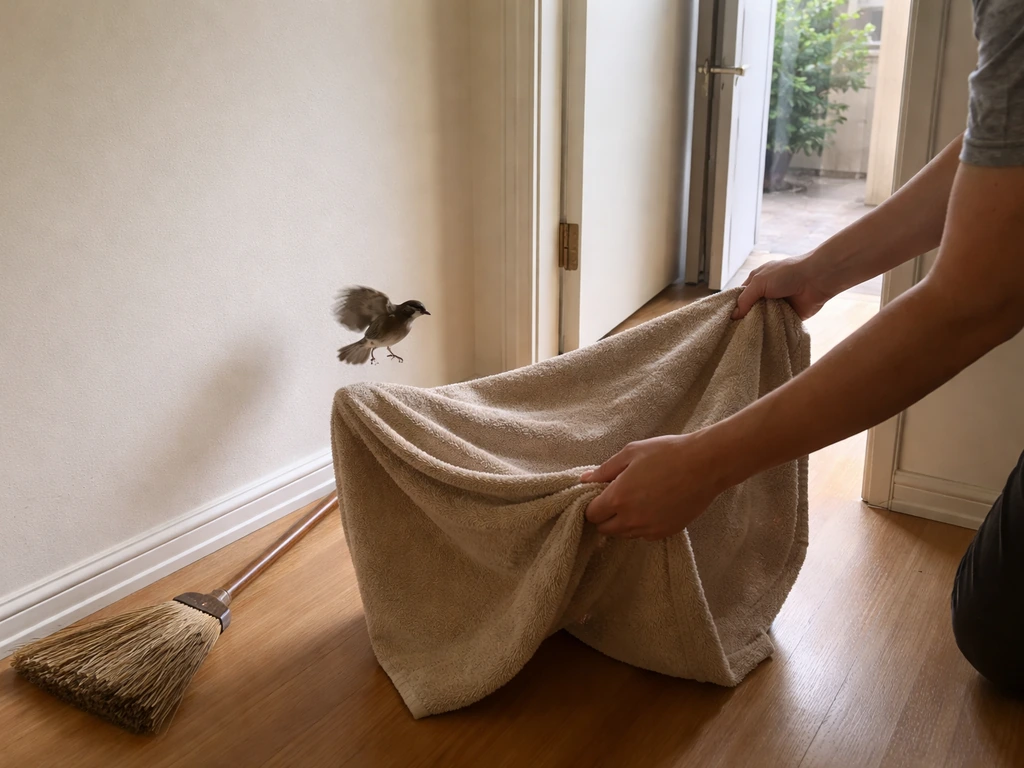
Your first priority is the bird's safety and yours. A frightened bird will exhaust itself flying into walls and windows, and a panicking bird is statistically more likely to injure itself. Stay calm and move slowly. Under U. Audubon advises that if you find an injured or orphaned bird, you can place it in a box or paper bag with air holes and crumpled paper towels, using extra caution for larger birds placing a bird in a box or paper bag with air holes and crumpled paper towels. S. federal law (50 CFR §21.14), any person may humanely remove a migratory bird from a residence without a permit, so you're legally in the clear to help.
- Close off any rooms the bird isn't in, to reduce the number of directions it can fly and limit its stress.
- Open one clear exit: a door or window leading outside. Make it the brightest point in the room by turning off interior lights or closing blinds elsewhere. Birds naturally fly toward light.
- Give the bird space and time. Stand back, keep pets and children out of the room, and let the bird find the exit on its own. Most birds leave within a few minutes if the path is clear.
- If it's a large bird or a raptor (hawk, owl, falcon), do not attempt to handle it yourself. Contact a licensed wildlife rehabilitator. The Minnesota Falconers Association and similar groups emphasize that stress and panic can exhaust a raptor rapidly, making the situation worse.
- If the bird is dazed or appears to have hit a window, place it gently in a cardboard box with air holes, keep it in a dark, quiet space, and contact your nearest wildlife rehabilitation center. All About Birds notes that a dazed bird's best chance of survival is professional help.
- Once the bird is out, leave the exit open for a few minutes to make sure it has fully departed.
Cleaning up safely afterward
Bird droppings require a bit more care than most people realize. The CDC and NIOSH both warn against sweeping or shoveling dry droppings because this can aerosolize particles and create a histoplasmosis risk, a fungal lung infection associated with bird and bat waste. Instead, lightly spray the area with a disinfectant solution or water-bleach mix first, then wipe up with paper towels. Dispose of everything in a sealed bag. Wash your hands thoroughly. Massachusetts DPH guidance for indoor bird waste remediation emphasizes minimizing aerosol generation throughout the process. If there was a significant amount of waste, especially in an enclosed space like an attic, consider wearing a simple N95 mask.
Keeping it from happening again
The FWS recommends turning off unnecessary lights at night during spring and fall migration, the two highest-risk periods. For daytime window strikes, decals or window films applied to the outside of the glass (not the inside, as inside treatments don't deter birds) are the most practical deterrent. Screens on chimneys, gaps in rooflines, and vents are the most common structural entry points to check. If the same entry point is used repeatedly, it's worth sealing it permanently between nesting seasons.
How to tell if it's an omen or just nature doing its thing
This is genuinely the hardest question to answer, and anyone who gives you a definitive one-size-fits-all response is oversimplifying. Here's the honest framework I use when thinking through these encounters.
| Detail to observe | Leans more natural | Leans more symbolic |
|---|---|---|
| Entry point | Obvious open window, door, or chimney | No clear entry point you can identify |
| Season/time | Spring or fall migration; nighttime near lit windows | Midsummer, midwinter; mid-morning with nothing unusual nearby |
| Species | Common local bird for the season | Rare, out-of-range, or nocturnal species |
| Bird behavior | Panicking, disoriented, flying at glass | Calm, landing near you, making eye contact |
| Bird condition | Injured or dazed (window strike) | Healthy, alert, exits calmly on its own |
| Repeated visits | One-off event | Same species, same area, multiple times in a short period |
| Your internal state | Curious but not moved | Felt a strong emotional reaction before or during the event |
None of these columns cancel each other out. A bird can have a completely explainable natural cause for entry and still land as symbolically significant for you personally. The two interpretations aren't in competition. What matters is whether the event resonates with something already in motion in your life.
How to interpret the message if it feels meaningful
If you've got the bird safely out and cleaned up, and you're still sitting with a feeling that the visit meant something, here's how to actually work with that rather than just wondering about it indefinitely.
Start with what you notice
Before you look up symbolism, write down what you remember: the species (or your best guess), the time of day, which room it entered, how it behaved, and most importantly, what your gut reaction was in the moment. Your first emotional response to an encounter is often your most honest spiritual data. Did you feel fear, warmth, sadness, surprise, or something else? That feeling is worth noting before outside interpretations layer on top of it.
Journaling prompts to dig deeper
- What was I thinking about or dealing with in the days before this happened?
- Is there a change, decision, or transition I've been avoiding or anticipating?
- If this bird were a message, what would I most want it to say? What would I least want it to say?
- Does the species remind me of anything or anyone?
- If someone I've lost could send a signal, would this feel like one?
Prayer, meditation, and asking for clarity
If you're spiritually inclined, this is a natural moment for a short prayer or meditation specifically asking for clarity about what the encounter might be pointing toward. You don't need to frame it as demanding an answer. Simply sitting with the question: "If this was a message, please help me understand it clearly," and then staying open over the next few days, is often more effective than trying to decode everything in the moment. Many people find that the meaning crystallizes a few days later, triggered by an unrelated conversation or event.
Ground whatever you receive in real action
The most useful thing you can do with a symbolic reading is translate it into something concrete. If the bird felt like a message about change, what one thing in your life most needs to change? If it felt like a warning, what situation have you been overlooking? If it felt like a sign of protection or guidance, what decision have you been hesitating on that this might be nudging you to make? Symbolism that stays in the abstract doesn't do much. Symbolism tied to a specific next step becomes genuinely useful.
For those curious about how the interpretation shifts depending on specifics: a black bird indoors carries its own distinct symbolic thread, a bird encountered in a dream while thinking about a real indoor visit layers differently still, and finding a bird already inside (versus watching one fly in) also reads differently across traditions. Dreaming of a bird flying in the house often gets interpreted as a sign of change, guidance, or an incoming transition, similar to meanings people associate with real indoor bird encounters Dreaming of a bird flying in the house meaning. The details always matter, and paying attention to them is half the interpretive work.
FAQ
How can I tell if the “bird coming into house meaning” is just natural behavior versus something symbolic?
Don’t assume it’s an omen if it came from an obvious open entry point (open window, ajar door, vent, chimney, or a roof gap) or if it repeatedly hits windows during the same time of day. In those cases, prioritize exclusion steps after the bird is safely out, like closing gaps and adding external window decals or screens, then treat any symbolism as personal reflection rather than a “message” that overrides practical causes.
What should I do differently if the bird comes into my house at night?
If the bird is indoors at night, assume light and navigation confusion first. Use minimal indoor lighting, close interior doors so you can guide it with a path to the exit, and turn on a single light near an exterior exit (not multiple bright rooms) to create an obvious direction. If you can, open the window/door closest to where it appears, because the bird often exits the easiest route rather than the route you think is best.
What if I can’t identify the bird species, does that make the meaning useless?
If you’re not sure what species it is, use behavior and markings to narrow it down: size relative to a sparrow or robin, wing shape in flight, presence of a crest, and whether it lands calmly or circles. For interpretations, most traditions weigh calm landing and direct eye contact differently than panic circling. Still, for safety, treat every indoor wild bird the same during removal.
Does the meaning change if the bird can’t find its way out?
A bird that flies in and then finds its own exit usually leads to “good news” or smoother transition readings in folklore, while a bird that panics, can’t find the way out, or stays for a long time is often read as a sign to slow down and address something unresolved. That said, long indoor time also commonly reflects poor visibility and multiple reflective windows, so it can be both (practical cause plus personal significance).
What should I do if the bird is hurt or keeps colliding with windows?
If a bird hits a window and falls or appears stunned, give it quiet and time before deciding it’s “gone.” Keep pets and kids away, place a box or towel-lined container over the bird (for safety and darkness), and contact a local wildlife rehabilitator if it does not recover within a short period. Avoid feeding or offering water directly, because handling stress and incorrect feeding can worsen injuries.
How does the meaning differ if it looks like a young or fledgling bird?
Yes. If it’s a baby bird that has fledged recently, it may wander because it cannot yet read the human environment well. If you see it fluttering on the floor or repeatedly trying to enter rooms, focus on getting it back outside through an open door or window rather than trying to interpret symbolism. Also check for an actual entry point, like an open vent or gap near eaves, where it may be coming from.
What if the symbolism makes me anxious, what’s a good way to handle that?
Most of the “spiritual” caution people need to take is about not escalating stress. If you’re worried after the encounter, ground it in an action plan: confirm all entry points are closed, clean the droppings safely, and write down what your gut response was. If the symbolism feels intense, wait a few days before making major decisions, because immediate fear or surprise can distort the “message” you think you received.
What’s the safest way to clean up bird droppings after a bird comes into my house?
For cleaning, treat droppings as a respiratory risk even if you feel fine. Spray first to prevent aerosolization, wipe with disposable paper towels, bag waste immediately, and wash hands thoroughly. If the droppings are in an attic or enclosed area, consider a fit-tested or at least an N95-style mask during cleanup and ventilate the space while you work.
What does it mean if a bird keeps coming into my house multiple times?
If it happens repeatedly, it often indicates a pattern you can fix, not a new “message.” Common repeat causes are ongoing window reflection, persistent nighttime lighting, the same open gap near rooflines, or a vent/chimney without a screen. Track the times and entry locations for a week, then address the most likely structural or lighting cause.
Is it a bad sign if the bird keeps hitting the same window?
Yes, especially if it enters through the same room or hits the same window again. In that case, interpret “meaning” as a prompt to make your space bird-safe, then do the practical fixes immediately, like external decals/film on the outside of glass and sealing gaps before nesting seasons. Repetition is usually a clue to your environment, not a sign that you should ignore safety steps.
How should I balance prayer or meditation with practical steps after a bird comes in?
For people who have religious or spiritual practices, the most common mistake is trying to “force” certainty right away. Instead, combine a short prayer or reflection with concrete follow-through, like checking doors and windows, improving lighting during migration periods, and watching for how you feel over the next few days. If the encounter truly resonates, you’ll often notice the clarity shows up later in a specific decision or conversation.
Does the meaning change if the bird seems sick or unusually disoriented?
If the bird appears to be acting strangely, keep a safety-first approach. Birds can become disoriented due to collisions, illness, or parasites, so avoid handling it with bare hands. If you notice obvious injury, weakness, drooping, or uncoordinated movement, contact a wildlife rehab center instead of trying to remove it yourself for extended handling.