A bird hitting you in the head is both a real physical event and, for many people, an experience that immediately feels like it means something. On the practical side, you need to check yourself for injury first, because even a small bird striking your head at speed can cause a mild concussion. On the symbolic side, across dozens of traditions, an unexpected bird strike to the head is read as a forceful message or wake-up call directed specifically at your mind, thoughts, and awareness. Both of those things can be true at the same time, and this guide walks you through both.
Bird Hit Me in the Head Meaning: Safety and Symbolic Signs

Maya Hartwell
4 May 2026
First: Check Yourself for Injury

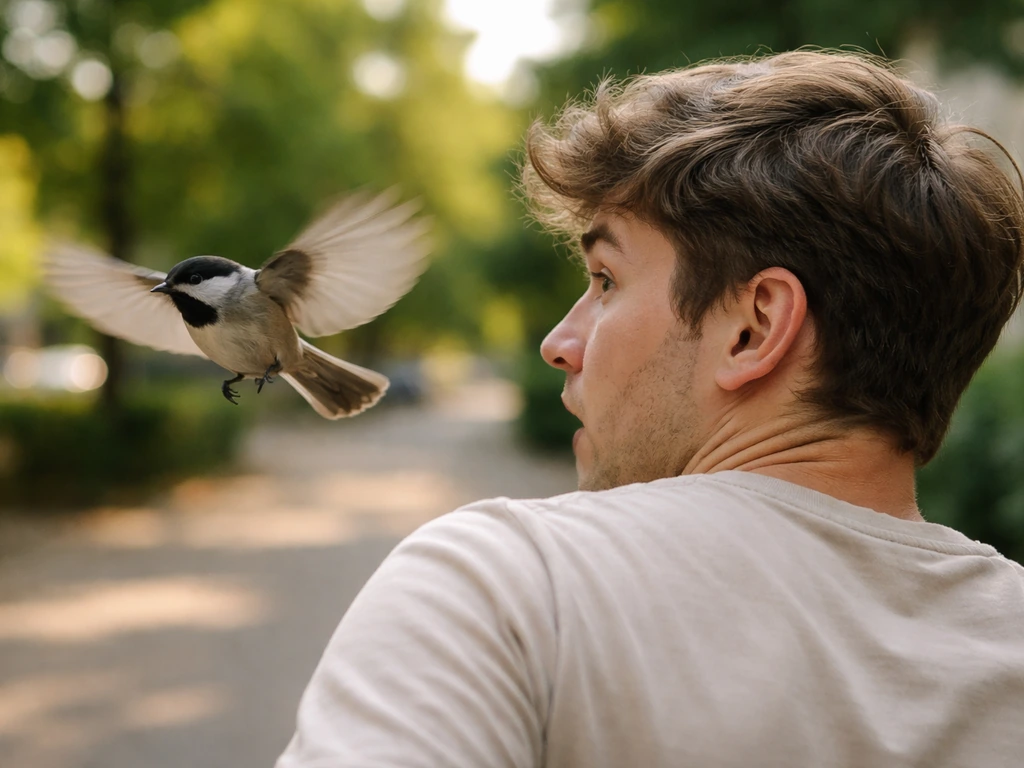
Before you look for meaning, make sure you are physically okay. A bird hitting you in the head is a blow to the head, full stop, and it deserves a basic safety check. Birds are heavier and faster than people expect, especially larger species like crows, hawks, or geese. Even a glancing hit can jolt the skull enough to cause a mild traumatic brain injury or concussion.
One important thing to understand: concussion symptoms do not always show up immediately. Johns Hopkins Medicine also notes that concussion symptoms can start right away, and others may take hours to appear, so observation may be needed depending on how you feel concussion symptoms do not always show up immediately. Some appear within minutes, but others can take hours or even days to surface. That means feeling fine right after the strike does not rule out a problem. Watch yourself (and have someone else watch you if possible) for at least 24 hours.
Symptoms to watch for
- Headache or a feeling of pressure in the head
- Nausea or vomiting, especially if it happens more than once
- Dizziness or balance problems
- Blurry or double vision
- Sensitivity to light or noise
- Unusual tiredness or difficulty staying awake
- Confusion, feeling foggy, or trouble concentrating
- Mood changes or feeling more emotional than usual
When to get emergency help immediately
Call emergency services or go to the emergency room right away if you experience any of the following: loss of consciousness (even briefly), a seizure, repeated vomiting, symptoms that are getting worse rather than better over time, extreme drowsiness or being impossible to wake, or any confusion that is not clearing up. These are the red-flag signs that tell you this is not something to sit with at home.
For the first day or two after the strike, rest is the right call. Limit activities that could worsen symptoms, avoid alcohol, and do not drive if you feel off in any way. If someone can stay with you for those first 24 hours to watch for developing warning signs, that is the safest approach. Once symptoms settle, ease back into normal activity rather than rushing it.
What a Bird Hitting Your Head Can Mean Symbolically
Once you are confident you are physically okay, you can sit with the other layer of this experience. A bird landing gently on your head carries its own symbolism, but a bird striking your head is a different kind of encounter entirely. A bird landing on your teeth can be read as a sudden, symbolic message, which is the idea behind the phrase “a bird in your teeth meaning.”. It is abrupt, surprising, and often a little alarming. That energy is exactly what many spiritual traditions associate with a direct message, a pattern-interrupting sign, or an urgent nudge from something beyond the ordinary.
The head is not an arbitrary target in symbolic thinking. Across traditions, the head represents the mind, consciousness, thought, and the seat of perception. When a bird, long understood as a messenger between earthly and spiritual realms, makes contact specifically with that part of you, the symbolic read is almost universally about your thinking, your awareness, or something you need to pay attention to mentally or spiritually. Many people search for the bird in your ear meaning, especially when the message feels personal and urgent. It is not random in the way a bird landing on your shoe might feel random.
Common Spiritual Interpretations: Message, Warning, and Timing
There is no single universal meaning here, and anyone claiming otherwise is oversimplifying. What there is, across many traditions, is a cluster of recurring themes. Here are the most common interpretive angles seekers find meaningful.
A wake-up call or pattern interrupt
The most widely shared interpretation is that a sudden bird strike to the head is a literal and symbolic interruption. Something in your thought patterns, your current direction, or your mental focus is being disrupted on purpose. Many people who reflect on this experience recall that at the exact moment it happened, they were lost in overthinking, stuck in a loop of worry, or mentally elsewhere. The strike pulls you sharply into the present moment. If that resonates with where you were mentally, the message may simply be: come back. Pay attention. Get out of your head and into the now.
A message arriving at the right moment
In many spiritual frameworks, birds are messengers. They move between realms in a way humans cannot, which is why they appear in so many traditions as carriers of divine or ancestral communication. A bird making forceful, undeniable contact with you, rather than simply flying nearby, is seen as a message too urgent or important to be delivered subtly. Ask yourself what you have been avoiding hearing, what decision has been hanging over you, or what you already know deep down but have not yet acted on.
A warning or course correction
Some traditions read a startling or painful bird encounter as a caution: slow down, reconsider the path you are on, or be alert to something you may be missing. This does not mean something bad is coming. In fact, the warning is often understood as protective, arriving early enough to let you adjust. Think of it less as an omen of doom and more like a friend grabbing your arm before you step into the street without looking.
An invitation to let go of rigid thinking
Because the head symbolizes the intellect and ego, a strike there can be interpreted as an invitation to loosen mental rigidity. Are you gripping a belief, plan, or narrative too tightly? Some people find that reflecting on this experience helps them release fixed expectations and open to something they had been unconsciously resistant to.
Timing and transitions
Several traditions treat sudden, unexpected bird encounters as markers of transition or threshold moments. If you are between chapters in life, navigating a big decision, or standing at a crossroads, the strike may be interpreted as a signal that a significant shift is either underway or needed. The abruptness of the encounter mirrors the abruptness of real transitions.
Cultural and Biblical Perspectives on Birds as Signs
The idea that birds carry meaning is not fringe thinking. It runs through nearly every major cultural and religious tradition in human history.
In the Bible, birds appear repeatedly as signs and messengers. The dove brings Noah confirmation that the flood is receding. Ravens feed Elijah in the wilderness when he is at his lowest. In the New Testament, a dove descends at the baptism of Jesus as a visible sign of the Holy Spirit. Throughout the Old Testament, unusual or unexpected encounters with birds are often treated as moments of divine communication, not coincidence. A bird striking you forcefully and unexpectedly fits into this framework as an encounter worth taking seriously in prayer or reflection.
In Celtic tradition, birds, especially ravens and crows, served as intermediaries between the living world and the otherworld. An encounter with a bird that broke the normal order of things (like one striking a person) was considered a sign that the veil between worlds was thin and a message was trying to get through. The Celts took bird behavior seriously as augury.
Many Indigenous North American traditions hold birds as sacred messengers from ancestors or the spirit world. A bird that makes unexpected, close physical contact is often interpreted as an ancestor attempting to communicate something urgent or protective. The specific species matters significantly in these traditions.
In Eastern traditions, including aspects of Hinduism and Buddhism, birds can represent the soul or higher consciousness. A sudden contact with a bird, particularly at the head or crown area, might be read in relation to awakening or activation of higher awareness, since the crown is associated with spiritual connection in these frameworks.
Even in Western folklore, birds flying into people or making sudden unexpected contact has historically been noted as significant. The specific omen varied by culture, time period, and bird species, but the consistent thread is that such an encounter was never dismissed as meaningless.
The Details Actually Matter: How to Read Your Specific Experience

General interpretations are useful as a starting framework, but what makes your experience meaningful to you personally is the specifics. The more you can remember about exactly what happened, the richer your reflection can be.
| Detail to remember | What it might add to the meaning |
|---|---|
| Bird species | Each species carries its own symbolism. A crow carries messages about transformation; a hawk about vision and perspective; a sparrow about simplicity and resilience; an owl about hidden truths or transition. |
| Bird's behavior | Was it swooping to protect a nest (defensive), accidentally confused by glass or wind (disoriented), or seemingly targeting you with no obvious cause? Protective swooping has different implications than an unexplained direct hit. |
| Time of day | Dawn encounters often relate to new beginnings; dusk or night encounters (like an owl) to endings, transition, or hidden knowledge; midday to clarity and directness. |
| Location | Home, workplace, a place of personal significance, or while traveling each adds different layers. A strike at home versus during a commute versus in nature can shift the context considerably. |
| What you were thinking | This is often the most telling detail. What was on your mind in the moments before impact? Many people find the message becomes obvious when they sit with this question. |
| What happened to the bird | Did it fly off immediately, seem stunned, or was it injured? A bird that recovers and flies away is often read as a message delivered and completed. A bird that stays nearby or returns may suggest ongoing significance. |
| Whether you were injured | The intensity of the physical impact may mirror the urgency of the symbolic message in some interpretive traditions. A serious strike may indicate a more urgent course correction. |
It is also worth noting that a bird physically hitting the head is a more forceful encounter than a bird simply landing there, which is its own experience covered in related explorations of bird-on-head symbolism. If you have ever wondered what it means when a bird lands on your head, this guide covers both the physical safety steps and the symbolic interpretations people report bird-on-head symbolism. This is where the bird on your head meaning discussion becomes more personal and specific. The impact itself, the surprise, and the physical sensation are part of what makes this particular encounter feel charged with meaning.
What to Do Next: Grounding, Reflection, and Practical Follow-Up
After you have handled the physical safety piece, there are some genuinely useful steps for integrating this experience, whether you lean toward spiritual interpretation, are just curious, or fall somewhere in between.
Ground yourself first
A sudden bird strike is startling. Before you try to extract meaning, give yourself a few minutes to land back in your body. Take slow breaths, put your feet flat on the ground, and let the adrenaline settle. Interpretation works better from a calm state than a reactive one.
Journal what you remember
Write it down while it is fresh. Describe what happened, what bird it was (if you know), where you were, what time it was, what you were doing, and most importantly, what you were thinking or feeling in the moments before impact. Do not edit or interpret yet. Just capture the raw experience. You can return to it later and look for patterns or resonance.
Sit with these reflection questions
- What have I been avoiding thinking about clearly?
- Is there a decision I already know the answer to but have been putting off?
- What patterns of thought or behavior feel like they might need to be interrupted right now?
- What message would make the most sense, given where I am in my life at this moment?
- What did I feel in the seconds right after the strike, before I started analyzing it?
Choose your reflective practice
How you process this experience should match your own orientation. If you pray, bring the encounter into your prayer and sit quietly for an answer. If you meditate, create space to observe what arises when you hold the image of the bird in your mind's eye. If you are drawn to nature, spend time outside and notice what comes up. There is no single correct way to sit with a symbolic experience.
Research the bird species
If you know what kind of bird hit you, look into its specific symbolism across the traditions that resonate most with you. A crow, a mockingbird, a hawk, and a hummingbird each carry very different symbolic associations. Sometimes identifying the species is the detail that unlocks the most personal meaning.
When to seek professional help (for both body and mind)
On the physical side: if any concussion symptoms appear or worsen in the hours or days after the encounter, see a doctor. Do not assume you are fine because you felt okay immediately afterward. Delayed symptoms are common with mild TBI, and it is always worth a professional evaluation if you are unsure. On the emotional or psychological side: if the experience triggered significant anxiety, intrusive thoughts, or distress that is not settling, speaking with a counselor or therapist is a legitimate and worthwhile next step. Taking an experience seriously does not mean you have to process it alone.
The most honest thing anyone can say about a bird hitting you in the head is that it is simultaneously an ordinary natural event and, for many people, an experience that arrives with unmistakable weight. You do not have to choose between treating it seriously as a potential injury and treating it seriously as a possible sign. Both deserve your attention, and attending to both is the most complete way to move through whatever this encounter was asking of you.
FAQ
How long should I monitor myself after a bird hit my head? (Is 24 hours enough?)
If you were hit and later develop sleepiness you cannot shake, worsening headache, repeated vomiting, confusion that persists, or any weakness/numbness, get medical evaluation the same day. Also tell the clinician that the injury was a bird strike to the head, because timing matters for concussion assessment and you may need observation even if the initial hit seemed minor.
What if the bird hit my head but also scratched or broke my skin?
If the bird left visible scratches or your skin broke, rinse with clean running water and mild soap, then watch for infection over the next several days (increasing redness, warmth, swelling, pus, fever). Even when the symbolism feels intense, treat any broken skin as a real wound and consider urgent care if the area is rapidly worsening.
Does wearing a hat or helmet change the concussion risk?
Yes, a bird strike can happen even with a helmet or hat, and you can still get a concussion because the impact can transmit force to the brain. After any head impact, apply the same symptom watch and rest guidance, and do not assume protective gear makes medical red flags impossible.
When is it okay to start reflecting on meaning after the strike?
For safety reasons, avoid “meaning-making” until you are past the immediate adrenaline phase (a calm check, slow breathing, and at least a brief symptom scan). If you are dizzy, nauseated, confused, or unusually drowsy, focus on medical care first, because trying to interpret while your body is unsettled can make you miss red-flag changes.
What if I felt totally fine right after it happened?
If the bird hit you but you never felt pain and no symptoms show up, the odds of a serious injury are lower, but delayed concussion symptoms are still possible. A practical compromise is to rest for 24 to 48 hours, limit screens and intense activity, and seek medical advice if anything feels “off,” even subtly.
What if I cannot identify what bird hit me?
If you do not know the bird species, you can still capture meaning by focusing on your context details (where you were, what you were doing, what you were thinking, how the moment changed your attention). Later, if you can identify the bird from photos or memory, you can refine the reflection, but you are not required to have exact species information.
How can I treat the “warning” meaning without becoming anxious or superstitious?
If you take it as a cautionary sign, turn it into a concrete, low-risk action: slow down, double-check your plan, and reduce exposure to the exact situation you were in when it happened (for example, driving, risky work steps, or an important confrontation). Avoid using the incident to make drastic decisions based purely on fear.
What are common mistakes people make after a bird strike to the head?
A common mistake is only watching symptoms for bruising or visible injury. Another is assuming concussion checks are unnecessary because the bird was small, or because it was a glancing hit. If you are uncertain, err on the side of medical evaluation, especially if you have a history of concussion or you are on blood thinners.
What if the experience causes ongoing anxiety or intrusive thoughts?
If the event triggered intrusive thoughts, panic, or persistent rumination that interferes with sleep or daily functioning, it is reasonable to talk to a mental health professional. A therapist can help you process the fear response and separate spiritual reflection from anxiety loops, rather than forcing you to “just calm down.”
What if there was bodily contact or droppings involved?
If the bird was defecating, you got splatter, or there was contact with your eyes or mouth, rinse thoroughly and consider contacting a clinician if you develop eye irritation or illness symptoms. Symbolic interpretation is optional, but hygiene and exposure control is a practical next step you should not ignore.
Next Article
There Is a Bird on Your Head: Safe Removal Steps Now
Calmly confirm and safely remove a bird on your head, check for injury, and explore natural and spiritual meanings.