If there is a bird on your head right now, here is what you do: stay calm, stay still, and do not swat at it. That is the single most important piece of advice, and everything else flows from there. Whether this is a sparrow that drifted down from a tree, a bold pigeon in a busy plaza, or something you are not even sure is real, this guide walks you through confirming what is happening, removing the bird safely, caring for yourself afterward, and then making sense of what the experience might mean.
There Is a Bird on Your Head: Safe Removal Steps Now

Maya Hartwell
2 Apr 2026
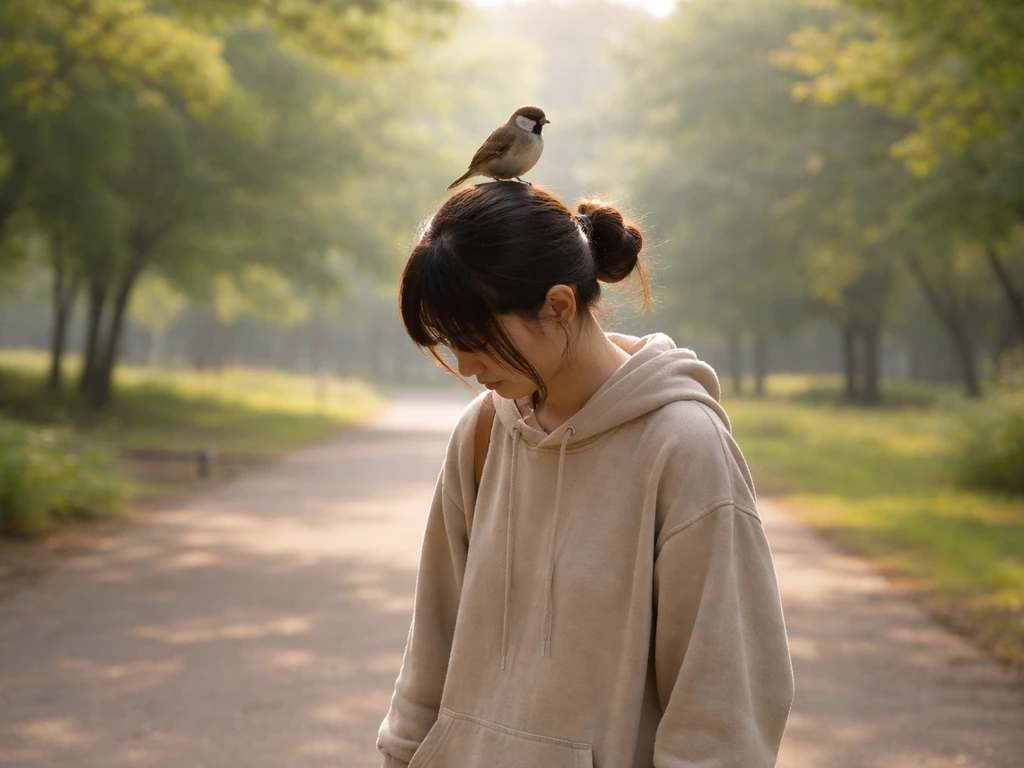
First: stay calm and do a quick safety check
Your instinct might be to duck, wave your arms, or run. Resist all of that. Sudden movement startles the bird into gripping harder, scratching, or pecking defensively. Take a slow breath and lower your shoulders. If you are standing in a hazardous place (near traffic, on a ladder, near open water), move slowly and deliberately to a safer spot before doing anything else. The bird will almost certainly fly off on its own within a few seconds once it realizes you are not a perch it chose on purpose.
A quick mental check: are you in pain, do you feel claws gripping your scalp, or do you just sense something? Run through those three things. If you feel actual weight and pressure, a bird is genuinely there. If you only feel a faint tickle or heard a brief flutter, it may have already left. If someone nearby can see you, ask them to confirm. That confirmation matters before you do anything else.
Is it actually a bird? How to tell
Not everything that lands on your head is a bird. Leaves, seed pods, bits of debris blown by wind, even a large insect can produce a similar startling sensation. Here is how to figure out what you are dealing with without panicking.
- Weight and grip: A bird has noticeable, uneven weight and small gripping points (talons or claws). Debris feels lighter and more distributed.
- Movement: Birds shift their weight, move their heads, and produce tiny vibrations. Debris sits still unless the wind moves it.
- Sound: Listen for soft chirping, wing rustling, or bill clicking. Those sounds confirm a live bird.
- Ask someone nearby: If anyone is with you or within a few feet, ask them to look and tell you what they see. A three-second visual from someone else is far faster than any self-check.
- Carefully raise one hand to just above your ear level and hold it flat. If you feel something warm with tiny moving points of pressure, it is a bird. If nothing is touching your hand, it has likely already left.
If the sensation is a dull impact rather than a perching feeling, what you experienced might be a strike rather than a landing. That is a different situation, and what it means when a bird hits you in the head carries its own set of practical and symbolic considerations worth understanding separately.
Step-by-step: how to remove the bird without hurting it or yourself
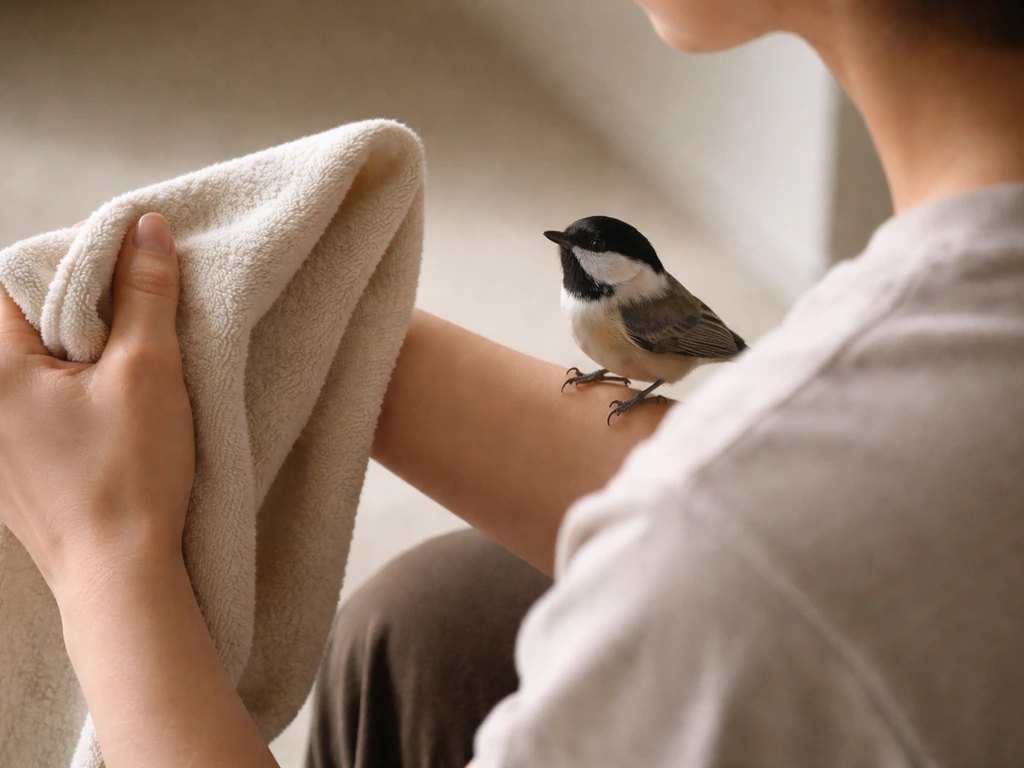
Most birds that land on a person's head depart on their own within ten to thirty seconds. If the bird is still there after that, work through these steps in order.
- Stay absolutely still and keep your voice low and even. No yelping, no loud commands.
- Very slowly tilt your head forward so that your head is no longer the highest point. Birds prefer elevated perches; lowering yourself removes the incentive to stay.
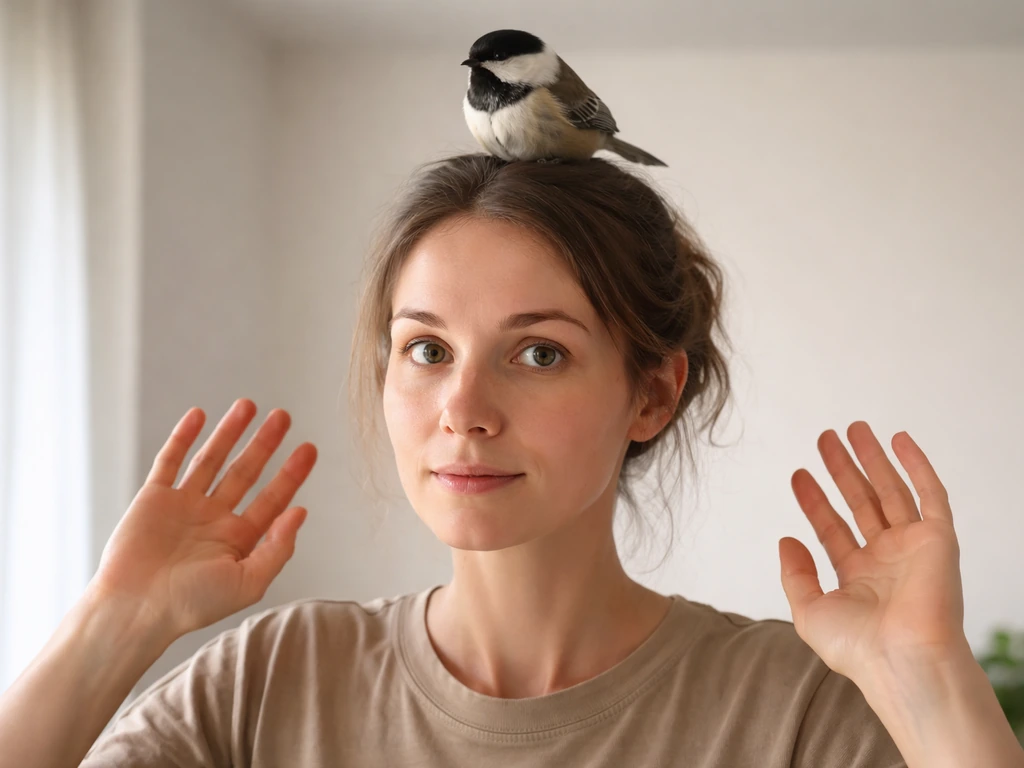
- If the bird does not leave after another ten seconds, raise one open, flat hand slowly beside your head and hold it steady at the same height. Many birds will step onto a hand as an alternative perch.
- Once the bird steps onto your hand (or moves to a nearby surface), gently lower your hand toward a tree branch, fence, or bush and let it transfer there.
- If the bird is injured or unusually docile and will not fly off, do not attempt prolonged handling. Instead, use a light towel or cloth to gently cover it (this calms many birds) and keep it in a well-ventilated box. Then contact a local wildlife rehabilitator. Attempting to treat or house a wild bird yourself can cause unintended harm, which is why wildlife authorities consistently recommend reaching out to trained professionals rather than improvising care on the spot.
What you should not do: do not grab the bird by its body, do not pull at its feet if it is gripping, and do not douse it with water to shoo it off. Those approaches almost always result in scratches, pecking, or a stressed bird that flaps chaotically and makes the situation worse for everyone.
What to do right after the bird is gone
Once the bird has left, do a quick self-check. Look at your hands and feel your scalp for scratches or droppings. Even an encounter that felt gentle can leave behind material you did not notice in the moment.
Wash your hands thoroughly with soap and water for at least 15 to 20 seconds, per guidance from OSHA and the CDC for any contact with birds or their droppings. If droppings landed on skin or in your hair, rinse that area well with soap and water too. If you have a scratch or small wound, wash it with soap and water immediately, apply antibiotic ointment if you have it, and cover it with a clean bandage. Consider your tetanus status, especially if the wound is deeper than a surface abrasion.
Bird droppings carry a small but real risk of histoplasmosis, a fungal infection caused by inhaling spores from disturbed droppings. The risk from a brief outdoor encounter is low, but avoid rubbing your face before washing up, and do not shake clothing indoors to dislodge droppings, since that can briefly aerosolize dust particles.
When should you see a doctor? If the bird bit you deeply, broke the skin meaningfully, or if you cannot confirm the bird's health status, it is worth a call to your healthcare provider. Rabies transmission from birds is not documented the way it is with mammals, but other infections are possible. For any bite that breaks skin, Mayo Clinic first-aid guidance recommends cleaning, covering, and following up with a provider who can assess your tetanus status and determine if further care is needed. When in doubt, call.
Why birds land on people's heads (the natural explanation)
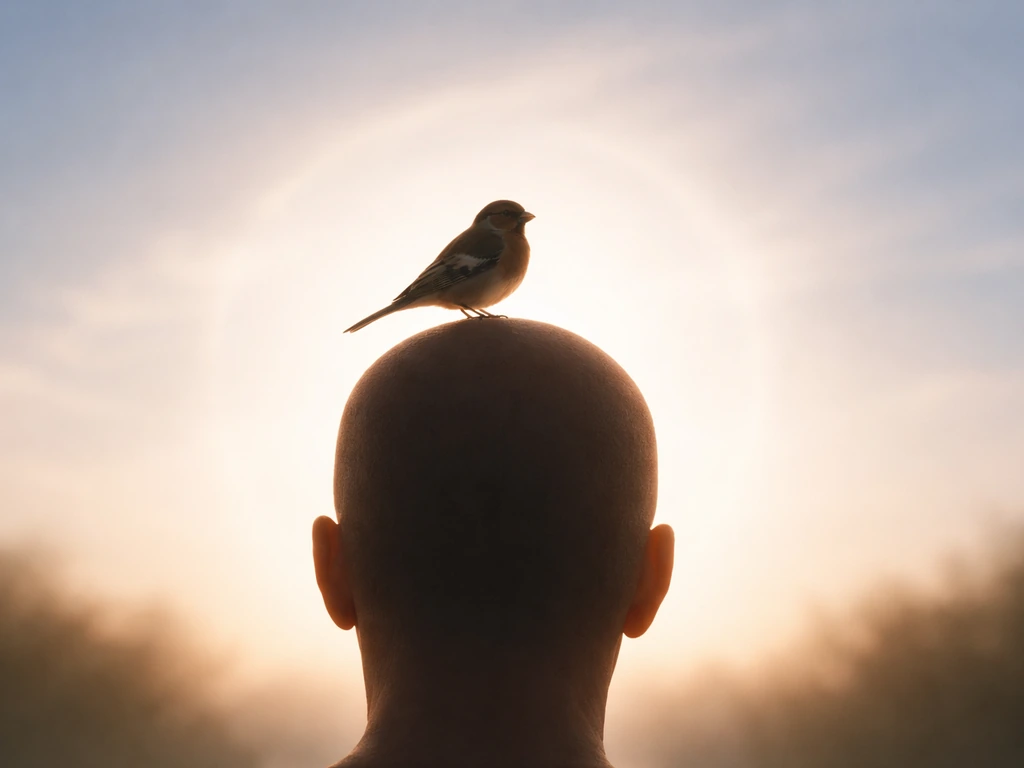
Birds are not usually trying to interact with you when they land on your head. Several perfectly ordinary behavioral explanations cover the vast majority of cases.
- Mistaken perch: Your head, especially if you are wearing a hat with a flat brim or a high ponytail, can look exactly like a branch from above. Birds assess landing spots quickly and yours simply looked suitable.
- Territorial or nesting behavior: During spring and early summer, many species (mockingbirds, red-winged blackbirds, and crows among others) actively defend nesting zones. A head-landing in this context is often a warning rather than affection.
- Habituation to humans: In urban parks where people regularly feed birds, some species (pigeons, sparrows, chickadees) lose their fear of humans entirely and will land on people expecting food.
- Disoriented or injured birds: A bird that is ill, window-struck, or otherwise disoriented may land erratically on any nearby surface, including a person.
- Curiosity about shiny or colorful objects: Hair accessories, earrings, or certain hat colors can attract birds that are drawn to reflective or bright materials.
Knowing the natural explanation does not cancel out the spiritual one for many people. These two layers can coexist. Understanding what happens when a bird lands on your head from a behavioral standpoint can actually deepen the symbolic reading, because you can ask: given that this bird had every reason to land somewhere else, why here, why now, why me?
What it might mean spiritually and symbolically
Across a striking range of cultures and traditions, a bird landing on a person's head is treated as significant. The head, in most metaphysical frameworks, is associated with the mind, divine connection, and the seat of consciousness. When a bird (long regarded as a messenger between the earthly and spiritual realms) chooses that specific spot, many traditions read it as something more than coincidence.
Biblical and Christian perspectives

In the Christian tradition, the dove descending at Jesus' baptism in Matthew 3:16 is one of the most iconic bird-and-head images in all of scripture, linking a bird alighting near or upon a person with the presence of the Holy Spirit. Separately, Matthew 10:29 to 31 reassures readers that not even a small bird falls without God's awareness, framing all bird encounters as occurring within divine attention. Genesis 8:11 adds another layer: the dove returning to Noah with an olive branch became the foundational biblical symbol for peace and the end of a period of hardship. Taken together, these texts encourage a reading of bird encounters as moments of divine acknowledgment rather than random events. For more on the layered spiritual meaning of a bird on your head, these biblical threads are worth sitting with.
Folklore and cross-cultural meanings
In Celtic tradition, birds (particularly wrens and robins) were regarded as spirit messengers, and an unexpected landing on a person was sometimes read as a visit from an ancestor or a signal that a significant change was approaching. In some Indigenous North American traditions, specific birds carry specific clan or totem meanings, and an unusual encounter is treated as a communication to be reflected upon rather than dismissed. East Asian folklore in several regions treats birds landing near or on a person as a sign of incoming good fortune, particularly if the bird is small and songlike. Even the widely known superstition that bird droppings bring luck is part of this broader cross-cultural instinct to find meaning in unexpected bird contact.
The most common modern spiritual interpretation is that a bird landing on your head signals a message from a higher source: you are being seen, protected, or prompted to pay attention to something you may have been ignoring. Some readings frame it as a blessing, others as a call to elevate your thinking (literally, the bird chose your crown). The specific meaning often shifts depending on the species involved. A crow carries very different symbolic weight than a dove or a sparrow. If you want to explore that dimension further, the meaning of a bird landing on your head varies in interesting ways depending on which tradition you draw from.
A note on unusual details: sound, location, and species
Not every bird encounter involves the head, and the body part matters symbolically. A bird landing near your ear, for example, is sometimes interpreted as a message meant specifically for your inner hearing or intuition. If the landing felt like it involved your ear area, the meaning of a bird in your ear is a thread worth following. Similarly, if the experience in some way felt like the bird was right in your face or mouth-level, traditions have specific interpretations for that too, and a bird in your teeth carries its own symbolic story across several folklore systems.
What to notice next: reading the full message
If you are inclined to interpret this encounter spiritually, the bird's behavior after landing matters as much as the landing itself. Here is a practical framework for paying attention.
| What happened after | Common symbolic reading | What to reflect on |
|---|---|---|
| Bird landed briefly and flew immediately upward | Message delivered, encouragement to rise or move forward | What have you been hesitating about? |
| Bird stayed for an extended time, calm and still | Deep blessing or strong ancestral presence, a moment to receive | What have you been asking for or praying about? |
| Bird landed and then flew toward a specific direction | Guidance toward that direction or area of life | What is in that direction symbolically (relationships, work, home)? |
| Bird was injured or disoriented | A call to care for something vulnerable in your own life | What or who needs your attention right now? |
| Bird made sound (song, alarm call) while on your head | Active communication, pay attention to the type of call | Was the call anxious or melodic? Fear or celebration? |
Timing matters too, though no single folklore tradition locks it down definitively. Morning encounters are often read as new beginnings or clarity arriving early in a cycle. An encounter during a period of personal transition (a job change, a loss, a new relationship) tends to carry more weight for people than one on an otherwise unremarkable Tuesday. Your own circumstances are part of the message, if there is one.
The question of whether the encounter was meaningful is ultimately yours to answer. What this guide can offer is the practical side (you handled it safely, you washed up, the bird is fine) and the interpretive framework (here is what different traditions say, here is what the behavior might suggest). Where those two things meet, in your own life and your own moment, is where the actual meaning lives. What do you think it was trying to tell you?
FAQ
What should I do if the bird is pecking me or won’t let go of my hair?
Keep your movements slow and minimize touch with your head. If it is actively pecking or clinging, look for a way to get to a safe, stable position (sit down if you can) so you do not lose balance. Avoid grabbing the bird, instead wait for it to release and fly off, then check for scratches and wash your hands before touching your face.
Can I try to help by brushing the bird off with a cloth or comb?
It is usually better to avoid contact. A cloth or comb often counts as a grab that can startle the bird and lead to scratches or a chaotic flap. If you must do anything, do it only by gently changing your position to remove the “perch,” for example slowly lowering your head position or stepping away carefully once you are safe.
What if the bird lands on my head during driving, on a bike, or while on a ladder?
Your priority is safety. If you are moving, stop and get yourself stable first (park the bike, step away from traffic, or climb down carefully before handling anything). Do not try to remove the bird while you are balancing, because sudden movement can cause falls or collisions.
How can I tell if it is actually a bird versus something else without staring too long?
Use the “perching versus tickle” check. True landing often feels like gripping or sustained weight, not a brief flutter. Also glance quickly at a nearby mirror or ask someone to confirm. If you cannot confirm and you felt impact, treat it as an “unknown contact” and wash up when you are able.
What should I do if there is bird droppings on my scalp or in my hair?
Do not rinse only with water and then touch your face. Wash the affected area with soap and water thoroughly. If droppings got into your hairline, you may need to lather and rinse more than once. Avoid shaking clothing or towels indoors afterward to reduce airborne dust from dried material.
Is it safe to shower immediately, or should I wait to see if it’s needed?
If you had contact with droppings or you touched the bird or its feet, washing promptly is best. A quick shower is fine, focus on hands first, then scalp and any area that could have been contaminated. If you are not sure, wash hands for 15 to 20 seconds and rinse any visibly soiled spots.
Should I report it to a local wildlife agency or building management?
Consider it if the bird appears injured, unusually aggressive, or unable to fly. For example, a bird that is repeatedly landing, acting confused, or showing visible injury may be a welfare issue, and staff may be able to coordinate safe removal. If it flew off normally, reporting is usually unnecessary.
What if the bird leaves a wound, bite, or puncture, what is the first step?
Clean the area immediately with soap and water, then cover with a clean bandage. For deeper punctures, seek medical advice promptly because tetanus timing and infection risk depend on wound depth and your history, not just whether it looks “small.”
How soon should I get medical advice after a bite that broke the skin?
As soon as practical, ideally the same day. Quick evaluation matters for tetanus updates and for deciding if antibiotics are needed. If you notice increasing redness, swelling, warmth, pus, fever, or worsening pain, do not wait.
Can my pet or child be at risk after I had a bird on my head?
The main issue is contamination from droppings on your hands, hair, or clothing. After washing up, keep your pet from licking your face or hands. If clothing may have droppings, avoid shaking it indoors and place it in a hamper or laundry as appropriate for your household.
Next Article
A Bird in Your Teeth Meaning: Spiritual and Real Causes
Meaning of a bird in your teeth, plus real causes and spiritual symbolism, with safe steps and when to see a dentist