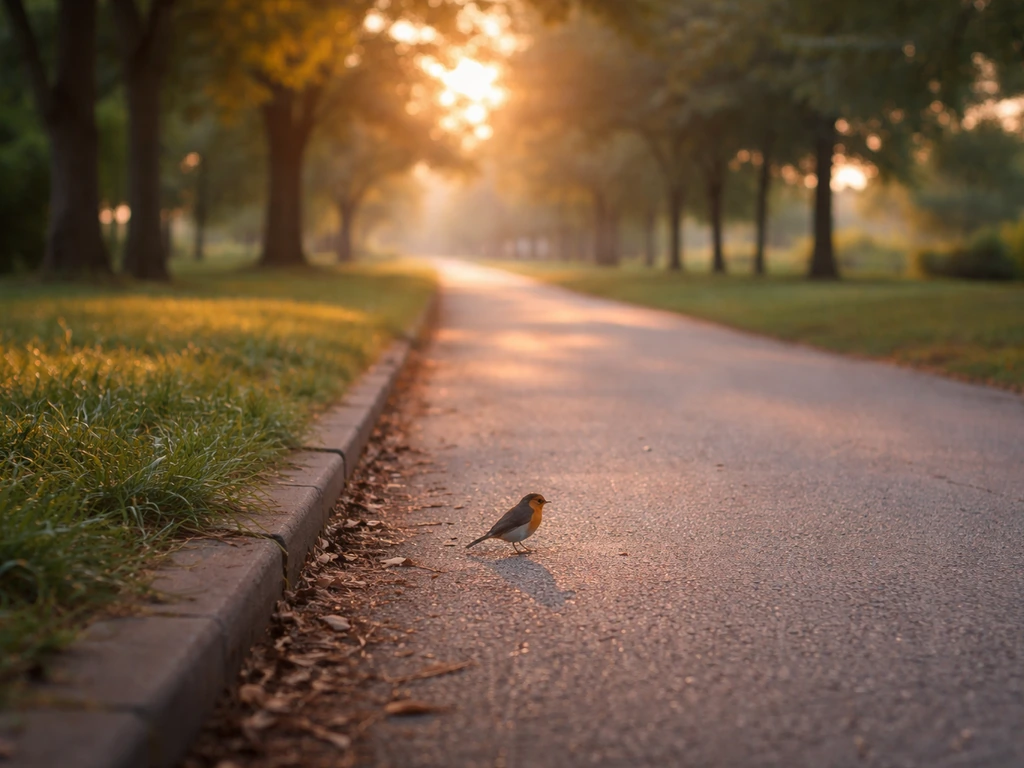
A bird on your porch can mean something as simple as it found a sheltered spot to rest, or it can feel like something more deliberate, especially when the bird lingers, stares, or keeps coming back. Most of the time, there's a perfectly practical reason a bird chose your porch.
Bird on Porch Meaning: Practical Causes and Spiritual Signs

Maya Hartwell
29 Apr 2026
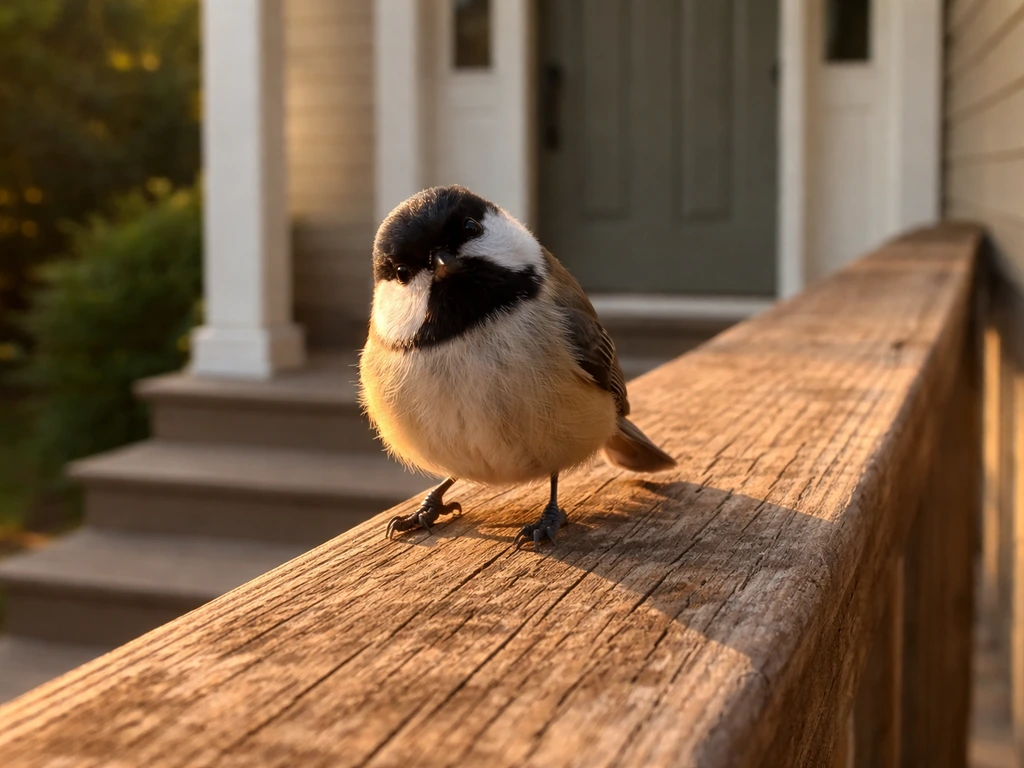
If you want to explain the personification in the phrase "a bird came down the walk," focus on how the bird is described with human-like intentions a bird chose your porch. But across cultures, doorways and thresholds have long been treated as boundary spaces where the everyday world and something beyond it touch, and birds arriving at that threshold carry symbolic weight that's hard to entirely dismiss. The honest answer is: both things can be true at once.
What people usually mean when they say 'a bird on my porch'
The phrase covers a pretty wide range of experiences, and which one you're dealing with matters for how you interpret it. The most common scenarios people are actually describing include:
- A single bird landing and staying longer than feels normal, sometimes staring toward the door or windows
- A bird pecking or tapping repeatedly at a window, door frame, or wall on the porch
- A bird that keeps returning to the same porch spot over several days or weeks
- A bird acting erratically, flying into the porch ceiling or walls, or seeming disoriented
- A bird that appears injured, dazed, or unusually calm and approachable
- A bird singing persistently from the porch railing or a nearby perch
- A nesting bird that has claimed part of the porch as home
- A bird that seems to be watching you specifically, tracking your movement
Each of these scenarios has a different set of practical and symbolic interpretations. A pecking bird means something different than a quietly resting one. A bird that's been visiting daily for a week carries different weight than a single flyby. Keep your specific scenario in mind as you read through what follows.
Practical reasons birds end up on porches (before you call it an omen)
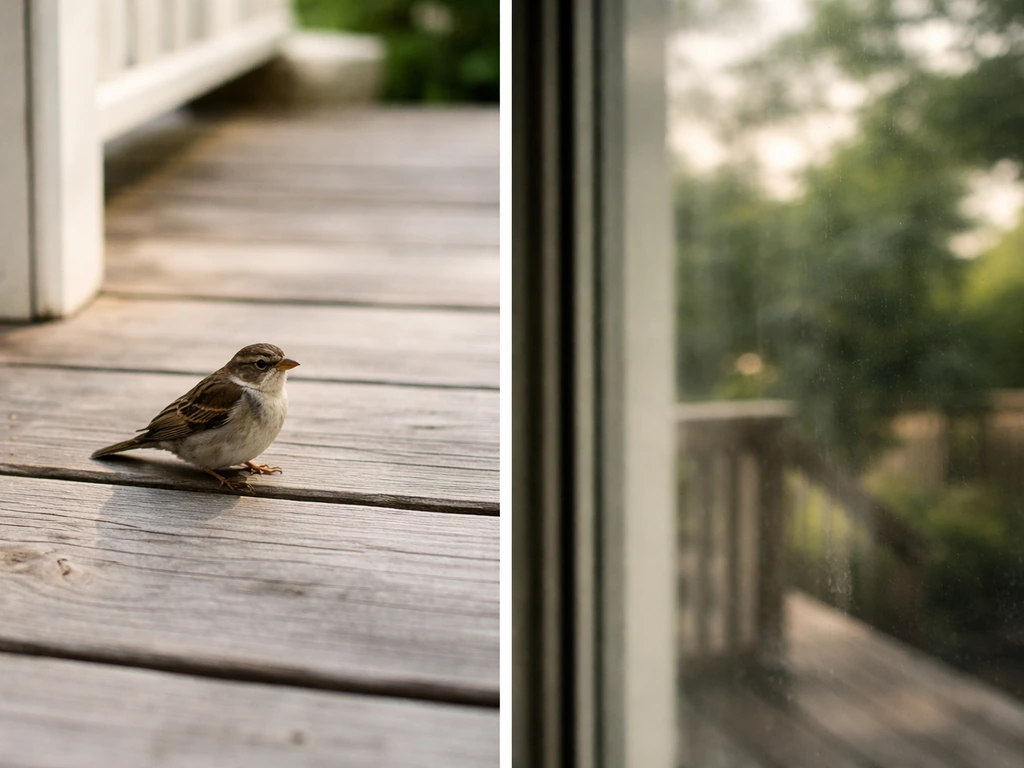
Let's get the natural explanations on the table first, because they're genuinely useful. Understanding why a bird chose your porch doesn't cancel out the symbolic meaning, it actually helps you read the situation more clearly.
Reflections and window confusion
If your bird is pecking or repeatedly flying at a window or glass door on the porch, the most likely explanation is a reflection. During breeding season especially, birds see their own reflection and interpret it as a rival bird invading their territory. They attack it. This is most common in spring when territorial instincts are at their peak. The bird isn't confused about you, it's locked in a standoff with itself. Audubon and the Cornell Lab both document this behavior extensively. Covering the outside of the glass temporarily with paper or film breaks the reflection and usually stops the behavior within a few days.
Shelter, food, and nesting
Porches are genuinely appealing to birds. They offer cover from predators and weather, especially in spring and fall. Eaves, ledges, and rafters are natural nesting spots. If a bird is gathering materials or investigating corners of your porch, it may simply be scouting for a nest site. Cornell Lab of Ornithology’s “Seven Simple Actions to Help Birds” emphasizes adding native plants to provide shelter and nesting. Other birds are drawn by insects around porch lights, seeds that have blown near the door, or water from a nearby garden hose or planter tray. These birds aren't delivering messages; they're just finding resources.
Weather and migration patterns
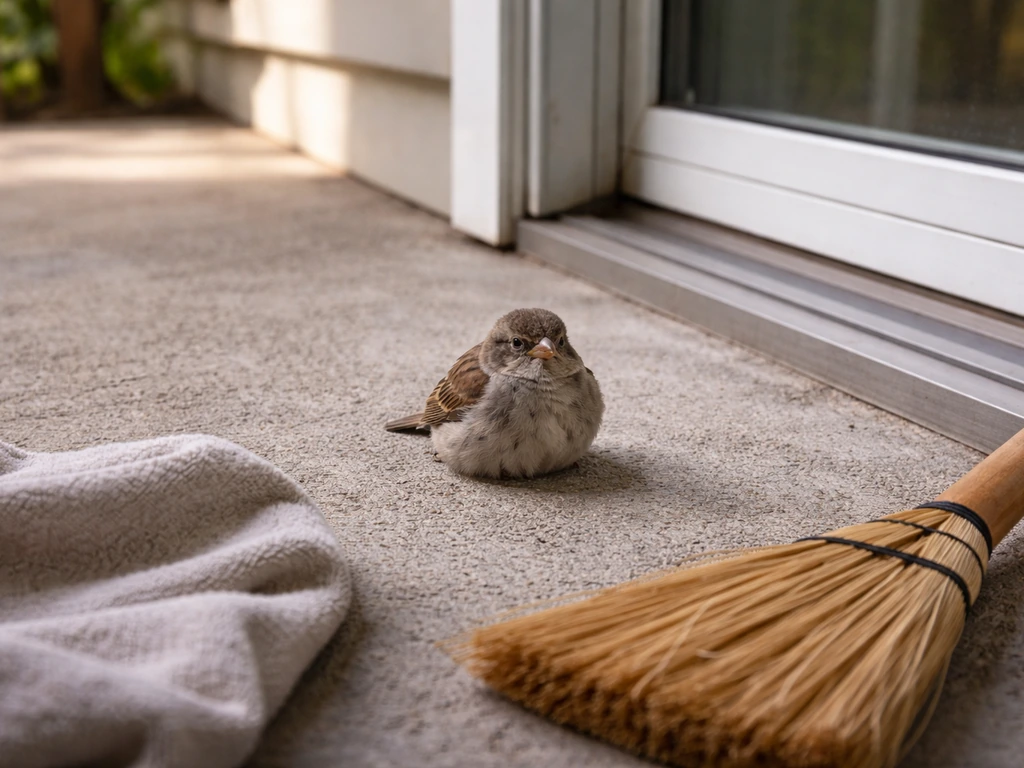
During migration, birds that are exhausted or disoriented can land in unusual spots, including porches, balconies, and doorways. A bird that seems unusually calm and close is sometimes simply worn out from a long flight. Spring and fall are the peak seasons for this. A sudden weather change, like a front moving through, can also cause birds to seek shelter quickly and land wherever feels protected, including your porch.
Disorientation after a window collision
If your bird appears dazed, is sitting on the ground near your porch, or seems unable to fly properly, it may have just hit a window. Window collisions are far more common than most people realize. Estimates from the Smithsonian Conservation Biology Institute and the U. S.
Fish and Wildlife Service put annual bird-window collisions in the U. S. at between 365 million and close to 1 billion per year, with roughly half occurring at residential buildings. A bird sitting very still on your porch after seeming to come out of nowhere may just need 30 to 60 minutes to recover.
If the bird is stunned after a collision, it may need assessment by a veterinarian or a permitted wildlife rehabilitator may need assessment by a veterinarian or permitted wildlife rehabilitator. Don't handle it unless necessary.
Spiritual and symbolic meanings by bird type and behavior
Once you've considered the practical angle, you can move into what the encounter might mean symbolically. If you are looking for the bird on my balcony meaning, the same practical and symbolic ideas apply to a balcony visit as well. The porch sits at a liminal threshold, the boundary between your private inner world and the outside. In many spiritual traditions, that boundary is exactly where meaningful encounters happen. A bird arriving there isn't inside your home (which carries its own folklore, and the tradition that a bird entering the house can signal a visitor or even death in some Appalachian and Southern folk traditions), but it's not quite apart from you either. It has chosen to come close.
Robin
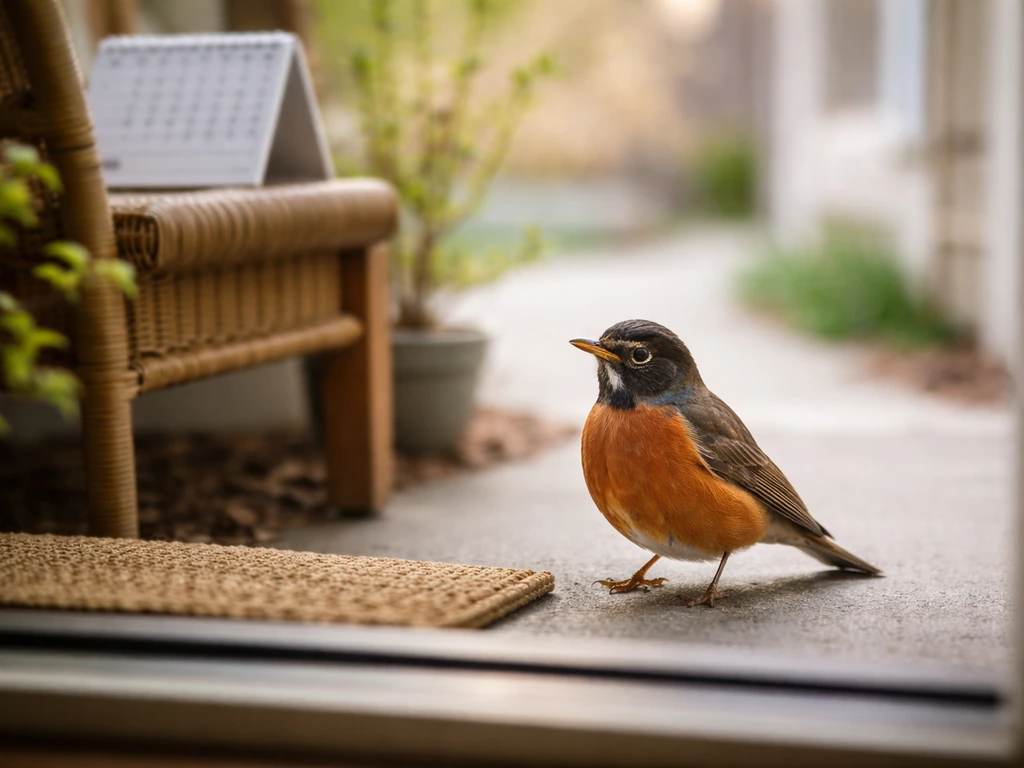
Robins are strongly associated with new beginnings, renewal, and the arrival of good news. Seeing a robin on your porch, especially in early spring, is widely interpreted in folklore as a sign that something fresh is coming: a new chapter, a new relationship, or an upswing after a difficult period. If the robin is singing, many traditions treat that as an especially positive sign.
Cardinal
Cardinals are among the most universally recognized messenger birds in North American spiritual folklore. A red cardinal on your porch is commonly interpreted as a visitation from a deceased loved one, or a message of love, encouragement, and divine care. The vivid red color is associated with vitality, passion, and the presence of something important. If you've recently lost someone close, a lingering cardinal on your porch tends to feel deeply personal, and many people across traditions treat it that way.
Sparrow
Sparrows represent simplicity, community, humility, and protection. A sparrow on your porch is often read as a reminder that you are watched over, cared for, and not as alone as you might feel. This interpretation is deeply rooted in the biblical texts where Jesus specifically uses sparrows to describe the extent of God's watchful care (Matthew 10:29-31). The sparrow is small and easy to overlook, which is exactly why it carries such pointed symbolic weight.
Crow or raven
Crows and ravens have complicated reputations across cultures, and they deserve more nuance than just 'bad omen.' In Celtic and Norse traditions, ravens are associated with wisdom, magic, and transformation. A crow on your porch can signal a significant change approaching, but not necessarily a negative one. It can indicate that something needs to end before something new can begin. In many Indigenous traditions, crow is a trickster and a teacher, not an evil sign. If a crow or raven is staring at you specifically, the symbolic invitation is often toward deeper self-reflection or honest assessment of something you've been avoiding.
Dove or pigeon
Doves carry the most consistently peaceful symbolism across almost every major tradition. Peace, love, reconciliation, and divine presence are the core themes. In the biblical story of Noah, the dove returning with an olive branch (Genesis 8) signals safety and a new beginning after great upheaval. A dove on your porch is broadly interpreted as a message of comfort, reassurance, and peace, especially if you've been going through a turbulent time.
Woodpecker
A woodpecker pecking at your porch, siding, or door frame is both a practical issue and a symbol worth noticing. Practically, it may be hunting insects in the wood or drumming to establish territory. Symbolically, woodpeckers are associated with persistence, opportunity knocking, and the importance of paying attention. If a woodpecker is repeatedly tapping at your home, many people interpret it as a signal to persist through obstacles or to notice a door of opportunity that is currently available to you.
Swallow or finch
Swallows nesting at or near your porch are considered extremely good omens in many traditions, particularly across European and Asian folklore. They represent loyalty, good luck, and protection of the home. Finches, especially goldfinches, are associated with joy, positivity, and abundance. Either bird choosing your porch as a regular stop is generally read as a favorable sign.
When you don't know the species
If you can't identify the bird, work with behavior instead. A bird that sings is almost universally associated with positive messages, joy, and communication. A bird that is still and watchful invites reflection and introspection. A bird that pecks or taps signals something demanding attention. A bird that simply rests near you for an extended period suggests presence, companionship, and comfort. You don't need a field guide to pick up on the basic symbolic language.
Biblical and cultural symbolism of birds at the threshold
The front porch and doorway have long been treated in spiritual traditions as more than just an architectural feature. If you're trying to understand the bird at front door meaning, it's helpful to compare the practical reasons with the spiritual symbolism described in the rest of this guide. They mark the point where outside and inside, public and private, the known and the unknown, meet. In biblical theology, birds appear throughout as signs of God's providence and care.
Jesus uses birds twice in the Gospels to address fear directly: in Matthew 6:26, pointing to birds as creatures the Father feeds without them laboring, and in Matthew 10:29-31, noting that God knows every sparrow and 'not one of them is forgotten. ' The message consistently attached to birds in the biblical tradition is: you are not forgotten, and you do not need to be afraid.
In Celtic traditions, birds at the threshold of a home were taken seriously as messengers between the everyday world and the spirit world. The threshold itself was considered a thin place, where ordinary and sacred intersect. A bird that came to the door or porch was often interpreted as a spiritual visitor or a warning worth heeding.
In Chinese folk tradition, certain birds arriving at the home are associated with incoming good fortune, especially the magpie, which is considered a happiness bird. Japanese tradition similarly treats certain bird visits as auspicious. In many Indigenous North American traditions, birds are understood as direct messengers from the spirit world or from ancestors, with specific species carrying specific messages depending on the context and the tribe.
British and Appalachian folklore tends to add more caution to bird encounters near the home. The magpie rhyme ('One for sorrow, two for joy') reflects older ornithomancy traditions where the number and behavior of birds was read as omen. A single bird lingering near the door, particularly a black bird, carried heavier weight than a flock passing through. Similar bird-at-the-door symbolism appears in Appalachian and Southern American folklore, where a bird that enters the home (rather than just the porch) could signal an incoming visitor or, in darker readings, a death in the family. The porch position, right at the boundary but not yet inside, lands somewhere between these interpretations and is generally read as less urgent.
Metaphysical meanings: timing, messages, and what the encounter might be pointing to
From a metaphysical standpoint, the porch encounter is less about the specific bird species and more about what's happening in your life at the moment the bird appeared. Many practitioners of spiritual discernment treat animal encounters as synchronicities, moments where the external world seems to mirror something internal. If you've been waiting on news, sitting with a difficult decision, grieving a loss, or feeling disconnected and purposeless, a bird arriving at your threshold right then can feel like a response.
Timing is a significant interpretive factor. A bird appearing during a moment of prayer, meditation, or emotional intensity carries more weight in metaphysical frameworks than one that lands while you're scrolling your phone and barely notice it. Repeated visits over several days, especially if the bird appears at roughly the same time, are treated by many spiritual traditions as a more deliberate sign, something asking to be noticed rather than a random event.
The direction the bird faces or the behavior it displays also carries interpretive meaning in various traditions. A bird facing toward your door is often read as something approaching you, an incoming message, visitor, or change. A bird facing outward, toward the street or open space, is sometimes read as an invitation to look outward, to pay attention to something in your external life or the wider world. A bird singing directly toward you is nearly universally treated as a positive communication, reassurance, or encouragement.
If you find this kind of interpretation resonant, it's worth comparing the porch encounter to related threshold experiences. A bird on the doorstep is often treated as a symbolic sign related to messages, timing, and what you may be facing right now.
A bird on the roof sits above and apart, which carries different symbolism than one at the doorstep level, and a bird that actually enters through a door is treated with much more intensity in folklore than one that simply rests on the porch.
If you're wondering about the bird on the roof meaning specifically, this higher perch is often taken to suggest a message from a more distant or elevated perspective A bird on the roof sits above and apart. The porch position, close but at the boundary, is often read as an invitation rather than an urgent message.
What to do after the encounter
If you want to take the symbolic message seriously
You don't need a formal ritual to engage with this. Sitting quietly for a few minutes and asking yourself what's been on your mind lately, what you've been hoping for, fearing, or avoiding, is enough. Let the bird's presence be a prompt rather than a definitive answer. If the encounter feels haunting or uncanny, you might also want to look up what the phrase like a dog with a bird at your door meaning is getting at.
Some people find it useful to write down what was happening in their life at the moment of the encounter, the emotion they felt when they first saw the bird, and any intuitive sense they had about what it meant. That reflection often tells you more than any symbolic reference guide could.
If prayer or gratitude practices fit your belief system, a simple acknowledgment of the encounter, along the lines of 'thank you for this moment of noticing' or a brief prayer for clarity, is a grounded way to receive the experience without over-interpreting it. You're allowed to sit with ambiguity. Not every bird is a messenger, and not every message needs decoding immediately.
If the bird appears injured or disoriented
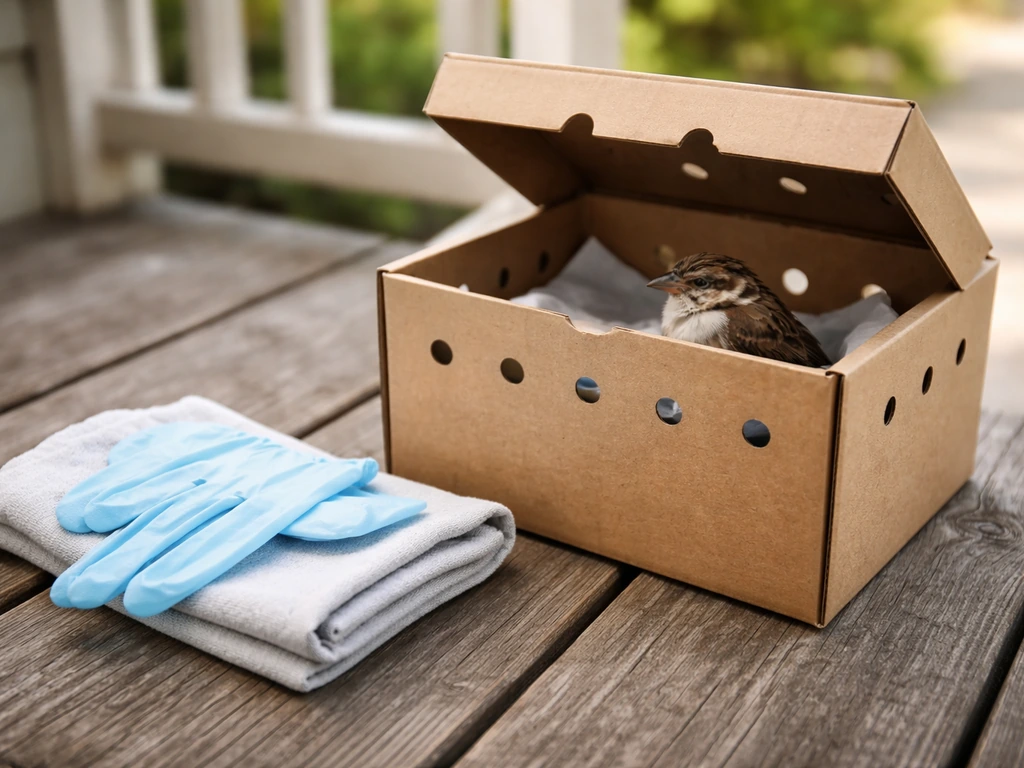
- Don't handle the bird with bare hands unless absolutely necessary. Use a soft cloth or light gloves if you need to move it.
- Place it in a small cardboard box with air holes and keep it in a quiet, dark, warm location for up to an hour to let it recover from a window strike.
- If it doesn't recover within an hour or appears seriously injured (bleeding, broken wing, unable to hold its head up), contact a licensed wildlife rehabilitator in your area.
- Do not offer food or water to a dazed bird. It can aspirate liquid and make the situation worse.
- Release it gently in a safe outdoor area once it's alert and able to grip your hand or a branch.
If the bird keeps pecking at your windows
Cover the outside of the glass with paper, film, or tape in a grid pattern (strips spaced about 2 inches apart) to break the reflection. Hanging something that moves near the window, like streamers or a wind chime, can also work. The goal is to make the reflective surface visible as a surface rather than an apparent open space. This usually resolves within a few days once the bird no longer sees a rival in the glass.
When to actually worry: health, safety, and real concerns
Bird droppings
Bird droppings on a porch aren't just a cleaning nuisance. If a bird has been roosting on your porch for a while, or if there's significant accumulation, take it seriously. The CDC notes that Histoplasma fungus lives in soil enriched by bird and bat droppings, and the real risk comes when dried droppings are disturbed and spores become airborne. When cleaning up droppings, wear an N95 mask and gloves, wet the area before sweeping to prevent dust, and disinfect with an EPA-approved disinfectant. Don't dry sweep or use a leaf blower on dried droppings.
Nesting birds
If a bird has started building a nest on your porch, be aware that most wild birds in the U.S. are protected under the Migratory Bird Treaty Act once active nesting begins. Removing an active nest (one with eggs or young) is generally illegal without a permit. If you want to deter nesting before it starts, physical deterrents like bird spikes, mesh, or reflective tape on ledges are your best options. Once a nest is established, the most practical approach is to wait until the nesting cycle is complete, typically 4 to 6 weeks, and then remove it and block the spot before the next season.
Aggressive birds
Some birds, especially mockingbirds, red-winged blackbirds, and certain corvids, will dive-bomb or physically strike people who come near their nests during breeding season. This is purely territorial and protective behavior, not anything spiritual. If a bird is repeatedly swooping at you near your porch, it almost certainly has a nest nearby. Wearing a hat, avoiding the area as much as possible, and giving the nest time to fledge (usually 2 to 3 weeks) is the most effective response. The behavior stops on its own once the young leave.
Quick safety reference
| Situation | Practical concern | What to do |
|---|---|---|
| Droppings accumulating on porch | Histoplasmosis risk if spores disturbed | Wet area first, wear N95 mask and gloves, disinfect with EPA-approved product |
| Bird pecking windows repeatedly | Bird stress, possible injury from collision | Cover glass exterior with film or tape to break reflection |
| Dazed or injured bird on porch | Post-collision shock or injury | Box in dark quiet space, call wildlife rehab if not recovered in 1 hour |
| Active nest on porch | Legal protection under Migratory Bird Treaty Act | Do not remove active nest; wait for fledging, then block site |
| Aggressive swooping bird | Territorial nesting behavior, minor injury risk | Wear hat, avoid the area, wait out the nesting cycle (2-3 weeks) |
A bird on your porch is almost always benign, and often it's genuinely interesting whether you read it practically, symbolically, or both. If you keep hearing about a bird in attic meaning, it helps to remember that birds can end up in unexpected places for practical reasons too. The most useful thing you can do is observe closely, rule out the straightforward explanations, and then sit with whatever meaning feels true to your own life at this particular moment. What were you thinking about right before you noticed it? What question have you been sitting with? Those answers usually tell you more than the bird species does.
FAQ
How can I tell whether a “bird on porch” moment is just timing versus a real sign?
Look for “arrival plus behavior” rather than the bird’s presence alone. If it is landing repeatedly, facing toward you or the door, and acting as if it is seeking something (food, water, a mate, a nest site), that is more likely an event with practical drivers and timing. A one-time appearance while you are stressed or praying can also feel significant, but it usually matters more when it matches the kind of attention you were already giving that moment.
What makes repeated visits different from a one-off bird appearance?
Use behavior and consistency. If you notice the same species returning at roughly the same time for several days, it is easier to justify as a meaningful “pattern” (for metaphysical reflection) while also being consistent with practical factors like a reliable food source, lighting that attracts insects, or a nearby nest. If the visits are random and stop quickly, practical explanations like weather shelter or a brief migration stop become more likely.
What should I do first if the bird keeps hitting or pecking the glass on my porch?
Treat reflections as the top “fast fix.” If the bird is pecking, hovering, or attacking the glass, cover the outside of the window temporarily (paper, film, or tape in strips) so the reflection cannot form. If you can see an obvious “mirror” effect, you can often tell within days because the behavior typically stops once the bird no longer sees a rival.
A bird looked stunned on my porch, what’s the safest next step?
If the bird seems dazed or won’t fly normally, isolate the situation for safety. Keep pets and people away, dim outdoor lights if possible, and give it 30 to 60 minutes to recover on its own before attempting any help. If it is bleeding, clearly unable to move, or you see repeated collision signs, contact a local wildlife rehabilitator rather than handling it yourself.
Why might birds keep coming back to my porch, even if I don’t feed them?
Do a quick, practical “resource check” around the porch. Common attractants include porch lights pulling in insects at night, water sources like planters or trays, seeds blown near the entry, and sheltered corners for nesting. Reducing these overnight drivers (turning off lights, removing standing water, clearing accessible food) often reduces future visits.
Does a bird building a nest on the porch mean anything “spiritual,” and what should I do practically?
It can be, but it can also be environmental. If you can identify it as a nest (construction, twigs, lined materials, eggs or chicks) prioritize legality and safety over symbolic interpretation. For active nests, removal is generally illegal without a permit in the U.S., so the practical “do now” step is to use passive deterrents before nesting starts, then wait until fledging is complete before removing and blocking the spot.
What are the health-safety rules for cleaning bird droppings on a porch?
If droppings are present, the main edge case is dust from dried material. Wet the area before cleanup, wear respiratory protection and gloves, avoid sweeping or blowing dry residue, and disinfect appropriately afterward. If you have asthma or other respiratory risks, consider hiring someone experienced in safe cleanup rather than managing it yourself.
If it’s a crow or raven, how do I avoid over-interpreting and missing a practical risk?
Many people misread the meaning when they ignore safety context. A crow or raven staring can be both a normal behavior (scanning, observing for food) and a trigger for metaphysical reflection. The practical decision aid is to note distance, whether it is near a nest, and whether you are being approached or threatened, because territorial nesting behavior is the priority explanation.
How do I interpret it without turning it into anxiety or forced meaning?
Use a “no definitive decoding” approach. Instead of asking, “What does it mean for me?” ask, “What was I feeling and thinking right before I noticed the bird, and what action would help me right now?” This keeps symbolism useful while preventing you from forcing certainty onto an ambiguous event.
Does “bird on porch” mean the same thing as “bird on doorstep” or “bird on roof”?
If your meaning attempts feel like they conflict with reality, revert to the threshold comparisons the article already outlines. A bird on the doorstep and a bird on the roof can feel different because of proximity to entry, but neither automatically outweighs practical causes like reflections, shelter seeking, or nesting. The practical tie-breaker is always behavior at the exact moment it appears.
Next Article
Meaning of a Bird Came Down the Walk: Spiritual and Practical Steps
Discover literal and spiritual meaning of a bird came down the walk, plus practical steps to interpret calmly and safely