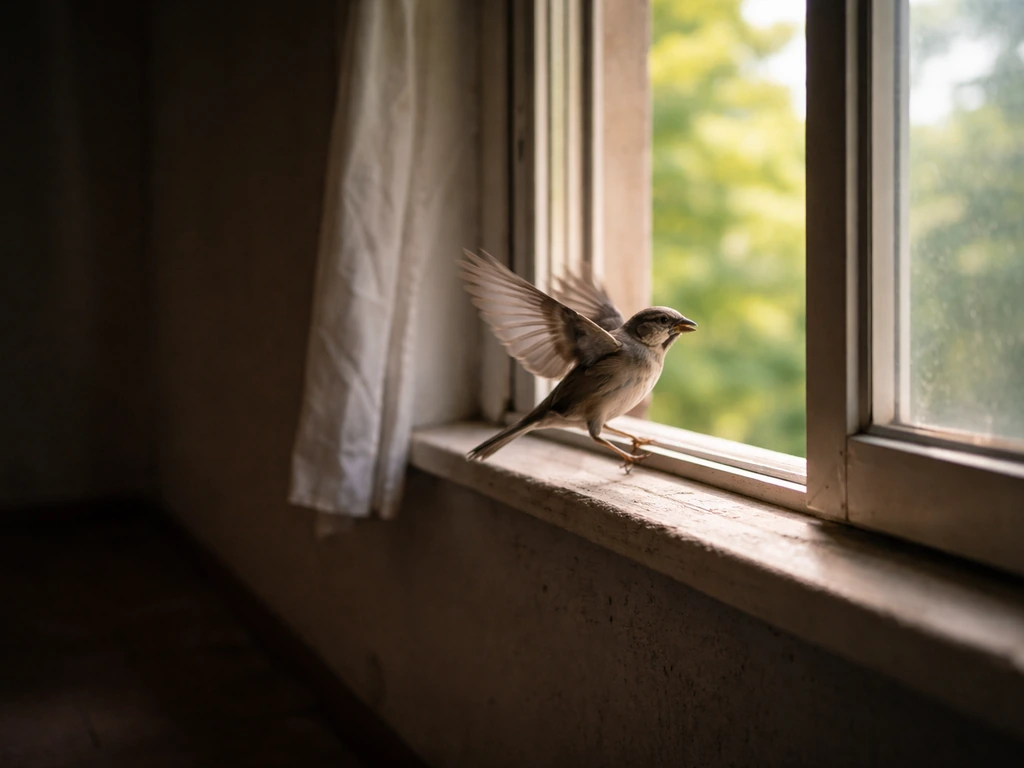
Dreaming of a bird nest most often points to themes of home, security, family, and the quiet work of building something that matters. The nest is one of the most grounded symbols in dream interpretation: it represents the place you create for yourself and others, the protection you offer, and the new life or new chapter you are either nurturing or grieving. Whether the dream feels warm and hopeful or hollow and uneasy depends almost entirely on the details, and those details are where the real meaning lives. If you want to understand the specific bird-eating-bird scenario, see how that detail shifts the bird eating bird dream meaning.
Bird Nest Dream Meaning: Family, Safety, Growth and Next Steps

Maya Hartwell
17 May 2026
What a bird nest dream is generally telling you
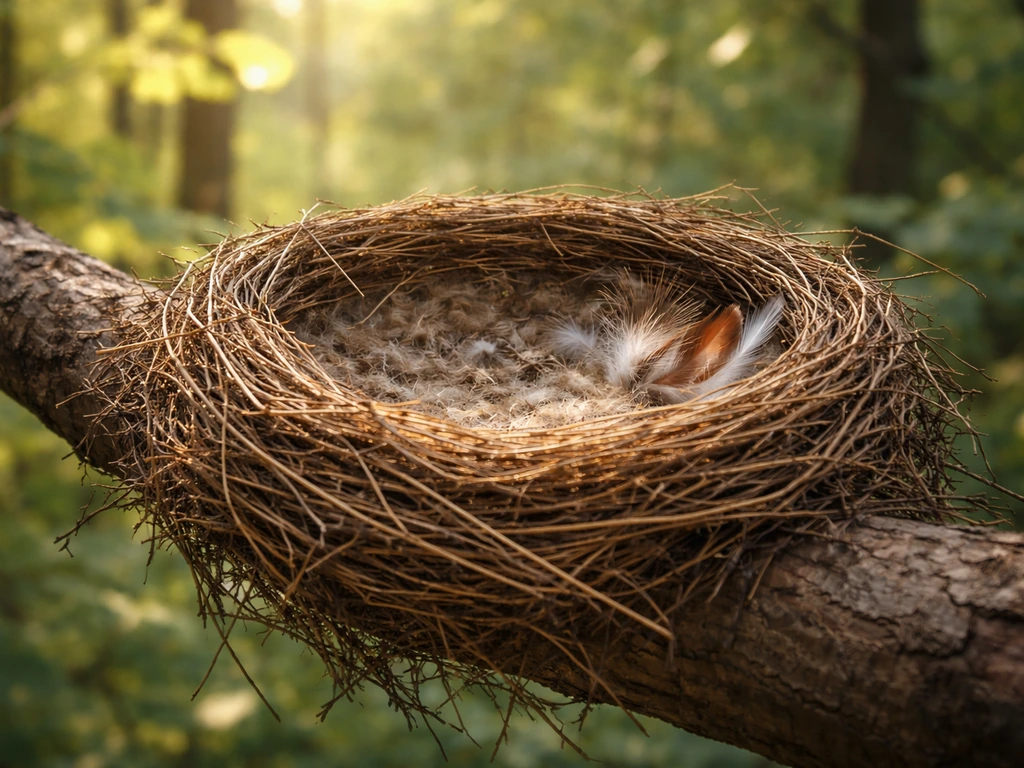
At its core, a bird nest in a dream is about the concept of home, not necessarily a physical house but the emotional architecture you build around yourself and the people you care about. Dream-interpretation traditions across many cultures treat a well-kept, intact nest as a symbol of security, nurturing, and readiness for growth. A nest that feels safe and full signals potential, new beginnings, and the sense that the conditions are right for something to hatch, literally or figuratively. A nest that is empty, broken, or abandoned shifts the message toward loss, vulnerability, or a phase of nurturing that has ended.
The emotional tone you carried inside the dream is the first thing worth paying attention to. Did you feel peaceful looking at it? Protective? Anxious? Heartbroken? That gut-level feeling often clarifies which interpretation fits your situation far better than any universal rule can.
The spiritual and symbolic layers worth knowing

Across spiritual and metaphysical traditions, the bird nest carries several overlapping themes that are worth sitting with.
- Home and belonging: The nest is one of the most universal symbols of home in the natural world. Dreaming of one often reflects your current relationship with your own sense of belonging, whether you feel rooted, displaced, or somewhere in between.
- Protection and safety: A sturdy nest with birds inside speaks directly to themes of guardianship. You may be in a season of protecting others, feeling protected yourself, or craving that security.
- Nurturing and care: The nest is where life is fed, warmed, and raised. This symbol frequently surfaces when caregiving is a central theme in your waking life, whether you are raising children, supporting a partner through something hard, or even tending to your own healing.
- Fertility and new beginnings: In archetype-based metaphysical readings, a well-built nest with eggs is strongly associated with creative fertility and readiness for a new chapter. It does not have to mean a literal birth. It can represent a project, a relationship, a move, or any beginning that needs careful tending.
- Creativity and building: The nest itself is a remarkable act of creation, assembled from whatever is available. Dreaming of one can point to your own creative work or the slow, deliberate process of constructing something meaningful.
- Stability through effort: Unlike finding shelter, a bird builds its nest. That active construction carries symbolic weight around the idea that security is something you create, not something that simply appears.
The dream details that actually change the message
The single biggest mistake people make when looking up a dream symbol is treating the symbol in isolation. A nest dream is not one dream, it is a whole family of possible meanings depending on what was happening. Here is how the most common scenarios shift the interpretation.
Building or repairing a nest
If you were actively building, weaving, or fixing a nest in the dream, the emphasis lands on intention and desire. This is commonly read as a signal that you are in a phase of wanting to create stability, establish safety, or set up something new in your life. It is forward-looking and energetic. The act of construction matters as much as the nest itself.
An occupied or thriving nest
Finding a nest that already has birds in it, especially one that feels alive and well, often speaks to a sense of grounded home life and the protection of those you care for. It can reflect a current relationship or family dynamic that is functioning well, or a deep longing for that kind of warmth if it feels absent in your waking life.
Eggs or chicks in the nest
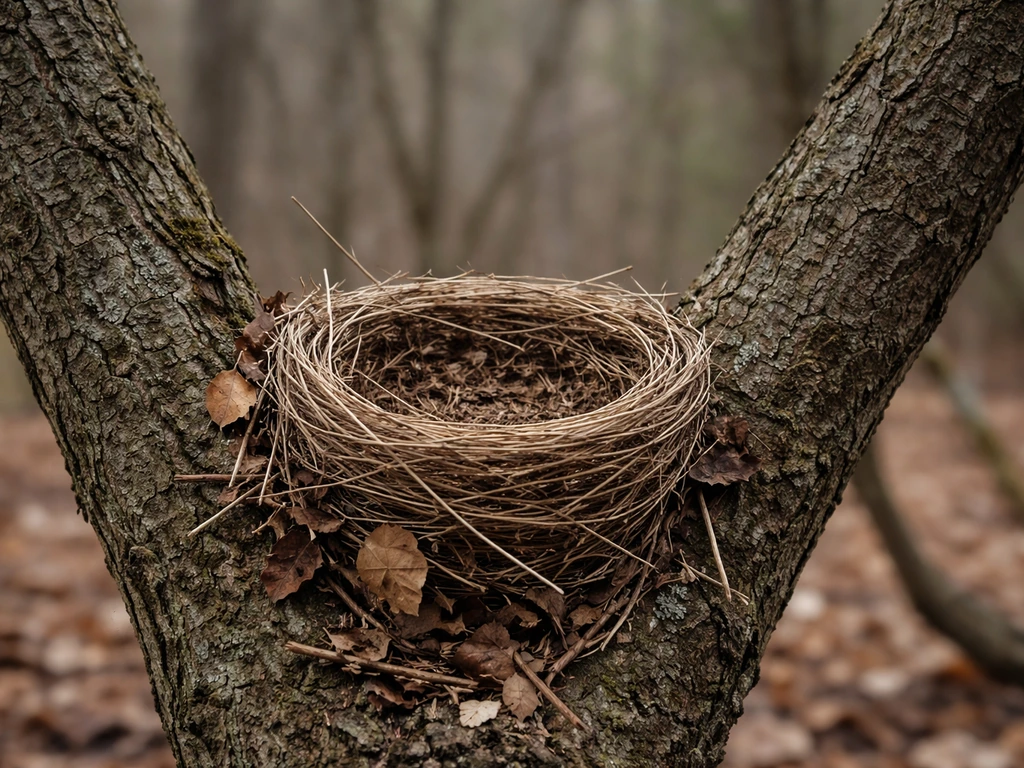
A nest with eggs or young chicks is one of the most hope-laden variants. Dream dictionaries across traditions consistently link this image to new beginnings, potential just waiting to hatch, and family growth. This could reflect an actual pregnancy or adoption, but it just as easily maps onto a new creative project, a fresh start in a relationship, or a life decision that is still in its early, fragile stage. If the image in your dream felt specifically like a bird laying eggs, that can point to the bird laying eggs in dream meaning of new beginnings and growth.
An abandoned or empty nest
An abandoned nest, one that is clearly no longer inhabited, tends to show up during periods of loss, transition, or grief. It can reflect the end of a nurturing phase, such as children growing up and leaving, the close of a relationship, or the feeling that you have been neglected or left behind. The emptiness is the message. It is not necessarily a bad omen so much as an honest mirror for what you are already feeling.
A broken or falling nest
A nest that is damaged, destroyed, or falling from a tree carries the sharpest emotional weight. This variant is typically linked to feelings of insecurity, fear of instability, or anxiety around a home or family situation that feels precarious. If this one resonated with you, it is worth asking honestly: where in your life does security feel threatened right now?
Holding a nest in your hands
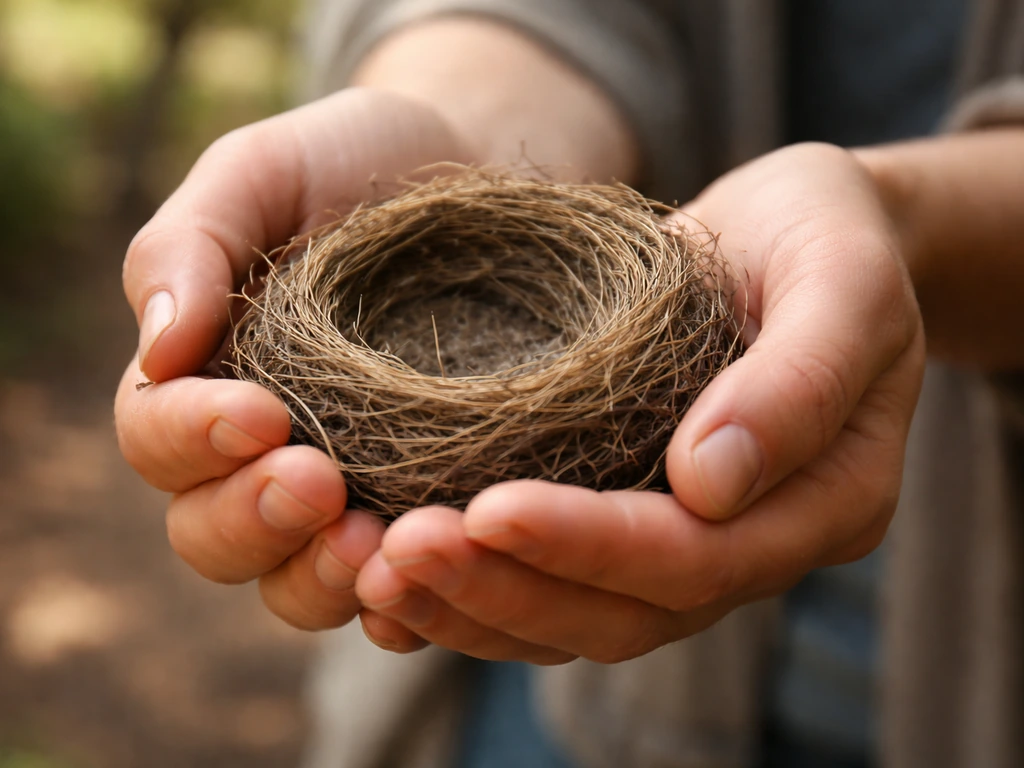
This is a surprisingly distinct scenario. Holding a nest places personal responsibility at the center of the dream. It is less about observation and more about stewardship. You are the one carrying something fragile and precious. Dream sources connect this image closely to themes of protection, responsibility, and the weight of caring for others.
How bird species and nest type add another layer
Bird species act as what some dream traditions call "nuance modifiers": they do not overwrite the nest's core meaning, but they add an emotional flavor. There is no single universal rule, but here are some of the most commonly recognized examples.
| Bird or Nest Type | Common Symbolic Modifier | What It Might Add to the Dream |
|---|---|---|
| Dove | Peace, love, purity | A dove's nest leans the meaning toward harmony in relationships or reconciliation |
| Swallow | Hope, return, good fortune | Swallow nests carry folklore associations with safe homecoming and protection of the household from harm |
| Owl | Wisdom, but also omen in many traditions | An owl's nest shifts the tone toward intuition or, in some cultural contexts, a warning worth heeding |
| Eagle or hawk | Power, vision, ambition | Nests of large raptors often amplify themes of strength, authority, or a high-stakes new beginning |
| Blackbird | Luck and creativity in some folk traditions | A blackbird nesting near the home is considered a good omen in some European and American folklore |
| Small, woven cup nest | Care, intimacy, domestic life | The delicate construction emphasizes the tenderness and effort behind building something safe |
| Large, sturdy platform nest | Stability, long-term vision, legacy | Adds a sense of permanence and ambition to the core nest symbolism |
If a specific bird stood out clearly in your dream, it is worth spending a moment with what that bird means to you personally. Cultural associations are useful starting points, but your own emotional reaction to the bird often says more than any general rule.
What the Bible and world cultures say about nests
The bird nest carries genuine weight in biblical and cross-cultural traditions, and those angles can deepen your interpretation without requiring you to commit to any single belief system.
The biblical perspective
One of the most striking nest references in the Hebrew Bible appears in Deuteronomy 22:6-7, where the law instructs that if you come upon a bird's nest with a mother sitting over her young or eggs, you must let the mother go rather than taking her with the brood. The stated purpose is care and restraint: that it may go well with you and that your days may be long. In the biblical framework, a nest is a site of protection deserving of respect, not exploitation. The mother bird's presence over the young is treated as something worth honoring.
In the New Testament, Matthew 8:20 records Jesus using the image of birds having nests as a contrast to his own homelessness, a metaphor about provision and belonging rather than a literal statement about birds. The broader Sermon on the Mount discourse in Matthew 6 invokes birds of the air as examples of creatures cared for by providence, which has led many readers to associate birds and their nests with themes of trust, shelter, and divine care rather than literal omens.
Folk and cultural traditions
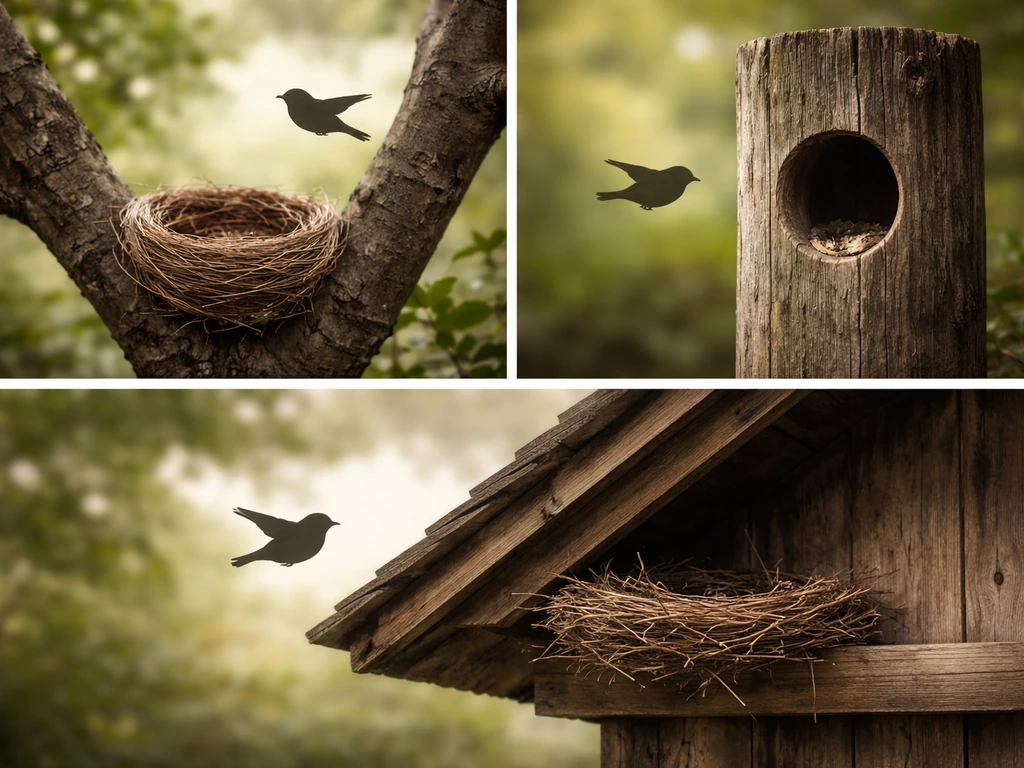
Across folk traditions, birds nesting on or near a home have often been treated as favorable signs. In North American and European folklore, a blackbird building a nest on your house is considered good luck.
Swallows nesting under the eaves of a home have long been seen in many cultures as a blessing, with some traditions believing the swallow protects the household from fire. These associations are not universal: owl nests or the presence of owls carries ominous connotations in Bhutanese, parts of South Asian, and various other traditions, where the owl is explicitly called a bird of ill omen.
The cultural origin of your family or the traditions you grew up around may shape which of these associations feels resonant and which does not.
Indigenous and Eastern traditions each carry their own layered readings of birds and nests, often tied to specific tribal teachings or regional folklore that treat birds as messengers, ancestors, or signs of seasonal change. If your background includes one of those traditions, the meaning may be more specific than any general dream dictionary can offer.
Reflecting on the dream and deciding what to do with it
The most useful thing you can do with a bird nest dream is to turn it into a brief reflection exercise rather than searching for a definitive prophecy. Here is a practical way to do that.
- Write down every detail you remember: the condition of the nest, the birds present, where it was located, who else was in the dream, and what you were feeling. Even fragments matter.
- Ask yourself what in your current waking life connects most directly to themes of home, family, security, or new beginnings. Often the answer is obvious once you hold the question.
- Notice the emotional tone. A warm, settled feeling in the dream points toward affirmation or readiness. Anxiety, dread, or grief in the dream points toward something that needs your honest attention.
- Identify one concrete area of your life where the symbol lands. Is it your relationship? Your living situation? A project or creative endeavor? A family dynamic that needs tending?
- Take one small, grounded action in that area today. If the dream pointed toward security, do something that strengthens a boundary or a commitment. If it pointed toward new beginnings, take one visible step toward the thing you have been hesitating on. If it pointed toward loss, let yourself acknowledge the grief rather than pushing past it.
- If the dream felt like a warning, ask what protective change you could make, not because the dream predicted disaster, but because your unconscious may be flagging something worth addressing.
- Return to the dream image in a journal entry or quiet moment later in the week. Sometimes meaning deepens with a little distance.
Dreams about bird nests belong to a broader family of bird-related dream experiences. If you have also had dreams involving birds attacking, birds biting your hand, birds laying eggs, or birds trapped somewhere they cannot escape, those scenarios each carry their own symbolic angle that may be worth exploring alongside this one. If the dream also involves a bird attack, that detail can shift the meaning toward fear, conflict, or a threat to what feels protected birds attacking. Taken together, they can reveal a more complete picture of what your unconscious is working through.
Common misreadings and a word on mental health
The over-literalizing trap
The most common mistake with any omen-style dream symbol is treating it as a literal prediction. A nest with eggs does not mean you will become pregnant or that a family member will. A broken nest does not mean your home is about to fall apart. Dream symbols are the mind's way of processing emotional and psychological material using imagery, not a forecasting system. When you read the dream as metaphor rather than prophecy, it becomes far more useful and far less alarming.
It is also worth noting that dreams frequently reflect what we are already carrying. If you have been anxious about your family's stability, your unconscious does not need a supernatural prompt to generate a dream about a broken nest. The dream may simply be processing what you already know at some level.
When the dream is distressing, recurring, or tied to something bigger
Most bird nest dreams are benign, even the unsettling ones, because they are doing the normal work of emotional processing. But if you are experiencing recurring disturbing dreams that disrupt your sleep, leave you anxious during the day, or feel connected to a past trauma or ongoing stress, that is worth taking seriously outside of a symbolic interpretation framework. Johns Hopkins Medicine notes that nightmares can be triggered by upset experiences and highlights stress as a possible factor, and it also offers practical coping steps like maintaining a regular sleep schedule and responding supportively after a nightmare upset experiences and stress can trigger nightmares.
The American Academy of Sleep Medicine recognizes nightmare disorder as a clinical condition when nightmares are frequent, persistent, and interfere with sleep or daytime functioning. Trauma-related nightmares, including those linked to PTSD, often involve replay-style content and can be treated effectively with evidence-based approaches like imagery rehearsal therapy, which involves consciously rewriting the nightmare's ending before sleep. The Mayo Clinic advises seeking medical evaluation when disturbing dreams persist over time or disrupt daily life. If that describes your experience, a conversation with a doctor, therapist, or behavioral sleep medicine specialist is a genuinely useful next step, not a sign of overreacting.
If you are in acute distress or experiencing thoughts of self-harm, please reach out to the 988 Suicide and Crisis Lifeline by calling or texting 988. You do not have to be in a crisis to talk to someone, and support is available regardless of whether the distress feels dream-related or not.
For most people, a bird nest dream is simply an invitation: look at where you are building, what you are protecting, what is hatching in your life, and what feels fragile right now. That is usually enough to find something genuinely worth paying attention to.
FAQ
What if my bird nest dream is the same one I have every few months, does that change the meaning?
Repetition often means the underlying emotional theme is still active. Try tracking what is different each time (same nest, different eggs, different bird, different mood), then connect the recurring pattern to a specific area of life that keeps coming up, such as relationship stability, parenting stress, or work security.
If I dreamed about taking something from a bird nest, is that always negative?
It usually points to boundaries and “taking” versus “caretaking.” The key is whether the nest felt violated or whether you felt justified or purposeful. A guilty or anxious tone suggests fear of crossing a line with someone’s vulnerability, while calm focus can reflect a need to handle responsibilities ethically and carefully.
Does a bird nest dream ever relate to money or finances, not just family and safety?
Yes. “Home” in dream symbolism can extend to resources that support your life, like savings, stable income, housing security, or reliable support systems. If the nest felt fragile or scarce, the dream may be mirroring financial stress about keeping stability in place.
What if the nest is in an unusual location, like inside my house or inside a car?
Location changes where the security theme is “meant to live.” A nest inside your home can emphasize inner life and emotional privacy, while a nest in a car or public place can point to safety feeling temporary, exposed, or dependent on motion and uncertainty.
How should I interpret a nest dream where the birds are silent or refusing to leave?
Silence can shift the emphasis from growth to containment. If the birds seem stuck or unresponsive, it may reflect being unable to express needs, waiting for a breakthrough, or feeling emotionally “held in” by a situation that is not moving.
What does it mean if the nest feels comfortable in the dream, but I feel uneasy when I wake up?
That mismatch can signal your mind processed comfort as an ideal, while waking feelings reveal a real-world conflict. Consider whether you are wanting safety (warm, protected imagery) but doubting whether it is currently deserved, realistic, or achievable.
Are bird nest dreams linked to pregnancy specifically?
They can map to pregnancy themes, especially when the dream clearly highlights eggs, gestation, or chicks, but they are not a direct prediction. A practical check is whether you are nurturing something new that is “early and fragile” (relationship, creative work, health plan). If not, pregnancy symbolism may be more about readiness for new responsibility or change.
If I see an empty nest, does that always mean loss?
Empty can mean loss, but it can also mean closure and completion. Distinguish whether the emptiness felt like grief (sadness, regret) or like relief (peace, acceptance). Relief often points to an ending that has already happened and a new phase you are ready for.
How do I interpret the dream if I was afraid of the nest or afraid to approach it?
Fear can reflect avoidance of responsibility. If you are afraid to approach, the “stewardship” theme may be active, meaning something in your life requires care but you are hesitating, overestimating risk, or not feeling equipped to protect it.
When should I stop focusing on symbolism and get support instead?
If the dream content is recurring and you are experiencing sleep disruption, daytime anxiety, or strong trauma-linked distress, it is worth speaking with a clinician. Especially if you notice hypervigilance or persistent intrusive imagery, evidence-based options like imagery rehearsal therapy can be more helpful than continued interpretation.
Next Article
Bird Trapped in House Dream Meaning and What to Do
Interpret a bird trapped in house dream plus safe real-life steps to rescue a bird and reflect on being stuck.