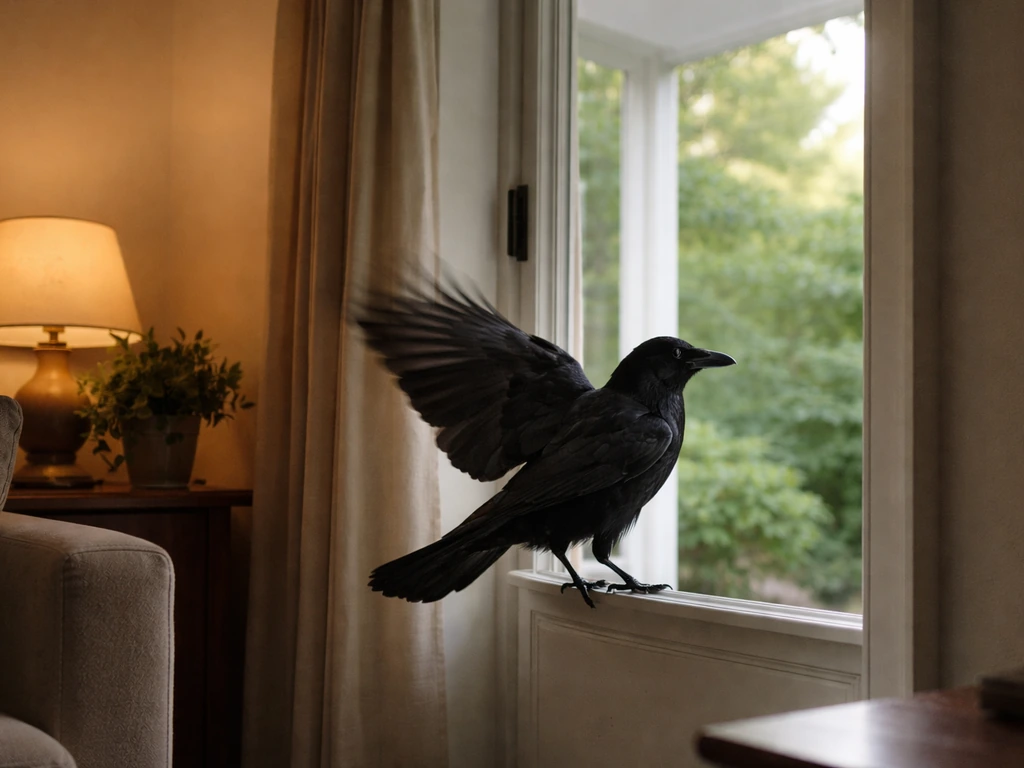
A black bird flying into your house almost always got in through an open window, door, or gap in the roof or chimney. Birds don't choose your home for mysterious reasons most of the time. They follow light, get disoriented by reflections, chase insects, or simply wander in during nesting season. That said, people across dozens of cultures have treated this moment as a message for centuries, and if you're here, you're probably curious about both angles. This guide covers the practical steps first, then the symbolic side, so you can handle what's in front of you and reflect on what it might mean to you personally.
Meaning of a Black Bird Flying Into Your House: What to Do

Maya Hartwell
20 May 2026
Why a black bird actually flew into your house
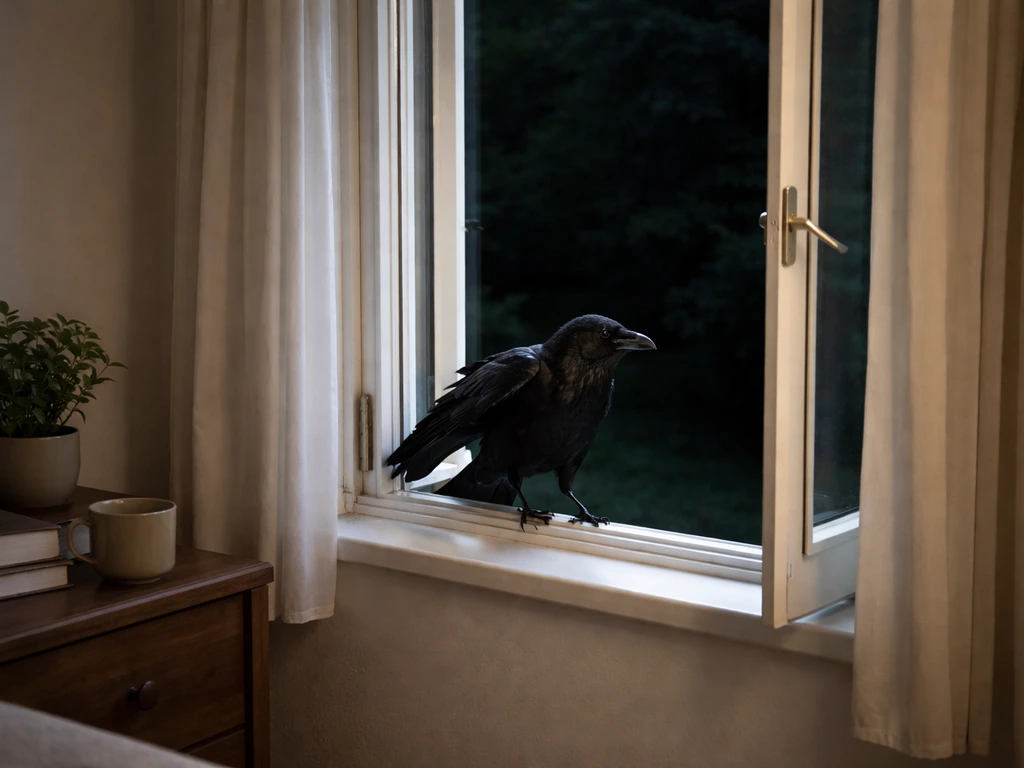
Before anything else, it helps to understand what pulled the bird inside, because it changes how you handle the situation and, if you're spiritually inclined, it adds useful context to your interpretation. Here are the most common real-world explanations.
- Open windows or doors: The most common entry point, full stop. A bird sees an opening, follows an insect or a breeze, and ends up inside before it realizes it.
- Reflection confusion: Birds often mistake glass for open sky. A window that reflects trees or sky can look like a clear flight path, and the bird hits or enters before it registers the barrier.
- Artificial light disorientation: Audubon's Lights Out Program research shows that bright indoor lighting and skyglow from buildings can disorient migrating birds at night, pulling them off course and toward structures they'd normally avoid.
- Chasing insects: Interior lights attract insects, especially at dusk. A hungry crow or blackbird will follow that food source right through an open screen door.
- Nesting and territorial season: In spring and early summer, black birds like crows become bolder and more exploratory. An open attic vent, chimney flue, or garage door is an invitation they'll sometimes accept.
- Storm or wind displacement: Strong weather can push birds into unfamiliar territory and toward structures for shelter. If a storm rolled through before this happened, that's likely a factor.
- Chimney access: Chimneys are a classic entry point for corvids and starlings. If you don't have a cap on your flue, birds sometimes fall or fly in from above.
None of these explanations are mysterious. They're all predictable animal behaviors driven by light, food, shelter, and seasonal instinct. Knowing this doesn't have to diminish any spiritual meaning you take from the encounter, but it does keep you grounded when you're deciding what to do next.
Which black bird was it, exactly?
"Black bird" describes several very different species, and the one you saw matters both practically and symbolically. Crows, ravens, common grackles, European starlings, and true blackbirds (like the red-winged blackbird or Brewer's blackbird) all look darkly-colored at a glance. Here's how to tell them apart quickly.
| Bird | Size | Key field marks | Tail shape | Common range |
|---|---|---|---|---|
| American Crow | About 17–21 inches | Broad, rounded wings with splayed wingtip 'fingers'; slim beak for its size | Short and squared-off | Widespread across North America |
| Common Raven | About 22–27 inches | Larger and heavier overall; thick, curved beak; shaggy throat feathers | Wedge or diamond-shaped | Northern and western North America, rural areas |
| Common Grackle | About 11–13 inches | Iridescent purple-green sheen on head; pale yellow eye; long body | Long, keel-shaped in flight | Eastern and central North America |
| European Starling | About 7–9 inches | Short tail; speckled in winter; walks rather than hops | Very short and squared | Widespread, especially urban areas |
| Brewer's Blackbird | About 9 inches | Yellow eye in males; glossy greenish-black head | Medium length, rounded | Western North America |
The easiest quick test is size. If the bird looked roughly pigeon-sized or a bit bigger, you're likely looking at a crow. If it was noticeably larger, with a heavy beak and a wedge-shaped tail, it was probably a raven. If it was smaller, slender, and had a long tail or iridescent sheen, think grackle or blackbird. Starlings are noticeably small and tend to walk along surfaces rather than hop. Getting this right matters because crows, ravens, grackles, and starlings carry different symbolic weight across traditions, and some (particularly corvids like crows and ravens) are protected under the Migratory Bird Treaty Act in the United States, which affects how you handle them if injured.
How to safely get the bird out right now
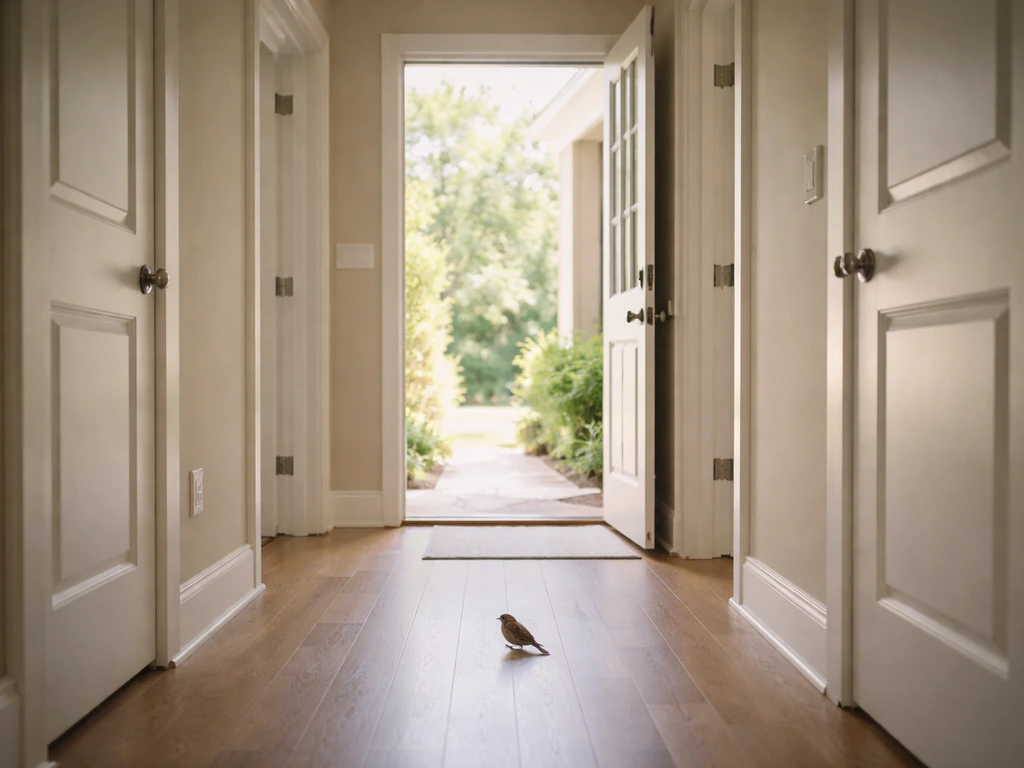
Stay calm. A panicked bird in your house is scary, but it's more scared of you than you are of it. The goal is to make the exit obvious and stop competing with it for space. Follow these steps in order.
- Isolate the bird to one room: Close all interior doors between the bird and the rest of your house. This stops it from flying deeper in and getting more disoriented.
- Open one clear exterior exit: Open a window or exterior door in the room the bird is in. Remove the screen if there is one. The Environmental Literacy Council specifically recommends this as the first practical step.
- Turn off the lights: Dim or kill the interior lights in that room. Wildlife Illinois and the Wisconsin Humane Society both recommend this. Birds navigate toward light, so making the exit the brightest point draws them out naturally.
- Step back or leave the room: Your presence adds stress. Give the bird a few quiet minutes with a clear, lit exit and it will often leave on its own.
- If it's still stuck, guide it gently: Use a large, light-colored towel or sheet held up as a soft barrier to slowly herd the bird toward the open exit. Move slowly. No sudden lunges or loud noises.
- Do not chase it, swing at it, or use a broom aggressively: This stresses the bird, risks injury to both of you, and can cause it to crash into walls or windows.
- Do not grab it with bare hands unless it's injured: Wild birds carry bacteria and can scratch or bite. If you must handle it, use thick gloves.
Most birds that aren't injured will find their way out within 10 to 30 minutes if you give them a clear, lit path and remove yourself from the picture. The Wisconsin Humane Society also recommends turning off lights and opening windows or other exits to give the animal a clear path out during daylight hours a clear, lit path. If it's been longer than that and the bird is still inside but behaving normally (alert, flapping, trying to find an exit), just keep the path open and give it more time.
If the bird is injured, trapped, or dead
Signs of injury to watch for
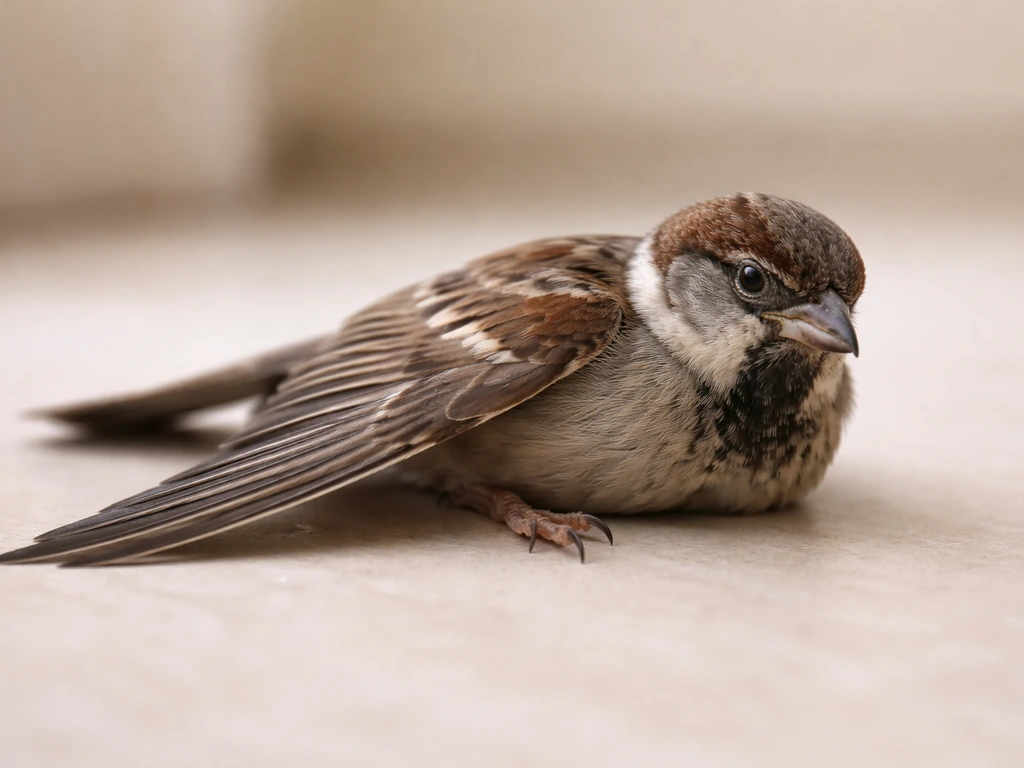
- The bird is sitting still on the floor and not attempting to fly
- One or both wings are drooping at an odd angle
- Visible blood, swelling, or labored breathing
- It's dazed or unresponsive to your presence at close range
Handling a stunned or injured bird
If the bird flew into a window and appears stunned but not visibly injured, Tufts Wildlife Clinic recommends placing it in a dark, ventilated container (like a shoebox with holes punched in the lid) lined with crumpled paper towels for soft bedding. Set the box somewhere warm and quiet, away from pets and children, and check it after an hour. Many birds that are stunned from a window collision recover fully with rest.
If it doesn't improve, or if you see blood, a drooping wing, or labored breathing, contact a licensed wildlife rehabilitator in your area as soon as possible. Audubon's guidance is consistent here: don't try to treat the bird yourself, and don't keep it past the point where professional help is needed.
For a larger bird like a crow or raven that appears seriously injured, use heavy gloves and wrap the bird loosely in a towel to contain its wings before placing it in a ventilated box. Raptor rehabilitation guidelines extend this to any large, potentially dangerous bird: protective clothing matters, both for your safety and to reduce the bird's stress during handling.
If the bird is dead
Do not touch a dead bird with your bare hands. The CDC advises using gloves, a mask, and eye protection when handling dead birds or cleaning areas with bird droppings, given the risk of avian influenza and other pathogens. Use a plastic bag turned inside-out as a glove to pick up the bird, seal it, and dispose of it in your outdoor trash. For droppings cleanup, the CDC recommends cleaning the area with soap and water first, then disinfecting with an EPA-approved disinfectant that covers avian influenza. Wash your hands thoroughly after. Remove and dispose of or disinfect any PPE you used.
What a black bird indoors has meant across traditions
This is the part most people are really here for. Once the bird is out and the room is cleaned up, the question lingers: what was that about? Across folklore, religion, and metaphysical traditions, black birds flying into a home have been interpreted in strikingly different ways, and none of them are universally agreed upon. Here's an honest look at the range.
Crows and ravens: transformation, not just bad omens
In Western popular culture, the first instinct is often to read a raven or crow indoors as a bad omen, tied to death or misfortune. That association has roots in European folklore and has been reinforced by literature (Edgar Allan Poe's raven being the obvious example). But that's only one thread in a much larger tapestry. In many Indigenous North American traditions, ravens are creators, tricksters, and wisdom figures, not harbingers of doom.
In Norse mythology, Odin's ravens Huginn and Muninn represent thought and memory, carrying information between realms. In Celtic traditions, crow figures like the Morrigan are connected to both battle and sovereignty, transformation rather than simple destruction. Wikipedia's overview of raven symbolism notes that across many cultures ravens carry revered spiritual significance before noting the Western negative associations. Astrology.
com frames ravens specifically as symbols of change, transformation, and an invitation to trust your intuition. Mindbodygreen echoes this, emphasizing healing and transformation rather than darkness or threat.
Blackbirds and grackles: messages and thresholds
True blackbirds (in the thrush family, common in European folklore) have a different symbolic tradition than corvids. In British and Celtic folklore, blackbirds are often associated with the threshold between worlds, the veil between the living and the dead, and messages from ancestors or spirit guides. The song of a blackbird near a home has long been treated as a communication from the beyond. Grackles, while less mythologized, share the general symbolism of dark birds in many folk traditions: omens that require attention and discernment rather than automatic fear.
Biblical and Christian readings
In biblical tradition, birds are frequently messengers and signs of divine attention. Ravens specifically appear in the story of Elijah, where God sends ravens to feed the prophet in the wilderness, framing them as instruments of provision and care rather than darkness. That's a very different read than the "bad omen" framing, and it's worth knowing if you're coming from a Christian or Jewish background.
The honest caveat
California Psychics notes directly that a blackbird indoors isn't automatically an ill omen, and that interpretations vary widely by tradition and reader. That's the most accurate thing you can say. The meaning of this encounter is not fixed. It's shaped by your tradition, your current life circumstances, and what you choose to make of it.
One visit versus recurring sightings: does it change the meaning?
In most symbolic frameworks, repetition is what turns a coincidence into a sign. A single black bird flying into your house during an open-window summer afternoon reads very differently from a crow that has entered your home three times in two weeks. Here's how behavior and pattern tend to shift the interpretation across traditions.
| Scenario | Practical read | Common symbolic read |
|---|---|---|
| Single visit, daytime, clear entry point (open window) | Accidental entry, bird navigating by light or following insects | A passing message or nudge; may not require deep interpretation |
| Single visit, nighttime, disoriented flight | Attracted by artificial lights; common during migration season | In some traditions, a nocturnal bird visit suggests something from the shadow or unconscious asking for attention |
| Repeated visits, same bird or species | Nesting territory nearby, food source attracting returns, unsealed entry point | More likely to be read as a persistent message or sign that something needs your attention |
| Frantic, crashing flight indoors | Panic response to being trapped; stress behavior | Some traditions read chaos and distress as urgency in the message, a warning rather than a gentle prompt |
| Calm perching, little fear of humans | Young or habituated bird; possibly raised near humans | Interpreted in many traditions as a spirit or ancestor comfortable enough to linger, a more intimate visitation |
| Bird found dead inside | Flew in and couldn't escape; exhaustion or collision | Often the most weighted interpretation across traditions; associated with endings, transition, and the need for ritual acknowledgment |
If this is a recurring event, start by ruling out a physical entry point that hasn't been sealed. A crow or starling that keeps getting in is almost certainly doing so through the same gap, chimney, or vent. Fix that first. If the recurrence feels genuinely improbable or coincidental (as in, the bird couldn't have gotten in by natural means), that's when the pattern becomes harder to explain away and easier to sit with as something worth reflecting on. Other bird-indoors experiences, including general bird visits and what it means when any bird enters your home, share this same interpretive structure: one visit is interesting, repetition is what most traditions treat as significant.
How to reflect on what this might mean for you
Whether you're a committed skeptic, a practicing spiritual seeker, or somewhere in between, there's a grounded way to sit with this experience without either dismissing it or spiraling into anxiety. The goal is to engage with curiosity rather than fear. Here are some practical next steps depending on your approach.
If you want a natural explanation and reassurance
You have it. Birds enter homes regularly. That can help you explore the meaning of a bird getting inside the house without assuming it must be a bad omen Birds enter homes regularly. Black birds are no more ominous in behavior than any other species. Once you've handled the situation safely, check your entry points (windows, chimney caps, vents, garage doors) to prevent a repeat. That's the full practical story, and there's nothing to worry about.
If you want to explore the symbolic meaning
Start by writing down the event before you try to interpret it. One trust-based metaphysical example frames these “signs” journaling or ritual practices as a way to separate perceived signal from noise while staying consistent with grounding habits, though it is not a science-based claim grounded synchronicity guidance.
This is the approach recommended in grounded synchronicity guidance (including structured journaling methods like the WEAVE approach): record what actually happened before layering meaning onto it. What were you doing when the bird entered? What had you been thinking about or working through in the days before? Is there a question you've been sitting with?
Panaprium's guidance on synchronicity makes a good point here: meaning usually comes from interpretation, not the event itself. The event is a prompt. You bring the meaning.
It's also worth being honest about cognitive bias in this process. Tactical Tarot's framework on bias in divination and omen reading is applicable here: if you're already anxious about something, a black bird inside will almost certainly feel like a warning. If you've been hoping for a sign that change is coming, it might feel like confirmation. Neither reading is wrong, but both are worth examining for that filter.
Reflection prompts to work with
- What was happening in my life when this occurred? Am I in a period of transition, loss, or new beginning?
- Which tradition or belief system feels most resonant to me when I think about this bird? Why?
- If this bird was a message, what would I want it to say? What does that reveal about what I'm hoping for or afraid of?
- Does the specific behavior of the bird (calm versus frantic, perching versus circling, daytime versus night) change how it feels to me?
- If I imagine telling this story to someone I trust in a year, what would I say it meant?
- Is there something I've been avoiding that this encounter is prompting me to look at?
If you want to mark the moment ritually
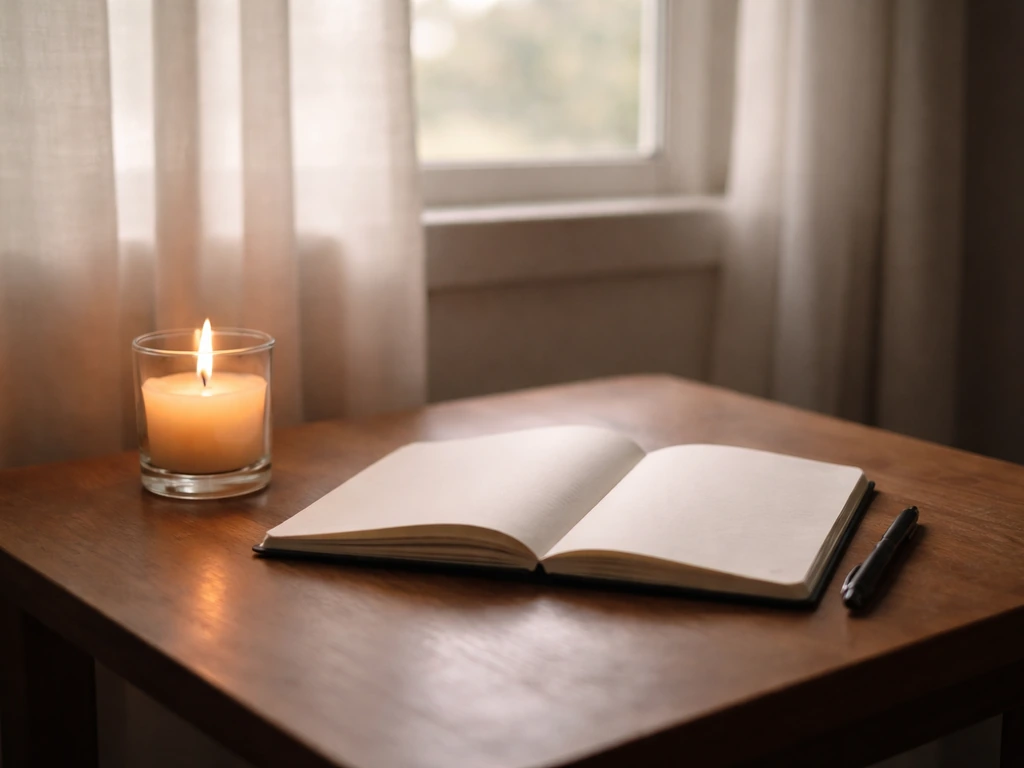
Many traditions treat unexpected bird visits as worth acknowledging, regardless of the interpretation. You might light a candle after the bird leaves, offer a brief prayer of gratitude (or for protection, depending on your read), or simply sit quietly for a few minutes and let yourself feel whatever came up during the encounter. Witchcraft and folk magic traditions often encourage building a personal symbol lexicon, meaning the specific meaning of a crow or raven in your life might differ from the cultural default, and your pattern of experiences over time is what defines your symbol set. Whatever you believe, treating the encounter as something worth noticing, rather than something to fear or dismiss, tends to be the most useful response.
If the bird that visited you came to you in a dream rather than in person, that carries its own distinct symbolic tradition. Dreaming of a bird flying in the house is also commonly treated as a sign worth exploring, especially in connection with change, messages, or transitions dream rather than in person. And if you're curious about a specific species like a myna bird visiting your home, the astrological interpretations around that are worth exploring separately. The thread connecting all these encounters is the same: something crossed into your space, and you're paying attention. That attention itself is meaningful, whatever you make of it.
FAQ
Is a black bird indoors ever dangerous beyond the mess and fear factor?
Yes. While most window-entry birds are only stunned, some can bite or claw, especially crows and ravens. Also, if the bird is dead or you see heavy droppings, health precautions matter due to pathogens. Use gloves and eye protection for cleaning, keep pets away, and contact a wildlife professional if the bird is behaving erratically or is bleeding.
How long should I wait for the bird to leave if it keeps flying around?
Most uninjured birds exit within 10 to 30 minutes once there is a clear route to the outdoors and you stop competing for space. If it is still inside after that, keep the exit path open longer, but also increase lighting outside near the exit if possible, and remove extra indoor lights that may confuse it.
What if the bird keeps returning after I let it out?
A recurring visit usually means the same entry path is still available (open window, vent, chimney gap, or damaged screen). Inspect and temporarily block likely gaps to confirm the route, then seal it permanently. If you cannot find the entry, watch when the bird appears (time of day, weather, nearby lights) to narrow down the cause.
Should I cover mirrors and turn off lights when trying to get it out?
Often, yes. Reflections and bright indoor lights can keep birds circling. Turn off or dim interior lights that reflect off windows, close curtains near the bird if safe, then leave one clear well-lit exit window/door with the path unobstructed.
Does the species matter for safety rules?
It can. Corvids (crows and ravens) are typically larger with stronger beaks and greater stress if handled, so use extra caution and avoid direct contact. Small dark birds are generally easier to guide out, but never assume they are harmless if they are injured or trapped for a long time.
What should I do if the bird hits the window and won’t move normally?
If it is stunned but not bleeding, place it in a dark, ventilated container with soft bedding and check after about an hour. If it is not improving, has visible injuries, droops, or shows labored breathing, contact a licensed wildlife rehabilitator promptly rather than trying to nurse it at home.
Can I feed the bird indoors to calm it?
Avoid feeding inside. Food can delay exit-seeking behavior and can make the bird more difficult to guide back out. If the bird is uninjured, focus on clearing a safe exit. If you need to consider feeding at all, do it only after speaking with a local wildlife professional, since species-specific feeding can be risky.
Is it okay to keep the bird overnight if I think it’s injured?
Do not keep it longer than needed to arrange help. For serious injuries or lack of recovery after an initial rest period, contact a wildlife rehabilitator. Keeping a wild bird without authorization or proper setup can worsen stress and reduces survival chances.
What if the bird leaves but I find feathers later, does that change the meaning or the safety steps?
Feathers alone do not necessarily indicate disease, but they do mean the bird was physically present in your space. For spiritual interpretation, it may feel significant, but for practical risk, focus on cleaning any droppings you find and washing hands. If there is evidence of blood, heavy contamination, or many droppings, treat it as higher risk and use PPE.
Are there cases where I should call animal control instead of a wildlife rehabber?
Yes. If you cannot safely reach a rehabilitator, if the bird is aggressive, if there are hazards like a bird trapped in an active engine bay or near electrical wires, or if there is an immediate public safety concern, local animal control may be the faster route. In all cases, avoid handling with bare hands.
Does “meaning” depend on whether it’s day or night?
It often does for practical reasons, because light conditions affect how birds enter and disorient themselves. Spiritually, many people treat a nighttime visit differently, but from a grounded angle the key is still context: what the bird did (stunned versus persistent flight), whether it was able to leave, and whether it’s a repeated event for your home.
If I’m religious or skeptical, what’s a safe way to reflect without getting anxious?
Use a boundary between observation and interpretation. For example, write down objective details (species look, entry point, behavior, timing), then limit symbolic reflection to a short journaling session. If your anxiety spikes, treat the event as a prompt to check practical home security and your current priorities, not as a prediction.
Next Articles
Bird Coming Into House Meaning: Causes, Symbols, and What to Do
Bird in house meaning and causes, symbolism, and immediate steps to safely remove, clean, and prevent recurrence.
Why Is My Bird Flapping Its Wings at Me? Causes and What to Do
Understand why your bird flaps wings at you and what to do, from hormones and stress to attention and warnings.
Makes My Bird Twitch Meaning: Causes, Fixes, and Red Flags
Understand why your bird twitches, what to check now, red flags, first-aid steps, and symbolic meaning safely.