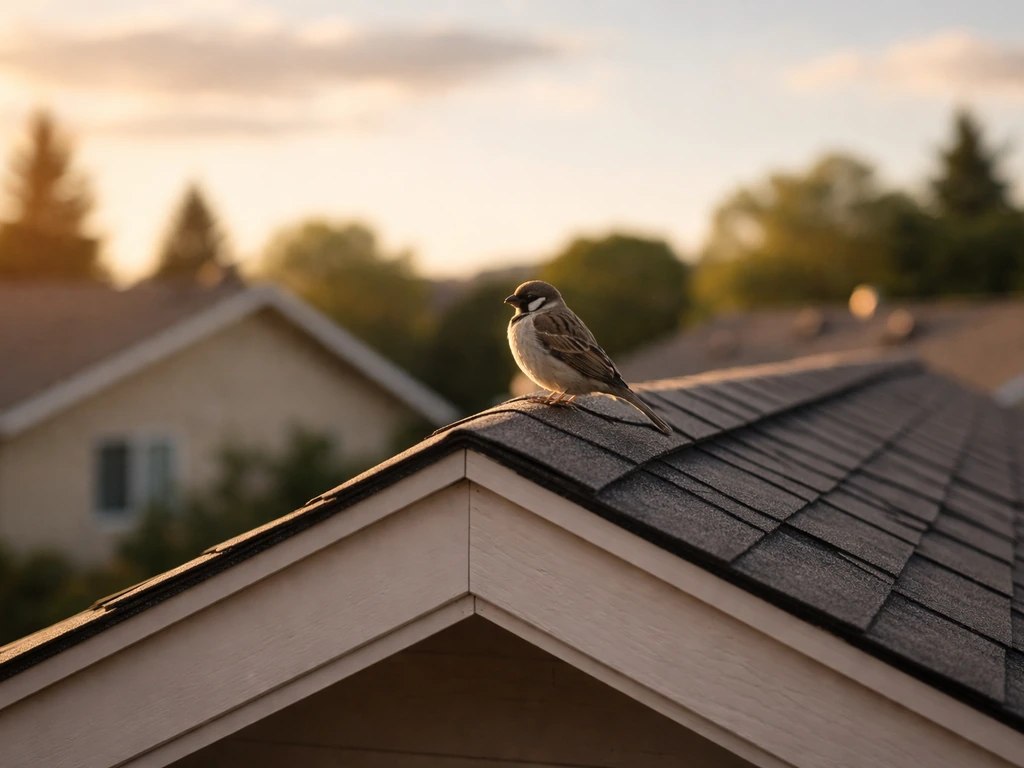
A bird in your attic is almost always there by accident. It squeezed through a roof vent, an open soffit gap, a chimney chase, or a crack around a ridge vent, and now it can't figure out how to get back out. Most of the time it's a House Sparrow, starling, or pigeon that followed a gap as small as 1 1/8 inches. That's the practical reality.
Bird in Attic Meaning: Causes, Safety Steps, Symbolism

Maya Hartwell
1 May 2026
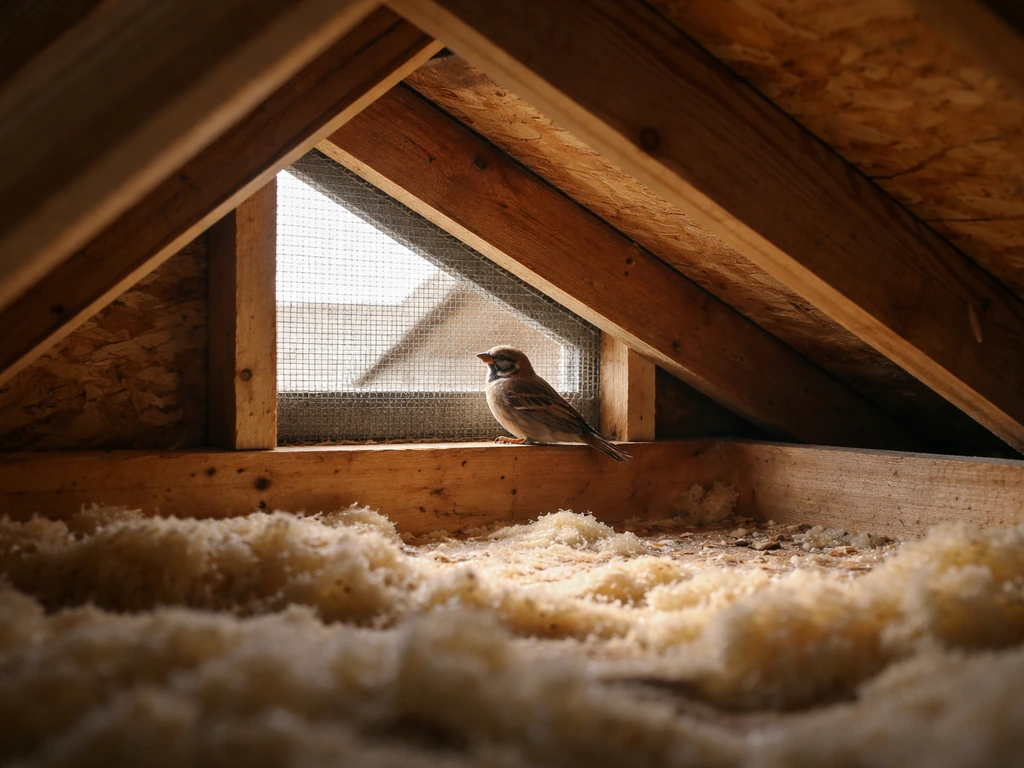
But people who search for what a bird in the attic means aren't just asking about wildlife control, and honestly, that makes sense. There's something about hearing wings beat against the ceiling above you that feels like a message. This guide covers both: what's actually happening up there and what different spiritual traditions say it might mean.
What a bird in the attic actually means, practically speaking
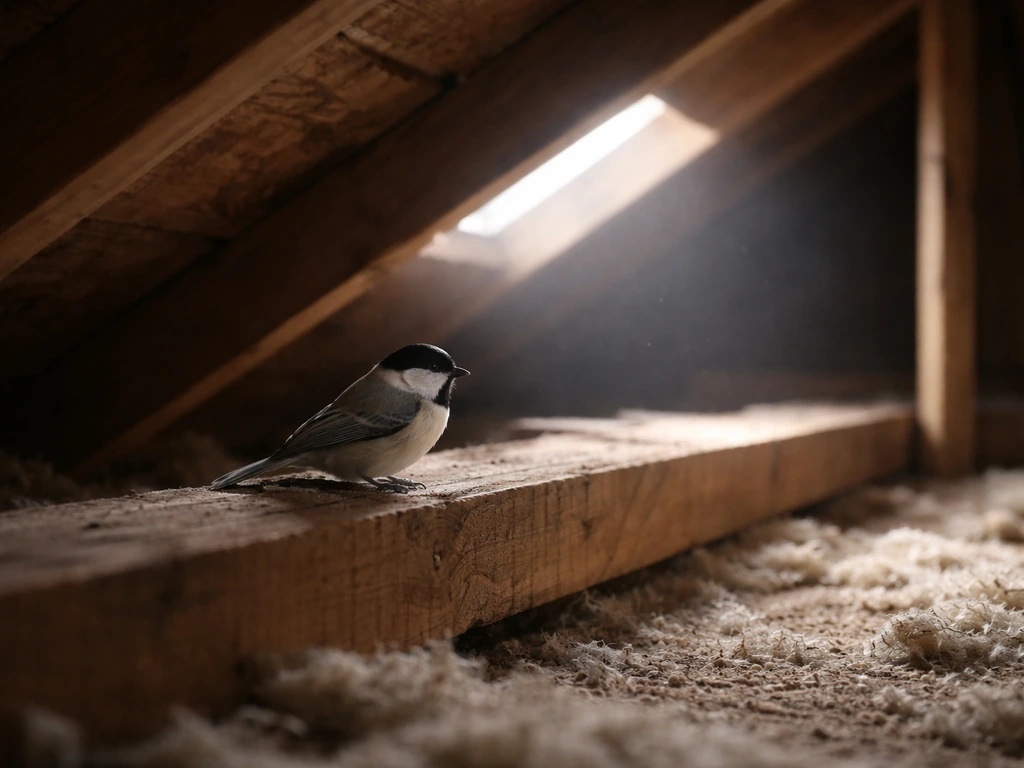
Before anything else, it helps to understand what you're dealing with. A bird inside your attic is almost never a sign that something is structurally wrong with your home in a major way, but it does mean there's at least one opening somewhere in your roofline that's large enough for a bird to pass through. House Sparrows, for example, can squeeze through entrance holes as small as 1 1/8 inches. Starlings and pigeons need a bit more room, but they're resourceful about finding it. The attic is appealing because it's warm, dark, enclosed, and protected from weather and predators, which is exactly what a nesting or stressed bird is looking for.
Most visits fall into one of three categories: a bird that accidentally wandered in and is now trapped, a bird actively scouting or building a nest, or an injured or exhausted bird that took shelter. Understanding which situation you're facing shapes both the practical response and, if you're spiritually inclined, the symbolic interpretation.
How birds get in: common entry points and seasonal patterns
Attic entry points are more common than most homeowners realize. The most frequent culprits are uncovered or damaged exhaust fan openings, open soffit vents, gaps around chimney chases, deteriorating ridge vents, and spaces where roof pipes or vent stacks pass through the attic ceiling without proper sealing. JLC Online's roof-venting guidance specifically calls out chimney chases and vent stacks as spots where gaps often go unnoticed for years.
Seasonally, late spring into early summer is peak nesting season, which means birds are actively seeking enclosed spaces to raise young. The U. S. Fish & Wildlife Service explains that most [bird nests](https://www.
fws. gov/story/bird-nests) are protected under the Migratory Bird Treaty Act, and destroying a nest with eggs or chicks can be illegal without the right permitting or exception. House Sparrows in particular have a well-documented tendency to nest in building cavities. They're closely associated with human structures, and if they find an opening that feels safe, they'll commit to it fast.
A single bird in January is more likely a cold or disoriented bird seeking warmth. A bird in April or May with nesting material is a different situation entirely, and one with legal implications (more on that below).
Reading the bird's behavior: escape, nesting, or injury?
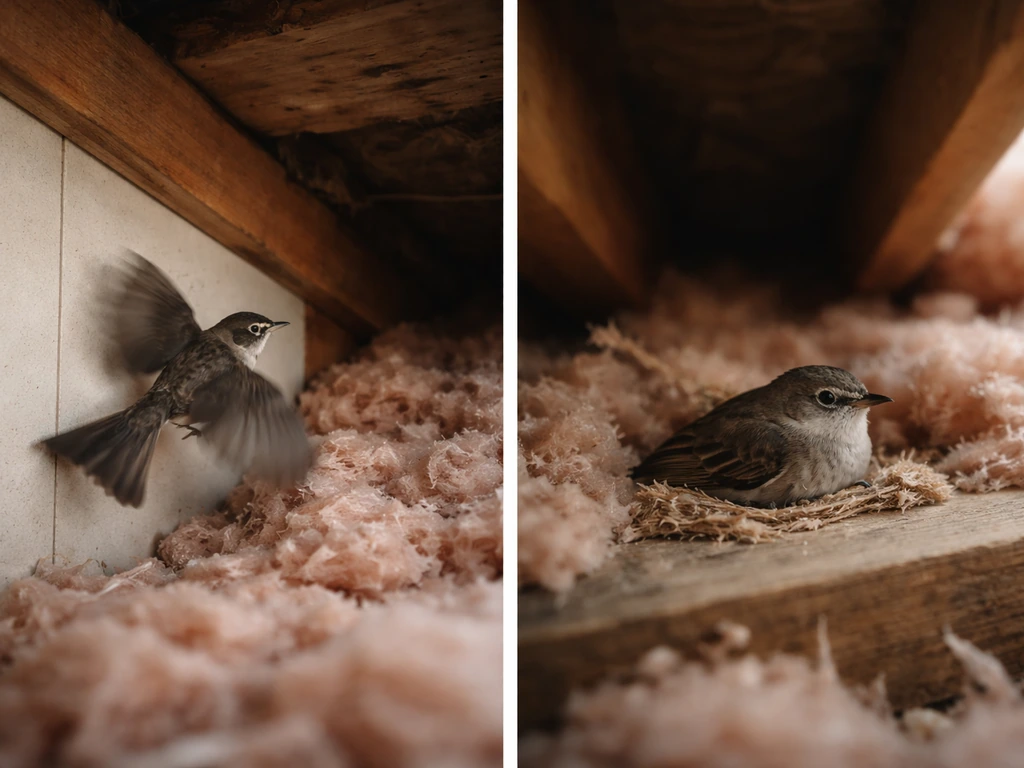
How the bird is behaving tells you a lot about why it's there and what it needs from you.
- Frantic flapping and repeated impact with walls or the roof decking: This is almost always a disoriented bird trying to escape. It entered, lost its sense of direction, and is now panicking. Light is the fastest way to guide it out.
- Quiet, still presence in a corner: This bird may be injured, exhausted, or in shock. Approach calmly and without sudden movements. It likely needs more help than it can manage alone.
- Carrying material or returning repeatedly to one spot: Nesting behavior. If you see grass, leaves, feathers, or fibers being gathered, the bird is trying to establish a home. Acting quickly before eggs are laid gives you the most humane and legal flexibility.
- Sounds at night: Most songbirds are diurnal, so nighttime scratching or fluttering more often points to a bat or rodent. However, some birds can become active at night if disturbed or disoriented by light.
The spiritual and symbolic meaning of a bird in the attic
Across cultures and traditions, birds moving into the spaces closest to the sky, including rooftops and upper rooms, have long been seen as carriers of messages between worlds. The attic is an interesting space symbolically: it's the uppermost part of the home, associated with the mind, with memory, with things stored away or left unexamined. A bird entering that space is, in many symbolic frameworks, an invitation to look at what you've been keeping up there, literally and figuratively.
In many metaphysical and New Age traditions, a bird entering your home is interpreted as a messenger. The attic specifically is sometimes read as a symbol of higher consciousness or spiritual awareness, meaning a bird there could be prompting reflection on thoughts, beliefs, or inner life that haven't been tended to. Many people also ask about the bird at the front door meaning, since entryways are often read as a sign of what is approaching your life.
If the bird is moving freely and singing, many people read that as a positive omen, a sign of incoming news, clarity, or spiritual energy. A trapped or distressed bird, banging against the rafters, tends to carry heavier associations: feelings of being stuck, a message not yet received, or a situation calling for release.
Timing and repetition matter to those who read these encounters symbolically. A single unexpected visit reads differently than a bird that returns to the same spot multiple times. Daytime visits are generally interpreted as conscious, active messages, while a bird appearing at night or causing noise in the dark hours is often connected to the unconscious, to things unseen or unresolved. The species of bird can add nuance too: a sparrow carries associations with community and simplicity, while a larger bird like a crow or dove might carry its own well-established symbolic weight depending on which tradition resonates with you.
It's worth noting that encounters like a bird on your roof, on your porch, or at your front door carry their own sets of meanings in many traditions, and the attic placement is significant precisely because it's inside the home's boundary but at the highest point, the threshold closest to the sky. If you are comparing these signs, you may also want to look up bird on the roof meaning as a related point.
If you are noticing a bird on your balcony instead, the meaning people assign can feel similar but still depends on the behavior and timing bird on my balcony meaning. Some people also use the phrase “like a dog with a bird at your door meaning” to describe a tense, insistent encounter that feels urgent and hard to ignore.
Many people also search for the bird at front door meaning, which is often read as a sign that attention is being brought to your home and relationships at the threshold bird at your front door meaning. If you want to focus specifically on a bird at the front door, that is where the “bird on doorstep meaning” question usually comes in.
If you are looking for the bird on porch meaning, it often points to attention on the boundaries between your daily life and what is coming next a bird on your porch. If you're wondering about the bird on porch meaning specifically, it’s often read as a prompt to reflect on transitions happening just beyond your everyday awareness.
Biblical and folklore perspectives on birds entering the home
In the biblical tradition, birds are frequently used as symbols of God's provision and attention rather than as omens. Jesus' teaching in Matthew 6:26 and Luke 12:24 asks followers to "look at the birds," pointing to how God cares even for sparrows as a way of encouraging trust and releasing anxiety.
From this lens, a bird appearing unexpectedly in your home might be less about a foreboding sign and more about a gentle reminder that you are seen and cared for. The meaning of a bird came down the walk is often discussed in folklore as a sign of something shifting, so it helps to notice the context and your own reaction.
Words of Hope, drawing on these same scriptures, frames bird encounters as prompts toward faith rather than signals of fate.
Broader Western folklore has a more complex relationship with indoor birds. In British and Celtic traditions, a bird flying into a house was often considered an omen of death or significant change, especially if it couldn't find its way out. The Appalachian and Ozark folk traditions of the American South carried similar warnings. However, many of these traditions made distinctions: the species mattered, whether the bird sang or stayed silent mattered, and whether it eventually escaped on its own mattered. A bird that found its way out freely was often reframed as a positive sign, of transition completed, a message delivered.
In some Indigenous North American traditions, birds entering human spaces are seen as relatives bringing a message from the spirit world, and the appropriate response is respectful attention rather than fear. Eastern traditions, including some schools of Feng Shui, interpret birds entering the home as an indicator of incoming good news or a shift in household energy, though the interpretation often depends on where in the home the bird appears. An attic, as the highest point of the structure, carries associations with elevated thought and spiritual openness.
What to do next: practical steps and spiritual practices
Getting the bird out safely

- Keep people and pets out of the attic immediately. A panicked bird can injure itself badly, and a frightened bird may scratch or peck if cornered.
- Open any attic window, vent, or access point that leads outside and darken the rest of the space as much as possible. Birds follow light, and removing competing light sources gives them a clear exit path.
- If the bird seems injured or exhausted and isn't moving toward the exit on its own, use a light towel or cloth to gently pick it up and carry it outside to a sheltered outdoor spot. Don't force it to fly if it's clearly in distress.
- If you suspect a nest is already established, check carefully for eggs or chicks before doing anything else. Under the Migratory Bird Treaty Act, it is illegal to destroy an active nest containing eggs or dependent young. If you find one, contact a local wildlife rehabilitator or your state's wildlife agency before proceeding.
- Once the bird is out, use a one-way exclusion door approach for any opening you suspect is the main entry. Maine's Fish and Wildlife guidance is clear: use the one-way door only when you're sure there are no young inside, and seal the opening immediately once the bird has exited.
- To identify whether the attic is still being used after an apparent exit, place newspaper over the entry point. If it's undisturbed after three days, the animal has likely moved on.
- For exclusion and prevention, cover exhaust fan openings with 1/2-inch by 1/2-inch hardware cloth mesh, and seal any gaps around vent stacks and chimney chases with appropriate materials.
If the bird is dead or there are droppings present
This is where health precautions become non-negotiable. Bird droppings can harbor Histoplasma fungus, the organism that causes histoplasmosis, as well as bacteria linked to psittacosis. The CDC is clear that the highest risk comes from disturbing accumulated droppings and breathing in aerosolized spores or particles. The CDC also notes that psittacosis is most commonly spread when people breathe in dust that contains dried bird secretions or droppings, and that antibiotics are used for treatment [breathing in aerosolized spores or particles](https://www.
cdc. gov/psittacosis/about/index. html). For cleanup, wear an N95 respirator or better, gloves, and disposable protective clothing if available.
Wet the droppings lightly before removing them to reduce dust, and bag everything securely for disposal. Do not use dry sweeping or anything that kicks material into the air.
For a dead bird, Massachusetts public health guidance recommends gloves and a surgical mask at minimum when handling the carcass. Place it in a sealed bag and dispose of it according to your local guidelines. Wash your hands thoroughly after removing PPE, and avoid touching your face during the process.
Spiritual practices to consider alongside the practical response
Once the immediate situation is handled, many people find it meaningful to sit with the experience rather than just move on. If you're drawn to the symbolic dimension, consider what was happening in your life when the bird appeared. Was there something on your mind that had been neglected, a decision avoided, a conversation overdue? The attic as a symbol of stored thoughts makes this kind of reflection feel particularly apt.
Some people mark the encounter with a simple ritual: opening a window with intention, burning sage or incense to clear the energy of the space, or spending a few quiet minutes in the attic after the bird is gone as a way of acknowledging what the visit may have stirred. Others find the biblical framing more resonant and use the experience as a prompt for prayer or gratitude. There's no single right interpretation here. What matters is that the meaning you find feels honest to your own experience.
If the bird returns or you find birds repeatedly finding their way in, that's worth paying attention to on both levels: practically, it means your exclusion work isn't done yet, and symbolically, repeated encounters tend to carry more weight across most traditions than a one-time event. It can also be linked to the phrase "like a dog with a bird at your door" meaning, which is often used to describe persistent, anxious attention like a dog with a bird at your door meaning. What is it that keeps finding its way in?
A quick comparison: what different traditions say

| Tradition / Framework | Interpretation of Bird in Attic | Tone |
|---|---|---|
| Biblical / Christian | Reminder of God's provision and attention; encouragement toward trust and faith | Reassuring |
| British / Celtic Folklore | Potential omen of change or death; outcome shaped by whether bird escapes freely | Cautionary |
| Appalachian / Southern Folklore | Often seen as a death omen or bad news, especially if trapped | Cautionary |
| Metaphysical / New Age | Messenger energy; invitation to examine thoughts (attic = higher mind); trapped bird = unprocessed situation | Reflective |
| Indigenous traditions (varies widely) | Relative from spirit world bringing a message; calls for respectful attention | Reverent |
| Feng Shui / Eastern | Possible good news or energy shift; location in home (attic = elevated/spiritual) adds positive nuance | Generally positive |
Interpretations are personal and non-universal. What resonates for one person may feel completely off for another, and that's exactly as it should be. The traditions above offer starting points for reflection, not prescriptions. Whatever framework you bring to this experience, it's worth pairing it with the practical steps above so the bird gets a safe outcome and your home stays protected too. If you notice the bird acting with humanlike intent, that can feel like personification, and it can be useful to explain the personification in a bird came down the walk as a related literary idea.
FAQ
How long should I wait before calling a wildlife professional for a bird in the attic?
Yes. If the bird is not flying freely, not settling, or you hear constant scratching or wing flapping for more than a short period, treat it as possibly trapped or exhausted. Open a clear exit path (typically by propping open an accessible attic hatch/door or opening a reachable window near the attic space), dim interior lights where possible, and keep people and pets out while you wait.
If the bird keeps returning to the same spot, what does that usually mean practically?
Night behavior matters. If the bird is making noise after dark or repeatedly reappears near the same opening, it often indicates it cannot locate the exit or it is nesting/scouting. During troubleshooting, check that exterior gaps are covered only after the bird is out, otherwise you can trap it inside.
What are clear signs the bird is actually nesting, not just trapped?
If you can do so safely, note the species and look for nesting signs without disturbing everything. Fresh nest material (straw, fibers), multiple droppings concentrated in one corner, or visible eggs are strong indicators of nesting. In that case, avoid sealing the opening until a permitted removal plan is used, because active nesting can create legal and timing constraints.
Does the type of bird change what openings I should inspect first?
Species affects both entry and risk. House sparrows can enter surprisingly tiny roofline openings, while pigeons and starlings often need slightly larger access points. If you have multiple bird species showing up, it can mean several openings, not just one, so do a sweep of vent stacks, ridge-vent edges, and soffit areas before you seal.
Can I clean the attic droppings right away if I still see the bird?
Avoid DIY “cleanup” while birds are present or if you cannot confirm the droppings are inactive. The key hazard is disturbing accumulated droppings and creating dust or aerosols. Wait until the bird is out, ventilate the area, then clean using proper protection and dampening methods rather than dry sweeping.
What’s the safest way to handle a dead bird in the attic?
If you must handle a dead bird, assume it could be contaminated and use barrier protection, seal it, and follow local disposal rules. Afterward, wash hands thoroughly and replace or bag any disposable clothing. If there are widespread droppings or strong odor, consider professional remediation rather than spot-cleaning.
Are there home remedies or “deterrents” I should use to get the bird out faster?
Yes, but the approach should be practical and non-harmful. If the bird is inside and you want it to exit, reduce confusion by turning off some lights and providing one accessible route to the outside. Do not use poison, glue traps, or loud disturbances, and avoid sealing openings while the bird might still be inside or nesting.
If birds keep getting into my attic, does that change the meaning or the fix?
In most cases, birds in attics are accidental visitors, but repeated entries can signal an ongoing access issue. Look for patterns in timing (daily or seasonal) and location (near the same vent or seam). If you find fresh droppings repeatedly in the same zone, that suggests regular use and stronger need for exclusion repairs.
When should I stop DIY and contact wildlife control immediately?
Decide first based on immediacy and legal risk. If the bird is trapped or injured, you can usually address it quickly with safe exit steps, but if there is active nesting, eggs, or multiple visits during breeding season, call a wildlife professional who can handle exclusion and compliance.
What should I repair to prevent it from happening again, and when should I do the sealing?
After the bird is gone, seal gaps so future access is blocked, but do it in the right order. Exclusion typically means repairing entry points after removal and after ensuring no active nesting. Use durable materials appropriate for roofline use (for example, proper vent covers rather than temporary mesh) to prevent new gaps from forming.
How can I reconcile the “bird in attic meaning” with the real-world safety steps without dismissing either?
If you find yourself interpreting the encounter spiritually, you can still use a “verification” approach. Write down what you noticed (time of day, behavior, whether it was trapped, whether it returned), then later compare your reflection with the practical cause you find. That way, the meaning stays personal without ignoring safety and repairs.
Next Article
Bird on the Roof Meaning: Spiritual and Practical Steps
Explore bird on the roof meaning in spiritual and biblical lenses, plus practical steps to identify and help safely.