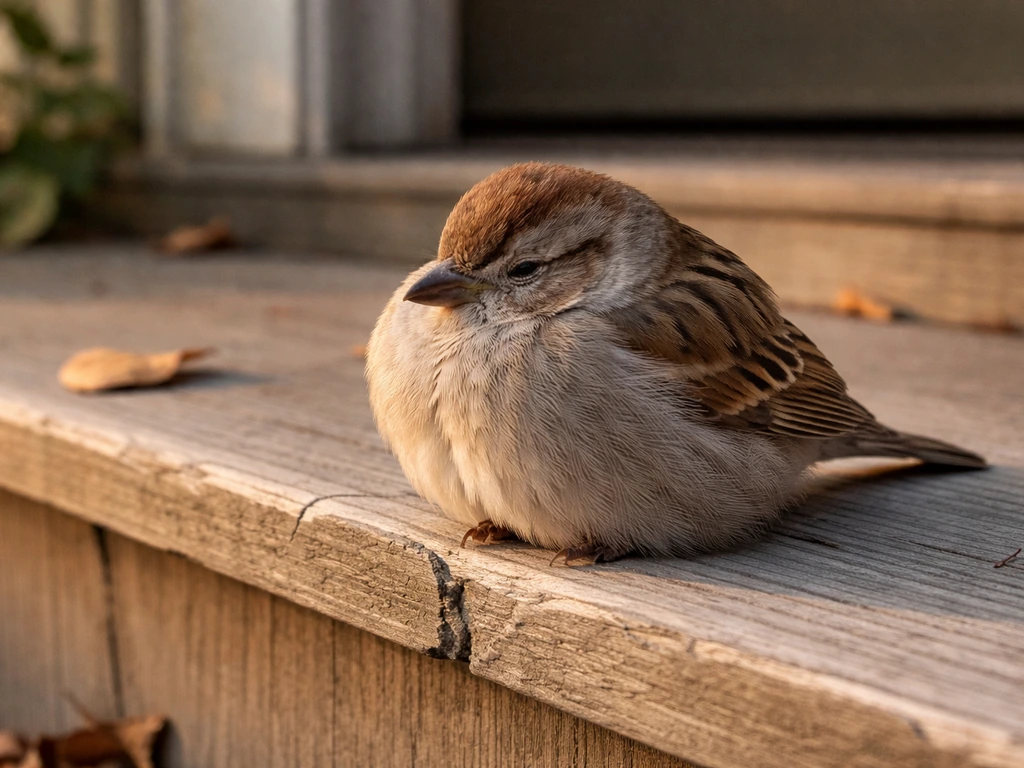
A bird sleeping on your porch is almost always doing exactly what it looks like: resting somewhere it feels safer than the open sky. Most of the time it chose your porch because it offered shelter from wind, rain, or cold, a surface that felt stable and elevated, and relative protection from ground predators. That's the honest, practical answer. But because a bird choosing your threshold to rest is also a layered symbol across dozens of cultures, there's a second dimension worth exploring too, and this guide covers both.
Why Is a Bird Sleeping on My Porch? What to Do Today
Maya Hartwell
19 May 2026
Why birds roost on porches in the first place
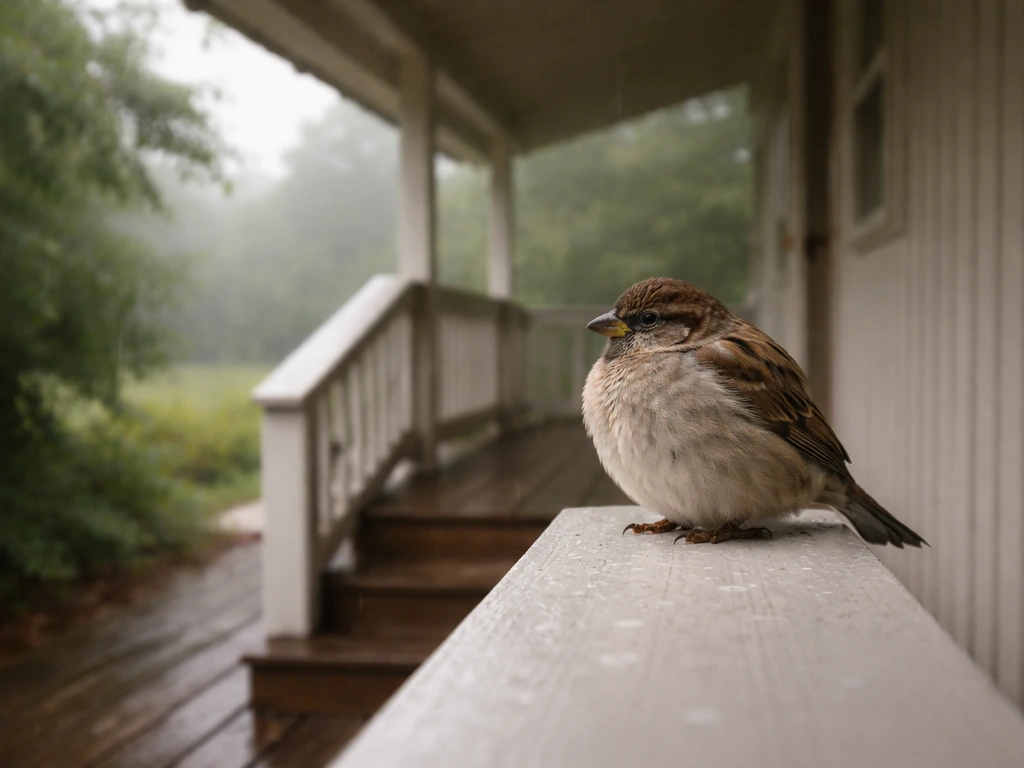
Birds don't pick roosting spots randomly. They're constantly solving a small survival equation: where can I rest while burning the least energy and facing the least risk? Your porch often solves that equation nicely. Overhangs block rain and cut wind. Elevated ledges, railings, and beams put distance between a sleeping bird and anything that hunts from the ground. The structure of a house retains warmth, which matters a lot on cold nights when communal roosting (birds huddling together to share body heat) isn't available to a solo traveler.
Weather is one of the biggest drivers. During storms, small birds like sparrows, jays, and cardinals instinctively look for the most protected surface available, ideally something solid and sheltered from wind direction. Your covered porch can mimic what a thick branch close to a tree trunk provides in the wild. If the bird showed up during or just before heavy rain, that's almost certainly why it's there.
Other common reasons include: fatigue during migration (a bird that's been flying all night may just need to stop), a nearby food or water source attracting it into the immediate area, territorial familiarity (some species like crows and doves will return to the same roost night after night), and simple disorientation from artificial lighting. Night-migrating songbirds are strongly attracted to artificial lights, and a lit porch can pull a bird off its flight path and into your space.
Normal roosting vs. a bird that needs help: how to tell the difference
This is the most important thing to assess before you do anything else. A healthy roosting bird and a sick or injured bird can look similar at first glance, but the signs that separate them are fairly readable once you know what to look for. Observe from a distance of at least 6 to 10 feet without approaching. You're looking at posture, breathing, and responsiveness.
A healthy roosting bird will be alert to your presence even if it doesn't fly away immediately. Its feathers will be smooth or only slightly puffed in cold weather, its eyes will be open and tracking, its wings will be symmetrically held against its body, and it will shift or move if you get closer. It might simply be resting and will leave on its own once it feels ready.
A bird that needs help shows a different picture. Watch for any of these warning signs:
- One wing drooping lower than the other, or wings held away from the body at an odd angle
- Visible wounds, bleeding, or feathers matted with blood
- Gasping, labored breathing, or a beak held open without vocalizing
- Eyes closed and unresponsive when you approach to within a few feet
- Inability to stand or keep its head upright
- Sitting directly on the floor of the porch rather than a railing or elevated surface
- Evidence it hit your window (dazed, off-balance, near a glass surface)
Window strikes are a specific scenario worth naming directly. If a bird hit your window and is now sitting stunned on the porch below it, it may recover on its own within an hour or two, but it may also have internal injuries that aren't visible. Head trauma from a window strike is considered urgent by wildlife rehabilitators. Don't assume a bird that looks okay after a collision is actually fine.
What to do right now
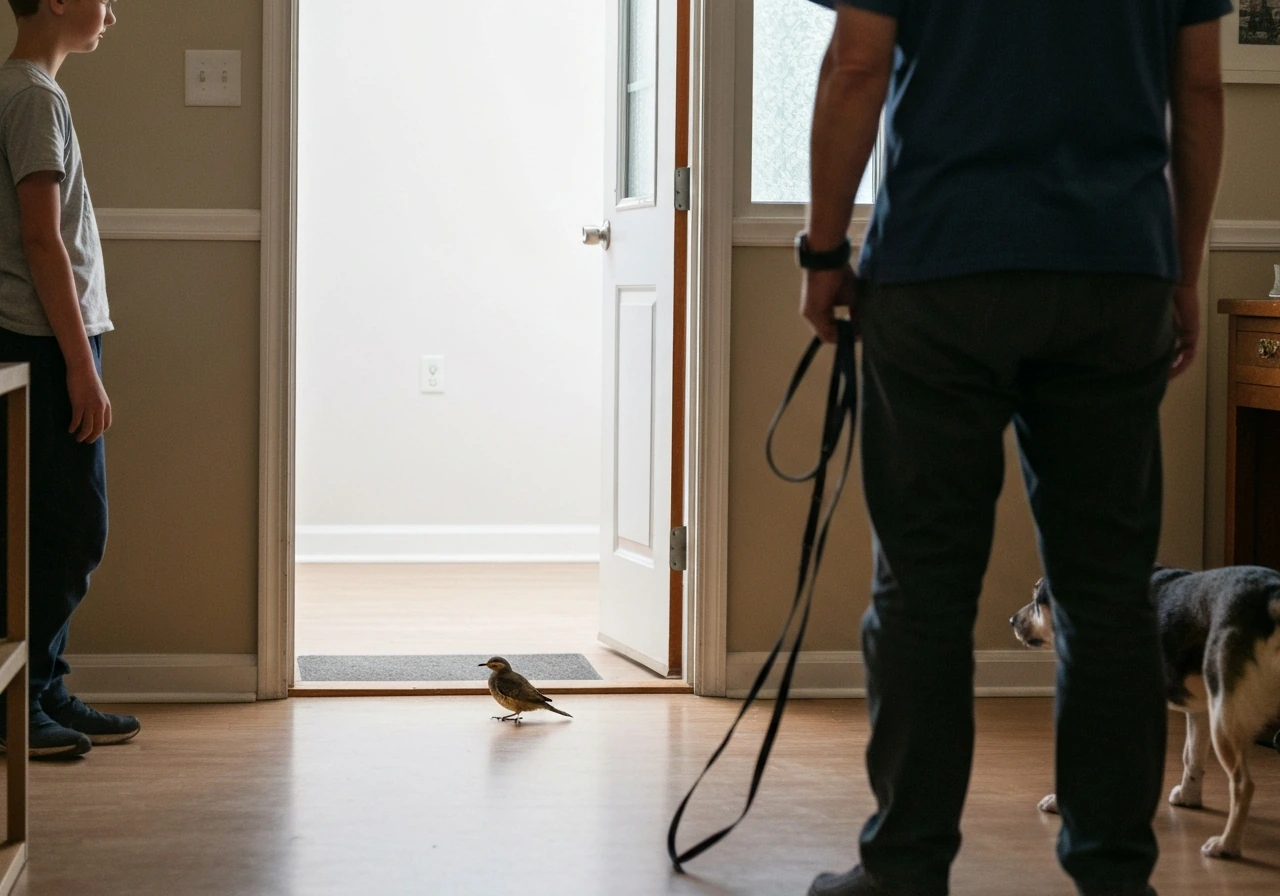
Step one is to leave the bird alone and observe. Don't approach, touch, or try to feed it. Most healthy roosting birds just need to be left in peace. Give it at least 30 to 60 minutes of undisturbed time before drawing any conclusions.
If the bird shows injury or distress signs, here's how to handle that carefully:
- Keep everyone (kids, pets) away from the bird immediately. Stress can kill an already compromised bird.
- If it needs to be contained for safety (cat outside, severe weather, obvious injury), use a small cardboard box with air holes, lined with a folded paper towel. Do not use a cage with bars where it can injure itself further.
- Place the box in a warm, dark, quiet location indoors, away from noise and pets.
- Do not offer food or water. Well-meaning feeding can cause choking or worsen injuries.
- Check after one hour. If the bird seems alert, bring the box outside and open it to see if it flies.
- If it does not fly, does not seem alert, or shows any of the injury signs listed above, call a wildlife rehabilitator.
A few things not to do: don't handle the bird more than necessary, don't attempt to splint a wing or treat wounds yourself, don't use gloves with rough textures that can damage feathers, and don't release it near a busy road or in an area where it immediately faces cats or other threats.
When to call wildlife rehab
The U.S. Fish and Wildlife Service recommends leaving most wild birds alone unless there's visible evidence of a problem (broken limb, active bleeding, shivering, a deceased parent nearby). But there are clear situations where a rehabilitator call is the right move, and you should make it the same day, not wait overnight.
- The bird has any visible wound, bleeding, or a drooping wing
- It's been exposed to a cat, even briefly. Pasteurella bacteria from cat mouths can be lethal to birds within 48 hours, even with no visible wound
- It hit a window and hasn't recovered in 1 to 2 hours, or shows asymmetric wing posture or a skewed beak
- It's been sitting in the same spot, unresponsive, for several hours
- It's a baby bird (featherless or downy) that has fallen onto the porch from a nest
- It's shivering or appears hypothermic in cold weather
To find a local wildlife rehabilitator quickly, search the NWRA (National Wildlife Rehabilitators Association) directory or call your state's fish and wildlife agency. Many areas also have 24-hour wildlife hotlines. When in doubt, call first and describe what you're seeing. A rehabilitator can often help you decide over the phone whether intervention is needed.
What the species tells you
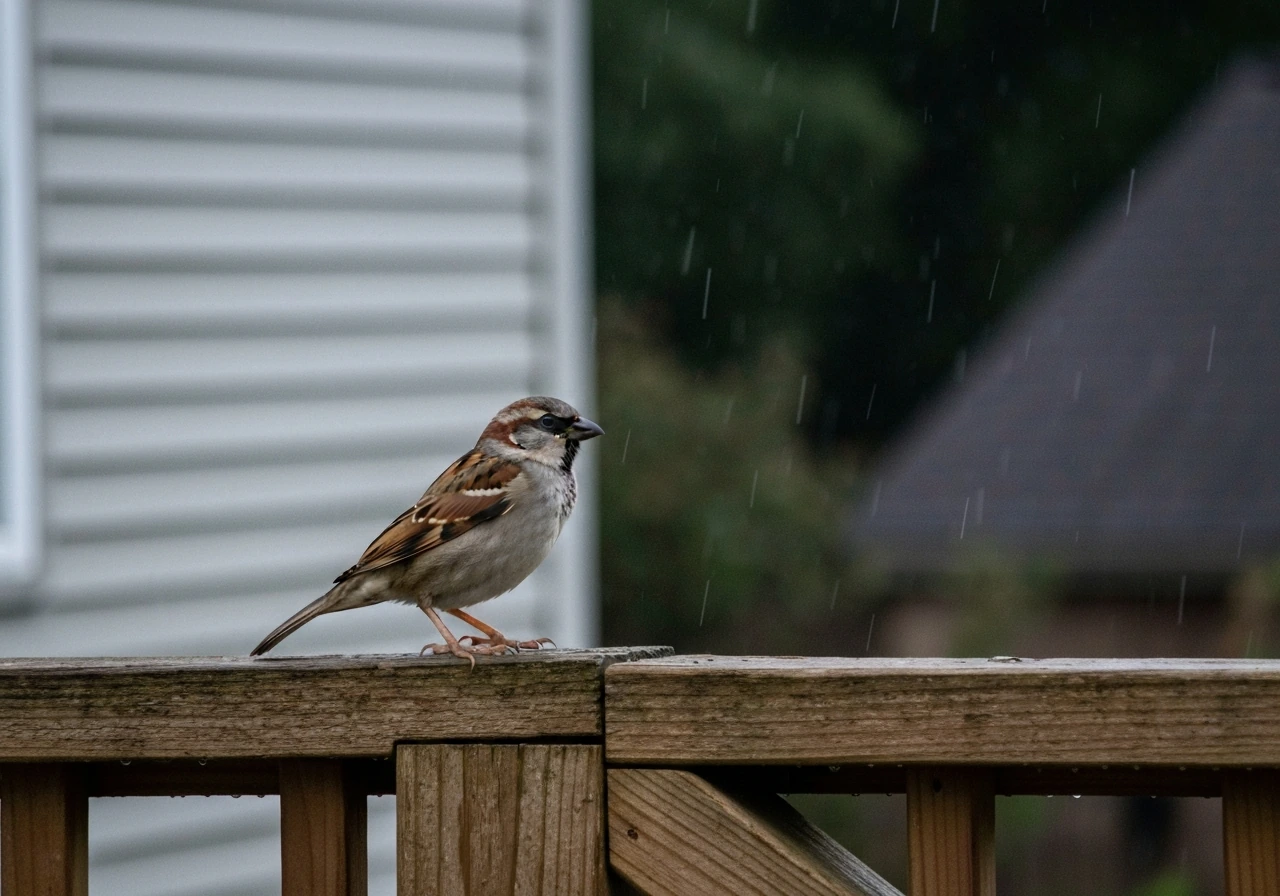
The type of bird matters quite a bit for interpreting what's going on and what to expect. Different species have different roosting habits, and a sleeping sparrow means something different than a sleeping crow.
| Bird Type | Likely Reason for Porch Roosting | What to Expect |
|---|---|---|
| Sparrows, finches, wrens | Weather shelter, fatigue, migration stopover | Will usually leave at dawn; may return during bad weather |
| Mourning doves / pigeons | Communal roosting habit, ledge preference, familiarity with area | May return nightly; doves roost communally outside nesting season |
| European starlings | Communal night roost commuting, urban shelter-seeking | Often part of a larger flock movement; may bring others |
| Robins | Post-migration rest, weather shelter | Typically transient; unlikely to stay more than a night or two |
| Crows / ravens | Territorial roosting, familiarity with a territory | May return repeatedly; known to remember and revisit specific roost spots |
| Owls | Daytime rest (they roost during the day), hunting proximity | Normal behavior; owls on porches in daylight are often just resting between hunts |
| Hummingbirds | Rare but possible in cold snaps; torpor (deep sleep) can look alarming | A motionless hummingbird may be in torpor, not dead; wait until warming before assessing |
Hummingbirds in torpor deserve a specific mention because panicked readers sometimes think they've found a dead bird. A hummingbird in overnight torpor will be completely still, cold to the touch, and unresponsive. This is normal. It will rouse on its own as temperatures rise in the morning. Don't bring it inside or try to warm it artificially.
Porch risks you can manage today
If a bird is choosing your porch to sleep, it's worth taking a quick inventory of what might put it in danger while it's there, and what might be drawing more birds in problematic ways.
Cats are the most immediate threat. A single cat contact can be fatal to a bird within 48 hours due to bacterial exposure even when the wound looks minor. If you have outdoor cats or neighborhood cats frequent your porch, keep them inside while the bird is present. This isn't optional if you want the bird to survive.
Lighting is both an attraction and a hazard. Artificial lights draw in night-migrating birds and can also increase window collision risk by making glass surfaces visible and attractive. The National Park Service recommends limiting porch lighting to where and when it's actually needed. Pointing lights downward rather than outward or upward reduces the attraction radius significantly.
Windows are the other major risk. If your porch has large glass panels or is adjacent to reflective windows, a resting bird that startles and flies can hit the glass at full speed. Temporary deterrents like hanging ribbon, tape strips, or window collision decals applied to the outside surface of the glass can reduce this risk. These don't need to be permanent.
Food sources near your porch (feeders, fruit trees, open compost, pet food left outside) can make your space more attractive to birds in general, which increases roosting frequency. If you're trying to discourage repeated roosting from large flocks (starlings, pigeons), removing food sources is one of the most effective first steps.
Finally, weather itself: if a bird is roosting during a storm, the kindest thing you can do is simply leave it undisturbed. A covered, windblocked porch is genuinely helping that bird survive the night. Let it do its job.
What it might mean spiritually
Once you've ruled out injury and the bird seems fine, it's natural, especially if you're someone who pays attention to signs, to wonder if there's a layer of meaning here. A bird choosing to sleep at your threshold, the liminal space between inside and outside, between your private world and the one beyond, is something that cultures across history have noticed and interpreted. These are offered as lenses, not certainties. What resonates for you is yours to decide.
Biblical and Christian symbolism
In biblical tradition, birds near a home or dwelling often carry themes of divine provision and watchfulness. Psalm 84 includes the image of a sparrow finding a home near the altar of God, a bird at rest as a sign of safety and being held. In this framing, a bird choosing rest at your threshold might be read as a quiet symbol of peace, of something being sheltered and protected, and perhaps by extension, of your home as a place of sanctuary. It's a gentle image rather than an ominous one.
Folklore and threshold symbolism
Across European folklore traditions, a bird resting at a doorstep or on a porch has long been considered a messenger. In some traditions, it signals that something is coming, not necessarily bad, just incoming: a visitor, a change, news from a distance. The porch or doorstep specifically carries meaning as a threshold space, neither fully inside nor outside, and in many folk belief systems, creatures that choose threshold spaces are thought to carry messages between realms. Celtic traditions in particular paid close attention to birds at liminal spaces (doorways, windows, boundaries between properties) as potential spirit messengers or guides.
Metaphysical and omen-based interpretations
In metaphysical and new-age interpretive frameworks, a sleeping bird at your home is often read as a symbol of rest, peace, and a nudge to slow down. The bird isn't fleeing, it isn't alarming, it's resting. Some interpret this as an invitation to do the same: to pause, to find stillness, to pay attention to what needs rest in your own life. The fact that it chose your porch specifically, your space, your threshold, is sometimes read as the universe gently pointing at you and saying: it's okay to stop for a while. Whether that resonates literally or just metaphorically, it's a calming rather than a frightening message.
It's worth noting that interpretations vary significantly by the specific bird. A crow roosting on your porch carries very different symbolic weight in most traditions than a dove does. A dove or mourning dove at rest is almost universally associated with peace, love, and gentleness across cultures. A crow or raven tends to carry themes of intelligence, transition, or messages from beyond the ordinary. An owl resting on your porch in daylight is sometimes read in Indigenous North American traditions as a signal to pay careful attention to something you may be overlooking. The species, the time of night, your own current life context, these are all part of how you might interpret the encounter personally.
A note on not over-reading omens
It's worth holding all of this lightly. Culturally variable interpretations mean that the same bird sleeping on a porch could mean completely opposite things depending on which tradition you look to. What tends to be more reliable is your own instinctive response to the encounter. Did it feel like an interruption, or a moment of unexpected peace? Did something in you soften when you noticed it? That subjective response is often more meaningful than any fixed symbol lookup. A bird at your threshold is an invitation to be present with it, not a guarantee of anything.
If you've also had a bird simply sitting on your porch without sleeping, or noticed a bird following you closely, those experiences carry their own interpretive layers worth sitting with. If you notice that a bird follows you closely, this same checklist helps you sort out whether it is normal roosting behavior or something you should respond to right away a bird following you closely. The through-line across most traditions is that birds, as creatures of sky and earth both, are seen as unusually perceptive, often appearing at the edges of significant moments. Whether that's metaphysically meaningful or just poetically true is something only you can decide.
The short version: leave it, watch it, or call for help
If the bird looks healthy and alert, it's almost certainly just roosting and will leave when it's ready. Remove any immediate dangers (cats, loose pets), dim or redirect porch lighting, and give it space. If it shows injury signs, follow the containment steps above and call a local wildlife rehabilitator the same day. And if you find yourself standing at your door watching a small bird sleep at your threshold and wondering what it means, that wondering itself is worth something. Pay attention to what comes up for you. The bird, at least, seems to have found exactly the rest it needed.
FAQ
If the bird is sleeping, how long should I wait before I intervene?
Try not to chase it. If it is healthy, it usually leaves on its own once it feels safe, or when morning light and temperatures make it easier to move. If it has not changed position after a couple of hours, or if you notice labored breathing, repeated stumbling, open-mouth gasping, or it cannot right itself when gently nudged with your own shoelace from a distance, that is a sign to contact a wildlife rehabilitator.
Should I bring the bird inside to help it if it looks cold?
Do not bring it inside “to warm up” unless a professional has told you to. Many healthy birds roost at night and recover when conditions improve. If it looks cold, unresponsive, or injured, the safer option is to keep people and pets away and call a wildlife rehabilitator, especially if you find it on the ground or it cannot lift its head.
How can I tell if it is truly resting or recovering from a window strike?
“Sleeping” can hide window-shock or internal injury. If the bird was near a window, has crooked posture, is unable to balance, shows seizures, or keeps its eyes half-closed and does not react normally to quiet observation from a distance, treat it as urgent and call a rehabilitator the same day.
Can I gently move the bird off my porch so I can use the entrance?
Yes, but only after you have checked for injury. If it is healthy and roosting, the best approach is to remove the biggest risk first (close the door, bring cats inside, reduce outdoor lighting) and then give it space. Avoid physically relocating it, because handling can worsen hidden injuries and can also stress the bird into panic flying.
What should I do if I need to come and go while the bird is there?
Many door or porch actions are the equivalent of a threat to a small bird. Wait until it lifts its head, ruffles, stands, or walks away on its own. A good rule is to avoid traffic in that area for at least 30 to 60 minutes, then reassess from a distance rather than hovering right next to it.
Could this mean the bird is going to nest there, not just sleep?
If you see droppings, feathers scattered, or repeated return of the same species at the same spot, it could be roosting more than once or possibly nesting nearby. Look for a specific hidden location (behind trim, under railings, in vents). If you suspect nesting, do not use deterrents that could disrupt eggs or chicks, contact local wildlife guidance for the correct approach.
What is the safest way to discourage repeat roosting without harming the bird?
Use deterrence that does not startle or injure. Dimming or turning off unnecessary porch lights at night is usually the most effective first step. If you use temporary window decals or tape strips, apply them to the outside of the glass and remove them later. Avoid sprays, sticky substances, or anything that could coat feathers or harm the bird.
What if the bird is a hummingbird that seems unresponsive at night?
If it is a hummingbird in overnight torpor, do not warm it with a heat source like a lamp or put it in a cage. Leave it in place, out of foot traffic, and allow natural warming in the morning. If it does not rouse by midday or shows signs of injury (broken wing, bleeding, persistent inability to move), contact a wildlife rehabilitator.
What information should I have ready when I call a wildlife rehabilitator?
First, prioritize safety for the bird: stop letting pets outdoors and reduce light. Then document without approaching, note the location (near window, near ground, under overhang), the bird’s behavior (breathing, posture, responsiveness), and the time you first noticed it. Those details help a rehabilitator decide quickly over the phone whether to send help immediately.
When is it urgent enough that I should not wait until tomorrow?
Yes. If a bird is actively bleeding, has a visibly broken limb, is unable to stand or balance, or is shivering and not responding normally, assume it needs immediate help. Also treat as urgent if it appears to be a fledgling, or if you find it under a window after a collision with no improvement over a short period.
Should I put out birdseed or water to help it while it is on my porch?
Feeding can backfire by increasing foot traffic and attracting more birds, which also raises risk from cats and window collisions. If your goal is to stop the behavior, pause feeders and remove accessible fruit or pet food outdoors while the bird is present. If your goal is to help a specific injured bird, do not offer food directly.
Why does it sometimes happen the same night, and how do I stop window collisions?
It can, especially at night if it is drawn by lighting. In that case, closing curtains, turning off or redirecting porch lights, and applying window treatments can reduce collisions. Keep in mind that if the bird is already injured or disoriented, deterrence may not fix the immediate problem, and you may still need a call to a rehabilitator.
Next Articles
When a Bird Sits on a Branch: Meanings and Reasons
Discover why a bird sits on a branch and how to interpret it spiritually, symbolically, or in dreams.
Why Does My Bird Like to Sit on My Head? Practical Guide
Why your bird sits on your head: bonding, warmth, attention and safety tips, plus red flags and optional spiritual meani
Why Is My Bird Flapping Its Wings at Me? Causes and What to Do
Understand why your bird flaps wings at you and what to do, from hormones and stress to attention and warnings.