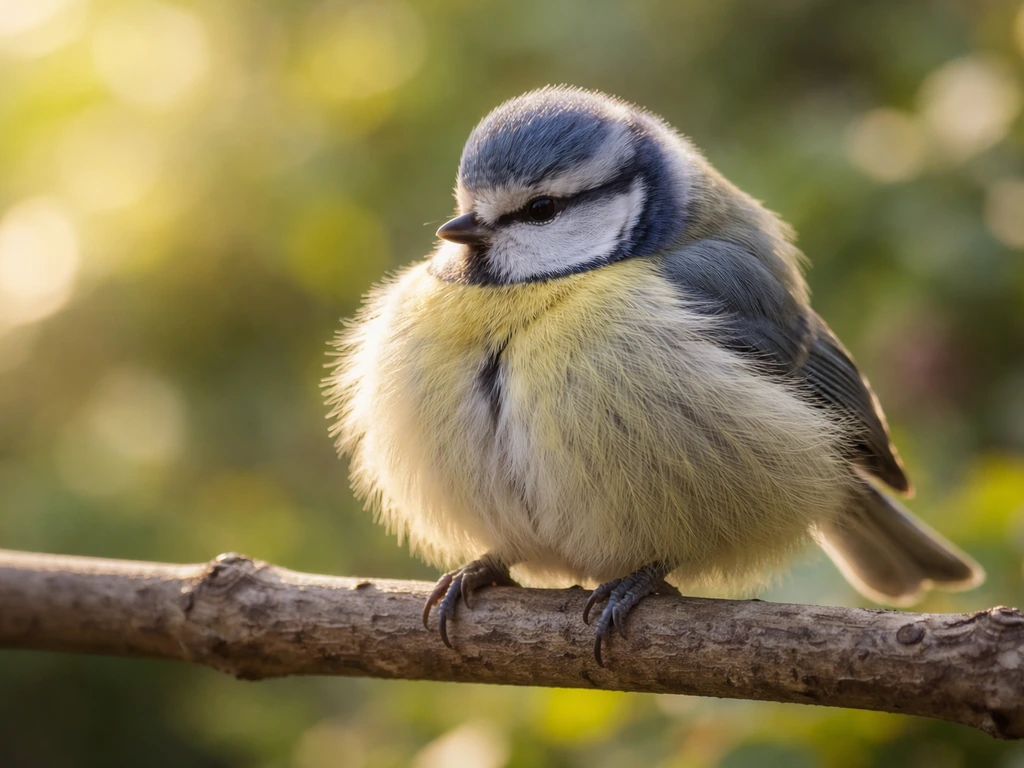
Finding a bird feather most commonly means one of a few things spiritually: a message of reassurance or guidance from the universe, a sign that you are being watched over or protected, or a nudge to pay attention to something you have been thinking about lately. In many traditions, feathers are seen as direct bridges between the earthly and the spiritual, carrying meaning precisely because birds themselves represent freedom, perspective, and connection to something beyond the everyday. That said, the specific meaning that fits your situation depends on the feather's color, its type, and where you found it. This guide walks through all of that so you can land on an interpretation that actually resonates with your life right now.
What Does Finding a Bird Feather Mean? Meanings by Color

Maya Hartwell
19 Apr 2026
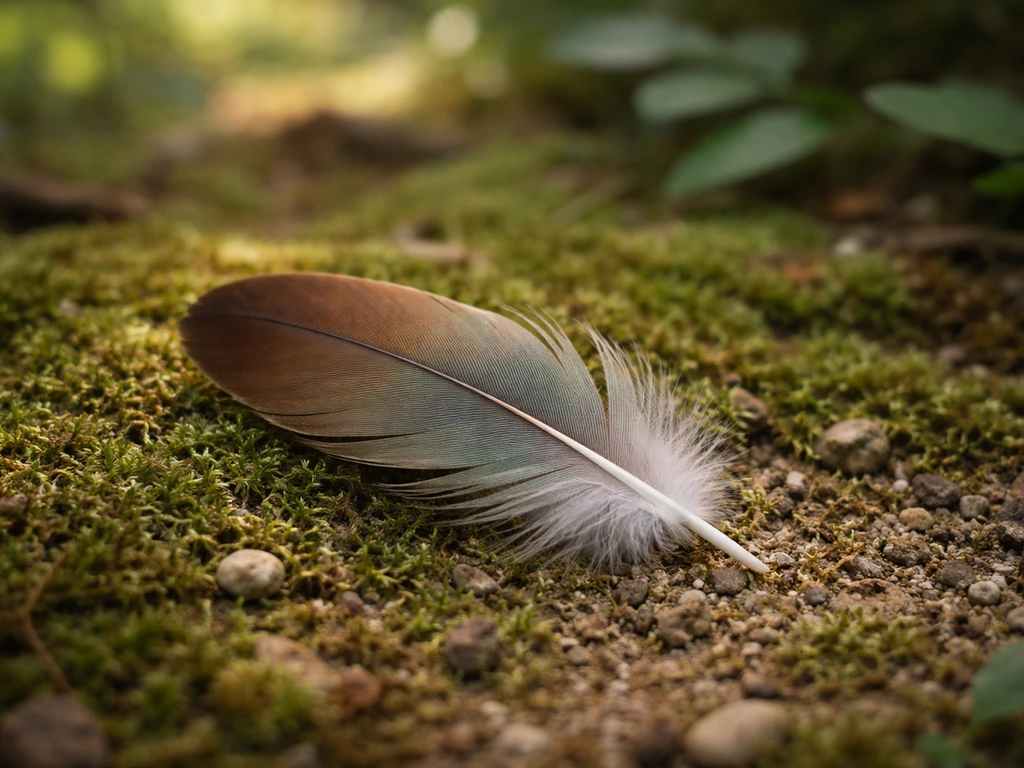
Quick Answer: What a Found Feather Most Likely Means
Across dozens of spiritual and cultural traditions, a found feather is most often read as one of the following:
- A sign of divine protection or angelic presence, particularly common in Christian and New Age interpretations (white feathers especially carry this meaning)
- A message from a deceased loved one or ancestor, offering comfort or confirmation that they are near
- Encouragement or validation: you are on the right path, and the universe is confirming your direction
- A call toward personal transformation, new beginnings, or letting go of something that no longer serves you
- A prompt to trust your intuition, especially if you found the feather while wrestling with a difficult decision
- A natural, biological occurrence with no supernatural meaning at all, which is equally valid and worth considering
None of these meanings cancels the others out. The most honest interpretation is the one that feels true to what you were experiencing in the moment you found it. If you were thinking about someone who passed away and then looked down to find a feather, that timing is worth sitting with, regardless of your belief system.
Where You Found It Changes Everything
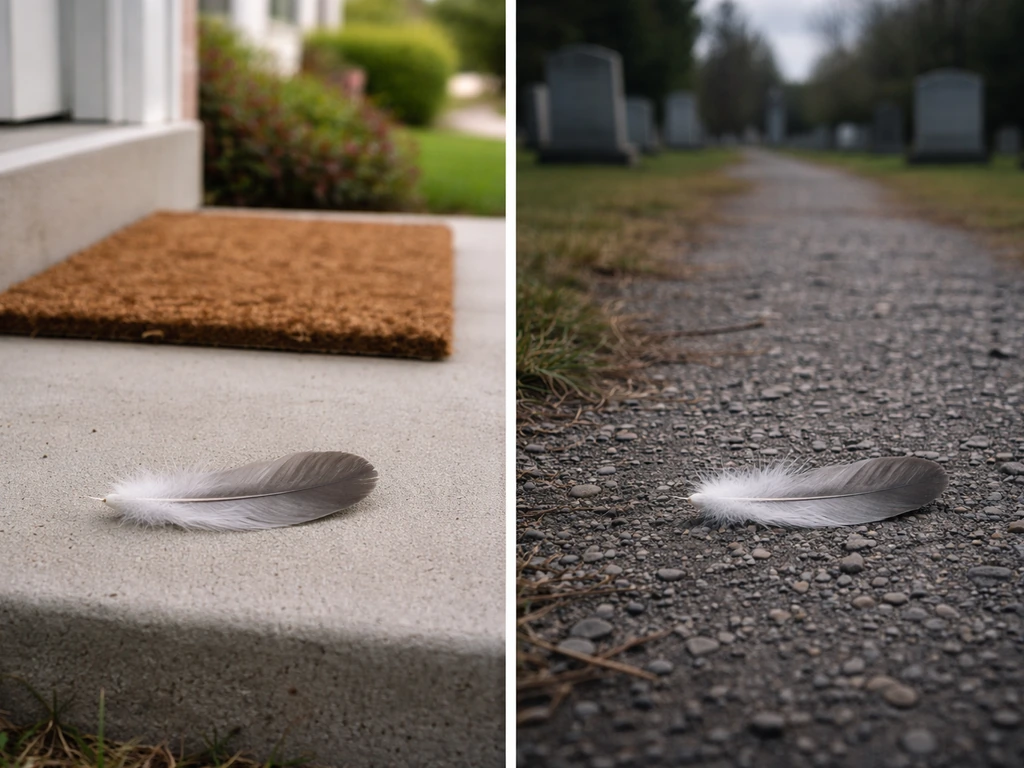
Context matters as much as the feather itself. A feather on your front doorstep carries a different symbolic weight than one found at a cemetery or inside your car. Here is how location tends to shift the interpretation:
| Where You Found It | Common Symbolic Interpretation |
|---|---|
| On your doorstep or front path | Protection arriving at your home; a welcoming or guarding energy near your threshold |
| Inside your home | A message meant specifically for you or your household; often read as a loved one making contact |
| In your car | A sign of safe travels or protection on a journey, literal or metaphorical |
| At a cemetery or memorial site | Strongly associated with connection to the deceased; comfort and acknowledgment from a loved one |
| Near a window | A bridge between two worlds (common cross-cultural interpretation); may echo the meaning of a bird flying toward a window |
| On a walking path outdoors | Guidance or confirmation you are moving in the right direction; a nudge to keep going |
| Near your bed or pillow | Dreams, intuition, or messages from the subconscious; a call to listen inward |
| Found after an emotional moment | Often read as direct spiritual response or validation to what you were feeling |
Finding a feather indoors deserves special attention. Birds do occasionally enter homes, and when they do, feathers may be left behind. That physical event can carry its own symbolism, much like the broader question of what it means when a bird enters your living space. But a feather found indoors with no visible bird present is often interpreted as the most intentional of signs, because there is no obvious biological explanation for how it got there.
Color and Type: How to Read the Feather Itself
What Feather Color Means
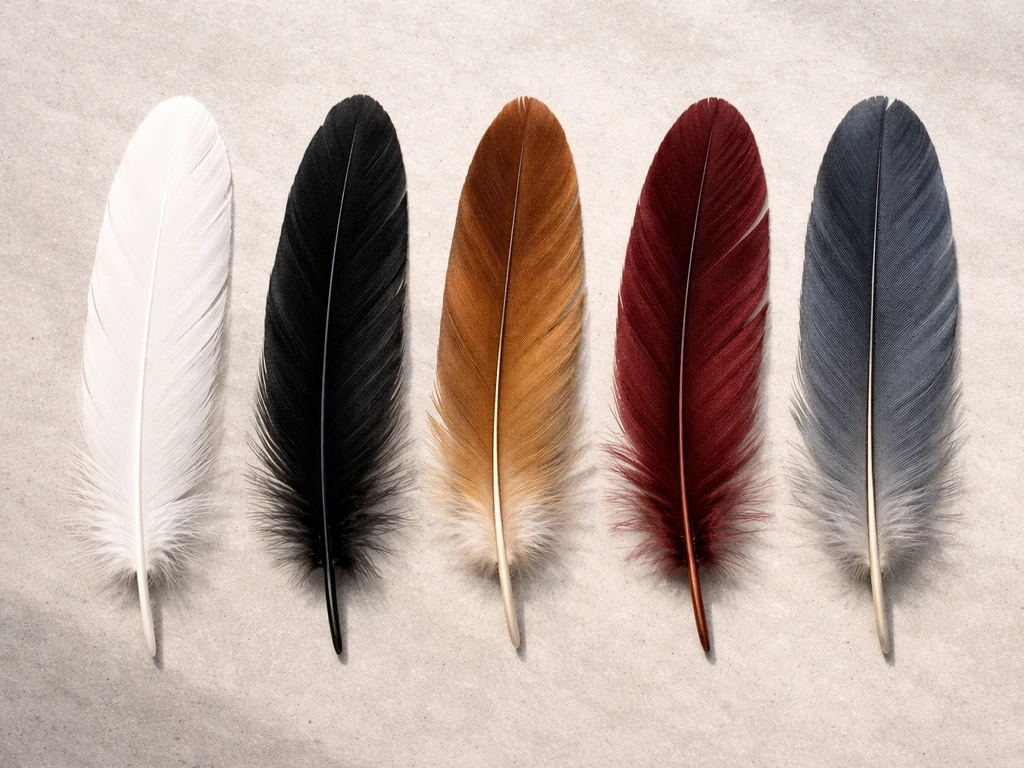
Color is the single most referenced detail in feather symbolism, and most traditions are fairly consistent about what each color signals:
| Feather Color | Common Symbolic Meaning |
|---|---|
| White | Purity, angelic presence, divine protection, peace, connection with a deceased loved one |
| Black | Protection from negative energy, spiritual wisdom, transition or endings that make way for new beginnings; sometimes misread as ominous, but most traditions see it as powerfully protective |
| Gray | Neutrality, calm, wisdom, peace amid uncertainty; a gentle encouragement to find balance |
| Brown | Grounding, stability, home, connection to the earth and physical world |
| Red or orange | Passion, courage, vitality, a push toward action or creative energy |
| Blue | Communication, truth, clarity, calm; associated with throat chakra and speaking your truth in some traditions |
| Yellow or gold | Optimism, mental clarity, intellectual energy, joy, solar energy |
| Green | Growth, healing, abundance, new opportunities |
| Striped or multi-colored | Complexity; multiple messages at once, or a feather asking you to look at a situation from several angles |
| Iridescent (black-green like crow/raven) | Magic, mystery, deep transformation, and heightened intuition |
Down vs. Flight Feather: Does It Matter?
Yes, the feather type matters. A soft, fluffy down feather is structurally different from a long, stiff wing or tail flight feather, and symbolically they are often interpreted differently too. That same idea can help explain what it means when a bird fluffs up, since it often signals comfort, warmth, or a change in mood soft, fluffy down feather. Down feathers are small, delicate, and close to a bird's body for warmth. Finding one is often read as a gentle, comforting message, something tender and close rather than bold and directional. Many people describe finding a tiny white down feather as the universe giving them a soft hug, particularly in the context of grief.
Flight feathers (the long, structured feathers on wings and tail) are associated with movement, direction, and purpose. They are the feathers that literally carry a bird through the air. Symbolically, a flight feather is often read as a more urgent or action-oriented message: time to move, a transition is coming, or you have the tools to rise above a current difficulty. If the feather is large and striking, that quality tends to amplify whatever color meaning it carries.
Spiritual Meanings Across Belief Systems
No single tradition owns feather symbolism, and it appears across remarkably different spiritual frameworks, often with overlapping themes.
Christian and Abrahamic Traditions

In Christian symbolism, feathers are closely linked to angels and divine protection. Psalm 91:4 references God covering the faithful with feathers as a metaphor for shelter and refuge. Finding a white feather is widely interpreted within Christian-influenced cultures as a sign of angelic presence, often read as reassurance from God or comfort after loss. The emphasis is on protection, grace, and being held through difficulty.
Celtic and European Folklore
In Celtic traditions, birds were seen as messengers between the living world and the Otherworld. Druids used bird omens, including feathers, for divination. A feather found on a path was considered a word from the spirit realm, delivered deliberately. Crows and ravens held particular significance in Irish and Scottish tradition as creatures of prophecy and wisdom, so a black feather found in those cultural frameworks often carried a message of deep knowing rather than any negative omen.
Indigenous and First Nations Perspectives
It is important to approach this section with genuine respect. Feathers carry sacred, ceremonial, and deeply cultural significance in many Indigenous nations across North America and beyond. For many communities, eagle feathers in particular are sacred objects tied to prayer, healing, honor, and spiritual ceremony, not general good luck symbols to be collected. If you are not part of a tradition where feathers hold ceremonial meaning, borrowing that specific framework directly is not appropriate. What you can take from Indigenous perspectives generally is the principle of deep respect for what the feather represents: a connection to the natural world, a reminder of your place within a larger living system, and the importance of listening, not just looking.
Eastern and Metaphysical Traditions
In Hindu and some Buddhist contexts, birds and their features symbolize the soul's movement toward liberation. Feathers in these frameworks often point toward lightness, release of ego, or spiritual ascension. In New Age and metaphysical traditions, feathers are among the most commonly cited signs from spirit guides or deceased loved ones, precisely because they appear unexpectedly in places that feel personally significant. The emphasis here is on synchronicity: the meaning comes not from the feather itself but from the timing and your internal state when you found it.
Cultural and Folklore Notes Worth Knowing
A few cultural notes help ground feather interpretation in its historical context. In ancient Egypt, the feather of Ma'at (goddess of truth and justice) was used to weigh the soul of the deceased against its moral weight. This gave feathers a strong connection to truth, justice, and the afterlife in Egyptian tradition. In Roman augury, birds and their behaviors were read as omens from the gods, and feathers that appeared in unusual places were noted alongside bird flight patterns as part of divination practice.
European superstition added nuance around finding feathers near the home: a feather near the front door was often seen as a protective charm, while feathers found after a bird flew into a window could signal a message from beyond, especially if someone in the household had recently died. These are not rules, they are threads of meaning that different cultures wove over centuries, and you get to decide which threads feel relevant to your life.
One consistent theme worth highlighting: across nearly every tradition, the moment of finding a feather asks you to pause. Whatever interpretation you land on, the act of noticing, stopping, and asking what it means is itself considered meaningful in most spiritual frameworks. When a bird tilts its head, it can also be a meaningful behavior worth paying attention to alongside your feather encounter what does it mean when a bird tilts its head.
If you are trying to interpret the bird ruffling feathers meaning in your life, consider what emotional trigger or conflict might be getting attention. If you are noticing similar symbolism around a bird opening its mouth, it can be helpful to compare the context and your feelings to understand what it might mean for you what does it mean when a bird opens its mouth. The pause is part of the message.
Practical Next Steps After Finding a Feather
Handle It Safely First
Before anything else, a practical note on hygiene. Feathers from molting or otherwise healthy birds are generally low-risk, but if the feather is near a dead bird or appears to be from a sick animal, take sensible precautions.
The CDC advises not to touch sick or dead birds, or their feces or litter, without appropriate PPE, and to avoid actions that would disperse contaminated dust or feathers into the air take sensible precautions if the feather appears to be from a sick animal. The NPS recommends using gloves if you must handle wildlife materials and avoiding touching your face afterward. USDA APHIS recommends contacting your State wildlife agency or State health department if you find dead wild birds: https://www.aphis.usda.gov/sites/default/files/fs-hpai-dead-wild-bird.508.pdf [Found a Dead Wild Bird? Here's What To Do Next (USDA APHIS, PDF).
](https://www. cdc. gov/west-nile-virus/php/surveillance-and-control-guidelines/index. html) If you find a dead bird alongside the feather, the USDA APHIS recommends contacting your state wildlife agency or state health department rather than disposing of it yourself, especially when disease could be a concern.
Most of the time a single found feather in a yard or on a path requires nothing more than not picking it up bare-handed if you are unsure of its origin.
Journal the Moment While It Is Fresh

The most useful thing you can do after finding a feather is write down the context before the details fade. Note where you found it, what time of day it was, what you were thinking about in the moments before, whether you were in an emotional state, and what your first instinct was when you saw it. That first instinct, before you had time to rationalize, is often the most honest reading of what the feather means for you personally. Over time, patterns emerge in a journal that a single encounter cannot reveal.
Sit With It: Meditation, Prayer, or Simple Reflection
If you feel drawn to work with the feather's meaning more intentionally, give yourself a few minutes of quiet. You do not need a formal ritual. Simply hold the question: what was I thinking about when I found this, and what would it mean if this were a response to that thought? Some people place the feather on a windowsill or altar space as a physical reminder of the message. Others prefer to leave it where they found it, as a way of honoring the moment without possessing it. Both approaches are completely valid.
Ask What Fits Your Situation
- What were you thinking about or worried about just before you found the feather?
- Have you recently experienced a loss, transition, or major decision?
- Does one of the color or location meanings above land with a sense of recognition?
- Which interpretation, if true, would actually help you move forward right now?
- Is there a bird species you can identify the feather from? Species carry their own symbolism (e.g., owl feathers for wisdom, hawk for clarity and vision, dove for peace).
When the Feather Probably Means Nothing Supernatural

It is worth being honest about this: most feathers you find outdoors are there because of normal bird biology. If you are wondering about the spiritual meaning of a bird showing up inside your home, you can explore what that moment typically symbolizes what does it mean when a bird enters your living space. If you are also noticing unusual behavior, like a bird opening its mouth, the same “context first” approach can help you interpret what might be going on in the moment what does it mean when a bird enters your living space. After breeding season, adult birds go through a full molt, shedding worn feathers and replacing them with fresh ones.
Audubon notes this is a predictable annual cycle, and All About Birds explains that feathers are keratin structures, essentially dead material, once they finish growing. During peak molting periods, finding a feather on a path, in your yard, or even blown into your home through an open door is extremely common and biologically unremarkable.
How do you decide whether your find is a spiritual sign or a biological coincidence? Honestly, you probably cannot prove it either way, and that is fine. A useful framework: if the feather appeared in a context that felt personally significant, in a place that surprised you, at a moment that felt charged with meaning, it is worth treating it as potentially meaningful.
If you found it in a yard that is regularly visited by birds, on a day with no particular emotional weight, the more grounded explanation is probably the right one. Both can coexist. A molted feather can still arrive at the right moment to mean something to you, and its biological origin does not cancel the personal resonance.
The key is not forcing a supernatural explanation when a natural one fits clearly, and equally, not dismissing a genuinely striking moment just to seem rational. The experience of finding a feather tends to tell you which is which if you give yourself a moment to check in honestly.
Choosing the Meaning That Is Actually Yours
At the end of this, no article can tell you definitively what your feather means. What the research, traditions, and symbolism can do is hand you a set of lenses, and you decide which one brings the scene into focus. A white down feather on your pillow the morning after dreaming about your grandmother reads differently than a black flight feather on a hiking trail the day you decided to change careers. Both are valid moments. Both deserve your attention. The best interpretation is the one that moves you toward something: toward comfort, toward clarity, toward action, or toward a question you needed to be asking.
If you found a feather today and something drew you to look up its meaning, start there. That curiosity is not nothing. Ask yourself what you were hoping it meant. If you are wondering what it means when a bird leaves a feather behind, follow the same instinct and match it to your situation what you were hoping it meant. Often, that answer is the most truthful one available to you.
FAQ
What should I do if I found a bird feather but I cannot identify the color or type clearly?
If the feather looks faded, wet, or broken, focus on the dominant features you can confirm. Note whether it seems like down (small and fluffy) or a larger wing or tail flight feather (longer and more structured), and describe the overall shade (light, dark, mixed) rather than chasing exact color labels. Your notes from the moment you found it will usually matter more than perfect identification.
Does finding a feather inside automatically mean it has a stronger spiritual meaning?
Inside finds can feel more intentional, but the most practical first check is biology. If a bird likely got into your home (open door, window, birds building nests nearby), the feather can be a straightforward result of normal movement. If there was no obvious access point and the feather appears in a surprising location (like a bedroom floor), that is when many people treat it as more meaningful rather than purely coincidental.
How can I tell if the feather might have come from a sick bird or be unsafe to handle?
If you see any dead bird nearby, or the feather looks unusually dirty, bloodied, or attached to unhealthy tissue, do not handle it bare-handed. Use gloves if you must move it, avoid touching your face afterward, and contact your local wildlife or health authority if there is a carcass or multiple birds found. A single clean feather is usually low risk.
What if I found the feather near a memorial or cemetery, does that change the interpretation?
Location near grief or remembrance tends to amplify personal associations, even when color meanings are unclear. Many people read that context as an invitation to pause and reflect on what is coming up emotionally, rather than predicting a specific event. A useful approach is to write down what you were feeling (not just thinking) when you noticed it.
Can the feather’s meaning contradict my own belief system?
Yes, and you do not have to force agreement with a tradition. Treat the meaning as a mirror for your experience, not a verdict. If a spiritual interpretation does not resonate, use the encounter as a prompt for a practical question (What issue needs my attention? What boundary or change do I feel ready for?), and let your reaction guide you.
What if I found multiple feathers at once or over several days?
Multiple feathers often suggests increased “synchronicity” for the person noticing them. Instead of assigning a single fixed message, look for a repeating theme in your journal entries from those moments, such as the same emotion, the same decision point, or the same conversation you were having. Repetition is usually more informative than the exact feather details.
Should I take the feather home, leave it, or keep it as a reminder?
There is no universally correct choice. If you want a reminder, keep it only if it feels respectful to you and safe to handle (clean, intact, no nearby carcass). If you feel it should remain part of the moment, leaving it where you found it can also honor the experience. The key is to avoid treating sacred feathers from Indigenous ceremonial contexts as collectible items.
What if the color meaning I found online does not match what I feel?
Color guides are helpful lenses, not strict rules. If your emotional reaction strongly differs from the color symbolism you read, prioritize the reaction and the context you wrote down. You can still use color as a clue, but the “fit” test is whether the interpretation helps you make sense of your current life moment.
Is it normal to feel uneasy or worried after finding a feather, especially a dark one?
Feeling uneasy does not automatically mean the sign is bad. Many people interpret dark feathers as depth, endings, or deep knowing, but individual associations vary. If anxiety spikes, re-ground by asking what practical action you can take right now (clarify a plan, reach out to someone, get closure on a pending task) so the moment becomes constructive instead of fearful.
How should I respond if I found a feather but later realize it is likely from a bird that lives nearby?
That realization does not negate your personal meaning. A molted feather can still arrive at the right time emotionally, especially if you were primed to notice it. A balanced approach is to keep two truths: the biological explanation exists, and the timing mattered to you. Let both coexist without forcing certainty one way or the other.
What’s the quickest way to record the context so I interpret it accurately later?
Write down three time-sensitive details immediately: where you found it, the exact time of day, and what you were thinking about within the few minutes before. Then add two quick emotional markers (calm, anxious, hopeful, grieving, distracted). This prevents later memory from reshaping the meaning you actually felt in the moment.
Next Article
What Does It Mean When a Bird Fluffs Up? Why and What to Do
Learn why birds fluff feathers and how to check if it is cold, stressed, molting, sleeping, or ill.