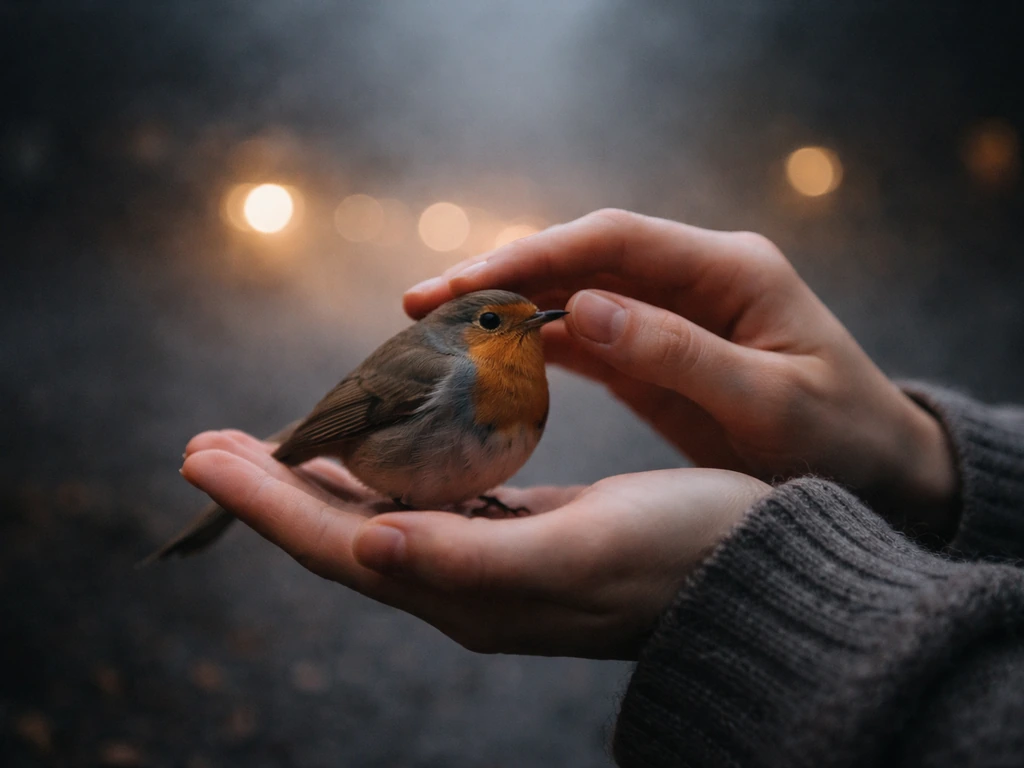
Seeing a starling usually carries themes of community, communication, adaptability, and timing, and depending on how the encounter happened, it can feel like a nudge to speak up, reconnect with your people, or pay attention to something you've been ignoring. That's the short spiritual read. But the full picture depends on the details: where you were, what the bird did, and whether it was a one-off moment or a pattern you keep noticing.
Seeing a Starling Bird Meaning: Signs, Symbolism, and Next Steps

Maya Hartwell
18 May 2026
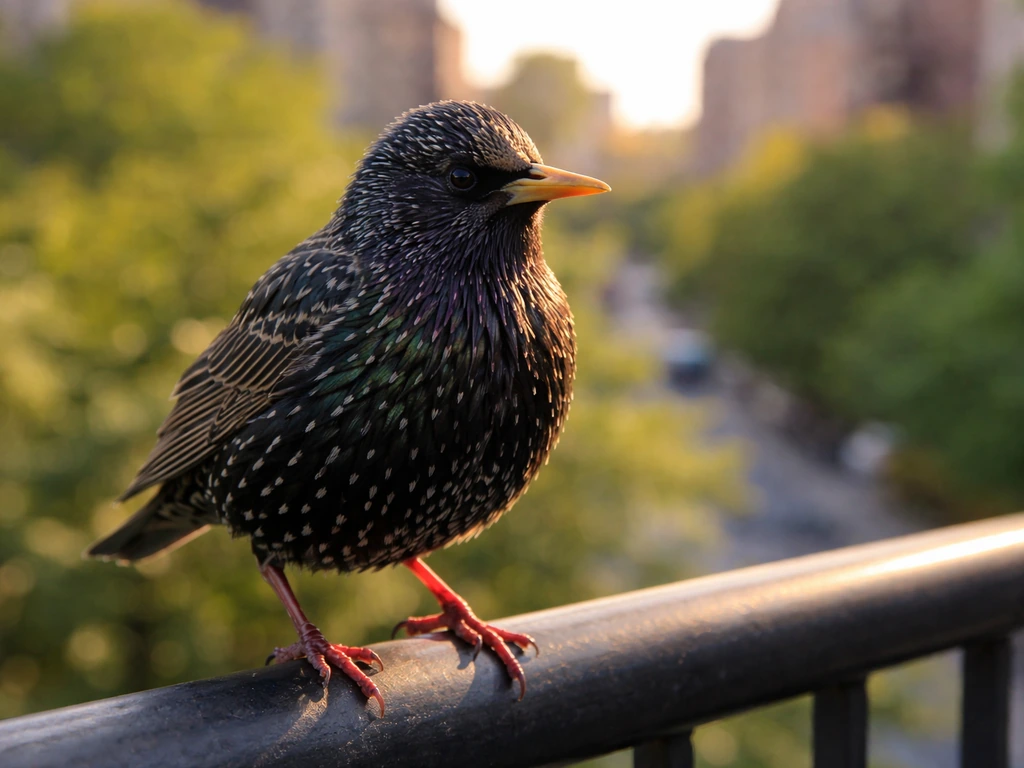
Why you might actually be seeing a starling right now
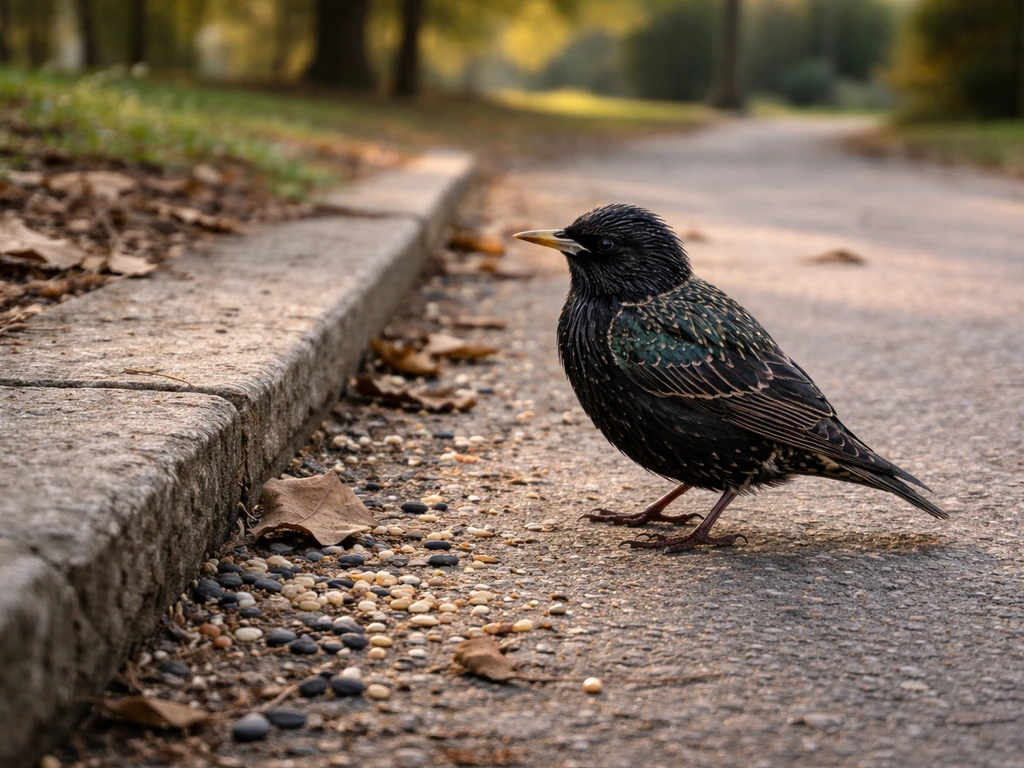
Before jumping into symbolism, it's worth knowing that starlings are genuinely hard to miss. European starlings are one of the most widespread and numerous birds in North America, they're year-round residents in most of the country, they're loud, they travel in large flocks, and they actively take advantage of human-altered environments like parks, parking lots, suburban yards, and urban rooftops. The USDA notes they use consistent roosts in industrial parks and recreational areas, often returning to the same spots reliably.
USDA notes that European starlings use consistent urban roosts in industrial parks and recreational areas, often returning to the same spots reliably [consistent roosts in industrial parks and recreational areas](https://www. aphis. usda. gov/wildlife_damage/reports/Wildlife%20Damage%20Management%20Technical%20Series/European-Starlings-WDM-Technical-Series.
pdf). So if you're in or near a city, suburb, or anywhere with trees and buildings, starlings are simply around.
Timing matters too. If you're reading this around late spring or early summer (roughly April through July), you're smack in the middle of starling nesting and fledgling season. Texas Breeding Bird Atlas data shows young starlings in nest cavities from as early as May 6 through late July, with adults actively ferrying food during that same window. That means you're more likely to notice them right now, they're noisier, more active, and more visible during this period. A starling encounter in May isn't rare. That doesn't make it meaningless, but it does mean the universe didn't have to work particularly hard to put one in front of you.
That said, the question isn't just 'was there a starling nearby?' It's 'why did this one catch my attention?' That's where the practical and symbolic interpretations start to overlap.
The encounter details that actually change the meaning
Not all starling sightings carry the same weight. A single bird landing two feet from you while you're sitting on a bench is a different experience than watching a murmuration from your car window. The specific details of your encounter are the most useful starting point for interpretation.
| Encounter Type | What It Might Suggest |
|---|---|
| Single starling lands very close to you | A personal, direct message — often about communication or paying attention to something specific in your life |
| Flock or murmuration overhead | Themes of community, collective movement, or a reminder that you don't have to go it alone |
| Starling chirping loudly near you | A prompt to speak up, express yourself, or listen more carefully to something around you |
| Starling follows you or reappears repeatedly | A pattern worth taking seriously — repeated sightings often carry more weight symbolically than a single encounter |
| Starling flying directly toward or past you | A transition or arrival of something new; movement and direction matter here |
| Starling at your window or near your home | Often interpreted as a message related to home life, family, or something trying to get your attention in your personal space |
| Distressed or injured starling | Warrants practical action first; symbolically may speak to something wounded or neglected in your own life |
First-time sightings are worth noting but don't overweight them. If you've been seeing starlings repeatedly, especially in unusual circumstances or at emotionally significant moments, that's when most spiritual traditions would say to pay closer attention.
Spiritual and omen interpretations of starlings
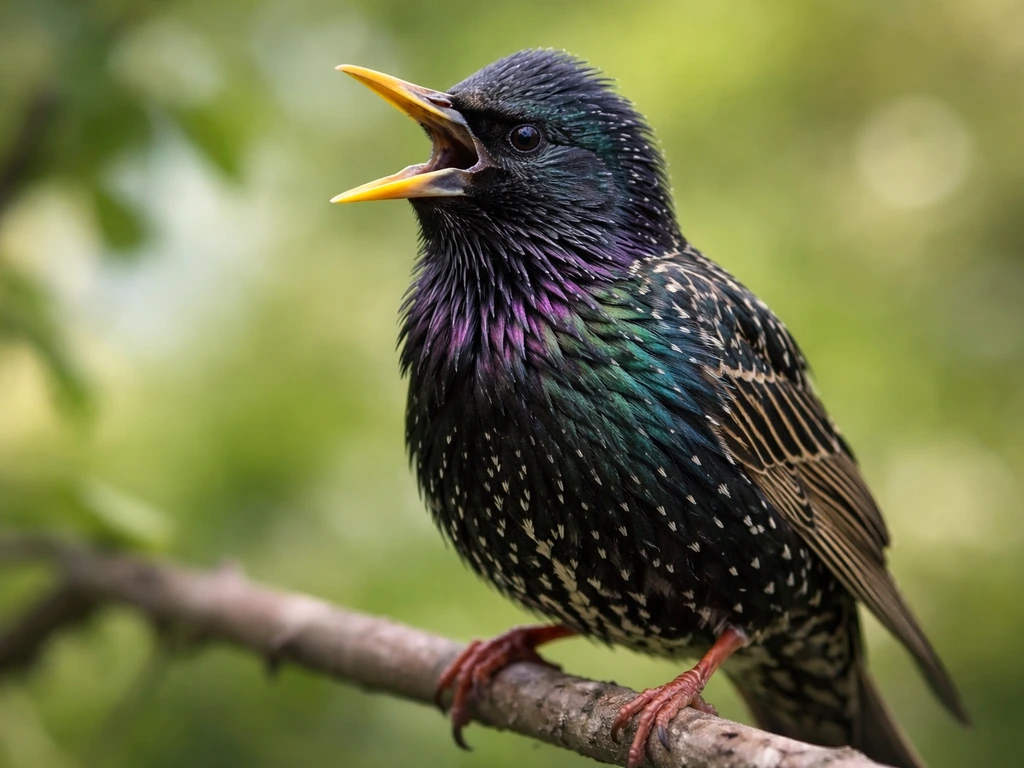
Starlings have a complex spiritual reputation. They're not songbirds in the classical sense of beauty and innocence, and they're not ravens or owls with centuries of ominous mythology. They sit somewhere in between, clever, vocal, adaptable, and deeply social. That makes them symbolically rich in a way that's often overlooked.
Communication and voice
The most consistent theme across spiritual interpretations of starlings is communication. Starlings are exceptional mimics, they can copy other birds, mechanical sounds, and even human speech. In a spiritual context, this often points to something in your own life around voice: Are you saying what you actually mean? Are you mimicking others instead of expressing your authentic self? Or conversely, are you drowning out your own inner voice with noise from the outside world? A starling appearing at a moment when you've been holding something back, avoiding a conversation, or feeling unheard can feel like a pointed prompt.
Community and belonging
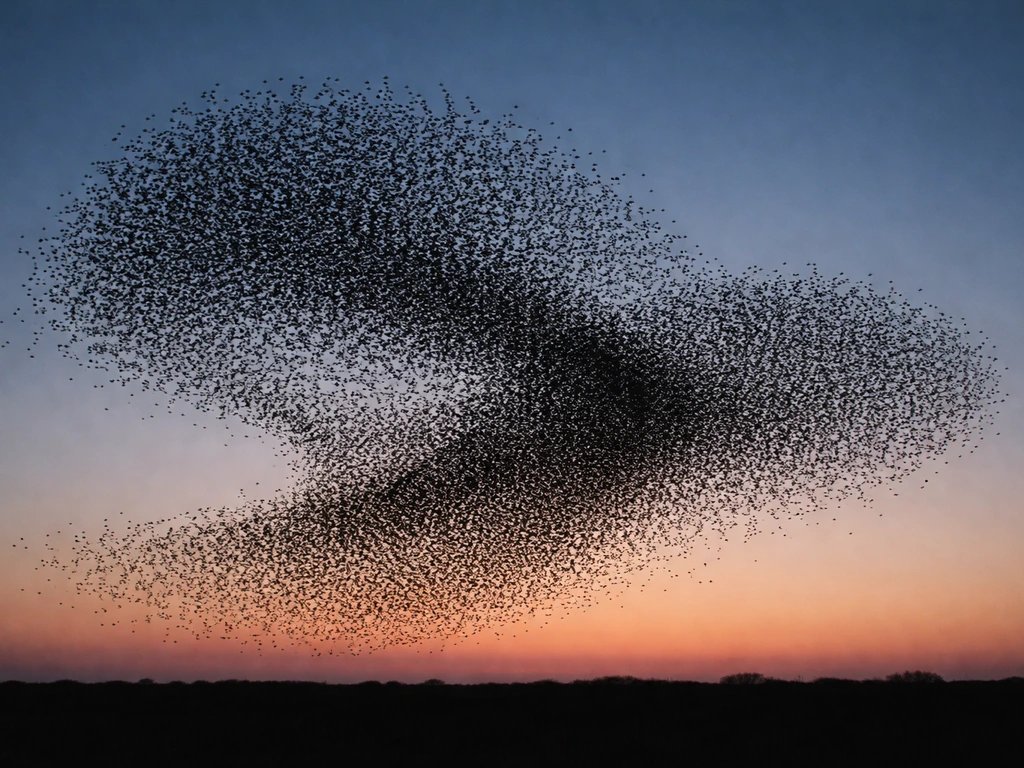
Starlings are profoundly social. They don't just flock, they create murmurations, one of the most breathtaking examples of collective movement in the animal world. Spiritually, this is often read as a message about your relationship to community: your found family, your friendships, your creative collaborators. Seeing a flock might be a reminder to reconnect, to lean on others, or to notice whether you've been isolating. For some, the murmuration itself becomes the symbol, the idea that moving together in sync with others can create something beautiful that none of you could do alone.
Adaptability and resourcefulness
Starlings thrive in difficult, competitive conditions. The National Park Service notes they're known for their aggressiveness in competing for nest sites. Symbolically, this side of the starling points to resourcefulness, resilience, and the ability to make something work even when the environment isn't ideal. If you're in a tough stretch, a challenging job, a complicated relationship, a period of uncertainty, a starling encounter might be read as encouragement that you have what it takes to adapt and find your footing.
Timing and change
Some interpretations connect starlings to transitions and timing, particularly the idea that something is arriving or shifting. Their migratory and seasonal patterns make them natural symbols of cycles and change. If a starling appeared at a notable personal moment (a decision point, a difficult day, a moment of clarity), that context adds to the interpretation significantly.
Folklore and cultural symbolism (with honest caveats)
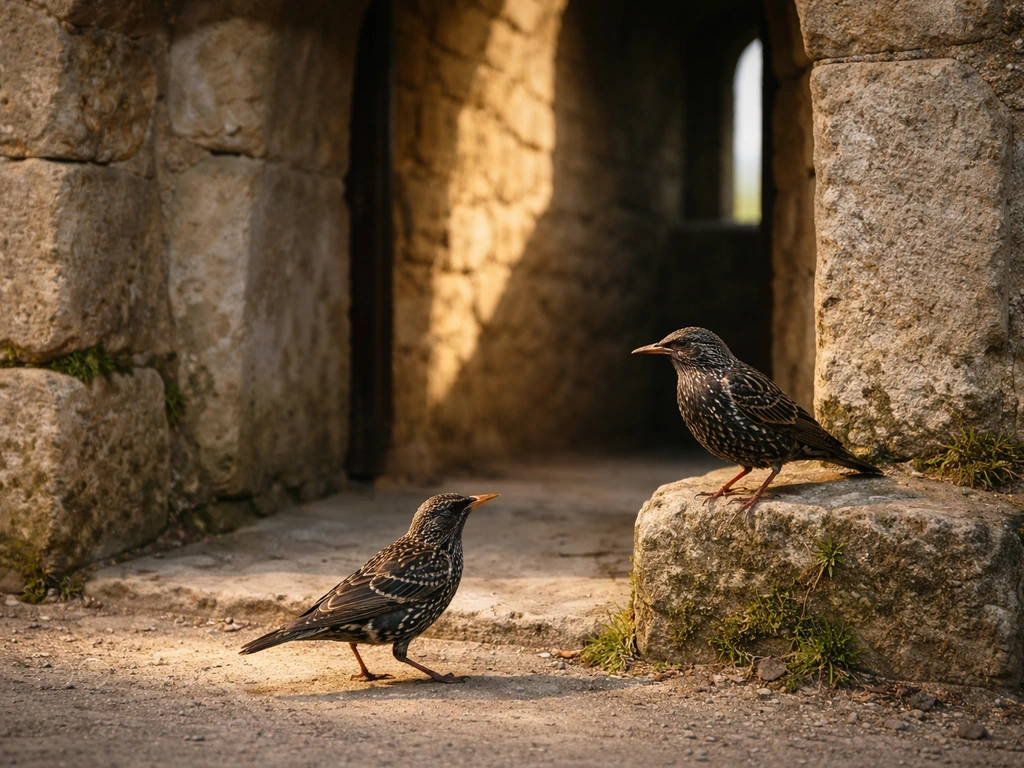
Here's where I want to be upfront: starlings don't have the same rich, unified mythological history as ravens, owls, or doves. Most of the starling's cultural symbolism is fragmented and modern, pieced together from general bird symbolism rather than a single deep tradition. That doesn't make it meaningless, but it does mean you should take any sweeping claim about 'ancient starling symbolism' with some skepticism.
- In Celtic traditions, birds broadly served as messengers between worlds, and vocal mimics were sometimes seen as carrying voices from other realms or the spirit world. Starlings, as prolific mimics, occasionally get folded into this framework.
- In Roman augury, the behavior and movement of flocking birds (including starling-type species) was read as omens — the direction of flight, whether the flock scattered or stayed cohesive, all carried meaning to augurs.
- In some European folk beliefs, a starling landing on or near a home was considered a sign of news arriving — sometimes welcome, sometimes not.
- In Shakespeare's time, starlings were associated with persistence and determination — notably, Hotspur in Henry IV plans to teach a starling to repeat a name endlessly as an act of defiance. This gives starlings a pop-culture folklore link to stubbornness and relentlessness.
- In modern spiritual communities, starlings are frequently linked to creativity, group harmony, and the balance between individuality and belonging — drawn more from their observable behavior than from classical mythology.
The honest takeaway from folklore: starlings carry themes of voice, community, and resilience across multiple traditions, but the symbolism is interpretive rather than codified. Use it as a reflective lens, not a fixed answer.
Biblical and faith-adjacent ways people connect starlings to meaning
The Bible doesn't name starlings specifically, but birds appear throughout scripture as messengers, symbols of divine care, and signs of providence. The most commonly cited passage in bird-encounter discussions is Matthew 10:29-31, where Jesus says not a single sparrow falls without the Father's knowledge, and that humans are worth far more. This passage is often extended by faith communities to cover all birds: that a bird appearing in a meaningful moment can be seen as a reminder of divine attention and care.
For many people of faith, a bird encounter isn't about the specific species so much as the feeling it produces: a sense of being seen, of timing that feels intentional, of peace arriving unexpectedly. In that framework, a starling appearing at a vulnerable or significant moment can be received as a gentle reminder that you're not alone, that something larger is paying attention. This isn't specific to any single denomination; it shows up across Christian, Jewish, and interfaith spiritual practices as a way of finding meaning in the natural world.
Some people also connect the starling's communal nature to biblical themes of fellowship, the body of believers moving together, and the importance of showing up for one another. That's a looser connection, but it resonates for readers who approach bird encounters through a faith lens.
What to actually do after you see a starling
The most useful thing you can do right after a notable encounter is pause and write something down, not because the universe is sending you a telegram, but because bird encounters often catch us in moments of openness, and your gut response to that moment is worth examining. Here are some prompts that tend to surface the most useful reflections:
- What were you thinking about right before the starling appeared? Is there a connection — even a loose one — between that thought and the themes of communication, community, or adaptability?
- How did the encounter make you feel? Surprised? Calm? Unsettled? Your emotional response is often the most honest data point.
- Is there a conversation you've been avoiding or a truth you haven't been saying out loud? The starling's mimicry symbolism often points here.
- Are you feeling isolated right now, or are you in a season where your community or relationships need attention?
- Has this happened before? Note whether this is a first encounter or part of a pattern — patterns carry more symbolic weight.
- What would you need to believe about yourself to see this encounter as encouragement rather than warning?
Beyond journaling, notice whether the theme comes up again in the next few days, in a conversation, a song lyric, a dream, or another unexpected encounter. Spiritual traditions across the board treat repetition as amplification. One starling is interesting. Three starlings in three days in three different contexts is worth sitting with seriously.
If the starling left droppings near your home or workspace, handle that practically first, starling droppings can carry health risks and should be cleaned up with gloves and a mask. Don't let the spiritual reflection distract from basic hygiene. You can hold both things at once: clean it up and still ask what the encounter meant to you.
When the situation is different: indoors, distressed birds, and dreams
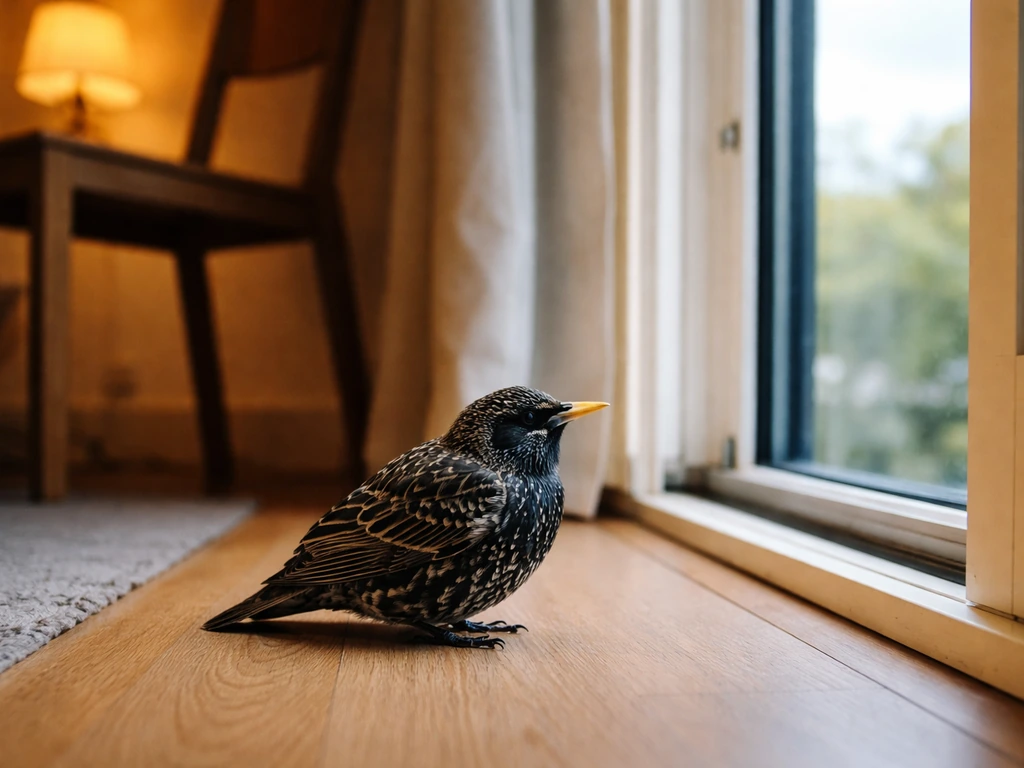
If the starling came inside your home
A bird entering your home is one of the most emotionally charged encounters people report, and starlings entering buildings isn't uncommon given how aggressively they seek out cavity nest sites (a building vent or gap is a perfectly good cavity to a starling). Practically, guide the bird out by opening windows and doors and darkening other areas so it moves toward the light. Don't chase it.
Symbolically, a bird entering your personal space is widely interpreted as a message requiring your direct attention, something about your home life, your inner world, or your sense of security is asking to be noticed. This crosses cultures: from European folk belief to various indigenous traditions, a bird inside the home is treated as significant rather than random.
If the starling seems distressed or injured
An injured or distressed starling should be handled practically first. Contact a local wildlife rehabilitator, you can find one through the National Wildlife Rehabilitators Association directory. Don't attempt to keep or nurse a wild starling yourself unless you're trained; it's actually illegal in most U.S. states without a permit. Once the bird is cared for, the symbolic layer: a wounded bird in your path often prompts reflection about what in your own life feels wounded, neglected, or in need of rescue. That's a hard question, but it's a useful one.
If you saw a starling in a dream
Dream encounters work differently than real-life ones, and it's worth being clear about that distinction. In a dream, the starling is part of your own psyche's symbolic language, it's less about an external message and more about what your unconscious mind is processing. A starling in a dream might represent a part of yourself that wants to be heard, a social situation you're working through, or a feeling of wanting to fit in (or stand out) within a group.
If you're exploring what bird dreams mean more broadly, that's a whole separate thread worth following, dream symbolism operates by different rules than waking encounters. If you keep seeing the same image or feeling from petting a bird dream, you can look at it through the lens of communication, comfort, and trust in your waking life bird dreams mean more broadly.
Some people also look into talking bird dream meaning when they want to understand how voice or communication appears in their subconscious. If you were specifically thinking about a love bird dream meaning, that can add a different layer to how you interpret the dream’s emotions and messages. If you’re specifically trying to interpret a love bird dream meaning, it can help to focus on the feelings of affection, attachment, and communication inside the dream.
If you’re focused specifically on turning into a bird dream meaning, it can point to transformation, escape, or a shift in how you see your voice and freedom exploring what bird dreams mean more broadly.
The core distinction: real-life starling encounters are interpreted outwardly, as potential messages, signs, or omens from the world around you. Dream starlings are interpreted inwardly, as reflections of your own inner state. If you are looking for talking bird dream meaning, focus on what the voice in the dream is trying to communicate to you. Both are valid and worth exploring, but mixing the two frameworks tends to muddy the reading.
Whatever drew you to this question today, the most important thing is what the encounter means to you specifically. Starling symbolism offers themes, not verdicts. Take what resonates, leave what doesn't, and let the reflection be genuinely useful rather than something you have to believe.
FAQ
How can I tell if my “seeing a starling bird meaning” moment is just coincidence versus something I should reflect on more?
Use a simple threshold: if the encounter is emotionally charged, happens at a clear decision point, or you notice a repeated pattern (same day of week, similar location, or the same behavior like landing near you), it’s more likely worth deeper reflection. A one-off sighting during peak nesting season is often just heightened visibility, not a unique signal.
Does the meaning change if I heard the starling more than I saw it?
Yes. Because starlings are known for loud vocalizations and mimicry, strong sound-focused encounters often steer the interpretation toward voice and boundaries. If the call started right when you were about to speak, stop yourself, or avoid a conversation, it can be a practical prompt to check whether you are expressing your actual thoughts or reacting to noise from others.
What should I do if a starling keeps landing near me or my window every day?
Treat it as both a meaning question and a pattern-management issue. First, confirm it’s actually the same spot (time and location), then check practical attractants like open food, reflective surfaces, or nesting-friendly gaps. If it’s truly consistent, reflect on what “returning to a place” symbolizes for you (unfinished conversation, repeated feelings, or a routine you want to adjust).
How do I interpret the meaning if the starling behaved aggressively or chased another bird?
Aggressive behavior often points your reflection toward competition, resource pressure, or asserting space. If you’ve been feeling pushed out at work, in a relationship, or socially, the symbolism can be read as resilience or a prompt to set clearer boundaries, rather than a sign to “win” by force.
What does it mean if the starling was in my car or followed me briefly?
An encounter while you are in transit can shift the timing theme toward “transition” rather than “message from above.” If the starling seemed to appear at a stoplight, parking decision, or route change, consider whether you are resisting a shift you already know is coming (new plan, new role, or a needed conversation).
Is it okay to interpret a starling meaning even if I do not believe in omens or spirituality?
Yes. You can frame it as meaning-making, not prediction. Use the encounter to run a quick check-in question (What am I avoiding saying? Who am I neglecting? What needs attention right now?) and let it be a reflection tool. This avoids turning a coincidence into a verdict.
What if I saw a starling inside my home, but it felt scary rather than comforting?
Start with safety and practical steps (ventilation, calm guidance toward light, avoid chasing). Symbolically, fear often indicates a boundary or security issue in your own mind, so after the bird is out, reflect on what part of “home” feels unstable (privacy, emotional safety, or a sense that something is not under your control).
If I want to journal, what details should I write down to make the “meaning” clearer?
Write the specifics that anchor interpretation: date and time, location (yard, sidewalk, inside home), what the bird did (landed, flew in, mimicked a sound, followed), your state right before it happened (rushed, sad, about to call someone), and the strongest emotion you felt. Those details help you separate symbolism you’re adding from the experience you actually had.
What if I recently dealt with starling droppings or cleaning because of a nearby roost?
Handle health and hygiene first, including gloves and respiratory protection when cleaning. After practical cleanup, you can still reflect, but keep the priorities separate so you don’t interpret the bird as “a warning” while ignoring a real exposure risk.
How should I interpret a starling dream if I’m also seeing starlings in waking life?
Don’t force one unified story. Real-life sightings are typically read outward (community, communication, timing), while dreams are usually read inward (your feelings about being heard, fitting in, or trust). If you keep connecting them, focus on the shared theme that matches your waking emotion, not the exact species details.
Are there any common mistakes people make when seeking “starling bird meaning”?
Common ones include overvaluing a single sighting during nesting season, assuming every encounter is a direct message meant for you, and ignoring practical factors (like an actual nest attempt or a safe way to remove a bird from indoors). Another mistake is treating repetition as proof of fate instead of using it as a cue to reflect on what has been consistent in your life.
When should I contact a wildlife rehabilitator instead of trying to handle a distressed starling myself?
If the bird is injured, behaving abnormally, unable to fly, or appears to be stuck where it can be harmed, contact a licensed local wildlife rehabilitator. Avoid keeping or trying to nurse a wild starling unless you are trained and permitted, since laws and animal welfare requirements vary by location.
Next Article
Petting a Bird Dream Meaning: What It Symbolizes and Why
Petting a bird dream meaning varies by bird, color, mood, and your feelings, pointing to trust, healing, and messages.