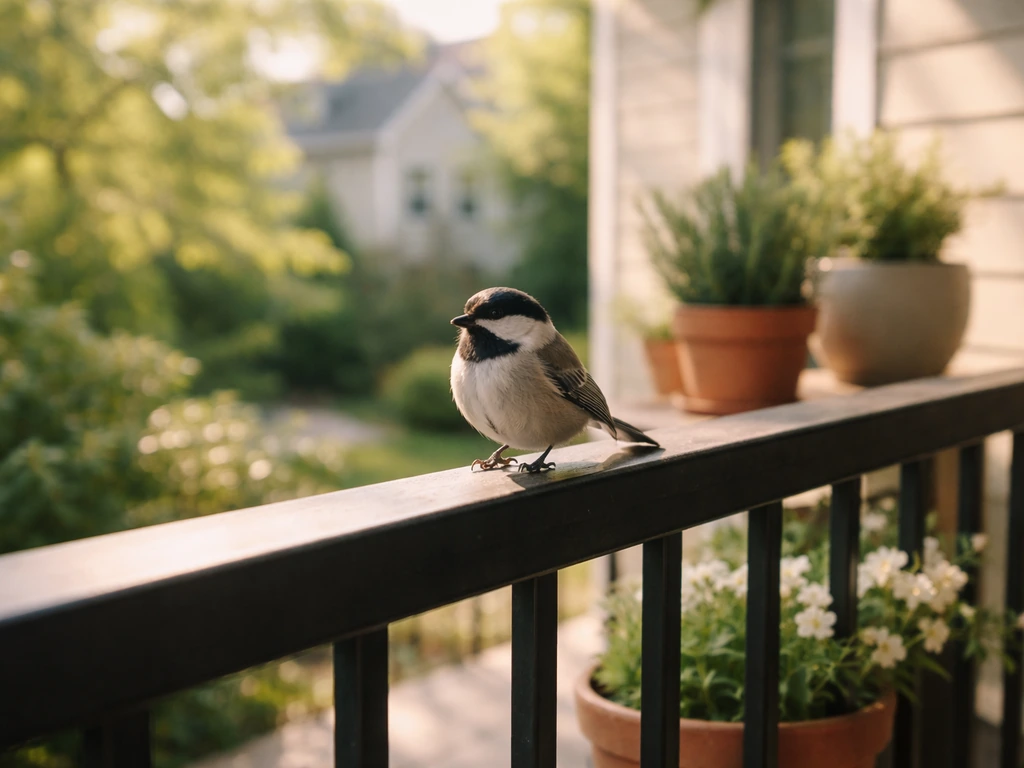
A bird on your balcony is most likely there because your balcony offers something useful: food scraps, a sheltered ledge, a water source, or a good vantage point during migration. That's the honest first answer. But the fact that you're asking what it means suggests the visit felt like more than a routine pigeon stop, and that instinct is worth taking seriously too. A bird on your doorstep can carry a “meaning” too, depending on whether it feels like a brief visit or something more persistent. The practical explanation and the symbolic one aren't mutually exclusive, and this guide will walk you through both. If you want, try reflecting on how that personification makes the scene feel alive and personally directed.
Bird on My Balcony Meaning: Natural Reasons and Spiritual Signs

Maya Hartwell
7 May 2026
Why a bird is probably on your balcony right now
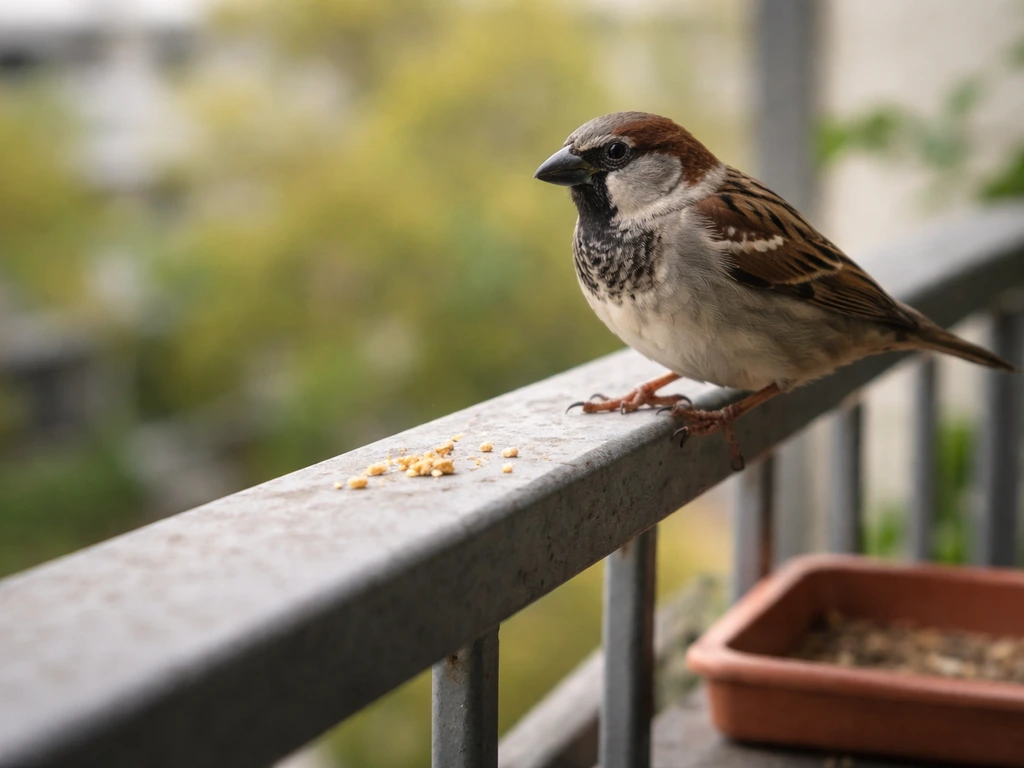
Birds are practical creatures. Before you read anything deeper into a visit, it helps to rule out the obvious natural draws. Balconies are prime real estate from a bird's perspective: they're elevated, partially sheltered, often near human food activity, and frequently surrounded by glass that reflects sky and vegetation. Any one of those factors can pull a bird in.
- Food scraps or crumbs left on railings or the floor (house sparrows, in particular, will hop and peck at anything that looks like birdseed or bread)
- Standing water in a dish, plant saucer, or drainage tray
- A sheltered corner that looks like a safe resting spot, especially during migration season
- Reflective glass or sliding doors that the bird mistakes for open sky or rival territory
- An existing or potential nesting site, especially on ledges or under overhangs
- Territorial behavior: the bird may be responding to its own reflection in your glass door or window
Window and glass reflection confusion is more common than most people realize. Birds can see the landscape or sky reflected in glass as if it were real open space, which is why they fly toward it. A bird repeatedly pecking or flying at your glass door is almost certainly not sending you a message; it's fighting what it thinks is a rival or trying to fly through what looks like open air. That behavior is worth addressing for the bird's safety as much as anything else.
How the bird's behavior changes what it might mean
Behavior is the single most useful filter here. A bird that visits once, sits calmly for a few minutes, and leaves reads very differently from one that returns every morning, or one that's clearly distressed and disoriented. Pay attention to what you're actually seeing.
A calm, single visit
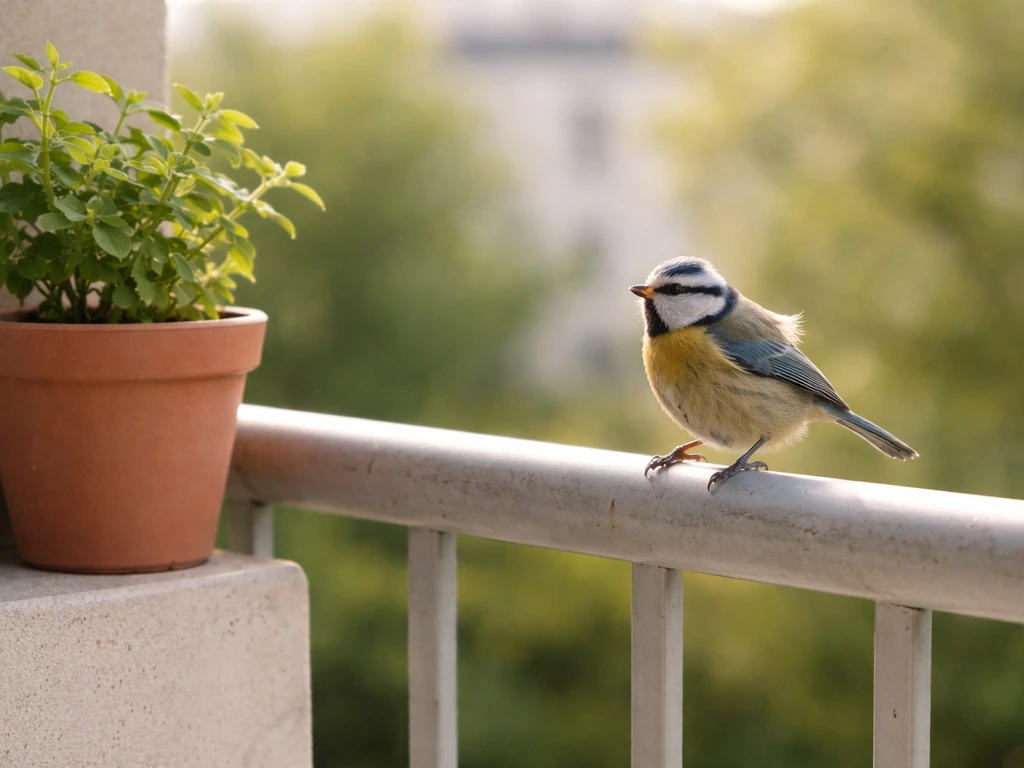
The bird perches, looks around, maybe preens, and flies off. This is the most common scenario and the one most easily framed as either a routine rest stop or a gentle symbolic visit, depending on your belief system. There's nothing alarming here on the practical side.
Lingering or repeated returns
If the same bird (or same species) keeps coming back, there's almost always an attractant: food, water, a favored perch, or early-stage nesting interest. Repeated visits are also the behavior most often described symbolically as a persistent message or a spirit trying to get your attention. Whether you take the natural or spiritual view, repeated returns are worth paying attention to.
Aggressive or agitated behavior toward windows
A bird repeatedly attacking its own reflection is mistaking it for a competing bird, usually a male defending territory during breeding season. This isn't a spiritual signal; it's a case of mistaken identity. The behavior can go on for days and is tiring for the bird. It's worth gently disrupting the reflection to help the bird move on.
Sitting still and unresponsive
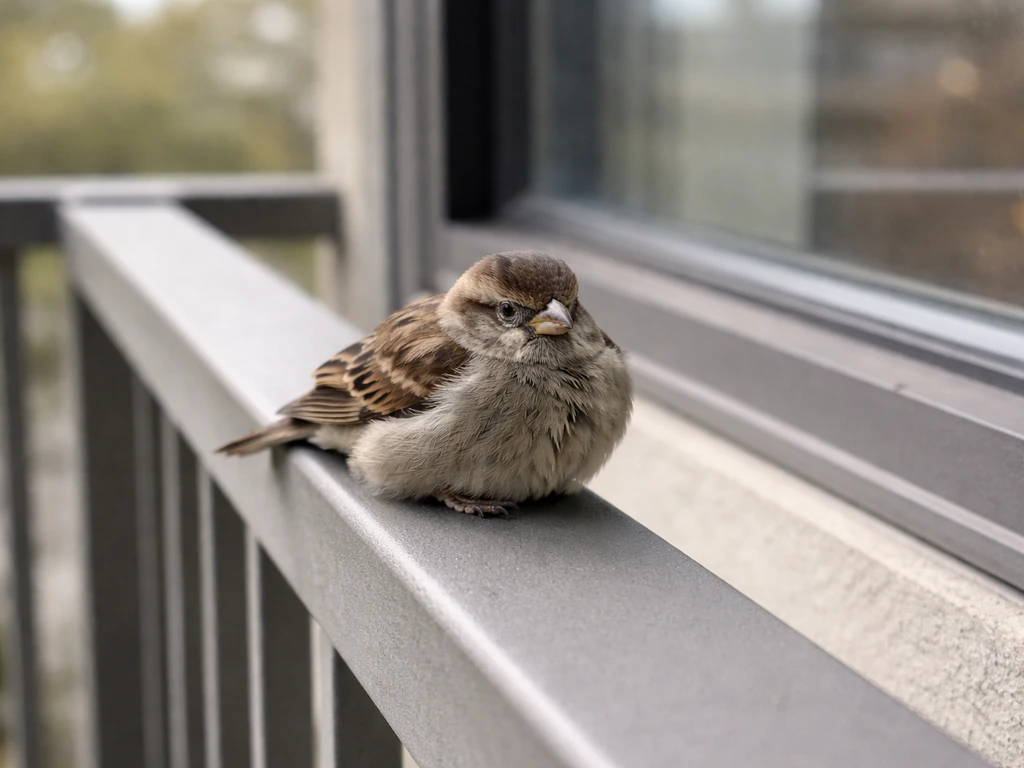
A bird that lands and just sits there, seemingly dazed or unable to fly, has likely struck your window. Birds can appear unharmed after a glass collision but still suffer from head trauma that may be fatal without care. This needs practical action first, before any symbolic interpretation.
Reading the clues: species, nesting, and signs to look for
The type of bird and what it's doing physically can tell you a lot about both the natural cause and the symbolic layer, if you're looking for one.
| Bird | What it looks like | Common balcony behavior | Symbolic association |
|---|---|---|---|
| House Sparrow | Male has gray head, white cheeks, black bib, rufous neck; small and compact | Hops and pecks at crumbs, often in groups | Community, resourcefulness, divine care (Matthew 10:29) |
| Mourning Dove | Beige-brown above, pinkish-brown below, dark eye, iridescent neck patch, black neck band with white border | Sits calmly, often in pairs, coos softly | Peace, grief, love, the Holy Spirit in Christian tradition |
| Barn Swallow | Deep blue back, rusty-orange throat, long forked tail | Swoops near eaves; may build a cup-shaped mud nest under overhangs | Good luck, summer arrival, protection of the home in many folk traditions |
| Pigeon / Rock Dove | Gray with iridescent neck, stocky build | Struts, coos, may begin nesting on ledges | Message-carrying, peace, persistence |
| Robin | Orange-red breast, dark back, yellow bill | May appear during migration; hops and tilts head | New beginnings, spring renewal, good news in folklore |
Beyond species, look for physical evidence of what the bird is doing. Twigs, grass, or mud on your balcony ledge mean a bird is scouting or actively building a nest. White droppings concentrated in one spot mean a bird has adopted that spot as a regular perch. Feathers or a stunned bird below or near your glass doors point to a window strike. Each scenario calls for a different response.
Spiritual and symbolic meanings tied to a bird on your balcony
Across cultures and throughout history, birds arriving at a person's living space have been read as messages, omens, or signs. The practice of interpreting bird behavior as meaningful, known in ancient cultures as ornithomancy or augury, stretches back thousands of years and shows up in nearly every human civilization. The fact that you noticed this bird and felt something means something, even if what it means is entirely personal.
In a general metaphysical framework, a bird visiting your home or balcony is often interpreted as a message from beyond ordinary awareness: from a loved one who has passed, from your own intuition, or from whatever spiritual force you believe guides your life. In many cases, people look for bird on porch meaning as a way to interpret a visitor that feels personal rather than random threshold between your private indoor world and the open sky. The key symbolic themes that come up most often are transitions, new beginnings, messages, freedom, and the idea that you're being watched over. A bird on a balcony, specifically, sits at the threshold between your private indoor world and the open sky, which many traditions read as a liminal space where the everyday and the spiritual meet.
The species matters here. A dove showing up on your balcony carries a different symbolic weight than a crow or a sparrow, and the behavior matters just as much. A calm, attentive bird that makes eye contact before flying off is described in many spiritual traditions as a deliberate visit. A bird that circles and leaves quickly is more like a passing wave. And a bird that returns day after day is often interpreted as an urgent or persistent message worth sitting with.
If you're going through a transition, grieving, making a big decision, or just feeling like something is shifting in your life, a bird visit often lands with more weight. That resonance is worth noting in a journal rather than dismissing. You don't have to commit to a single interpretation to find the visit meaningful.
Biblical, folklore, and metaphysical lenses
The biblical view
In Christian tradition, birds are primarily symbols of divine care and provision rather than omens to be interpreted. Matthew 10:29 to 31 is the central passage: Jesus points out that not even a sparrow falls to the ground outside of God's knowledge, and uses that to reassure his followers that they are valued and watched over. If a sparrow lands on your balcony and you follow this tradition, the instinct to feel seen or reassured is theologically grounded, even if the church has historically been cautious about omen-reading. Doves carry a separate layer of Christian symbolism as representations of peace and the Holy Spirit, rooted in the baptism of Jesus and centuries of iconographic tradition.
Folklore traditions
In Celtic folk tradition, certain birds, especially robins and wrens, were considered messengers from the Otherworld, and their appearance near your home was taken as a communication from ancestors or spirits. In many Indigenous North American traditions, specific birds carry specific teachings, and their arrival calls for quiet attention rather than a quick Google search for meaning. Japanese folklore associates the crane with longevity and good fortune, while Western European traditions often read a lone dove at the window as a message from a deceased loved one. These traditions don't agree with each other perfectly, but they share a common instinct: birds matter, and their arrivals are worth noticing.
Metaphysical and modern spiritual perspectives
In contemporary metaphysical and New Age frameworks, birds are often understood as spirit guides or as physical manifestations of energy and messages from higher consciousness. The specific meaning is almost always framed as personal: what the bird means to you, in the context of your current life, is more important than any fixed symbolic dictionary. This approach is worth taking seriously because it keeps the interpretation honest. A bird that shows up the day after you lose someone you love carries emotional weight that a bird on a random Tuesday simply may not. Context is everything, and modern spiritual writers are generally careful to note that meanings vary by observer, by species, and by circumstance.
What to actually do today
If the bird is calm and just visiting
Let it be. Watch it quietly from a distance if you want to. Note the species, the behavior, and how you feel about its presence. If you don't want it to become a regular visitor, remove any food scraps, standing water, or other attractants from the balcony. That's usually enough to redirect casual visitors.
If the bird is injured or stunned
Don't offer food or water, and don't try to nurse it yourself unless you have wildlife rehabilitation training. Place the bird gently in a dark, quiet, warm container (a cardboard box with air holes works well) and contact a local licensed wildlife rehabilitator. If the bird doesn't recover within a couple of hours, get it to a veterinarian or wildlife rehab facility. Obvious injuries like bleeding or a visibly broken wing mean you should skip the waiting period and call for help immediately.
If the bird keeps attacking your windows
- Cover or break up the reflection on the outside of the glass using window film, decals, or a screen placed close to the window surface
- Close blinds or curtains temporarily to reduce the reflection that's triggering territorial behavior
- Hang something lightweight near the glass (streamers, tape strips) to visually disrupt the mirror effect
- If the behavior persists for more than a few days, the reflection disruption needs to be more complete; the bird will eventually move on once it can no longer see the 'rival'
If you think a bird might be nesting
Check carefully before disturbing anything. Look for a cup-shaped structure of mud, grass, or twigs on a ledge or under an overhang. Barn swallows often build mud-and-saliva nests in exactly these spots. Canada’s residence description for the barn swallow notes that its nest is a half-cup-shaped structure made of mud pellets with layers of grass stems, typically built on human-made structures like ledges or overhangs blank" rel="noopener noreferrer">Barn swallows often build mud-and-saliva nests in exactly these spots.. PWCONserve describes barn swallows’ cup-shaped nests of mud lined inside with feathers and grass, attached under eaves or other sheltered edges blank" rel="noopener noreferrer">Barn swallows often build mud-and-saliva nests. In many countries, disturbing an active nest with eggs or young birds is illegal, so if you find one, leave it alone until the season is over. If you want to prevent future nesting, use physical exclusion like netting after the birds have left for the season.
If you want to deter birds from the balcony generally
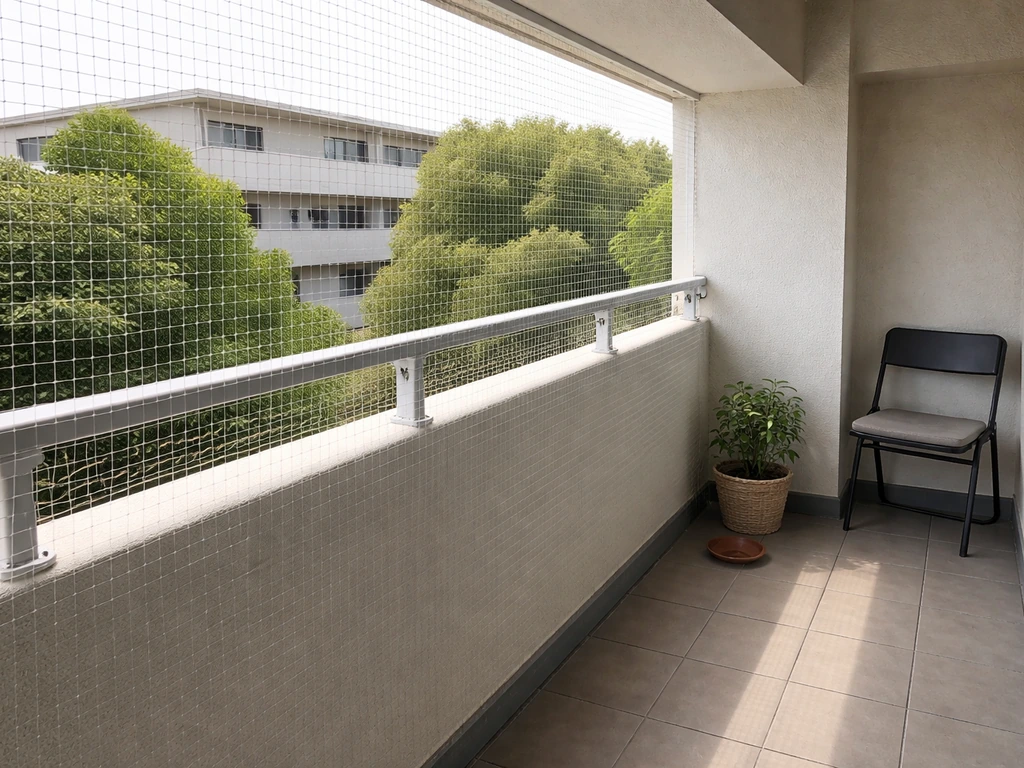
- Remove all food sources including unsealed trash, pet food, and plant debris
- Eliminate standing water in saucers, pots, or drainage areas
- Install bird netting along the open sides of the balcony (make sure it's properly secured so birds bounce off rather than get tangled)
- Use bird spikes or repellent gel on railings and ledges where birds like to perch
- Avoid placing bird feeders on or near the balcony if you don't want frequent visits
How to decide what the visit means for you
The most honest answer to 'what does this mean' is: it depends on what you bring to it. A bird on your balcony is simultaneously a wild animal doing what wild animals do and, if you're open to it, a moment with symbolic weight. Both things can be true at once, and neither reading cancels the other out.
If you want to work with the symbolic side, start by asking yourself a few grounding questions. What was happening in your life when the bird arrived? What did the bird do, and how did you feel watching it? Does the species carry any meaning from your own cultural background or spiritual tradition? A dove showing up the morning of a difficult conversation lands differently than a sparrow hopping around looking for crumbs, even if both visits are 'just birds being birds. That phrase, “like a dog with a bird at your door,” is often used to describe a sudden, urgent sense that something is about to happen like a dog with a bird at your door meaning. '
Journaling is the most practical tool here. Write down what you saw, the date, the weather, what was on your mind, and what the bird did. If the bird returns, add to that entry. Over time, patterns emerge that can feel genuinely meaningful, or they can reveal that you were simply noticing birds more because you'd started paying attention. Either outcome is useful.
If you're drawn to a specific spiritual tradition, let that tradition guide the interpretation rather than a generic meaning list. The biblical reading of birds is about reassurance and care. The folkloric reading is about messages and transitions. The metaphysical reading is about personal resonance and inner guidance. Choose the lens that fits where you are right now, hold it lightly, and let the bird mean what it needs to mean for you today.
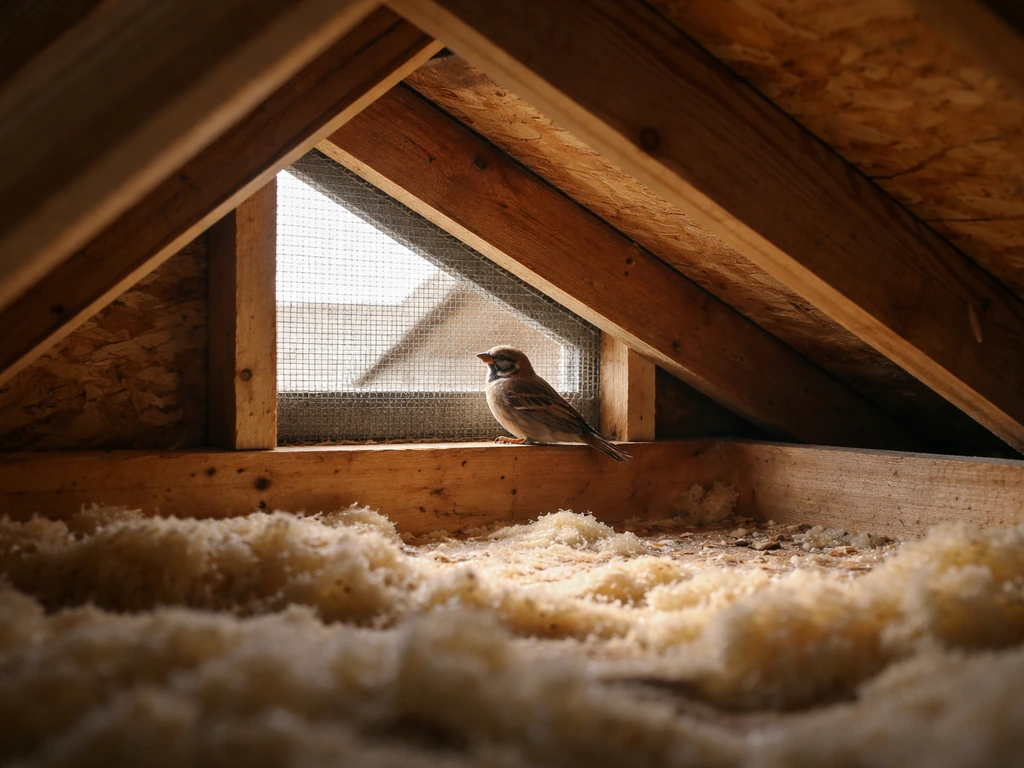
This kind of encounter shares something with other bird-at-the-threshold moments: a bird at your front door, on your porch, or on your rooftop all sit at that same intersection of the ordinary and the meaningful. What makes the balcony visit distinct is the intimacy of it. Your balcony is an extension of your home, a space you've chosen to make your own, and a bird choosing to land there feels personal in a way that a bird on a telephone wire simply doesn't. Some people also connect this kind of indoor-to-outdoor bird visit with the bird in attic meaning, especially when a bird ends up inside a home. That feeling is worth sitting with, whatever you decide it means.
FAQ
My bird keeps attacking the window, does that still count as a “meaning” sign?
If the bird is repeatedly hitting or pecking the same glass surface, treat it as a window-strike risk first. Birds often see reflection as open space, so remove or break up reflections (close curtains, move bird-attracting feeders farther away, or add an exterior visual marker like decals or netting on the glass). Meaning is optional until the bird is safe.
How can I tell if it’s a natural visit or a sign with real significance?
To judge whether it is likely natural or symbolic, separate “pattern” from “moment.” A single calm visit is usually explainable by perch and food access, while a return on specific days, at similar times, or during a particular life event suggests heightened personal salience. Still, even persistent return often has a practical driver like nesting interest or regular food habits.
What should I do if the bird lands and looks dazed or can’t fly?
Yes. If a bird lands and seems unable to fly or is sitting low, don’t interpret it symbolically first. It could have internal injury from a collision, even if it looks alert. Keep your distance, limit handling, and contact a wildlife rehabilitator or vet promptly, especially if it cannot right itself.
What details should I write down to interpret a balcony visit more accurately?
Start with what you can document without disturbing it: species, time of day, weather, where it perched, and what it did (sitting, pecking, nest building, calling, circling). Avoid making a meaning decision before you note behavior, because different actions map to different likely causes.
How do I stop birds from returning without harming them?
If you want less bird traffic, stop the attractants rather than chasing the birds away. Remove food scraps, cover trash, take down bird feeders near the balcony, eliminate standing water, and secure any pet food. Then use gentle deterrents like keeping the area tidy and blocking easy landing spots once the birds leave.
What if I see mud, grass, or feathers on my balcony ledge, does that mean it’s nesting?
If you find evidence of nesting, do not relocate materials or disturb the area. Many birds are protected during nesting, and removing a nest can be illegal. Wait until the birds have finished for the season, then use exclusion methods like netting or physical barriers to prevent future nesting.
Can I leave food or water out for a bird that seems confused?
Don’t feed the bird “to help it,” especially if it appears injured or disoriented. Offering food can delay proper care, and different species have different dietary needs. If recovery is needed, use the “safe container and contact rehab” approach described in your article, and only give care professionals the final decision.
What if I can’t identify the bird species, can I still interpret what happened?
If you’re unsure about the species, rely on observable traits like size, color pattern, beak shape, and behavior (ground hopping vs perched preening vs mud carrying). Species-specific symbolism can come later, but safety and behavior assessment should come first, especially during suspected nesting or glass strike situations.
If it feels spiritual, how do I avoid taking it too literally or anxiously?
Yes, but keep it grounded. If you believe a spiritual message is present, use it as a prompt to reflect rather than a prediction. Ask whether the visit coincides with a real transition you are navigating, then choose one practical action you can take this week (a conversation, a decision, or a self-care step).
Could changes around my balcony explain why birds started visiting?
A bird that shows up right after a glass cleaning, reflective treatment, or new decorations often signals environmental change rather than a message. Check what changed on the balcony first, like new glossy surfaces, changed lighting at night, or rearranged plants that create clearer sightlines for perching.
Next Article
Bird in Attic Meaning: Causes, Safety Steps, Symbolism
Bird in attic meaning: practical causes, safe removal steps, and symbolic interpretations, plus health and nesting risks