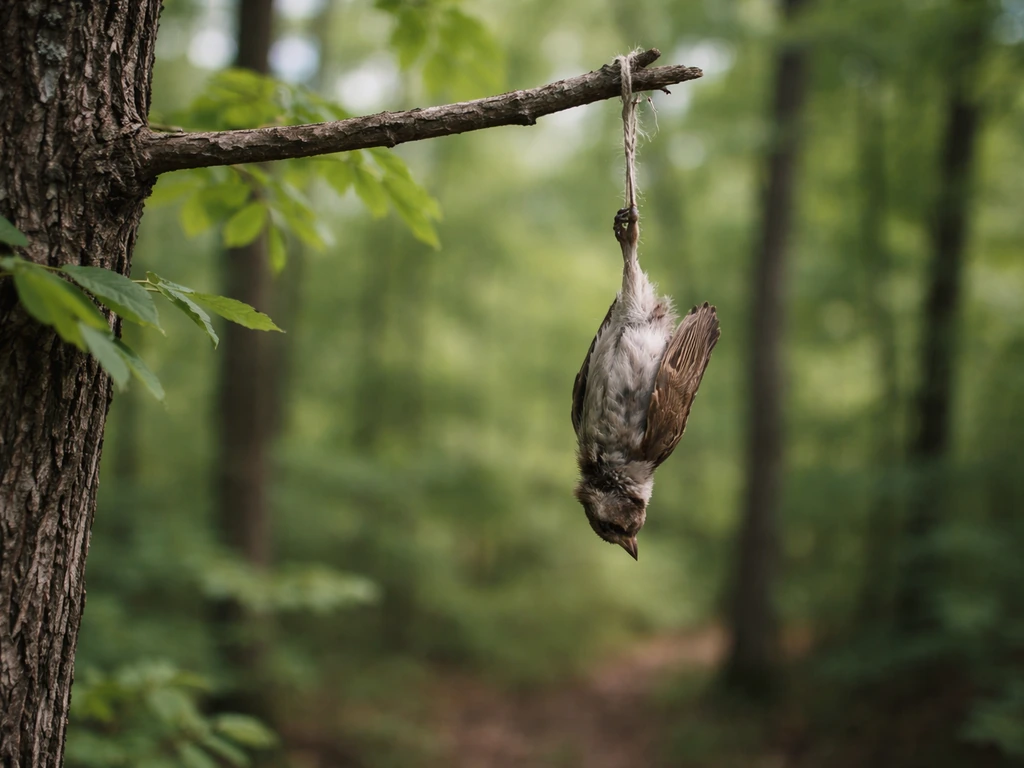
Finding a dead bird hanging from a tree is genuinely startling, and your instinct to stop and ask "what does this mean?" makes complete sense. Most of the time, it has a straightforward physical explanation: predation, a collision injury, entanglement, or disease. But for many people, the image carries weight that goes beyond biology, and both sides of that reaction deserve a real answer. Start with the practical stuff first, get safe, then explore the meaning.
Dead Bird Hanging From Tree Meaning: Safety and Spiritual Interpretations

Maya Hartwell
27 Apr 2026
What probably happened to that bird
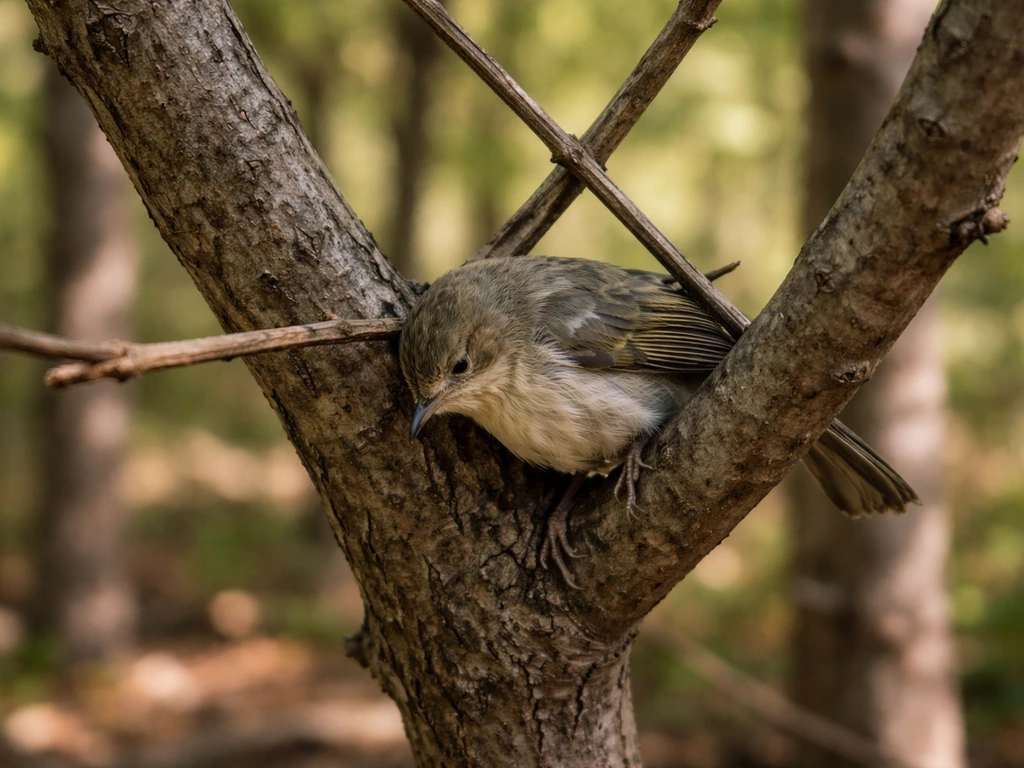
Before you do anything else, it helps to understand what you're actually looking at. A dead bird hanging from a tree usually falls into one of four categories.
- Predation: A hawk, owl, shrike, or cat may have caught the bird and left it wedged or caught in a branch. Shrikes in particular are famous for impaling prey on thorns or sharp twigs, earning them the nickname "butcher bird." If the bird looks pinned or wedged rather than tangled, predation is very likely.
- Entanglement: Birds can become fatally trapped in loose string, fishing line, or thin vines while nesting or foraging. You may see material wrapped around the feet or body. This is one of the more common reasons a bird ends up suspended mid-tree.
- Collision and injury: A bird that flew into a window or structure while injured may have landed in a tree and died there before falling. Check whether the body looks undamaged externally.
- Disease: Avian influenza (including HPAI H5N1) and West Nile virus can kill birds rapidly, and a sick bird may simply have died while roosting. If the bird appears to have died in a resting position without obvious trauma, disease is worth considering.
- Natural death: Older or weakened birds sometimes die roosting. It is less common for the body to remain visibly suspended, but it happens.
You don't need to investigate closely to figure this out. A quick visual scan from a few feet away is enough to get a working idea. Resist the urge to pick it up or touch it to examine it.
Immediate safety steps
Dead wild birds carry real health risks, especially given ongoing concerns about highly pathogenic avian influenza. The CDC advises wearing personal protective equipment when you are within about six feet of a sick or dead wild bird. Washington State's Department of Health specifically asks the public not to handle dead wild birds directly and to report them instead of picking them up. Massachusetts guidance for handling and disposing of dead wild birds specifies using PPE such as gloves and a surgical mask, then placing the bird in a thick plastic trash bag and double-bagging it for disposal placing the bird into a thick plastic trash bag and double-bagging for disposal.. Here is what to do right now.
- Keep kids and pets away from the area immediately. Don't wait to investigate first. Create distance first.
- Do not touch the bird with bare hands. If removal is necessary, put on disposable gloves and, if available, a surgical mask or N95.
- Avoid contact with body fluids including blood, droppings, or any discharge. California wildlife protocols specifically flag blood, urine, and feces as contamination risks.
- If a child or pet has already touched the bird, wash the area thoroughly with soap and water. For pets, rinse their mouth, paws, or coat and contact your vet if they consumed any part of the bird.
- Wash your own hands with soap and water for at least 20 seconds after any interaction with the area, even if you only handled a stick or tool near the bird.
When to call wildlife authorities or pest control
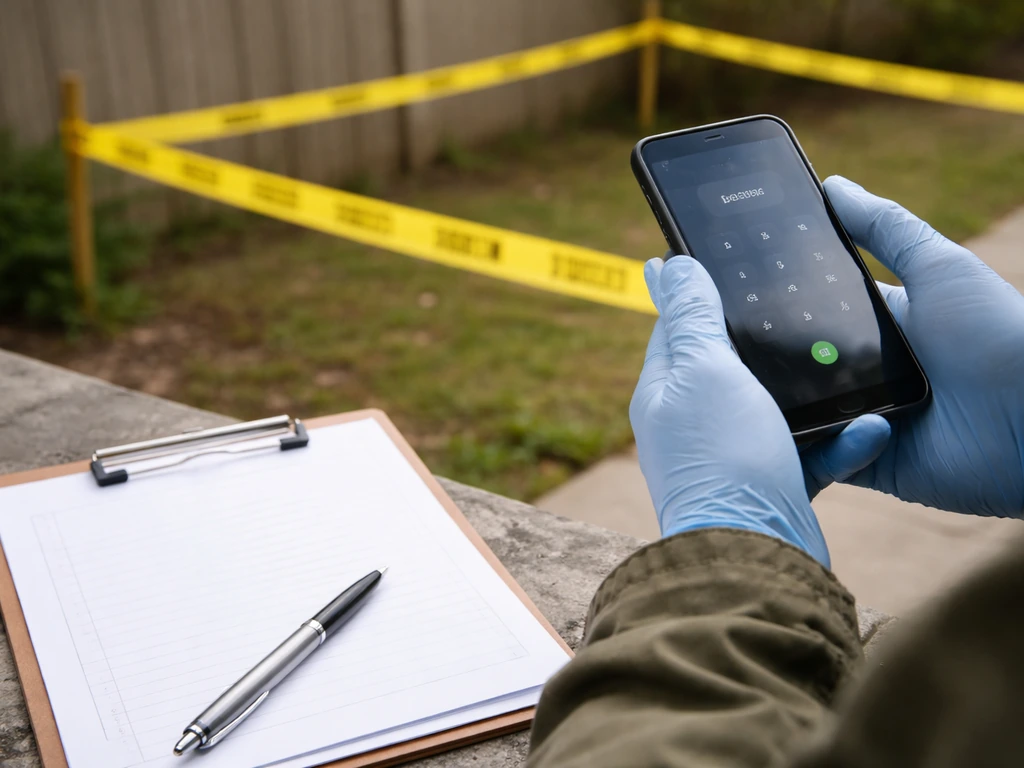
Call your local wildlife agency or animal control if you find multiple dead birds in the same area (which can signal a disease event), if the bird is a raptor or other protected species, or if you live in an area with active HPAI surveillance. Washington State's guidance asks residents to report dead wild birds rather than handle them personally. If the bird is in an inaccessible location like a high branch and poses no immediate risk, you may also choose to leave it for natural decomposition and simply keep the area off-limits to children and pets in the meantime.
How to remove and dispose of the bird safely
If the bird is reachable and you need to remove it, the process is straightforward. Massachusetts public health guidance recommends using gloves and placing the carcass into a thick plastic trash bag. California protocols say to place the body into a sealed plastic bag as soon as possible. NYC's Department of Sanitation says a dead animal can go out with regular household trash when double-bagged in heavy-duty black plastic bags. Follow your local rules, but in most places, double-bagging and sealing tightly is the standard.
- Put on disposable gloves before touching anything.
- Use a plastic bag turned inside-out over your hand like a glove to pick up the bird, then invert and seal it.
- Place that sealed bag inside a second heavy-duty plastic bag and tie it tightly.
- Dispose of it in your household trash or according to your local waste guidelines.
- Remove gloves by pulling them inside-out, bag them separately or in the same bag, and wash hands immediately.
- If string or fishing line is involved in the entanglement, carefully cut it with scissors or a knife (gloves still on) and dispose of it with the bird.
To prevent future incidents, check nearby trees for loose string, yarn, or fishing line that birds could get tangled in. If shrikes or raptors frequent your yard and you're concerned about songbirds, reducing brush piles and offering fewer perching spots near feeders can help. If you found the bird near a window, consider adding window film or decals to prevent future collisions.
The symbolic weight of a dead bird hanging from a tree
Once the physical situation is handled, it's completely natural to sit with the image and ask what it might mean. Many people find the specific visual of a bird suspended in a tree especially haunting, and across traditions there are consistent themes that attach to this kind of encounter. Many people also search for dead bird omen meaning when they want a clearer idea of what the symbolism could represent.
In broad metaphysical and synchronicity-based thinking, a dead bird is often interpreted as a transition symbol. Birds carry a near-universal association with freedom, soul, and the space between the earthly and the spiritual. When one dies, many traditions read it as a marker of change: an ending that makes space for something new. The hanging position specifically can amplify that reading. Being suspended between earth and sky, between the living canopy and the ground, can feel like a symbol of something caught between two states, a transition that hasn't fully resolved yet.
In synchronicity thinking (rooted in Carl Jung's idea that meaningful coincidences carry personal significance), the fact that you noticed this bird at this particular moment is itself worth paying attention to. The question isn't whether the bird chose to die there to send you a message. It's whether the image resonates with something already in motion in your life. That distinction matters: it shifts the meaning from omen to mirror.
The specific species of the bird also carries weight in metaphysical traditions. A dead sparrow, dove, crow, or hawk each arrives with its own symbolic vocabulary. A crow is associated with transformation, prophecy, and the liminal. A dove carries peace and the soul's journey. A sparrow speaks to the ordinary, the overlooked, and small joys. If you recognized the species, that layer of symbolism is worth exploring separately.
Biblical and folklore perspectives
In the Bible, birds appear repeatedly as messengers and symbols of divine attention. Matthew 10:29 famously states that not even a sparrow falls to the ground without the Father's knowledge, a passage that has long been read as comfort that no death, however small, goes unnoticed by God. In this framework, finding a dead bird isn't a punishment or a curse; it's a reminder that you are seen, and that loss is held within a larger order.
Levitical law in the Old Testament treated dead birds as sources of ritual impurity, which is part of where folk traditions around dead birds as "bad omens" picked up steam. But biblical scholars are careful to note that impurity in that context was a ritual category, not a moral one, and it wasn't meant to imply that finding a dead bird was a sign of coming misfortune.
In Celtic folklore, birds were seen as messengers between the human world and the Otherworld. A dead bird near a home could be read as a visiting spirit or a warning, depending on the context and the species. Ravens and crows in Celtic tradition were associated with the goddess Morrigan and with prophecy and war, while wrens were considered sacred (and in some traditions, killing one accidentally was said to bring bad luck). In Appalachian and broader American folk tradition, a bird that dies near your window or door is sometimes read as a sign that someone close to you is about to pass, though this varies widely by region and family tradition.
In some Indigenous North American traditions, birds serve as messengers between humans and the spirit world, and their death near a person can signal that a message is being delivered or that a period of change is beginning. These interpretations are highly specific to each nation's teachings, so it's worth approaching them with respect and curiosity rather than generalizing.
Eastern traditions, including aspects of Chinese and Japanese folk belief, also hold that birds can carry messages from ancestors. In these frameworks, a dead bird encountered unexpectedly might prompt reflection on recent communications with deceased loved ones or unresolved family matters.
Cultural meanings and what to reflect on personally
Across all of these traditions, the one constant is that meaning is contextual. What a dead bird hanging from a tree means to a Celtic-influenced pagan is not what it means to a biblical Christian or a Jungian psychologist. And what it means to you is shaped by your own history, beliefs, and what is happening in your life right now. Here are some questions worth sitting with.
- What was I thinking about or dealing with in the days before I found this bird? Is there a theme of endings, transitions, or unresolved situations?
- What emotion did I feel in the first moment I saw it? Dread, sadness, stillness, curiosity? Your gut reaction often points toward the personal meaning.
- Do I have a particular relationship with birds? Did a loved one keep birds, or is a certain species meaningful in my family or culture?
- Has anything died recently in my life, literally or metaphorically? A relationship, a job, a version of myself?
- Have I been dreaming about birds, or has this species appeared repeatedly in my life lately?
- Does the image of something suspended, caught between two states, resonate with how I'm feeling right now?
You don't have to force an answer. Sometimes an encounter like this functions more as a pause than a message. It stops you, makes you present, and asks you to look at something you might be avoiding. That in itself can be the meaning.
If this feels urgent, repeated, or tied to grief
If this isn't the first dead bird you've encountered recently, or if the image feels particularly charged and you can't shake it, that's worth taking seriously on a personal level. Repeated encounters with death symbols (whether dead birds in trees, dead birds falling from the sky, or birds found in places like pools and doorsteps) are sometimes called synchronicities: patterns that the psyche notices before the conscious mind catches up. If you're wondering about the specific idea of a dead bird falling from the sky, the symbolism is often discussed alongside that same broader theme of personal significance and transition dead bird falling from sky meaning. If you're specifically wondering what does a bird falling from the sky mean, it is often discussed in the same synchronicity-and-transition context. If you are wondering specifically about a dead bird in a pool, the meaning can be similar yet more tied to what happened around the water dead bird in a pool meaning. If you're spiritually inclined, that repetition may be an invitation to slow down and pay attention to what is shifting in your life.
At the same time, if you are grieving or have recently lost someone, encounters with dead animals can feel disproportionately heavy. Grief sensitizes us to symbols of mortality and transition. That's not delusion; that's a very human response. Letting yourself feel the weight of the moment without needing to immediately decode it is also a valid response.
If you feel called to respond to the encounter in a spiritual way, there are gentle practices that cut across many traditions: sitting quietly near the spot for a moment, offering a word of thanks or goodbye to the bird, lighting a candle in the evening, or journaling the thoughts that came to you when you first saw it. None of these require a specific belief system. They are simply ways of honoring the moment rather than rushing past it.
And if the practical side still feels unresolved, for example if you're concerned about disease risk for your household, or if the birds keep appearing in the same spot, addressing the environmental factors (window placement, predator activity, entanglement hazards) is itself an act of care, for yourself, your family, and the birds.
The honest answer is that a dead bird hanging from a tree is both a natural event and, for many people, a deeply felt one. You're allowed to hold both. Handle the practical, care for your safety, and then take whatever time you need to sit with what the image brings up for you.
FAQ
What’s the difference between a dead bird “meaning” and just a normal wildlife event?
A practical meaning usually connects to a visible cause (window strike, predation, entanglement, illness). A personal or spiritual “meaning” is about what the image stirs in you at that moment, not about proving intent from the bird. If you can identify a clear hazard nearby, start with that explanation before interpreting symbolism.
Should I report a single dead bird, or only multiple dead birds?
Many places focus reporting on clusters, raptors, or protected species, because multiple carcasses can indicate a disease event. If the bird is in an accessible, high-traffic spot or you suspect it’s from an illness outbreak in your area, it’s still reasonable to contact local wildlife or animal control even for one bird.
What if the bird is hanging high up and I’m worried about kids and pets getting close?
If it’s inaccessible and there’s no immediate handling risk, leaving it and cordoning off the area is often the safest approach. Use a clear boundary (temporary barrier or tape) and avoid letting pets investigate the tree base, since contact with bodily fluids or contaminated droppings is a realistic concern.
How can I tell whether it was likely a window collision versus something else?
Window strikes often leave nearby feathers, scattered debris, and sometimes blood spotting on the glass or ground. Predation signs can include bite marks or missing body parts. Entanglement hazards are suggested by nearby string, yarn, fishing line, or netting. If you see no obvious hazards but the bird looks intact, disease or collision remain possibilities, so keep distance.
Is it safe to take photos or observe up close?
Observing from a few feet away is safer than going hands-on. If you photograph, avoid leaning over, minimize time near the carcass, and don’t let anyone touch the bird or branch. If you must get closer for framing, consider gloves and wash hands afterward.
What should I do if I accidentally touched or brushed the bird or branch?
Treat it as a contamination event: wash exposed skin with soap and water, avoid touching your face, and change any clothing that contacted the carcass or debris. Then disinfect any surfaces the bird may have touched. If you develop flu-like symptoms after exposure, contact a clinician and mention the exposure to a dead wild bird.
Does the spiritual meaning change if it’s hanging by one foot versus suspended by material?
Yes, people often interpret “what it’s caught on” as part of the symbolism. Hanging by a natural position (for example, the body caught in branches) is commonly read as a transition caught between states. Hanging by visible string, line, or netting often adds a theme of entanglement or constraints, which can guide what you reflect on in your life.
What if I don’t know the species, can I still do a meaningful interpretation?
Absolutely. If you cannot identify the species confidently, focus on the context instead (near a window, at a doorstep, in a yard you feed birds, during a specific life period). Species-specific symbolism works best when it matches what you can actually observe, otherwise you might overfit a story to the wrong bird.
How should I respond if I’m grieving and the encounter feels unbearable?
In grief, symbolic interpretations can intensify the pain. A helpful approach is to slow down and prioritize emotional needs over meaning-making, for example sitting quietly, grounding yourself, and journaling memories rather than trying to decode an omen. If the distress feels persistent or escalating, consider talking with a grief counselor or trusted mental health professional.
Can repeated dead birds in the same spot be a sign of “something spiritual,” or is it usually practical?
Repeated encounters often indicate an ongoing environmental cause, like a feeder attracting certain species, a nearby predator routine, window placement, or lingering entanglement hazards. Spiritual interpretations may still be meaningful to you, but it’s wise to treat the repetition as a prompt to reduce hazards first, then reflect on what the pattern is bringing up emotionally.
What’s a simple spiritual practice that doesn’t conflict with safety guidelines?
If you want to honor the moment, do it without contact. You can stand at a respectful distance, take a few slow breaths, and say a brief goodbye or thank you, then journal what surfaced. Avoid candles or rituals that could attract fire risk near dry leaves or trees, especially in dry seasons.
When should I avoid any interaction entirely and just wait?
Avoid interaction if the bird is protected, if you’re unsure whether it’s disease-related, if it’s heavily soiled or dripping, or if you would need to step into unsafe areas (steep roofs, high branches, busy traffic). In those cases, report it or keep people and pets away until local guidance tells you the next safest step.