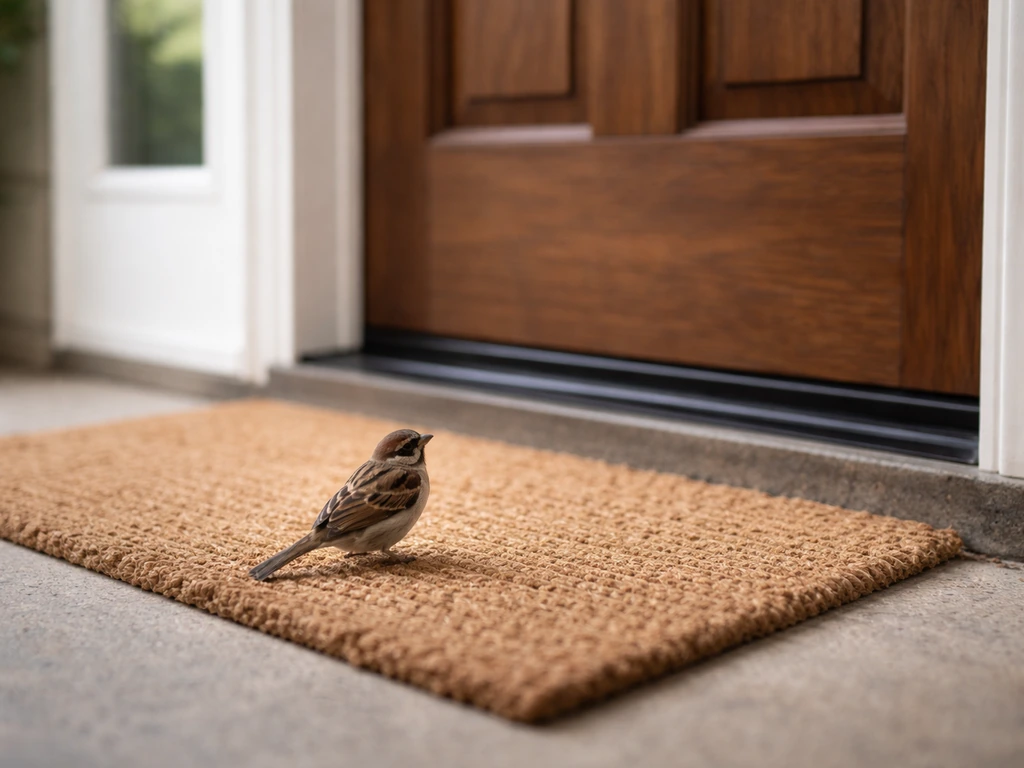
A bird that keeps coming back to your car is almost always responding to one of a handful of very specific triggers: it sees its own reflection in your mirror or windshield and thinks it's a rival, it's found something useful near your car (warmth, bugs, water drips, or a nesting spot), or it's using your hood or roof as a drum to announce its territory. Identifying which of those things is happening takes about five minutes of observation, and once you know, there's a fix you can put in place today. Identifying which of those things is happening takes about five minutes of observation, and once you know, there's a fix you can put in place today, which is the core of why is a bird attacking my car.
Why Is a Bird Obsessed With My Car? Fix It Today

Maya Hartwell
11 May 2026
Common reasons a bird keeps targeting your car
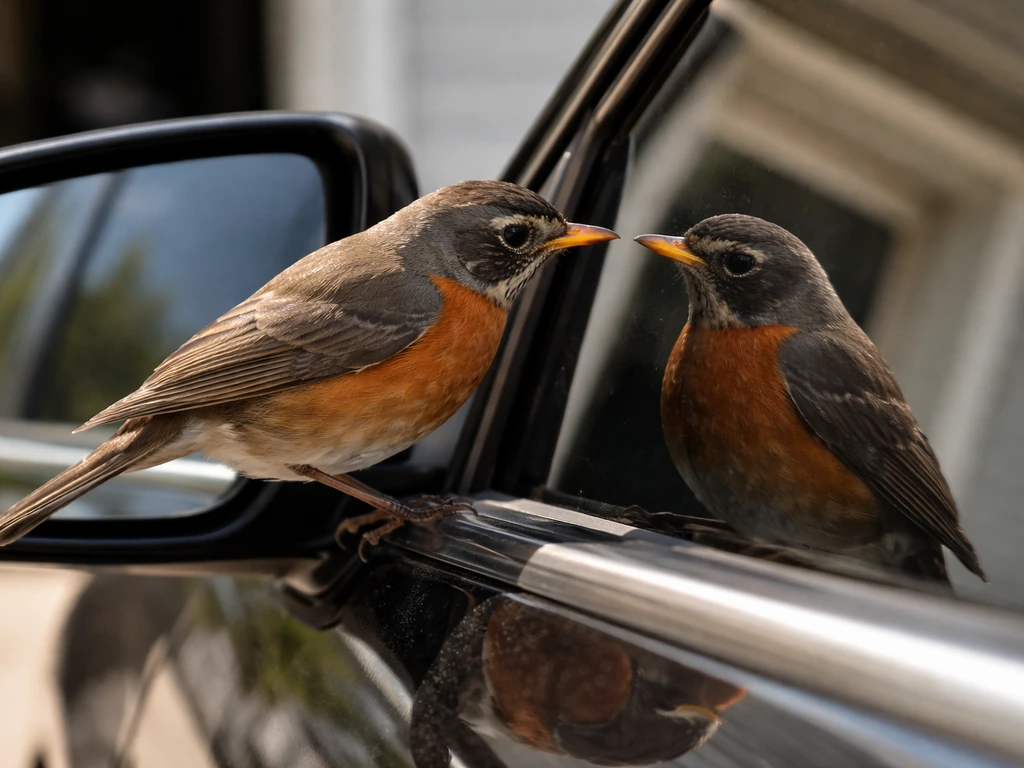
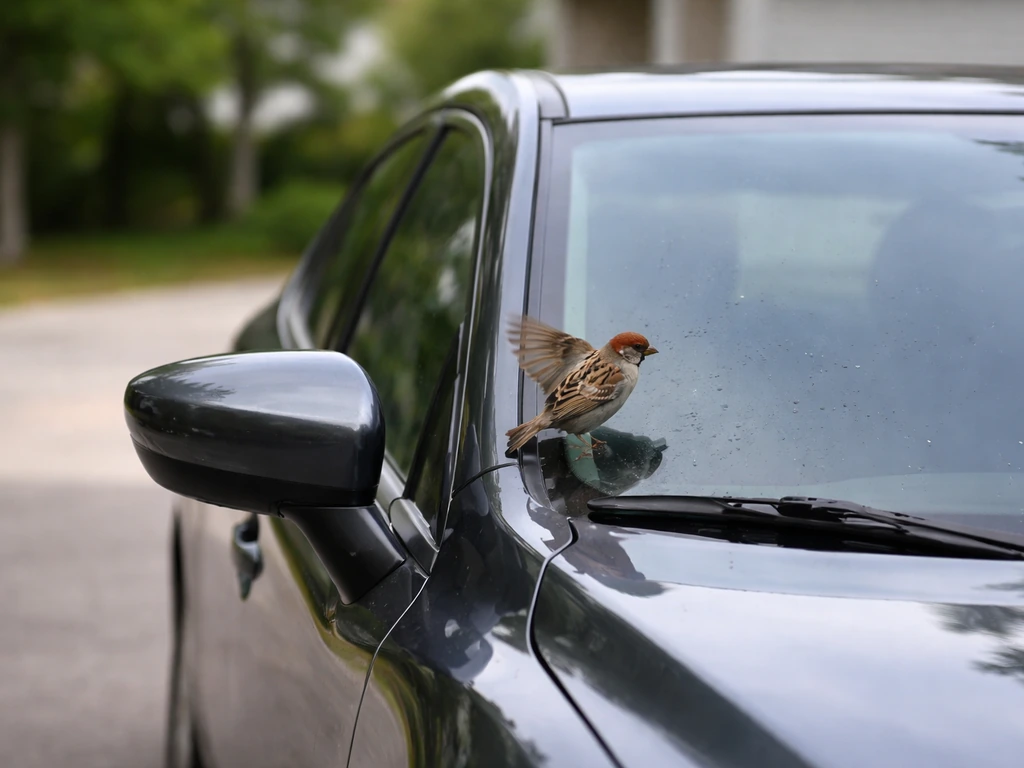
The most widespread reason is reflection aggression. Birds like Northern Cardinals, American Robins, titmice, California Towhees, and several sparrow species will see their own image in a side mirror or a polished door panel and interpret it as an intruding competitor. Because the "rival" never backs down, the bird keeps coming back, sometimes for days or weeks, especially during breeding season in spring and early summer. Audubon describes this as a simple territorial defense response, but that doesn't make it any less maddening for car owners.
Beyond reflections, there are other solid practical reasons a bird might fixate on your car. Insects collect around headlights and grilles, making your bumper a reliable hunting ground for insect-eating species. Engine warmth under the hood or in the wheel wells is attractive for roosting, especially on cool mornings. Water dripping from the air conditioning or undercarriage can draw birds looking for a drink. Seed or food debris that fell in or around the car can bring scavengers. And if the bird is drumming rather than pecking aggressively, it may simply be using your metal roof or hood as an amplifier, exactly the way a woodpecker uses a hollow tree.
Species-specific behavior: figuring out which bird it is
You don't need to be an expert birder to narrow this down. Behavior and structure together will usually give you the answer within a minute or two of watching. Audubon notes that behavior alone can lead to an ID almost instantly, so pay attention to what the bird is actually doing rather than just what it looks like.
| What you're seeing | Likely species | What's driving it |
|---|---|---|
| Pecking or hitting side mirrors repeatedly | Northern Cardinal, American Robin, titmice, towhees | Reflection aggression (territorial) |
| Rapid rhythmic drumming on roof or hood | Woodpeckers (Downy, Hairy, Red-bellied, Flicker) | Territory advertising or mate attraction |
| Perching on car, not attacking anything | Starlings, pigeons, sparrows, doves | Roosting, lookout perch, or food nearby |
| Swooping aggressively at people near the car | Mockingbirds, Red-winged Blackbirds, Crows | Active nest defense nearby |
| Circling or hovering near grille/bumper | Swallows, sparrows, warblers | Insect hunting around lights or grille |
| Gathering material near wheel well or grille | Sparrows, starlings, House Finches | Nest building attempt |
Crows and Ravens are worth a special mention because people often confuse them. If the bird is large, all-black, and you want to tell them apart at a distance, All About Birds points to flight style as a reliable cue: Ravens soar more, Crows tend to flap continuously. Crows near cars are usually scavenging food or using the car as a perching vantage point rather than attacking reflections.
What the bird is actually after
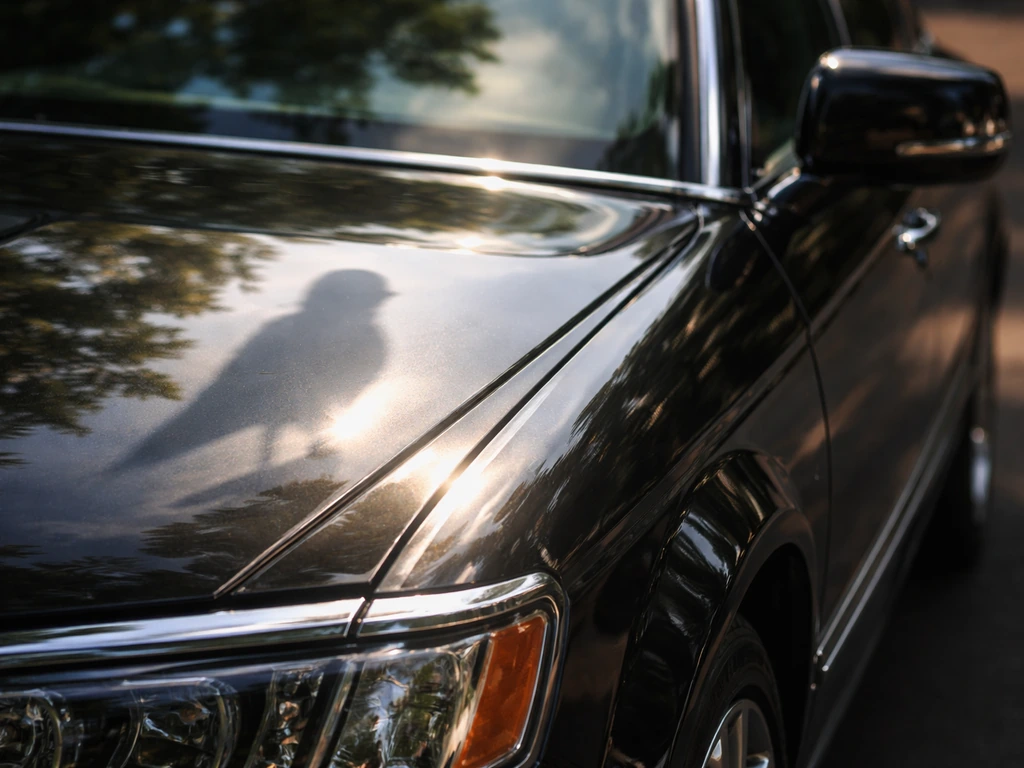
Reflections and shiny surfaces
This is the most common culprit. Your side mirrors, chrome trim, polished paint, and even the windshield at certain angles can produce a reflection vivid enough to fool a bird into thinking another bird is encroaching on its territory. The behavior is almost always tied to breeding season because that's when territorial instincts peak. Wildlife Illinois confirms that altering the reflective quality of the attacked surface is the single most effective intervention.
Heat and shelter
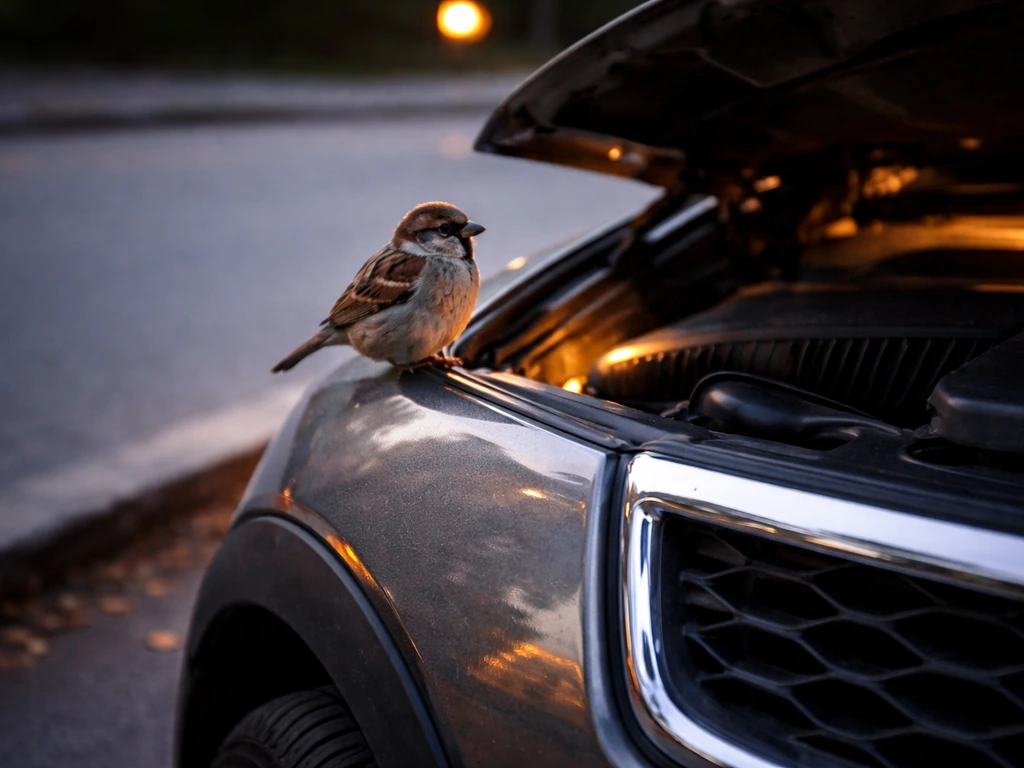
Engines retain heat for hours after you park, and that warmth radiates upward through wheel wells, grilles, and gaps around the hood. On cool mornings you may notice a bird sitting very still on a tire or tucked near the front grille. If you want the quickest answer, focus on whether the bird is reacting to a reflection, seeking heat, or going after food or a nesting spot. It's not after your car specifically, it's after warmth, and it will use any warm surface it can find.
Food sources
Insects accumulate around headlights, especially if you park under lights at night. If you've driven through areas with bugs or roadkill, scent can linger on the undercarriage. Seed spills in a truck bed or seeds stuck in a grille from driving through vegetation are all real attractants. Corvids (crows and jays) are sharp enough to remember specific cars that have provided food before.
Drumming and communication
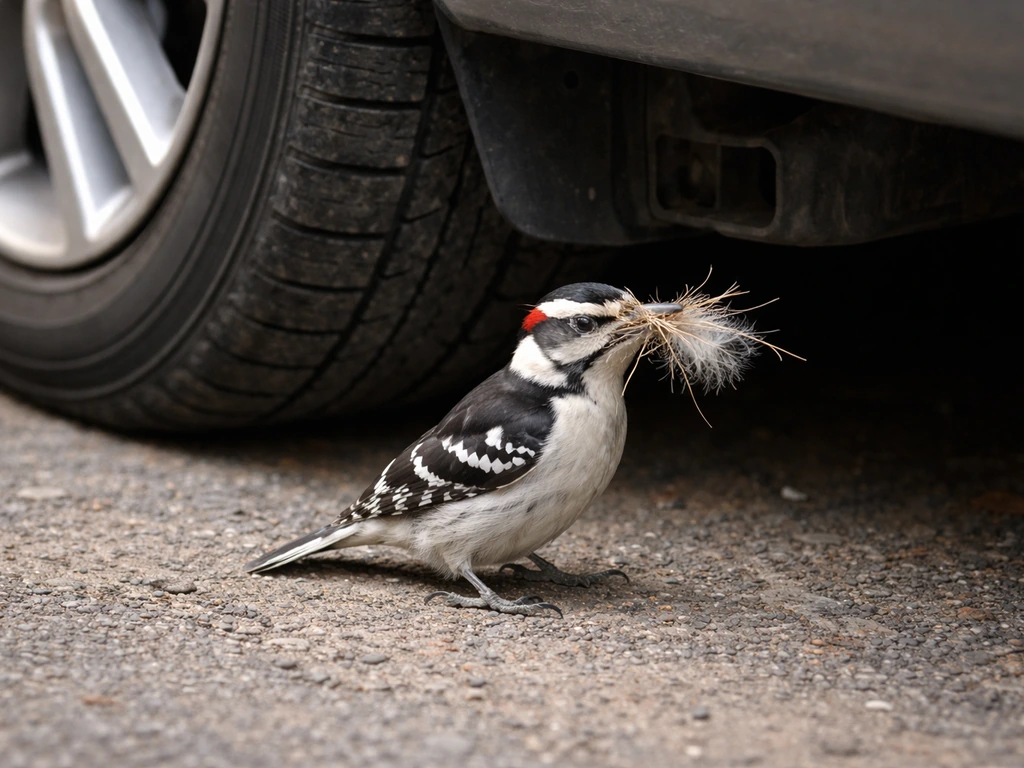
Woodpecker drumming on your car is not the bird trying to find bugs in your sheet metal. As Audubon explains, drumming serves the same function as song does for other birds: it declares territory and attracts mates. Metal surfaces are louder than wood, which makes your car an irresistible amplifier, especially at dawn. Research published in Frontiers in Ecology and Evolution confirms that drumming is a territorial signal produced especially as birds settle and defend breeding territory.
Nesting attempts
If you see a bird carrying grass, twigs, or feathers toward your car, or notice debris building up in the wheel well or under the hood near the air intake, a nest attempt is underway. This is the scenario that escalates fastest from nuisance to genuine problem, and it has legal implications you need to know about (covered below).
How to stop the bird from coming back today
The fix depends on what the bird is doing, so start by matching your deterrent to the behavior you've identified. Here's a practical order of steps.
- Fold your side mirrors in whenever you park. This is Audubon's recommended first response for reflection aggression, and it costs nothing.
- Cover mirrors with paper bags or old socks if folding isn't enough. The goal is to break the reflection entirely, not just reduce it.
- Move the car. If you have a garage or an alternate parking spot that takes the car out of the bird's perceived territory, use it for two to three weeks until breeding season intensity drops.
- Apply a non-reflective film or tape to the attacked area temporarily. Even strips of painter's tape across a mirror will disrupt the reflection enough to stop the behavior.
- Use visual deterrents near (not on) the car: hanging reflective tape, old CDs, or predator silhouettes on a nearby fence or post can shift the bird's attention away from your car.
- Block access to wheel wells and the area under the hood with wire mesh or hardware cloth if a nest is forming, but only before any nest or eggs are present.
- Remove food sources: clean out seed or food debris, address any insect accumulation around headlights, and check whether a nearby light source is drawing bugs at night.
- For woodpecker drumming, try attaching a piece of foam weather stripping or a rubber mat to the spot being drummed. Removing the resonance takes away the appeal.
A few things to avoid: never use sticky traps or glue products near birds, don't use fake plastic owls without moving them regularly (birds adapt to static decoys within days), and don't try to scare the bird with loud noises repeatedly as this causes stress without solving the underlying trigger. Harmful deterrents are not just cruel, many are illegal under federal law.
When to actually worry: damage, health, and legal issues
Paint and trim damage
A bird pecking at a mirror or windshield repeatedly can scratch chrome, chip mirror housing plastic, and leave paint gouges over time. Droppings are more damaging than most people realize: bird uric acid etches automotive clear coat quickly, especially in summer heat. If a bird has been roosting on your car regularly, clean droppings as soon as possible using a damp cloth rather than dry wiping, which scratches the surface.
Health considerations from droppings
Accumulated bird droppings carry a real but often overstated health risk. The CDC notes that the most effective way to prevent exposure to histoplasmosis (a fungal infection associated with bird and bat droppings) is to prevent droppings from accumulating in the first place. If you do need to clean a significant accumulation, the CDC recommends wetting the area first to prevent dust and airborne particles rather than dry-sweeping or blowing the material. For a normal day-to-day roosting situation, basic hygiene is enough.
Active nests and federal law
This is where things get serious. Most birds in the US are protected under the Migratory Bird Treaty Act (MBTA), and the US Fish and Wildlife Service is clear: it is generally illegal to destroy an active nest, eggs, or chicks without a federal permit. Permits are typically issued only when a nest poses an immediate health or safety hazard. If you find a nest already established in your wheel well or under the hood, do not remove it yourself.
Contact your local wildlife rehabilitator or animal control agency, describe the situation, and get guidance. You generally must wait until the nest is inactive (young have fledged) before removing it. Blocking access points before a nest forms is legal and smart; removing one after the fact is not, without authorization.
The spiritual and symbolic side of a bird fixating on your car
On a website like this one, it would feel incomplete to stop at biology. Many people asking why a bird is obsessed with their car are sensing something beyond the practical, and that instinct is worth honoring. Across traditions, birds appearing repeatedly in unexpected places are often read as messengers or signs, and a bird that keeps returning specifically to your vehicle (something tied to your movement through life) carries its own symbolic weight.
In Christian tradition, birds carry deep symbolic meaning. The dove is the most recognized symbol of the Holy Spirit, rooted in the Gospel accounts of Jesus' baptism where the Spirit descends in the form of a dove (Luke 3:22). The Biblical Archaeology Society notes that the dove became a central Christian symbol precisely because of this moment, and it carried the meaning of peace, divine presence, and blessing into centuries of art and liturgy. A bird appearing persistently near you, particularly a gentle or recurring visitor, has been interpreted by many Christians as a reminder of spiritual presence or watchful care.
In Celtic folklore, birds were liminal beings, creatures that moved between the human world and the Otherworld, carrying messages between the living and the dead or between the seen and unseen. A bird that refuses to leave your space was sometimes read as a message that demanded attention before it would release you. Indigenous traditions across North America, Africa, and Asia similarly treat persistent bird visits as communications from ancestors or spirit guides, though the specific meaning varies enormously by tradition, species, and context.
In a more metaphysical or intuitive framework, some readers find meaning in the specific species involved. A cardinal repeatedly appearing is often associated in contemporary American folk spirituality with a loved one who has passed, sending reassurance. A crow returning to your car might be interpreted through the lens of transformation, intelligence, or a prompt to pay attention to something you've been avoiding. A robin, often a symbol of new beginnings in European and North American folklore, showing up at the start of a new season or life chapter can feel like validation.
What's worth sitting with is the question the encounter raises for you personally. The biology explains the mechanism. The symbolism, across all these traditions, asks what you might be meant to notice. These aren't mutually exclusive. A Northern Cardinal attacking your mirror because of territorial instinct is also, if you're open to it, a flash of startling red arriving at your car every morning, asking for your attention. What you do with that is yours to decide.
If the bird's behavior connects to sibling themes you've been exploring, like why a bird keeps coming to your house, why a bird keeps sitting on your car, or why a bird seems to be trying to get inside your car, the symbolic thread running through all of them is similar: persistent presence, boundary-crossing, and repeated return.
If you are also wondering why a bird keeps coming to your house instead of your car, the same approach can help you pinpoint the trigger and choose the right fix why does the same bird keep coming to my house. Many spiritual traditions treat repetition as the key signal. One visit is coincidence. Three visits in the same week is a pattern worth noticing.
What to do next: observe, document, and act
Whether your priority is stopping the behavior, understanding the species, or reflecting on the encounter's meaning, the same first step applies: pay attention and write it down. A few days of notes will tell you more than any single observation.
- Note the time of day the bird appears. Early morning visits often signal territorial behavior tied to dawn activity. Midday visits are more likely foraging.
- Record the exact location on the car. Mirror attacks point to reflection aggression. Roof or hood drumming points to woodpecker territory display. Grille or undercarriage interest points to food or warmth.
- Describe what the bird looks like and what it's doing, even a rough description helps narrow the species.
- Track how many days in a row the behavior occurs and whether it's escalating or staying consistent. Breeding-season aggression usually peaks and then fades within a few weeks.
- If a nest is forming, photograph it and document the date before contacting wildlife services.
- If the bird is injuring itself against your car, contact a local wildlife rehabilitator. Repeated impact against a hard surface can injure birds even if they look unhurt.
For most people, the practical fix (fold the mirrors, cover the reflection, move the car) resolves the situation within a week. Audubon recommends getting rid of the reflection as the simplest way to stop a bird attacking its reflection, and for vehicles targeted at mirror reflections, folding mirrors in can be an effective first fix. If it persists past breeding season, or if you're dealing with a nest, escalate to your local animal control office or a licensed wildlife rehabilitator who can assess the situation and advise within the law. And if you find yourself pausing in the parking lot each morning watching this bird and wondering what it's trying to tell you, well, that impulse is worth following too.
FAQ
How can I tell whether it is a reflection problem or it just likes warmth/food on my car?
Yes. If the bird is hitting reflections, you can usually solve it faster by covering or using the car’s anti-glare strategy (tilt mirrors inward, avoid leaving polished panels exposed, and park so the windshield does not face open sky or a reflective surface). If heat or insects are the lure, reflection fixes will not change the behavior, so confirm which trigger you’re seeing before buying deterrents.
Why does the bird keep coming back even after I tried one thing once?
Treat “days in a row” as a clue, not a mystery. During spring and early summer, territorial birds often return to the same surface each morning. If it keeps coming back past the local breeding window, switch your focus to the non-seasonal attractants (food debris, nesting materials, drips, or insect buildup around the grille).
What if more than one bird is involved, or I keep seeing different species?
Do not assume a single bird means a single solution. Different birds may target different parts of the car (one pecks mirrors, another roosts on the hood, another scavenges on the bumper). Photograph the bird when it arrives and note the exact behavior (pecking, drumming, roosting, nest-building). That prevents you from applying the wrong deterrent to the wrong visitor.
Does weather affect why a bird targets my car?
Winter and rainy weather change the attraction. On cool mornings, heat-roosting is common, so blocking access and removing lingering warmth sources matters more than reflection covers. After rain or AC condensation, focus on eliminating consistent water sources (fix leaking lines, clean pooled water near the front, and clear debris that holds moisture).
Can I move the car to figure out what’s attracting the bird?
A good test is to relocate the car 10 to 30 feet (or park in a different spot) for 2 to 3 days while you observe. If the bird follows the car, it is likely reacting to warmth, drips, or a consistent food source. If it stays with the original location, it is probably tied to a specific reflective surface or nearby nesting area.
What’s the safest way to clean bird droppings to avoid damaging the paint?
Yes. The fastest “no-complication” approach for droppings is to wet the area first, then gently wipe with a damp cloth, and avoid abrasive pads. If stains are already baked on, use an automotive-safe cleaner designed for bird droppings, then re-wax or apply a protective sealant to reduce future etching.
When should I stop DIY cleaning and get professional help?
Spot cleaning is fine, but avoid dry-sweeping, blowing, or vacuuming dusty droppings, especially if you have a heavy accumulation. For significant mess, wear protective gear (gloves and eye protection), keep the area wet, and dispose of waste properly. If you have to tackle a large buildup under the hood or in crevices, consider getting a professional detailer.
I found grass or debris around the hood or wheel well. What should I do next?
If you discover a nest or the bird is clearly carrying nesting material, stop any removal attempts immediately. In the meantime, you can usually prevent a future nest by installing exclusion methods after the area is confirmed inactive, such as temporarily blocking access points with appropriate barriers recommended for the specific vehicle area.
Is it ever legal to remove an active nest if it seems like it’s damaging my vehicle?
You should not remove an active nest or eggs yourself in the US without the right federal authorization. If there are immediate hazards (for example, nest materials blocking a critical vent, or a situation creating a safety risk), contact local animal control or a wildlife rehabilitator and describe the exact location (under hood, wheel well, inside grille) and current activity level.
How quickly can the bird damage my car, and what should I do first to prevent more?
If the bird is pecking repeatedly, window and mirror scratches can happen surprisingly quickly, and droppings can etch clear coat in hot weather. Start with a behavior-matched fix immediately (mirror coverage or relocation for reflection issues, exclusion for nesting/roosting). If damage has already started, have a body shop assess chips or clear coat etching before rust begins in any exposed areas.