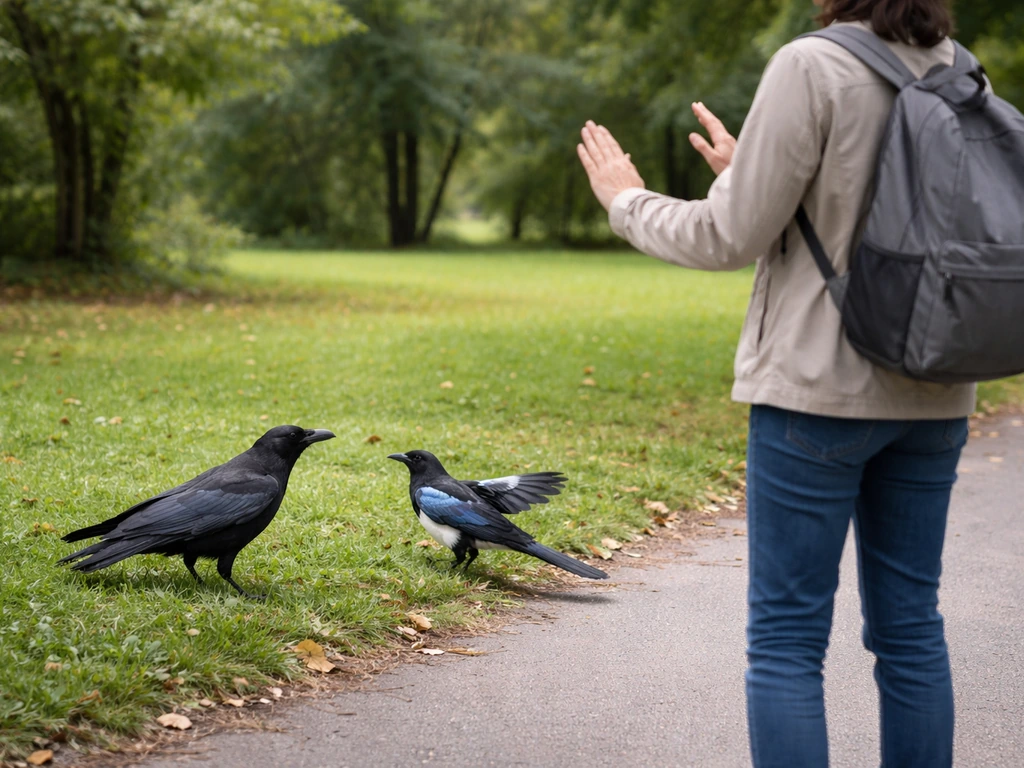
A bird staring at you usually means one of a handful of things: it's sizing you up as a potential threat, it's curious about whether you have food, it's defending a nearby nest, or it's reacting to something unusual in its environment. That's the short answer. The longer answer depends on how the bird is standing, what species it is, and what the context looks like. And if you're someone who feels like the moment carried a certain weight, there's a whole other layer worth exploring too. This guide covers both.
What Does It Mean When a Bird Stares at You? Meaning
Maya Hartwell
17 Apr 2026
Why birds stare: the most likely natural reasons
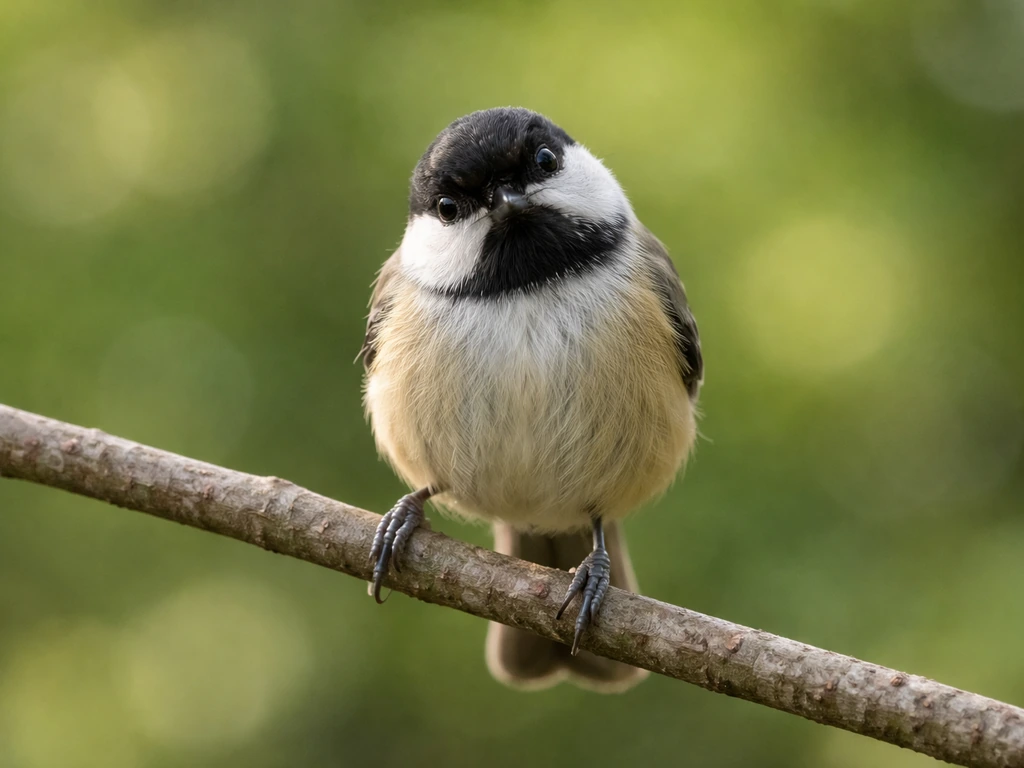
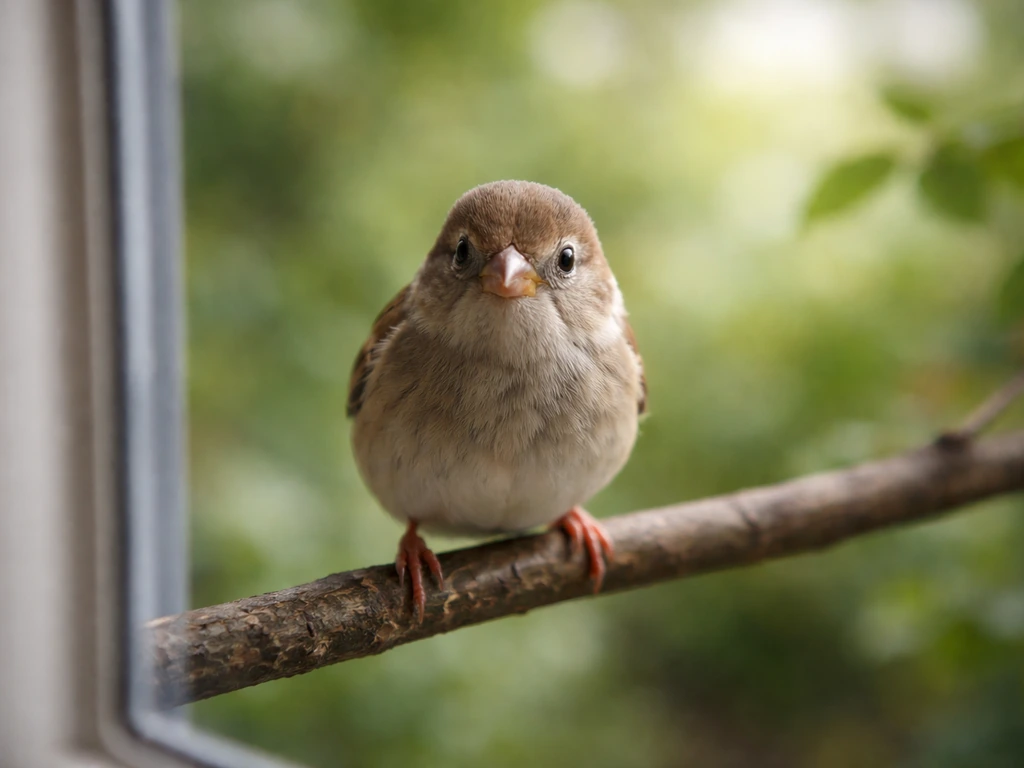
Birds don't have the full range of facial expressions mammals do, so eye contact and body orientation are two of their primary tools for gathering information about the world. When a bird locks eyes with you, it's almost always doing one of the following: assessing whether you're a predator, deciding whether you're a food source, warning you that you're too close to something it's protecting, or simply learning what kind of creature you are. Wild birds that live near humans (sparrows, robins, crows, pigeons) are especially good at reading people. They've been watching us for generations.
Curiosity is genuinely common. Birds are intelligent and observant, and some species, crows and jays especially, will stare at you for a surprisingly long time while working out if you're worth approaching. If you've been feeding birds regularly in your yard, that steady gaze is often more of a polite request than anything threatening. The bird knows you. It's watching to see what you'll do next.
Territorial and nesting behavior is the other big driver, and it tends to feel more intense. During breeding season, a bird that stares without looking away is frequently telling you that you're standing in or near its territory. This is especially true for species like the Northern Mockingbird, American Robin, Gray Catbird, and Blue Jay, which are known to be particularly assertive about their nesting zones. Terns, gulls, and several hawks and raptors will also attempt to intimidate intruders near nesting areas. The stare is the first warning. What comes next depends on whether you take it.
Body language cues that tell you what's actually going on
Reading a bird's posture alongside its gaze gives you the clearest picture of its intent. A calm, curious bird will usually hold a relaxed body position, maybe tilt its head slightly, and stay at a comfortable distance. It might hop closer, then back off a little, in that classic exploratory pattern. That kind of stare is benign.
An agitated or defensive bird looks completely different. Key aggression indicators documented by avian veterinary specialists include: feathers puffed up around the head and shoulders, wings held out away from the body, tail fanned wide, eye pinning (rapid dilation and contraction of the pupil), mouth open, and the bird actively lunging or running toward you. White facial skin flushed and feathers slicked tightly back are also signs the bird is in a heightened stress state. If you're seeing more than one or two of those signals together, the bird is not just watching you out of curiosity.
Species matters too. A crow staring at you from a tree branch is probably curious or cautious. A robin standing between you and a low hedge with its chest puffed up is almost certainly defending a nest. A raptor holding eye contact from a post while you walk by is likely doing what raptors do: monitoring everything in its hunting territory. Knowing a little about the bird in front of you, even just a rough identification, helps you interpret the gaze correctly.
When staring is most likely to happen (and why)
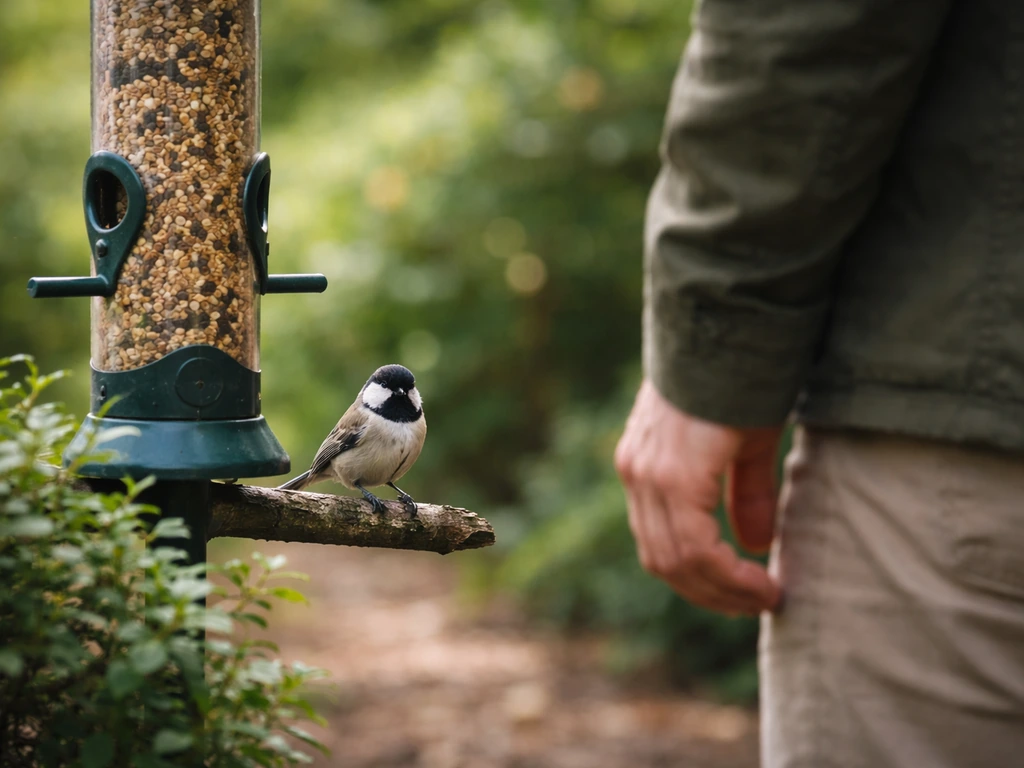
There are four situations where a bird locking eyes with you is especially common, and each one calls for a slightly different response from you.
- Feeding situations: You're near a feeder, you're eating outside, or you've fed birds in this spot before. The bird is watching for an opportunity, not issuing a challenge.
- Nesting season (spring through mid-summer): A bird near its nest will watch you intently from the moment you enter its perceived territory. The stare is a first warning before escalation to swooping or diving.
- Territory defense outside nesting: Some birds, mockingbirds especially, defend feeding and roosting territory year-round. A fixed stare while the bird sings repeatedly is a classic territorial display.
- Mating and courtship: During breeding season, birds are acutely aware of other creatures in their space. Heightened alertness and direct eye contact are part of this seasonal intensity.
- Something is wrong: A bird staring without fleeing, especially at close range, can sometimes indicate injury or illness. Healthy wild birds maintain a flight distance from humans. If the bird won't move even when you approach slowly, that's worth paying attention to.
What to actually do based on the situation
When it's harmless
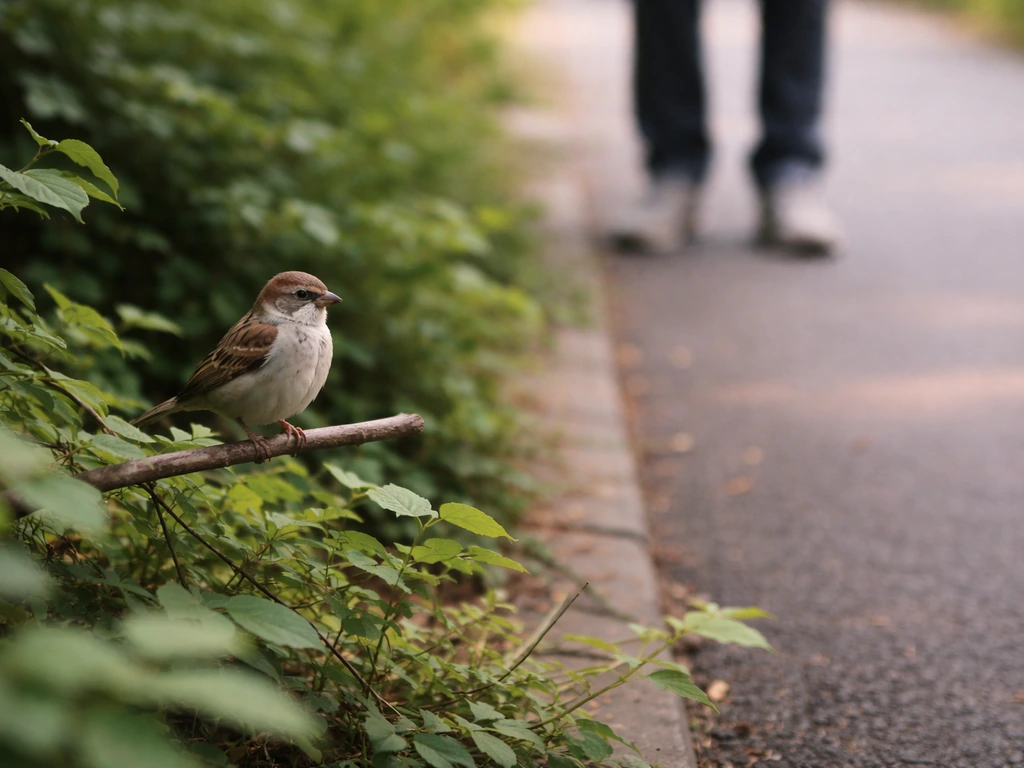
If the bird looks calm, is keeping its distance, and isn't showing any of the aggression signals listed above, the right move is simply to enjoy the moment and leave it alone. Don't approach, don't try to feed it from your hand unless that's an established pattern with this bird, and avoid sudden movements or loud sounds. Most bird stares in this category resolve themselves in under a minute.
When it might be territorial or aggressive
If you're getting the full defensive posture, or if this is spring and you're near low shrubs, hedgerows, or a ground-level area where a nest might be hidden, back away slowly and calmly. Don't make eye contact, don't wave your arms, and don't try to scare the bird off. For nesting birds especially, trying to intimidate or displace them tends to escalate the situation rather than resolve it. Keep children and pets well back. If aggressive birds are consistently using a path or public area, contact your local wildlife agency rather than trying to manage it yourself. This is especially common advice for situations involving nesting geese or particularly territorial raptors.
It's also worth knowing that some birds attack their own reflection in windows or vehicle mirrors during breeding season, which can look like the bird is staring intensely at something inside your home or car. This is a territorial response to what the bird perceives as a rival. It isn't directed at you personally, but repeated window collisions can stress the bird significantly, cause bill injuries, or in some cases be fatal. If this is happening at your home, covering or breaking up the reflective surface on the outside (with tape, decals, or fabric) is the recommended fix.
When you're worried the bird is sick or injured
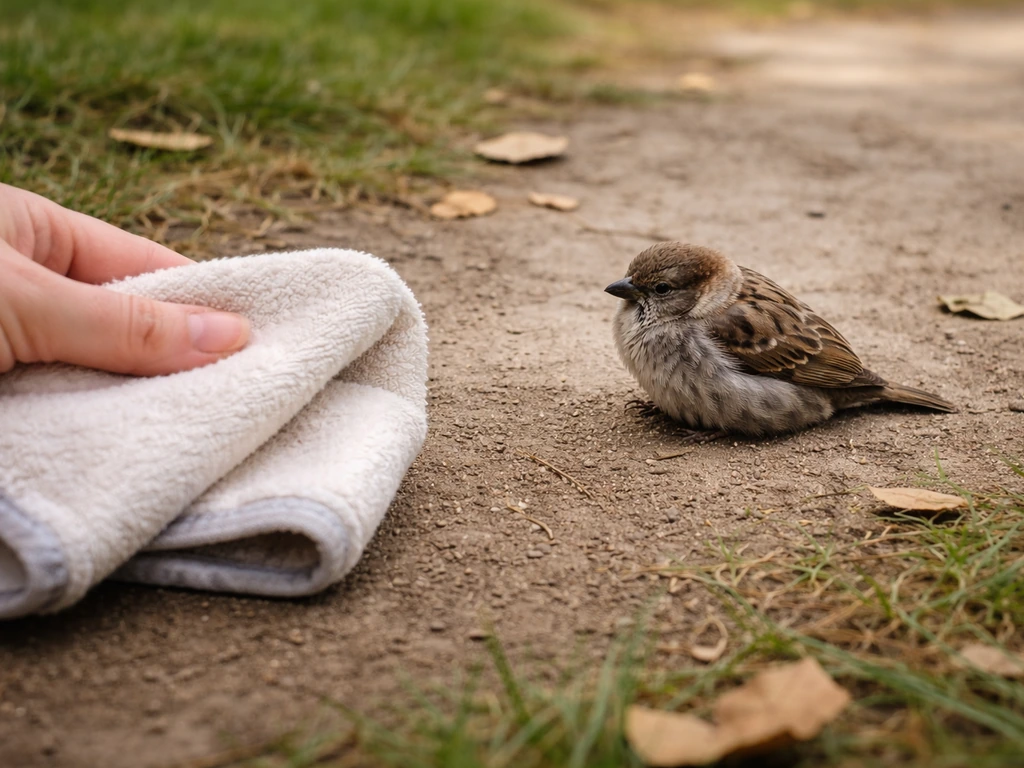
A bird that won't flee, that sits on the ground staring at nothing in particular, or that is tilting its head abnormally or moving unsteadily needs help. Do not attempt to feed it water or food, and avoid handling it without disposable gloves. Before you try to pick it up, prepare a box: a cardboard shoebox with air holes, lined loosely, placed in a dark and quiet location away from people and pets. Minimizing handling and keeping the environment calm reduces trauma significantly. Then call a licensed wildlife rehabilitator or local wildlife veterinarian as soon as possible. If you find a bird that has hit a window and is stunned but not visibly injured, contain it the same way and monitor it in a quiet space for an hour or two before calling a rehabber.
One important note: a bird that appears very still and unafraid does not necessarily mean it's comfortable around you. Freezing is often a fear response, not a sign the bird is tame or tolerating your presence. If a bird is frozen and staring, treat it as distressed until you have reason to think otherwise.
How different traditions interpret a bird's gaze
Once you've ruled out a practical explanation, or even alongside one, it's completely natural to wonder if the moment carried some kind of meaning. Across many cultural and spiritual traditions, birds are understood as messengers, and sustained eye contact specifically is often seen as the bird delivering that message directly. Here's how some of those frameworks interpret the encounter.
| Tradition / Framework | Common Interpretation of a Bird Staring at You |
|---|---|
| Biblical / Christian folk tradition | A bird's gaze is sometimes understood as a reminder of divine watchfulness or presence. Birds appear throughout scripture as signs of God's attention (Matthew 10:29). |
| Celtic tradition | Birds were seen as souls or spiritual emissaries crossing between worlds. A bird that holds your gaze was thought to be carrying a message from the Otherworld or from an ancestor. |
| Indigenous / Native American traditions (varies widely by nation) | Many traditions hold that birds are spiritual relatives or messengers. A bird that stops to look at you directly may be delivering guidance, a warning, or a reminder to pay attention to something in your life. |
| Eastern / East Asian folklore | Certain birds, cranes, owls, and swallows among them, are associated with wisdom, longevity, or impending change. A bird that stares is sometimes interpreted as an invitation to reflect. |
| General spiritual / New Age framework | Sustained bird eye contact is often read as a sign that a message is meant for you: guidance, reassurance, a prompt toward awareness, or occasionally a warning to slow down and reconsider something. |
| Folklore (Western European) | A bird staring through a window or directly at a person was historically interpreted as an omen, sometimes of news arriving, sometimes of a transition (good or difficult) on the way. |
Some traditions treat certain species as carrying distinct meanings. Crows and ravens, for example, are frequently associated with both protection and warnings in Celtic and indigenous frameworks. A hawk holding your gaze is often read as a message about vision, focus, or a call to see something you've been avoiding. An owl staring at you, especially in daylight, is treated in many cultures as a significant omen requiring reflection. These aren't certainties. They're interpretive lenses, and you're always the one deciding whether they resonate.
There's a broader spiritual framing worth mentioning here too. In many traditions, birds function as a kind of bridge between the physical and spiritual worlds. That moment of eye contact, where a wild creature pauses and seems to truly see you, is treated as a two-way interaction: the bird is asking for your attention, and the question becomes what you're being called to notice. This is part of a much larger conversation about what it means when birds interact with humans in unusual ways. If you've had the experience of a bird not just staring but landing on you, that's generally interpreted in spiritual traditions as an even more direct form of contact or blessing.
The spectrum of bird encounters: where staring fits
It helps to think about bird eye contact within a wider range of possible interactions. A bird staring at you from a distance is at the gentler, more observational end of the spectrum. Things escalate from there. If you're wondering about what it means when a bird's behavior becomes more direct, like when a bird flies into you, or more confrontational, like when a bird attacks you outright, those encounters carry their own specific interpretations, both practical and symbolic. Even when a bird attacks your head specifically, there's a mix of nesting biology and symbolic tradition worth understanding. And at the calm end of the scale, when a bird sits on you quietly, many traditions consider that one of the most significant and personally meaningful encounters possible. The stare is often a beginning, a moment of mutual recognition before whatever comes next. In a PubMed-published study on wild magpies, researchers found that birds can recognize individual humans linked to nest access, supporting the idea of individual recognition in wild settings mutual recognition before whatever comes next.
How to reflect on the experience and find your own meaning
Whether you're spiritually curious or more practically minded, there's real value in pausing after an unusual bird encounter and asking a few grounding questions before you decide what it meant (or didn't mean) for you.
Start by noticing the context: What time of day was it? What species was the bird? Where were you, and what were you thinking or feeling just before the encounter? Patterns matter here. A single staring bird in spring, near your garden, probably means you've walked near a nest. The same species staring at you in the same place over several consecutive days, in a way that feels different from ordinary wildlife behavior, is the kind of repetition that many spiritual traditions say is worth taking seriously.
Journaling is one of the most practical tools for this kind of reflection, not because it gives you answers, but because it surfaces patterns you might miss in the moment. Try recording the encounter with a few simple data points: the date and time, the species if you know it, your emotional state, and a word or two about what was happening in your life that day. A structured approach, something like noting the emotion you felt, its intensity on a scale of 1 to 10, and the context around it, builds a picture over time that raw memory can't hold. After a few entries, you may notice that certain birds appear during certain kinds of days, which is meaningful information whether you interpret it spiritually or psychologically.
If prayer or meditation is part of your practice, the bird encounter can serve as a simple entry point. Sit quietly for a few minutes, breathe, and ask what the bird's appearance might be drawing your attention toward. You're not looking for a cosmic answer delivered to your inbox. You're creating space for your own intuition to surface something you already know. Notice where your mind goes. Notice whether it feels like guidance, reassurance, a warning, or nothing in particular. Trust that reading.
And if none of the spiritual framing resonates, that's completely valid too. A bird that stared at you was still a moment of genuine contact with a wild creature, which is quietly remarkable on its own terms. You don't need a metaphysical framework to appreciate that.
The most honest answer to what it means when a bird stares at you is this: practically, it means the bird is paying attention to you, for reasons that are almost always traceable to food, territory, nesting, or curiosity. Spiritually, across dozens of traditions, it means you've been seen, and something in that exchange is worth your attention in return. What you do with either of those answers is entirely yours to decide.
FAQ
What should I do if a bird locks eyes with me but doesn’t look puffed up or aggressive?
If the bird is staring but staying at a distance, the safest default is to remain still, give it space, and avoid eye contact escalation (no waving or shooing). In many species, a long stare with a relaxed posture is “information gathering,” and sudden movements are what usually turn it into a defensive event.
How can I tell if a bird’s staring is about a nest versus general curiosity?
Treat repeated or worsening eye contact differently than a one-off stare. If the bird keeps repositioning to block your path, hovers low, or “faces” you while hopping around, that’s often territorial nesting behavior, and backing away slowly without eye contact is usually the best response.
Does feeding birds make them more likely to stare at me, and how do I adjust my behavior?
If you are outside feeding birds regularly, a stare can be a learned association with food, but it can also be territorial once young are present. A practical check is to pause and watch whether it tracks you toward a specific spot (feeding area) or toward an unseen nest location (hedge, low shrubs, ground).
If a bird looks totally still and doesn’t seem afraid, is it safe to approach?
Yes, posture matters. A frozen, very still bird can be fear-based and still dangerous or stressed, especially if it later bolts abruptly or shows other stress cues. If you see freezing plus other indicators like flattened posture, tail fanning, or wing spread, assume it is not comfortable and increase distance.
Is it okay to offer food to a bird that keeps staring at me?
Avoid hand-feeding unless it’s an established, species-appropriate pattern and you can do it without drawing the bird closer to nests. Hand-feeding during breeding season often increases the chance of defensive behavior, and even “friendly” approaches can teach birds to approach humans in unsafe ways.
How can I tell if the bird is staring at me or actually seeing its reflection in my window or car mirror?
Window or mirror “staring” is common and often looks like intense focus indoorsward. If the bird is repeatedly striking the same surface, the fix is to reduce reflections on the outside (covering, taping, decals, or fabric barriers) and then watch for the bird to stop returning to that exact spot.
What should I do if the bird is staring and not flying away after I notice it?
Do not assume the bird is healthy. A bird that won’t flee, sits on the ground, tilts abnormally, or moves unsteadily can be stunned, sick, or injured, and even giving water can worsen stress or aspiration risk. Use a prepared ventilated box, keep it dark and quiet, and contact a licensed wildlife rehabilitator or local wildlife veterinarian promptly.
What’s the safest way to move past a nesting bird that’s staring at me from a walkway?
If the bird seems stressed, your goal is distance plus calm, not reassurance. Keep pets and children back, move slowly, and give the bird a clear exit route. If it’s a nesting goose or a territorial raptor using a public path, contacting your local wildlife agency is often better than trying to manage the situation yourself.
What if the same bird stares at me repeatedly in the same spot over several days?
Look for patterns across time and location. If the same species stares at you from the same place on multiple days, especially during breeding season, it’s more likely to be nesting or territory-related than random curiosity, and you should treat it as a “watching boundary” rather than a temporary mood.
How do I reflect on the spiritual meaning without ignoring the practical causes?
If you want to interpret it spiritually, use “ground truth” first: time of year (breeding season), species, and what you were near (hedge, shrubs, pathway). Then decide whether the experience feels like guidance, warning, or nothing, without forcing it into a single meaning based only on eye contact duration.
Next Article
What Does It Mean When a Bird Attacks You and What to Do
Bird attacks explained with safe steps, reasons by species, and optional spiritual meanings to interpret calmly.