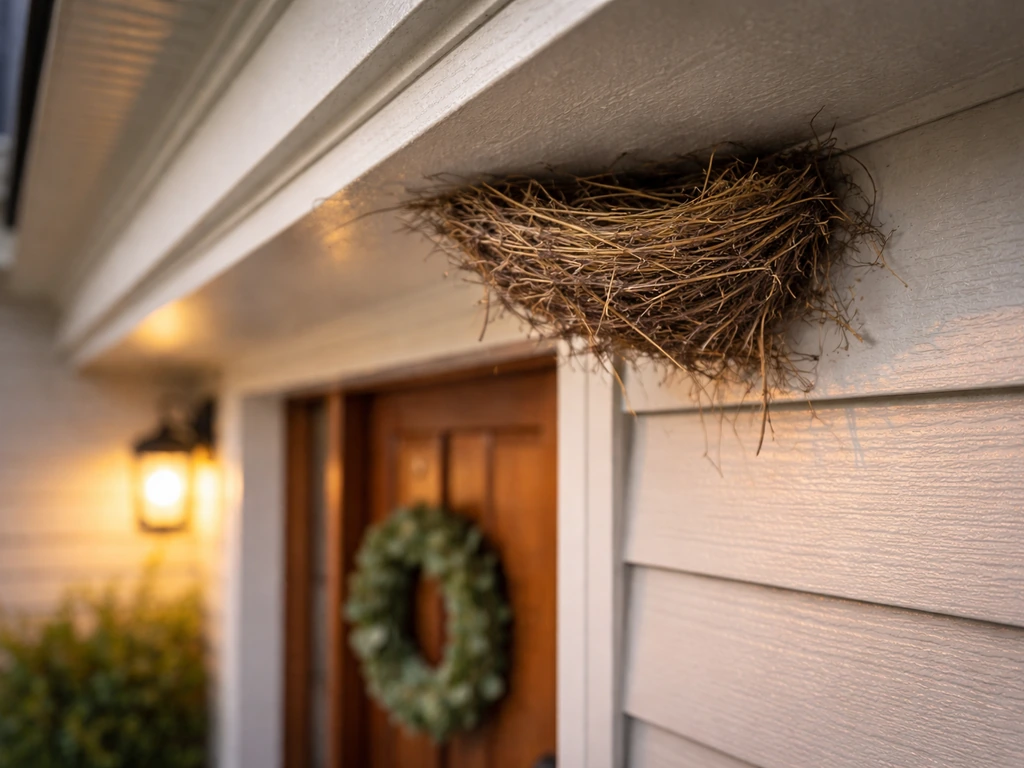
A bird nest in front of your house almost always means something good is happening, whether you read that as a simple act of nature or a deeper symbolic message. In practical terms, birds choose the front of homes because they offer shelter, structural support, and safety from predators. In symbolic terms, nearly every culture that has ever paid attention to birds agrees: a nest near your door is a sign of blessing, protection, and new beginnings. Both readings can be true at once, and this guide will walk you through everything you need to know right now, starting with where exactly the nest is.
Bird Nest in Front of House Meaning: Practical and Spiritual

Maya Hartwell
21 Apr 2026
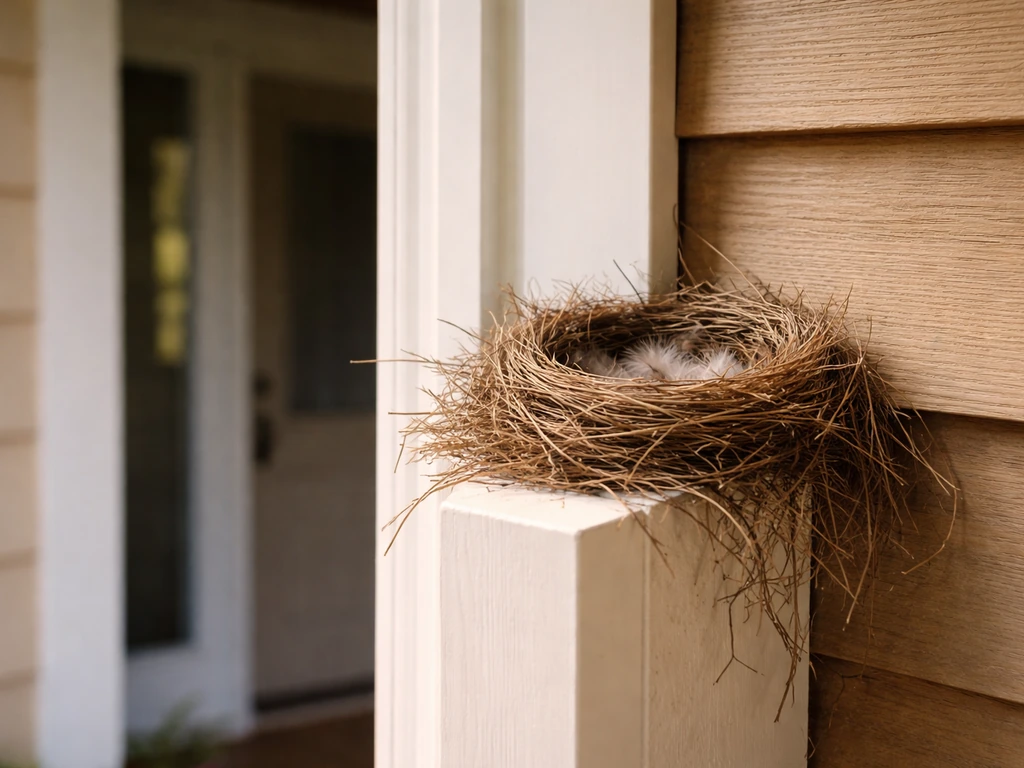
What the Location Actually Tells You
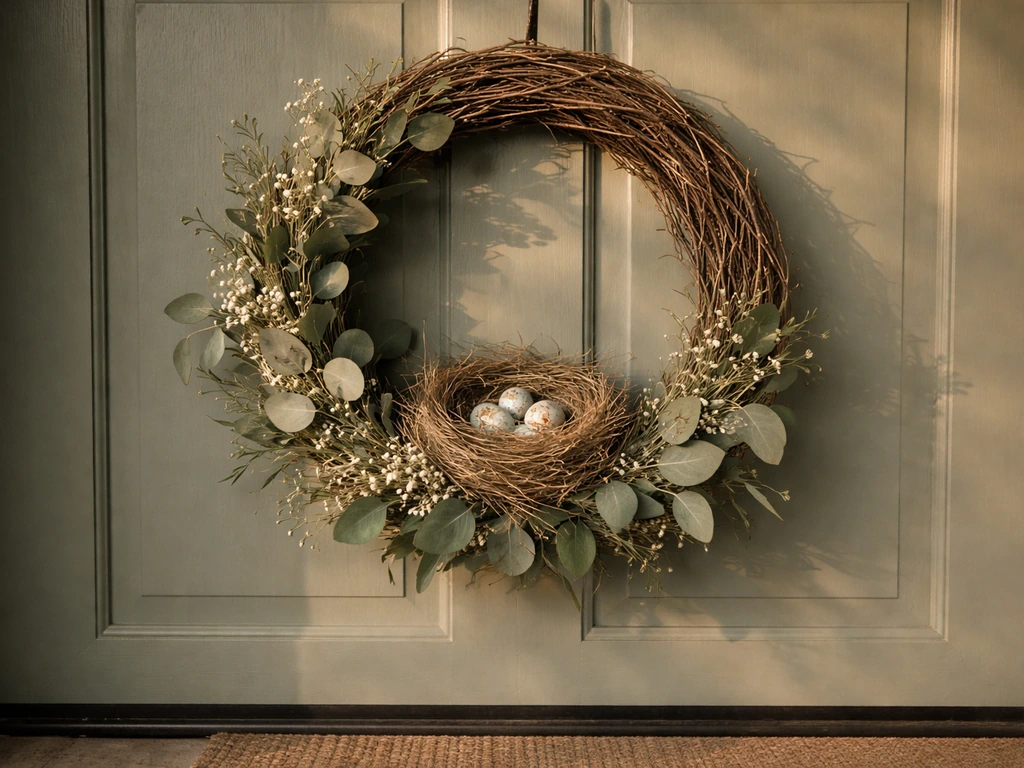
Location matters a lot, both practically and symbolically. A nest tucked into a door wreath sits in a very different context than one built under your porch eave or inside your attic. Here is a quick breakdown by placement so you can orient yourself immediately.
| Nest Location | Practical Situation | Symbolic Reading |
|---|---|---|
| On or in the front door / door wreath | Usually a small songbird (robin, finch, phoebe) drawn to the structure and shelter of a wreath or door frame. High foot traffic can stress the bird. | Strongly tied to threshold symbolism: blessings entering the home, protection of the household, new beginnings at the literal doorway of your life. |
| Above the front door (eave, light fixture, beam) | Swallows, phoebes, and robins favor overhangs. Mud or cup nests are common. Droppings on the doorstep are likely. | A guardian presence watching over all who enter and leave. Many traditions see this as the bird choosing to align its family with yours. |
| On the front porch (rafter, column, hanging plant) | Same species as above, plus sparrows and wrens. The porch offers more airflow protection than a wreath but more exposure than an eave. | Prosperity and warmth entering the shared space between your home and the outside world. A porch nest often reads as a communal blessing. |
| Near the house (shrub, yard tree, fence) | Any nesting species in your region. Distance from the door reduces direct coexistence friction. | Still meaningful symbolically but slightly less intense than a threshold nest. Think of it as the bird keeping watch over the property rather than the doorway specifically. |
| Inside the house (attic, wall cavity, chimney) | This is an active situation requiring attention. Starlings, sparrows, swifts, and chimney swifts are common culprits. Entry points need to be identified. | Interpreted in some traditions as the bird bringing its family inside yours, a deep intimacy of spirit and household. Practically, it also signals a structural gap that needs addressing after the nesting season. |
The closer the nest is to your front door, the more direct and intentional the spiritual symbolism tends to feel. If you are drawn to meaning-making, that distinction is worth sitting with. If you are primarily concerned with the practical side, the location also determines your urgency: a nest inside your house or directly blocking your entry deserves more active (and careful) management than one in a nearby shrub.
Why Birds Actually Pick Your Front Door or Porch
Birds are not picking your front door because they like you (though it is nice to think so). They are solving a structural problem. A good nest site needs protection from rain, a stable base, proximity to food and water, and some cover from aerial predators. Your porch eave, door wreath, hanging basket, or exterior light fixture checks all of those boxes. Overhangs deflect rain. Wreaths offer a pre-built cup shape. Light fixtures provide a warm, elevated perch. From the bird's perspective, you built a perfect neighborhood.
The most common species you will find nesting in these spots in North America are American Robins, Barn Swallows, Eastern Phoebes, House Finches, House Sparrows, and Carolina Wrens. Robins and phoebes build open cup nests using mud, grass, and plant fibers. Barn Swallows build mud-pellet nests under eaves and return to the same sites year after year. House Finches and sparrows favor dense vegetation, wreaths, and sheltered ledges. Identifying the species helps you know what to expect in terms of timeline and behavior.
How to Tell If a Nest Is Active Right Now
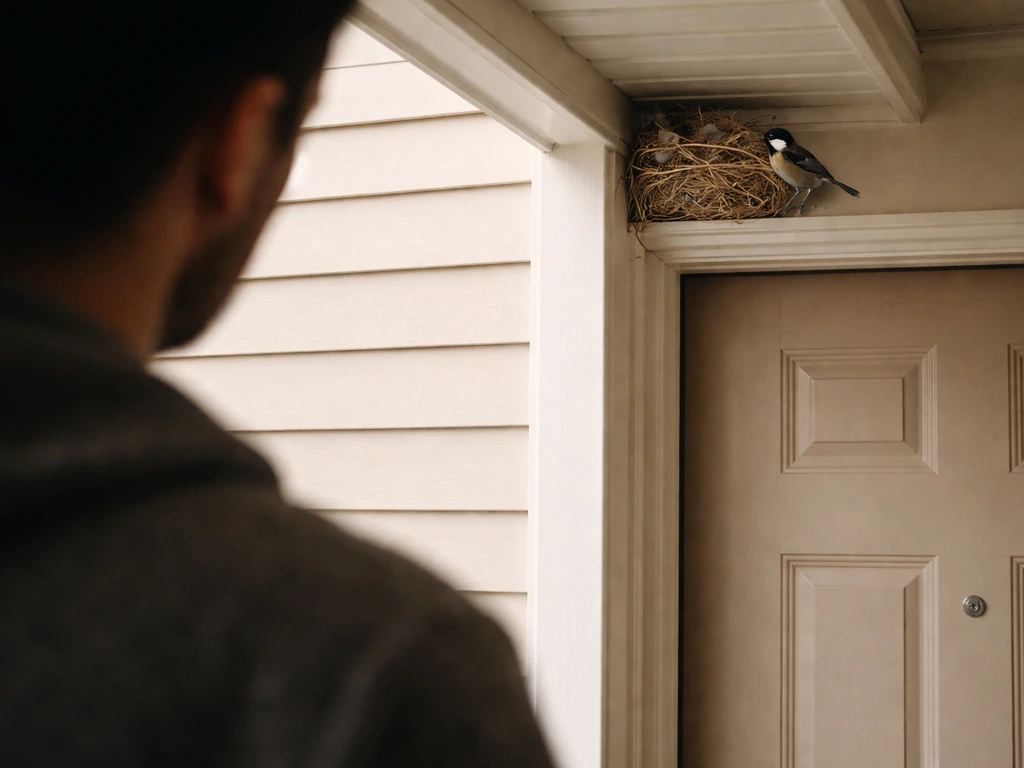
Before you decide what to do, you need to know whether the nest is active. Stand a few feet back and observe for 10 to 15 minutes without getting close. Active signs include: an adult bird visiting repeatedly, eggs visible in the cup, or nestlings (baby birds) with open mouths. A nest that looks tidy and undisturbed but shows no bird activity over several days could be abandoned, but do not assume.
NestWatch specifically warns that people often assume a nest is abandoned simply because eggs have not hatched yet. Incubation can take longer than expected, especially if a bird was temporarily scared off. For an American Robin, incubation runs 12 to 14 days and nestlings stay in the nest another 14 to 16 days before fledging. For a Barn Swallow, [expect roughly 12 to 17 days of incubation and 15 to 27 days](https://www.
allaboutbirds. org/guide/Barn_Swallow/lifehistory) until the young leave. That is a total window of roughly 4 to 6 weeks of protected activity per nesting attempt.
What to Do Right Now: Safe Coexistence Steps
If the nest is active, your job is simple: leave it alone and give the bird as much calm as possible. Here is what that looks like in practice.
- Reduce disturbance at the entry point. If the nest is on or near your front door, use a side or back door temporarily. Repeated startling of the nesting bird can cause abandonment.
- Do not touch the nest, eggs, or young. This is not just courtesy. Under the U.S. Migratory Bird Treaty Act, it is illegal to disturb, move, or remove an active nest of a native migratory bird without a federal permit. The same principle applies in many other countries.
- Keep pets away from the nest area. Cats and curious dogs are a real threat to low-placed nests.
- Note the date. Once you spot a nest, mark it on your calendar. Knowing the species' typical timeline helps you plan. Most nests are vacated within 4 to 6 weeks.
- Skip exterior home projects near the nest until it is vacated. Painting, pressure washing, or hanging new lights can disturb an active nest and is legally risky if it causes harm.
- Watch quietly and enjoy it. Active nesting is genuinely fascinating and over before you know it.
What NOT to Do During Active Nesting
- Do not knock the nest down or relocate it, even a short distance. Birds navigate by memory and may not find a relocated nest.
- Do not use repellent sprays, loud sound devices, or anything designed to scare the bird off while eggs or young are present.
- Do not let well-meaning visitors handle the nest. Spreading the word to family and guests is worth doing.
- Do not seal the entry hole if a bird is nesting inside a wall or attic cavity. Wait until after the birds have fledged and left.
Protecting Your Home: Droppings, Cleanliness, and Preventing Future Entry
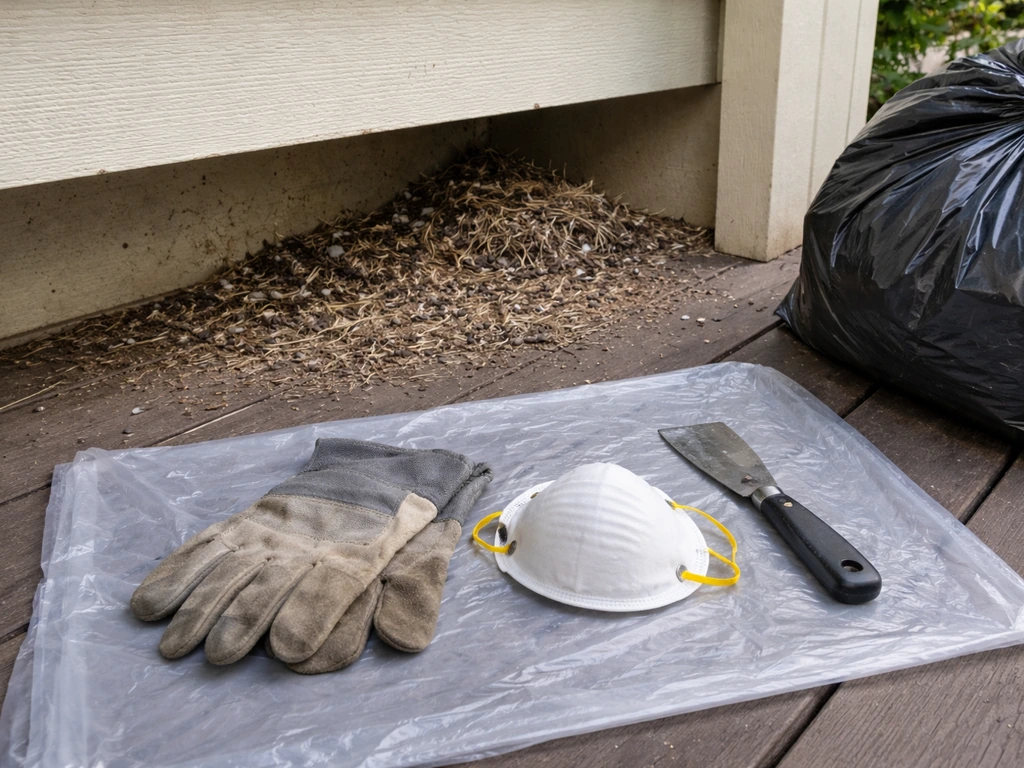
The main practical downside to a nest near your entrance is droppings. Barn Swallows nesting under eaves can produce significant accumulation beneath the nest over a 4 to 6 week season. During active nesting, place a plywood or cardboard sheet below the nest to catch droppings and protect the porch surface. Do not place it so close that it disturbs the bird.
When cleanup time comes after the nest is vacated, do it carefully. Bird droppings can carry Histoplasma capsulatum, a fungal organism that causes histoplasmosis when spores are inhaled. The CDC and NIOSH both recommend against dry sweeping or any method that kicks up dust from dried droppings. Instead, lightly mist the area with plain or soapy water to dampen the material before wiping or scooping it up. Avoid using a high-pressure washer, compressed air, or a standard household vacuum without a HEPA filter, all of which can aerosolize particles. For heavy accumulation (more common under swallow nests than under a single robin nest), consider wearing an N95 mask and disposable gloves.
Once the nest is gone and the season is over, take preventive steps for the following year. For door wreaths, you can store them indoors between seasons so birds cannot start building early. For eaves and light fixtures, consider installing physical nest deterrents (like small angled ledge strips or wire mesh) in late winter before birds begin prospecting, which is typically February through March in most of North America. Do this only after confirming no nest is present. For interior nesting situations like attic entries, chimney openings, or wall gaps, identify the entry points after fledging and seal them before the following nesting season. Chimney caps and dryer vent covers are inexpensive and highly effective.
The Spiritual Meaning of a Bird Nest at Your Front Door or Entryway
For most of human history, a bird choosing to nest at the entrance of a home was considered a significant event. The front door is not just a threshold in architecture; it represents the boundary between your private world and the larger one outside. A bird placing her nest precisely there is, in symbolic terms, an act of alignment. She is choosing to build her future at the same place you enter and exit your life every day. If the bird is in or on the nest, keep your distance and avoid disturbing it while it’s active place you enter and exit your life every day.
Across many traditions, this kind of nest is read as a protective omen. The bird is understood to bring watchfulness, guardianship, and good fortune. More specifically, because a nest holds eggs and eventually new life, it is almost universally linked to beginnings: new projects, new relationships, new phases of life, or domestic happiness coming into form. If you have been waiting for a sign that something new is ready to grow, this is one of the more direct symbols nature tends to offer.
There is also an element of trust in this symbol that many people find moving. A bird is a wild creature with options. She could nest anywhere. The fact that she chose your door, your porch, your home means something, even if that something is only that the space you have created feels safe. In spiritual terms, that reading can reflect back to you the idea that your home carries a welcoming, nurturing energy. Worth sitting with.
What the Specific Placement Adds to the Meaning
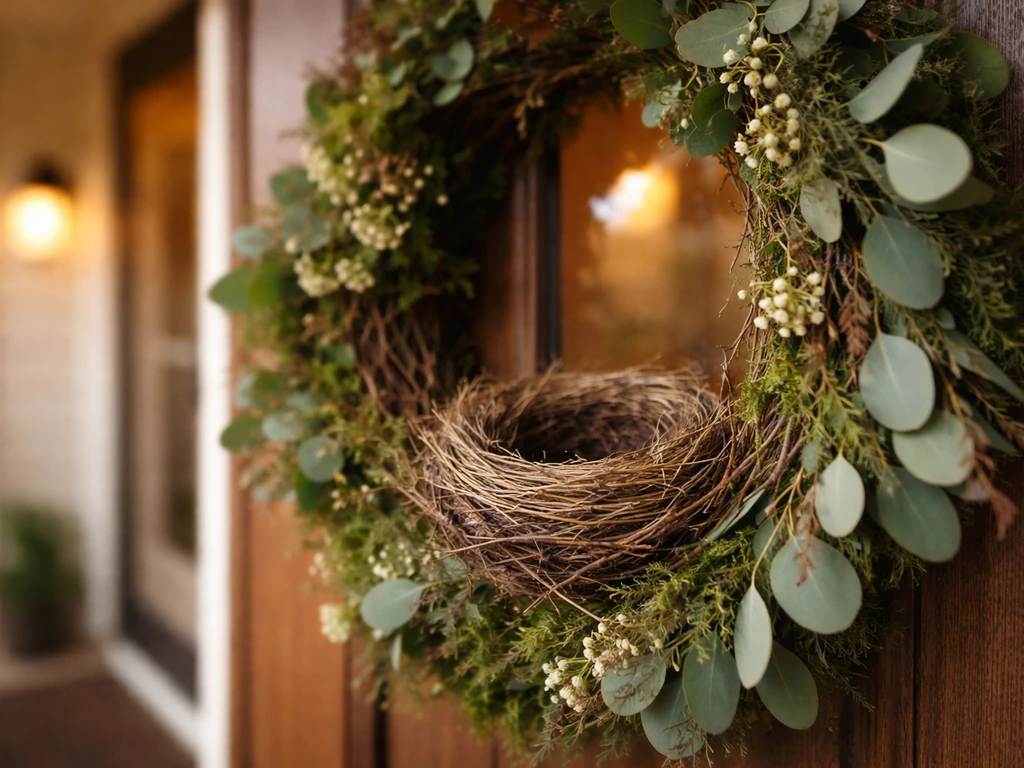
A nest directly on or in the front door, like a door wreath nest, is one of the more striking placements you can encounter. The door wreath is already a symbol of welcome and circular continuity. A bird nesting inside it intensifies that symbolism significantly, turning a decorative gesture into a living one. Many people who experience this describe it as feeling personally chosen, and the symbolic tradition supports that reading.
If you are also curious about the specific meaning of a nest on a door wreath or the broader meaning of a bird building a nest on the outside of your house, those are related threads worth exploring. If you want the specific bird building nest in my house meaning, use the same placement logic, checking whether it is active and how close it is to your entry points.
If you want to go deeper into bird nest outside my house meaning, look at the specific placement, the bird species, and whether the nest appears active.
A nest above the front door, on an eave beam or light fixture, carries a slightly different quality. In many traditions, height is associated with divine perspective and oversight. A nest built above the threshold reads as a blessing placed over the household rather than at its gate. Think of it less as a visitor and more as a guardian taking a position overhead.
A nest inside the house, especially one that was not invited, adds a layer of urgency and intimacy to the symbol. Some indigenous and folk traditions interpret this as the bird bringing spirit directly into the domestic space, a deep union of wild and home energies. Practically it requires action, but symbolically it can be received as an intense, undeniable message about home, family, and the vitality of the space you inhabit.
What Different Traditions Say About This
In the Christian and biblical tradition, birds nesting near homes carry layered meaning. Psalm 84:3 speaks directly to birds finding a home near the altar of God: 'Even the sparrow has found a home, and the swallow a nest for herself, near your altar.' The imagery connects nesting birds with refuge, divine protection, and the idea that God's presence makes a place safe. Many readers in a Christian framework interpret a nest at the front door as a sign of God's blessing resting over the household, a living emblem of shelter and grace.
In Celtic tradition, birds were considered messengers between the physical world and the spiritual one. A bird nesting at a home's entrance was read as a sign that the Otherworld was paying attention to that household, often interpreted as ancestral protection or the favor of spirits associated with the land. Wrens in particular were considered sacred and deeply tied to household luck in Celtic lore.
In Chinese and East Asian folk traditions, birds nesting near the home are closely associated with prosperity, harmony, and marital happiness. Swallows specifically are considered extremely auspicious in Chinese culture, and a swallow nest under the eave of a home is one of the most welcomed signs a household can receive. Removing such a nest is considered bad luck in this tradition, a point of view that happens to align perfectly with legal protections in Western countries.
In various Indigenous North American traditions, the specific meaning depends on the tribe and the bird species. Generally speaking, birds are understood as messengers, and nesting behavior near humans carries significance related to the qualities the species represents. A robin (associated with spring, renewal, and emotional openness) nesting at your door would carry different nuance than a swallow (speed, adaptability, return after long absence) or a wren (resourcefulness, tenacity, the power of small things).
From a metaphysical or New Age perspective, a bird nest at the front door is often read as a manifestation signal: the universe affirming that you are in a fertile period where what you are building (relationships, goals, creative work, family) is being supported. The nest as a symbol of intentional construction, warmth, and patient waiting resonates strongly with anyone working toward something meaningful.
It is also sometimes read as a prompt to examine your own sense of home and belonging: what are you building? What does your threshold mean to you? If you are wondering what does it mean when a bird roosts, it can point to safety, routine, and where the bird feels most protected.
If you’re wondering what it means when a bird builds a nest, it can point to the same themes of safety, routine, and where the bird feels most protected what does it mean when a bird builds a nest.
When You Should Actually Intervene (and When to Call a Pro)
Most front-door or porch nests require nothing from you except patience and a temporary adjustment of your habits. But there are situations where intervention becomes necessary, and knowing the difference matters both legally and practically.
The Migratory Bird Treaty Act in the United States protects almost all native wild birds, their nests, and their eggs. This means that moving, destroying, or disturbing an active nest of a protected species without a federal permit is a federal offense. House Sparrows and European Starlings are not protected under the MBTA because they are non-native invasive species, so the rules differ for them. If you are unsure of your species, assume it is protected and act accordingly.
Call a licensed wildlife removal professional or your state's wildlife agency in these situations:
- The nest is inside your home (attic, chimney, wall cavity) and there is evidence of structural damage, significant mold risk, or a fire hazard (like a nest in an active chimney flue).
- A bird appears injured or sick at or near the nest.
- You have a genuinely unsafe situation, like a nest blocking a mandatory emergency exit, that cannot wait for the nesting season to end.
- You are unsure whether a nest is active and want a professional assessment before taking any action.
- You are dealing with a large colony-level situation, like a building heavily colonized by Barn Swallows, that goes beyond typical homeowner management.
For interior nests in particular, the USFWS notes that Barn Swallows and similar species can return to the same nest site year after year, and that fledglings may return to the nest briefly even after leaving. An extension wildlife damage management page likewise reports typical barn swallow incubation around 13 to 17 days, along with fledging time ranges for barn swallows barn swallows and similar species can return to the same nest site year after year. This means that sealing entry points at the wrong time can trap birds inside. Always wait until you are certain the nest is fully vacated before closing any opening.
The ethical baseline is simple: if in doubt, wait and watch. Four to six weeks is a short time in the life of a home. A little inconvenience at the front door in exchange for a season of new life right outside it is, by most measures, a fair trade. And if you are someone who looks for meaning in these moments, it might just be the most interesting thing that happens at your threshold all year.
FAQ
How can I tell if a bird nest in front of my house is truly abandoned versus just between visits?
If there is no adult coming and going, no eggs visible, and no nestlings, it is more likely inactive or completed. Still, do not treat a “quiet” nest as abandoned until it has been undisturbed for several days and you confirm the species and structure (open-cup nests and mud-cup nests can look different even when active).
Is it ever legal to move or remove a bird nest in front of a house?
In the US, most active native bird nests are protected under the Migratory Bird Treaty Act. Even if the intent is to “move it gently,” relocating, destroying, or disturbing an active nest without the right permit can be illegal. For peace of mind, contact your state wildlife agency or a licensed wildlife remover before doing anything beyond observing.
What if I think the nest is from a common pest bird, can I remove it then?
House sparrows and starlings are non-native invasive in many areas, so they are handled differently than protected native species. However, you cannot reliably identify every situation from a distance. If you are unsure of the species, treat it as protected and follow the same “leave it alone” approach until confirmed.
Can I still use my front door normally if there’s a nest near it?
Yes, but only in a low-impact way. The recommended approach is to avoid direct contact and keep a consistent distance while limiting traffic near the area. If you need access, create a temporary alternate route and keep pets inside, because repeated disturbances can cause adults to abandon the site.
How should I handle droppings under a nest near my porch without harming the birds?
If you must deal with droppings while the nest is active, use a barrier like plywood or cardboard placed below the nest (not too close to the nest) to catch waste. Wait until the birds are fully gone for cleanup, and never dry sweep, blow, or vacuum without a HEPA filter.
When is the safest time to seal off porch eaves, vents, or entry gaps after a nest?
Waiting matters most for nests under eaves or in other enclosed-looking areas. Some birds can return, and fledglings may linger near the area briefly. As a rule, only seal or block entry points after you have confirmed the nest is empty and there has been no activity for multiple days.
What preventive steps work best before next season, and when should I do them?
For year-round prevention, timing is key. Many species start “prospecting” in late winter (often February to March), so deterrents should be installed before that window. But do not install deterrents while a nest is present, and confirm it is truly vacated first.
What should I do if a baby bird falls near the front entrance?
If you see injured birds, tangled feet, or nestlings on the ground, contact a licensed wildlife rehabilitator. Do not try to “rescue” the nest or move nestlings yourself, because parents may continue feeding nearby and mishandling can reduce survival.
How long will a bird nest usually take from start to finish when it’s near the front door?
Species and placement change the timeline, but a practical planning window is about 4 to 6 weeks for many common front-door nests. The actual length can vary with weather and whether a nest attempt is interrupted, so use observed activity (adult visits, eggs, and nestlings) to update your expectation.
What if the nest is on a door wreath I use a lot, can I change the wreath while it’s nesting?
Yes. For example, if a nest is directly on a door wreath or inside a doorway area you use daily, you may need to temporarily remove or replace your own decorations to reduce contact and give the bird space. Avoid disturbing the nest itself, and prioritize alternate access routes rather than frequent door handling.
How should I clean up after the nest is gone if the droppings buildup is significant?
Check local rules, then follow a safety-first approach: wear gloves, dampen droppings with water or soapy water, wipe carefully, and avoid actions that aerosolize dust. If the accumulation is heavy, use respiratory protection such as an N95 and consider professional cleanup.
What should I do if I’m not sure whether the nest is active because I can’t see eggs or babies?
If you hear continuous begging calls, see adults feeding, or notice nestlings, treat the situation as active and keep distance. If you are unsure, record brief observations (time of day, frequency of adult visits) and contact a wildlife professional to confirm activity rather than guessing from one snapshot.
Next Article
Meaning of Bird Nest at Front Door and What to Do Next
Bird nest at front door meaning, practical causes, spiritual symbolism, and a do-this-today checklist for safe next step