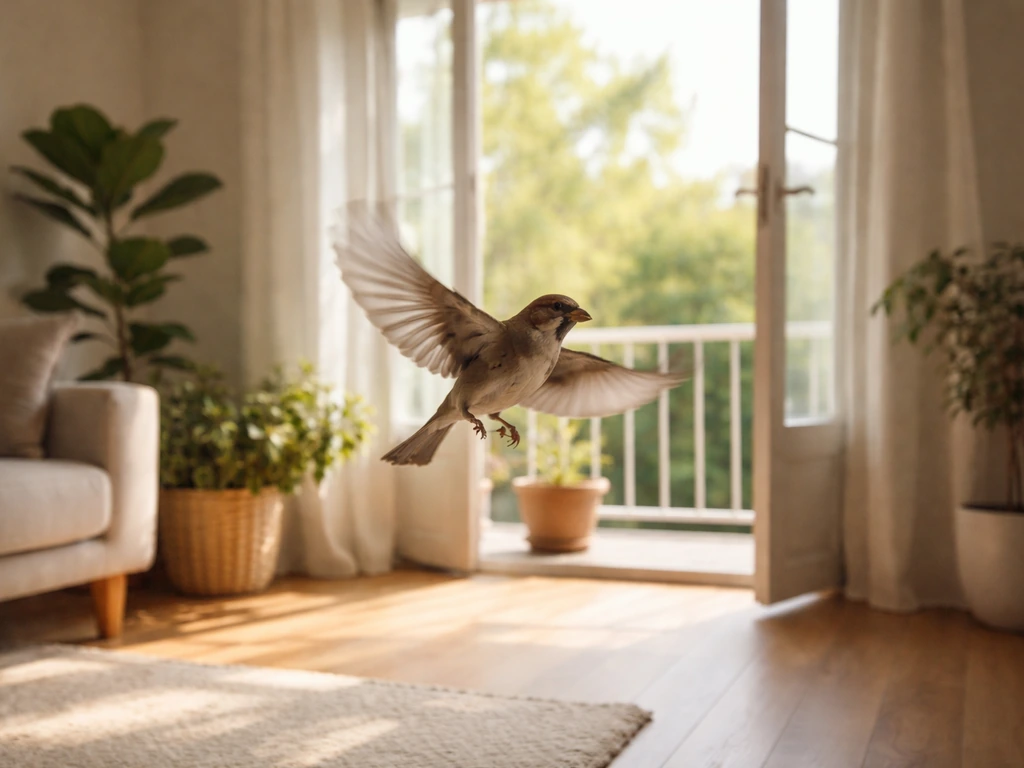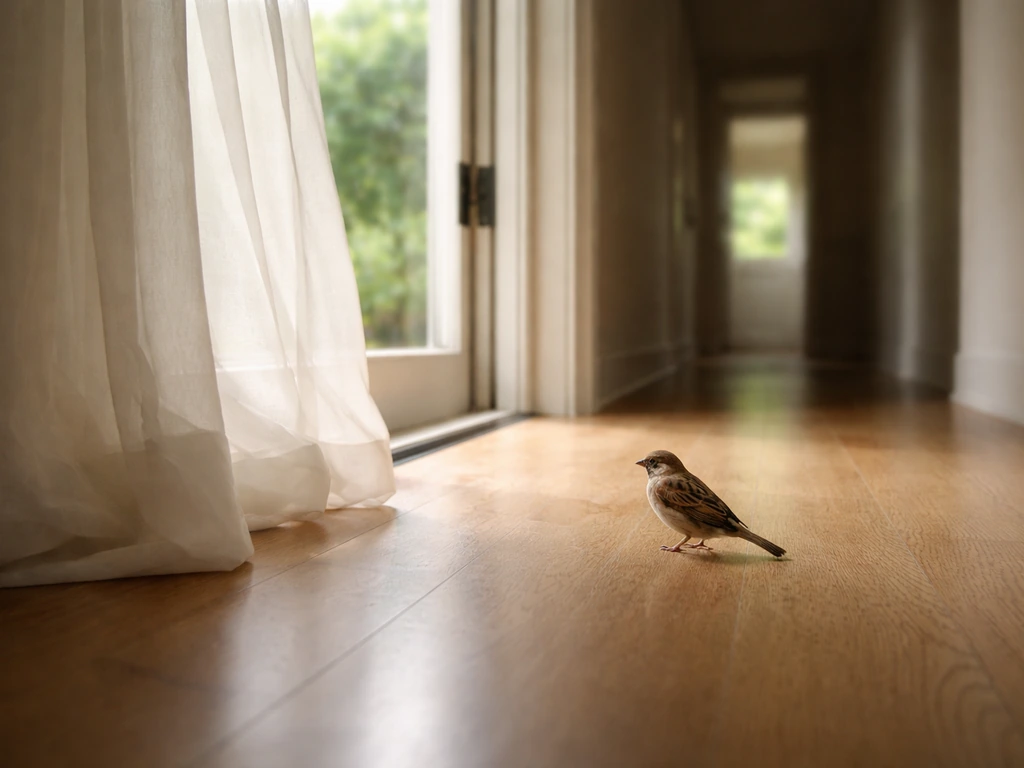
A robin getting inside your house most often means a window or door was left open during the bird's active foraging hours, and the robin followed light, movement, or a reflection inside. That's the practical reality. But for many people, the moment carries weight beyond the accident itself, and traditions from folklore to metaphysics have long treated a robin indoors as something worth pausing over. You don't have to choose between the two readings. This guide covers both: what's actually happening, what it might mean if you're open to symbolism, and exactly what to do right now to get the bird safely back outside.
Robin Bird in House Meaning: Practical Causes and Spiritual Signs

Maya Hartwell
2 Jun 2026
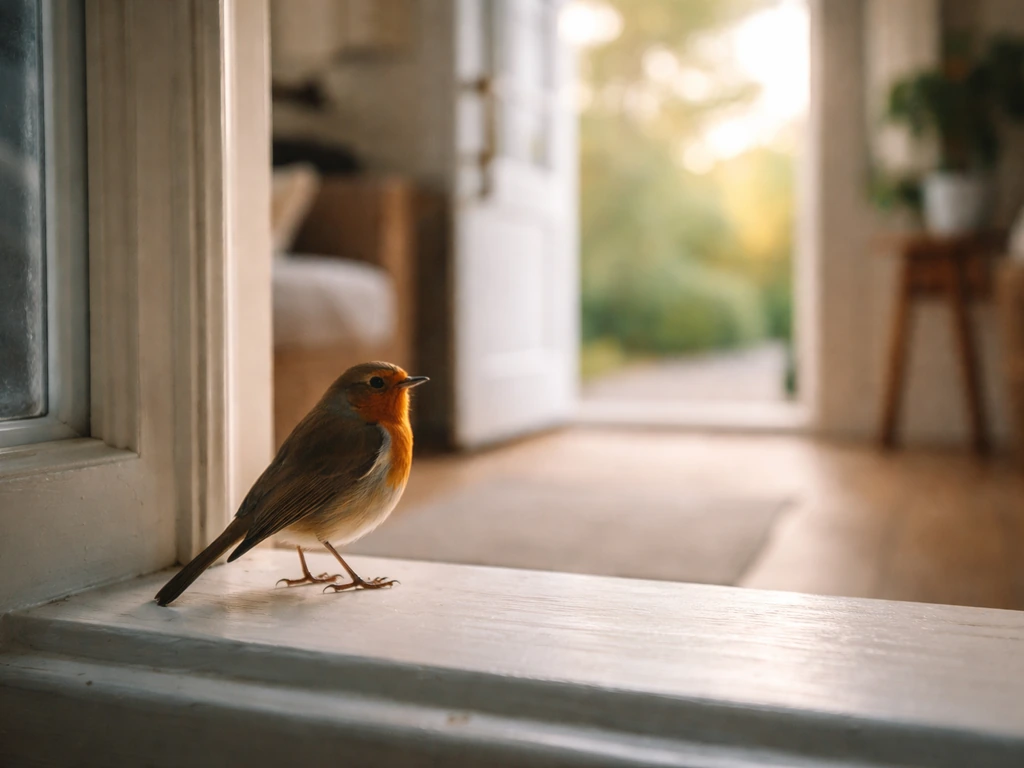
Why a robin actually ends up inside your house
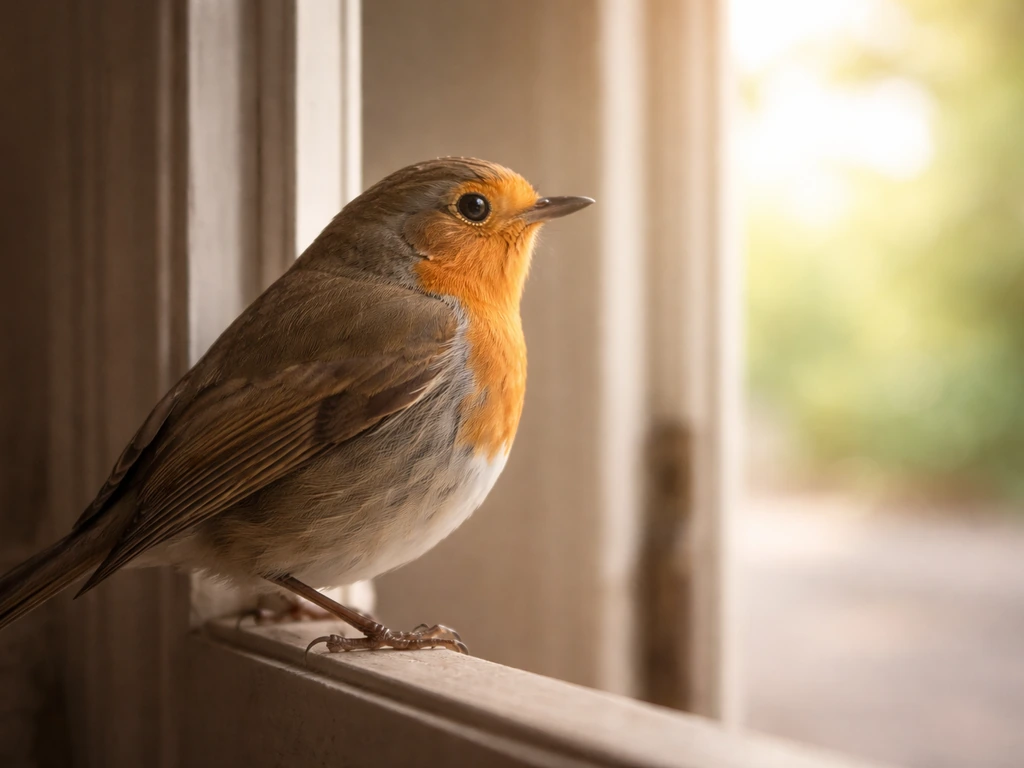
Robins are diurnal birds, meaning they're active during the day when light levels are highest. That same attraction to light is often what pulls them indoors. An open door or window on a bright morning, a sunlit hallway, or a sliding glass door left ajar can look like an inviting passage from the outside. The robin doesn't realize there's a house on the other side.
Glass is the other big culprit. According to research from Tufts Wildlife Clinic and USGS, birds fly into windows because they see reflections of trees, sky, and clouds on the glass and perceive it as open space. A robin can genuinely believe it's flying toward habitat when it's actually heading straight for your living room window. This "transparency" effect, where a bird sees through a window to plants or sky on the other side, is equally disorienting.
During spring and early summer, there's a third reason specific to robins: territorial behavior. Male robins defending a breeding territory will sometimes spot their own reflection in a window or glass door and treat it as a rival. According to Audubon and the Wildlife Center of Virginia, this triggers repeated window-tapping or striking, which can occasionally escalate to the bird ending up inside if a window is open. If you're seeing the same robin return to a specific window again and again, this is almost certainly what's happening rather than anything unusual.
- Open doors or windows during active daylight hours letting the bird wander in
- Glass reflections of sky, trees, or clouds perceived as open flight paths
- Seeing through a window to plants or sky on the far side (the "transparency" effect)
- Territorial attacks on a reflection mistaken for a rival bird, especially in breeding season (spring through summer)
- Seasonal disorientation during fall flock gathering and migration shifts
What the robin's behavior inside tells you
How the robin is acting once it's inside matters, both practically and symbolically. A bird that's alert, hopping around, and looking for a way out is in good shape physically. It's stressed, but it's functional. Your job is simply to create a clear exit before it exhausts itself.
A robin flying in frantic circles and repeatedly hitting windows is likely panicking, which is when window strikes become dangerous. This behavior lines up with what Tufts notes about birds fleeing perceived predators. It also means the bird may already be close to a collision injury. Move slowly, close interior doors to limit the space it can reach, and get an exterior window or door open as quickly as possible.
A robin that lingers, lands on furniture, and seems calm or even curious is often described in folklore as the most symbolically significant visit. From a purely practical standpoint, it may also be a bird that's temporarily disoriented or mildly stunned rather than panicked. Either way, it's not something to rush. Give it space and a clear exit path.
Repeated tapping on a window from outside (the bird isn't inside but keeps returning) is almost always the territorial reflection-attack behavior described above. It peaks during breeding season, typically March through July for American robins, and usually fades on its own once the season ends or the reflection changes with the light angle.
What a robin in the house means spiritually
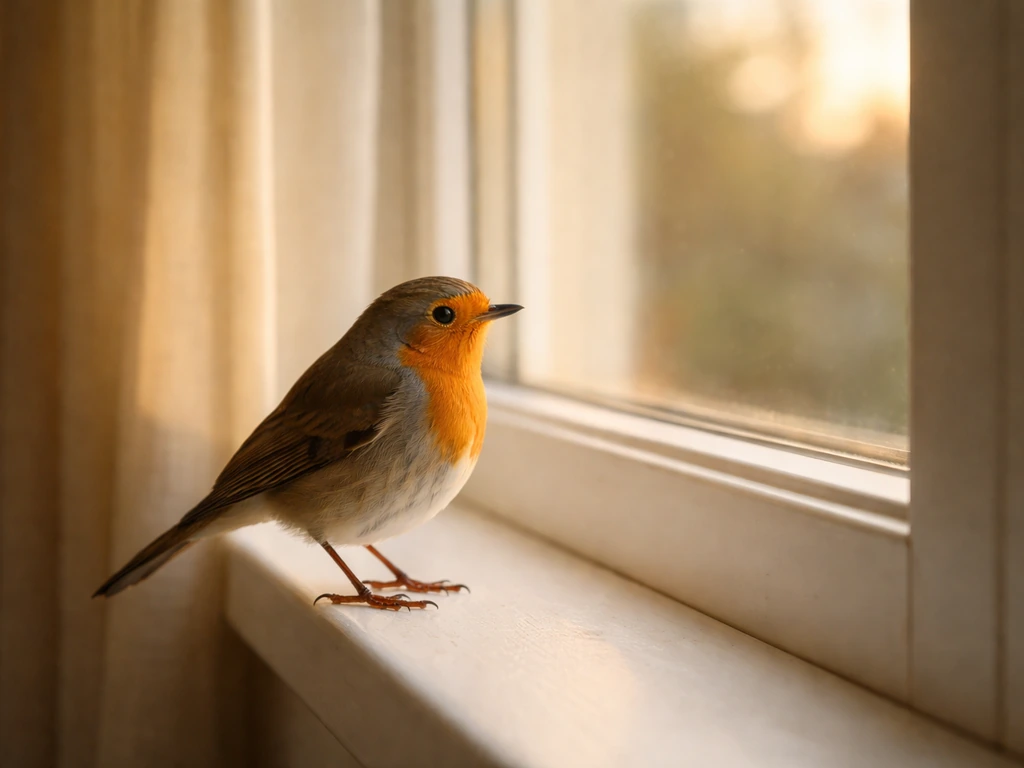
Across multiple traditions, robins carry a consistent symbolic thread: renewal, transition, and messages from beyond the everyday. The robin is one of the most emotionally resonant birds in Western folklore, partly because of its bright red breast and partly because it appears so reliably at the edge of seasons, especially at winter's end when spring begins. Finding one inside your home amplifies that symbolism considerably. Some people also search for the specific bird in bedroom meaning after seeing a robin in a private room Finding one inside your home amplifies that symbolism considerably..
In many traditions, a bird entering the home is interpreted as a crossing of thresholds, both literal and spiritual. The home represents the self, your inner world, your private life. A wild bird entering that space is often read as a message that something new is trying to get your attention, or that a transition is underway. If you're specifically wondering about the wild bird in house meaning, this same mix of practical causes and symbolism can help you interpret what happened. The robin specifically is frequently associated with the arrival of hope, fresh starts, and the courage to move through endings into something new.
WorldBirds and similar cross-cultural sources note that robins carry different tonal meanings depending on the regional tradition. In some European folk contexts, a robin nesting near a home is considered protective. In others, the robin's red breast is tied to sacrifice and compassion, a bird that was said to have tried to remove thorns from Christ's crown and stained its chest in the act. That image of a creature willing to enter a painful situation on behalf of others is one reason robins are sometimes seen as messengers of empathy or reminders to be present with someone who is struggling.
If you're exploring the broader question of what it means when any wild bird enters your home, those themes of threshold-crossing and messages from the unseen world tend to run through nearly all traditions. A robin simply brings its own distinct emotional register: warmth, arrival, and the promise of something better ahead.
Biblical and folklore angles worth knowing
The Bible doesn't specifically mention robins. It's worth being honest about that. Many spiritual meaning sites connect robin symbolism to biblical passages about sparrows, but as lexical sources like Smith's Bible Dictionary note, the word translated as "sparrow" in scripture often just meant any small bird generically. The famous verse in Matthew 10:29 ("Are not two sparrows sold for a penny?
Yet not one of them falls to the ground outside your Father's care") is about the value of small, seemingly ordinary things to God, not about any one species. That said, the principle is spiritually applicable: if even the smallest birds are noticed and cared for, a robin flying into your home can be read, in that Christian-adjacent framework, as a reminder that you are seen and that the moment is not random.
In Southern Appalachian and broader American folk traditions, a bird entering the house has long carried weight as an omen. The most common reading is an impending visitor, a message arriving, or in more dramatic versions of the superstition, a sign of death or significant change in the household. In many superstition traditions, a bird in the house is taken as a warning or an omen of significant change bird in house meaning superstition.
Robins specifically are sometimes treated in these traditions as messengers from deceased loved ones, particularly when they appear during a time of grief or anniversary. This interpretation is presented as folklore rather than literal truth, but it clearly resonates for many people who've had these encounters during emotionally significant moments.
Some Norse and Celtic-influenced folk readings, as noted by the Environmental Literacy Council, frame birds entering the home as protective presences or guides, figures crossing between the visible world and something beyond it. In that context, a robin inside the house isn't threatening; it's an escort or a check-in from a guiding energy.
Metaphysical and energy-based meanings
From a metaphysical standpoint, the timing and circumstances of the robin's visit tend to matter as much as the visit itself. A robin appearing inside your home during a period of uncertainty or transition is often interpreted as a sign of encouragement: a nudge that the change you're resisting or the new beginning you're nervous about is aligned with your path. Astrology.
com frames the robin as connected to the energy of spring arrival and new life, and it also notes that in contexts of stagnation or grief, robins can signal themes of missed opportunities being reclaimed arrival of spring and new life. Astrology.
com's robin symbolism entry frames the robin as connected to the energy of spring arrival and new life, but also notes that in contexts of stagnation or grief, robins can signal themes of missed opportunities being reclaimed.
In energy-based frameworks, a robin that enters calmly and seems unafraid, or that makes extended eye contact before leaving, is often interpreted as a deliberate communication rather than an accident. The direction it enters from, the room it visits, and whether it leaves easily or struggles are all things some practitioners read as part of the message. A robin that lands near something personally significant (a photograph, a window you look out of during hard moments, a room where someone recently died) tends to carry the most emotional charge for people who find meaning in these encounters.
The question worth sitting with isn't "was this an omen?" but rather: what was on your mind when it happened? What have you been circling around lately that you haven't addressed? A robin in your house is, at minimum, a disruption that makes you stop and pay attention. What you pay attention to in that moment often says as much as the visit itself.
What to do right now to get the robin safely out
Speed and calm are the two things that matter most here. The longer a bird stays trapped inside, the more exhausted and injured it can become from repeated window strikes and stress. Here's the method recommended by the San Diego Humane Society and RSPCA, and it works:
- Close all interior doors to confine the bird to one room, ideally the room with the best exterior exit.
- Turn off all interior lights in that room.
- Open one exterior door or window as wide as possible.
- Draw or close any curtains or blinds over windows that don't open, so the open exit is the only bright spot.
- Leave the room quietly. The bird will naturally move toward the brightest point, which is now the open exit.
- Give it 10 to 15 minutes. Most birds find their way out without any further intervention.
- If the bird is still inside after that time, you can gently herd it toward the open exit using a large piece of cardboard or a sheet held as a slow-moving barrier. Never chase or grab.
The key principle is that birds move toward light. Interior lights competing with the exit confuse them. One bright opening, total darkness everywhere else, that's the formula. Don't try to catch the bird with your hands unless it's clearly injured and can't fly. Chasing it will cause more stress and more window strikes.
To prevent repeat visits, especially if you've had a robin repeatedly returning to a specific window, consider applying window collision deterrents. The U.S. Fish and Wildlife Service recommends external treatments: tape strips, bird-safe window film, or moving a bird feeder or reflective object that might be drawing the bird's attention to that spot. For territorial reflection attackers, covering the outside of the window temporarily with soap, paper, or film during breeding season removes the reflection and ends the behavior within days.
When the situation is more serious: injured or dead robin
If the robin seems stunned or injured
If the robin has hit a window and is sitting dazed on the floor, don't assume it's fine just because it's breathing. According to Tufts Wildlife Clinic, stunned birds can appear to recover briefly and then die from internal injuries hours later. The right move is this: gently place it in a shoebox or small cardboard box lined with a paper towel, put a lid on it with a few small air holes, and set the box somewhere warm, quiet, and away from pets. Don't offer food or water unless a wildlife rehabilitator specifically tells you to, according to Audubon's injured bird guidance.
After about an hour in the quiet box, take it outside and open the box. If it flies away strongly, you're done. If it sits still, hops but can't fly, or flutters weakly, it needs professional help. Contact a licensed wildlife rehabilitator or your local humane society immediately. The Golden Gate Bird Alliance and Best Friends Animal Society both emphasize this handoff: your job is to stabilize and transport, not to treat.
If the robin is found dead inside
A dead robin inside the house is spiritually the most charged version of this encounter and practically the most straightforward to handle. Wear gloves when removing it. Place it in a sealed bag and dispose of it, or bury it in your yard if that feels more meaningful to you. Avoid handling it with bare hands due to general wildlife health guidelines.
Symbolically, a dead bird found inside a home is one of the most discussed omens across folklore traditions, and it carries a wide range of interpretations from impending change to the end of a difficult period. It isn't inherently a bad sign in all traditions; many read a dead bird found indoors as a sign that something that was holding you back has completed its cycle. If you want to explore this theme further, the meaning of a dead bird found inside a home is its own rich topic with specific interpretations by species and circumstance.
After the encounter: a few reflection prompts
Whether you lean spiritual, practical, or somewhere in between, these questions are worth sitting with after the visit:
- What was I thinking about or feeling in the hours before this happened?
- Is there a new beginning I've been hesitating to step into?
- Is there someone I've been meaning to reach out to, especially someone I've lost or drifted from?
- What room did the robin enter, and what does that space represent in my daily life?
- Did it leave easily, or did it struggle? What might that reflect about my own current situation?
There's no pressure to land on a single meaning. A robin in your house is genuinely both a bird that got confused by a reflection and a moment loaded with centuries of human meaning-making. You get to hold both of those things at once, and decide for yourself what feels true.
FAQ
What should I do if the robin seems injured after flying into my house?
If you notice the robin is not flying normally, appears dazed, or keeps trying to hit the same window, treat it as potentially injured and limit movement in the room. Close other doors to reduce space, keep pets away, and use the quiet, warm box approach if it cannot rise or looks unsteady.
Why does the same robin keep coming back to the same window, and how do I stop it for good?
For repeat visitors, the best results usually come from fixing the attractant and the pathway. Check for daytime open doors, cracked windows, and especially sliding glass doors that look closed but are slightly ajar, then reduce reflections by temporarily covering the outside of the problem window during peak seasons.
How long should I try to guide it outside before I escalate to a wildlife rehabilitator?
Wait for full natural light changes and remove interior lighting near the exit. If it is still trapped after you set up a single bright exit and dark the rest, it usually means it is too stressed to reorient, so keep the environment quiet and switch to the box-and-handoff plan.
Is it okay to pick up the robin to move it to the door?
Yes, but only in a limited, non-forceful way. If it is grounded and cannot fly, you can gently place it into a box for stabilization. Do not chase, corner, or toss it, since that increases panic and window strikes.
What’s the best way to handle it if the robin is in a different room than the exit?
If the robin is in another room, bring the exit setup to the bird rather than trying to herd it across the house. Turn off competing lights in that room, open one door or window closest to the bird, and close hallway doors so it does not slam into more windows.
The robin looks alert and it’s breathing, but it still seems off. Do I still need to worry?
A quick check helps, but it should not replace safety steps. Breathing can continue even with internal injuries after a window collision, so if it is not flying strongly within about an hour after a quiet box rest, plan on contacting a licensed rehabilitator.
Does it matter whether I cover the window from inside or outside during reflection-related attacks?
Covering a window from the outside is typically more effective than blocking from inside, because reflections are what the bird is targeting. Use temporary, weather-safe coverage (like removable film or paper) during the days it is repeatedly striking, then remove it once the behavior stops.
What if it flies out, but I’m worried it could be hurt somewhere else?
If it flies out on its own, still do a quick look for signs it may have injured itself nearby, such as a second robin in distress or a spot it repeatedly bounced off. If you find blood or the bird remains grounded, switch to the injured-bird protocol.
What are the most common mistakes people make when trying to get a robin out?
A common mistake is leaving multiple lights on near the exit, which creates several “false” directions. Another frequent issue is partially opened doors that do not provide a clear path. Use one bright exit and darkness elsewhere, and make sure the opening is wide enough for a bird to commit immediately.
If the robin seems calm and curious, should I still intervene right away?
When the robin is calm, the goal is still to reduce stress, not to interpret it by waiting for a “sign.” Keep noise and movement low, maintain a clear exit, and avoid feeding or handling, unless a wildlife professional instructs you otherwise.
How can I explore the spiritual meaning without ignoring the safety side?
If you are staying with the spiritual interpretation side, consider the context you are in (timing, emotions, and what you were thinking about) rather than treating the event as a guaranteed prediction. Practical actions like preventing injury can coexist with meaning without requiring you to “believe” a single outcome.
What kinds of window deterrents actually work best for robins, and what should I avoid?
For deterrents, apply them on the outside when possible, since birds see reflections before they see interior changes. Also avoid permanently glossy or confusing surfaces, because some setups can increase strikes during certain light angles.