When a bird hits your door, the first thing to do is check whether it's still alive and stunned, then give it quiet space to recover while you watch from a distance. Most birds that survive the initial impact just need 20 to 60 minutes to regain their bearings.
What Does It Mean When a Bird Hits Your Door?

Maya Hartwell
23 Apr 2026
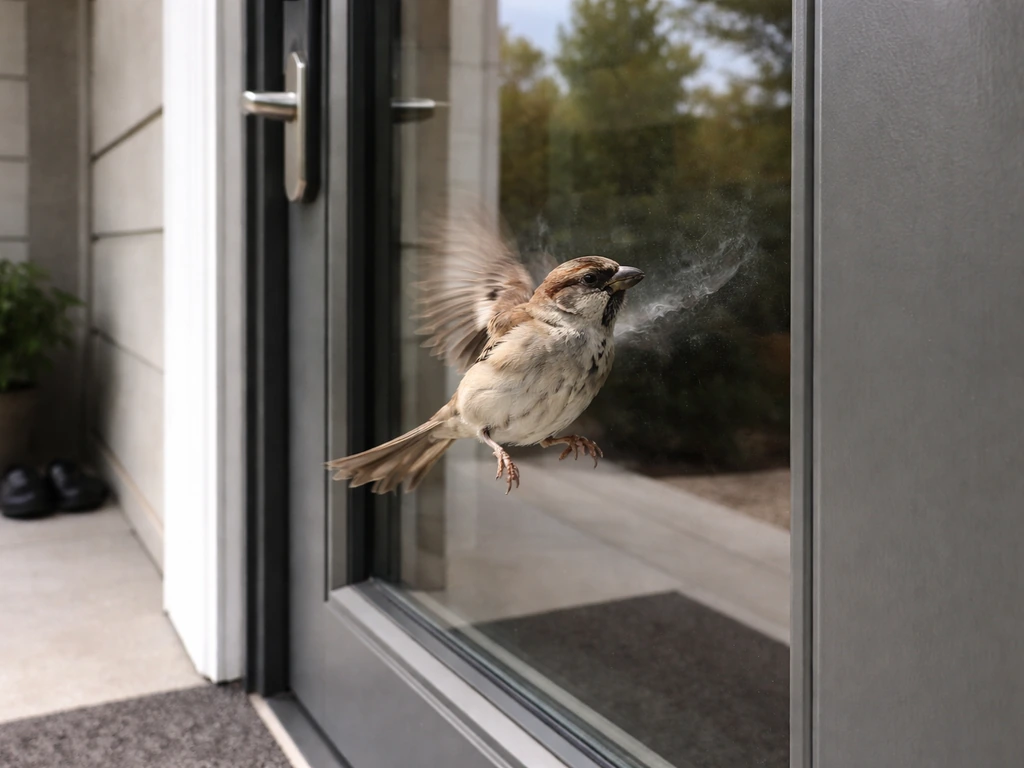
Tufts Wildlife Clinic also says that if a bird does not recover within a couple of hours, it should be taken to a veterinarian or wildlife rehabilitator If a bird doesn’t recover in a couple of hours, it should be taken to a veterinarian or wildlife rehabilitator. If it hasn't flown off after an hour, or if you see blood, a drooping wing, or labored breathing, that's your cue to call a licensed wildlife rehabilitator.
As for what it means symbolically, doorways carry deep threshold symbolism across many traditions, and a bird striking that boundary is widely interpreted as a message, a warning, or a call to pay attention to something changing in your life.
What to do right away when a bird hits your door
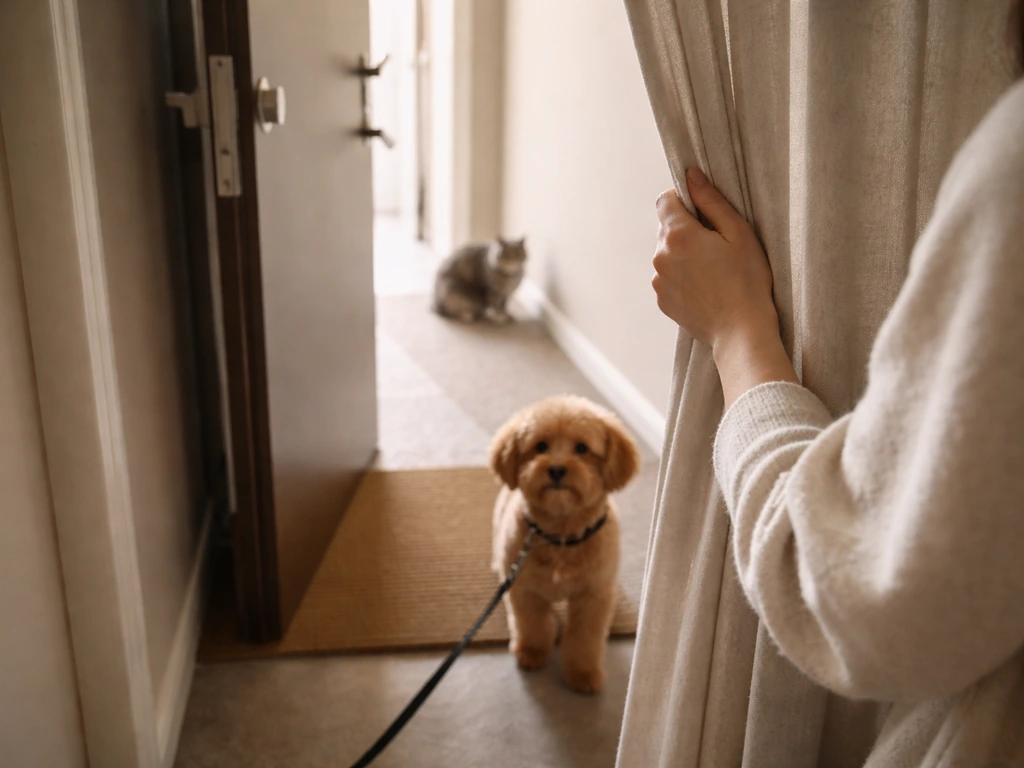
Stay calm and resist the urge to immediately pick the bird up. Your first move is to keep the area quiet and move pets and people away so the bird isn't further stressed. If it's lying on the ground and clearly stunned but breathing, gently place it inside a ventilated box, such as a shoebox with air holes punched in the lid and a soft cloth or towel on the bottom for it to grip. Put the box in a quiet, warm, dark place. Darkness is calming and helps reduce panic.
Do not try to feed the bird or give it water. Wildlife rehab organizations are consistent on this point: feeding can cause aspiration or further harm in a stunned bird. Just let it rest. Then set a timer for one hour and check back. Many birds come around fully and will flutter and scratch at the box when they're ready. If that happens, take them outside and open the box, and they'll typically fly off on their own.
If the bird is still sitting out in the open and looks alert but isn't in your hands, don't force handling. Just observe from a respectful distance. The goal is to protect it from predators while it recovers, not to introduce a whole new stressor.
When to call for professional help
After an hour, if the bird hasn't flown off, contact a licensed wildlife rehabilitator or your local wildlife center. Signs that make the call urgent rather than optional: visible bleeding, a wing or leg held out at an odd angle, gasping or labored breathing, squinting or eyes that won't open, or complete unresponsiveness. The U.S. Fish and Wildlife Service and Canadian Wildlife Federation both stress that internal injuries can be present even when nothing looks obviously wrong on the outside. Stunned doesn't automatically mean safe, so don't assume it just needs more time if these signs are present.
Why birds hit doors in the first place
The most common cause is simple: the bird saw what looked like open space or habitat in the reflection and flew toward it. Glass doors, storm doors, and doors with large glass panels can mirror trees, sky, and surrounding vegetation so convincingly that the bird genuinely cannot detect the hard surface. According to Tufts Wildlife Clinic, birds see the landscape reflected in glass but have no way to recognize that a solid barrier exists between them and what they're seeing. It's not a mistake born of carelessness. Their vision just isn't wired to catch that specific kind of deception.
A second major trigger is territorial behavior. During spring and early summer nesting season, birds, especially American robins and Northern mockingbirds, frequently attack their own reflections in glass. They see a rival bird and go at it repeatedly. This is different from a startle collision. The bird may come back again and again, not because of a spiritual message but because breeding hormones are making it defend its turf against what it thinks is an intruder.
Low light and artificial lighting at night are also significant factors. Audubon notes that lights in and around buildings attract birds, especially during migration season, and can disorient them enough that they fly into structures they would otherwise avoid. The U.S. National Park Service specifically recommends turning off nonessential outdoor and indoor lights at night to reduce collision risk during migration periods, which peak in spring and fall.
And sometimes a bird is simply fleeing a predator at full speed and doesn't have time to process what's in its path. The collision isn't drawn to your home; it's the unlucky geometry of a fast escape route and a reflective surface.
Assessing the bird: injured, stunned, or just lingering?
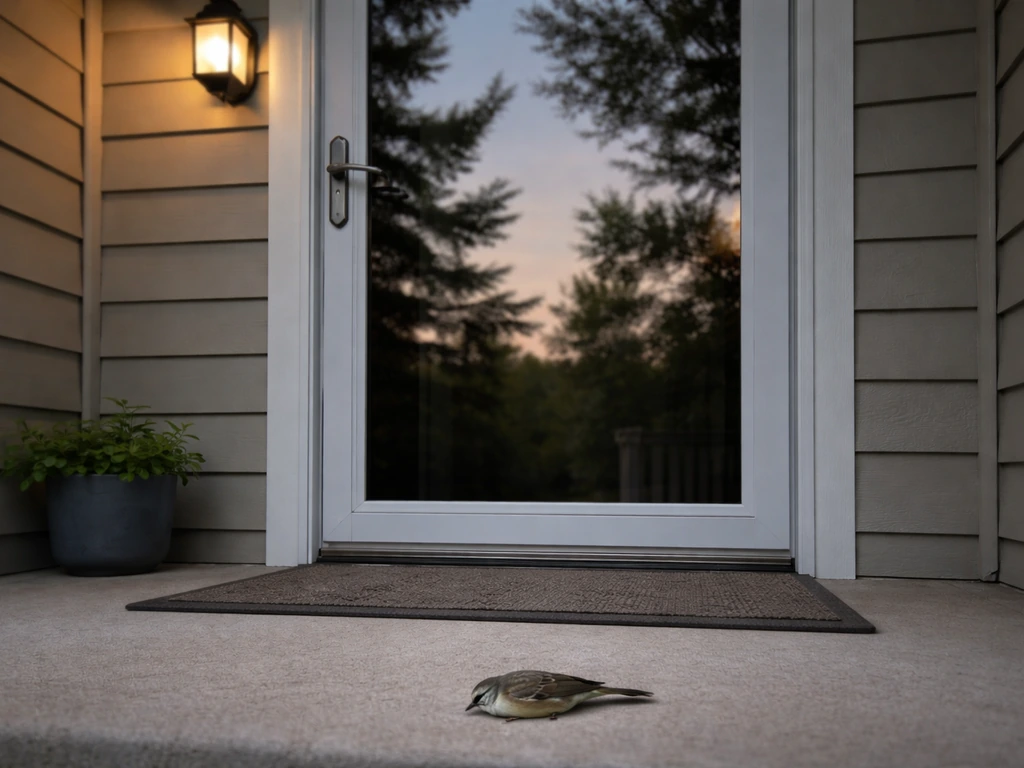
Not every bird that hits a door is seriously hurt, but you do need to make a quick assessment. Here's a practical breakdown of what you might observe and what it likely means.
| What you see | What it likely means | What to do |
|---|---|---|
| Bird is stunned, sitting upright, eyes open | Mild concussion, may recover on its own | Box it gently, wait up to an hour, watch for improvement |
| Bird is on its back or side, not moving | Serious impact, may have internal injuries | Box carefully, call wildlife rehab immediately |
| Drooping or extended wing | Possible wing fracture | Do not attempt to set it, call rehab |
| Bleeding visible on head or body | Laceration or internal trauma | Call rehab, handle minimally |
| Gasping or open-mouth breathing | Respiratory distress | Call rehab immediately, keep bird calm |
| Alert, standing, flies off within 30 minutes | Stunned but recovered | No action needed, monitor for return collisions |
| Lingers near door for hours, seems healthy | May be disoriented or weakened | Check again at the one-hour mark, contact rehab if no improvement |
One thing worth knowing: the Golden Gate Bird Alliance notes that many collision-struck birds do recover on their own, but delayed symptoms can develop. So even a bird that looked okay when it flew off might have sustained internal damage. There isn't much you can do in that case, but it reinforces the importance of taking a stunned bird seriously rather than assuming it'll be fine.
The spiritual meaning of a bird hitting your door
Now for the part many people are really asking about. Across cultures and throughout history, birds arriving at the entrance of a home, especially in an abrupt or dramatic way, have been treated as carrying meaning. The door, as a threshold, isn't just an architectural feature in symbolic thinking. It's a boundary between the inner and outer world, the known and the unknown. Many traditions treat thresholds as liminal space, places where messages can pass through more easily than they can anywhere else.
In a broad spiritual reading, a bird hitting your door can be interpreted as an urgent message arriving at your threshold. The nature of the message often depends on context: the type of bird, whether it survived, what was happening in your life at the time, and whether the event was isolated or repeated. Most interpretive frameworks, across many traditions, treat the encounter as something worth pausing over rather than dismissing.
Common symbolic themes
- Change or transition is approaching, particularly something that will affect your home or family life
- A message from a deceased loved one, especially if the bird lingers or appears calm after the strike
- A call to pay attention to something you've been ignoring or avoiding
- A warning to slow down or reassess a decision you're about to make
- The arrival of unexpected news, not necessarily bad, but significant
- Spiritual protection or intervention, depending on the bird species and tradition
The condition of the bird after impact can shift the interpretation in many traditions. A bird that recovers and flies away is often read as a message delivered and received, something passing through. A bird that dies is sometimes interpreted as a more serious sign, historically associated with warnings of loss or major change. A bird that remains near your door and seems unafraid may be read as a lingering presence or spiritual visitor.
Related scenarios and how the meaning shifts
When a bird hits your door repeatedly
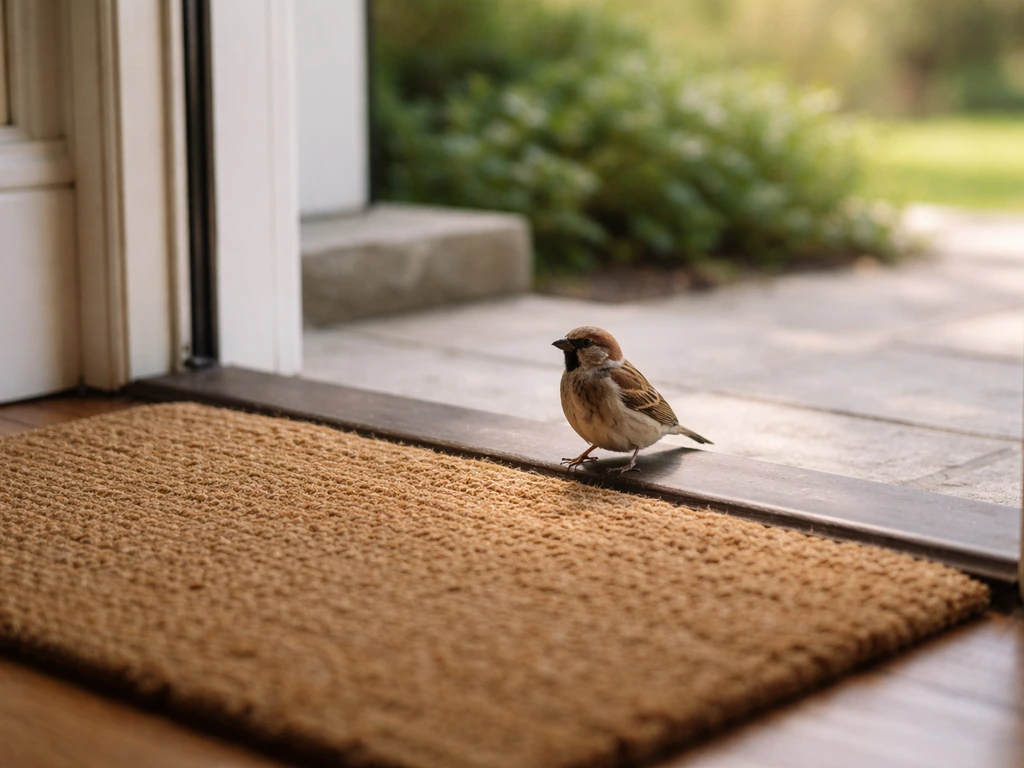
Practically speaking, a bird that returns and hits the same door or window multiple times is almost certainly responding to its own reflection, especially during spring nesting season. Territorial birds like robins can do this for days or weeks. From a spiritual perspective, though, repeated hits are traditionally interpreted as an escalating message, something that demands your attention more urgently than a single strike. Some Southern U.S. folklore traditions read repeated bird strikes against a home as a warning of impending death or serious misfortune, a 'death knock' pattern. Whether you give that weight is entirely your own call, but the pattern of repetition is worth sitting with even if you hold the interpretation loosely.
When the bird flies into your home after hitting the door
A bird that hits the door and then ends up inside your home carries different symbolism in most traditions. The bird crossing the threshold fully is generally read as more significant than one that simply strikes and falls back. This is closely connected to the symbolism explored in bird-flying-indoors encounters, which many cultures treat as either an omen of major change or a visiting spirit. Practically, your priority is guiding it back outside calmly: darken all rooms except one with an open window or door so the bird moves toward the light.
When the bird lingers near your door afterward
A bird that survives the impact and then simply stays near your entrance, calm and unhurried, is one of the more evocative scenarios people describe. Practically, it may be recovering or disoriented. Symbolically, a bird that chooses to stay at your threshold after an impact is often read as a messenger that hasn't yet delivered its message, or as a protective presence. This is especially common in grief contexts, where people describe a bird arriving and lingering at a doorway after a loss.
When you find droppings at the door
Finding droppings at a door where a bird collision happened, or where a bird regularly returns, can indicate the bird is spending significant time near that entrance. Some traditions read bird droppings as a sign of incoming luck or financial change, while others treat them as a minor protective marker. On the practical side, it tells you this spot is a regular perch or attraction point, which is useful information for both collision prevention and for the symbolism of the encounter being an ongoing one rather than a one-time event.
Biblical, cultural, and folklore interpretations
In Christian tradition, birds carry strong associations with divine care and spiritual awareness. Matthew 6:26 describes God's attentiveness to every sparrow, making birds in many Christian readings a symbol of divine presence or reminder. A bird striking your home's entrance can be interpreted, in this framework, as a nudge toward faith, a reminder to trust that something is being watched over, or a call to prayer. Some Christian folk traditions also associate birds at the threshold with departed souls checking in on the living.
In Jewish tradition, the commandment of shiluach haken, the directive to treat birds with care and moral consideration, grounds bird encounters in an ethical frame rather than an omen one. A bird at your door, in this reading, is first and foremost a living creature deserving of protection, and how you respond to it reflects your character and values.
Celtic and Northern European folklore are rich with bird messenger traditions. Birds, particularly crows, ravens, and owls, were considered messengers between the living world and the Otherworld. A bird that struck a home's entrance and survived might be read as a spirit messenger that bounced off the veil, unable to cross fully but delivering its signal in the impact itself. A bird that died at the threshold was treated more seriously, as a sign that the boundary between worlds had thinned significantly.
In various indigenous North American traditions, birds are spirit helpers and often carry specific tribal meanings depending on species. A sudden, dramatic bird encounter at a home's entry point is generally treated as something to consult an elder or spiritual guide about, rather than interpret alone. The meaning is tied to the specific nation's relationship with that bird species and to the individual's circumstances.
Southern U.S. Appalachian and African American folk traditions, particularly older ones, connect bird strikes to death omens more directly than most other frameworks do. A bird repeatedly hitting or knocking at a window or door was historically called a 'death knock,' and was taken as a warning that someone in the household would soon die or face serious illness. This tradition doesn't frame the bird as malicious; it's seen as a messenger doing its job.
Eastern traditions, including some Chinese folk beliefs, often read birds near the home as omens of news arriving. The species matters enormously here: a magpie near the door is a classic good-luck omen in Chinese culture, while other species carry different associations. The dramatic nature of a collision, in these traditions, tends to amplify whatever meaning the bird normally carries.
If you want to treat this as a message: what to do next
You don't have to choose between the practical and the spiritual here. Both can be true: a bird hit your door because of reflective glass, and it also arrived at a threshold moment in your life with something worth reflecting on. These aren't mutually exclusive. Here's how to engage with both.
Reflection prompts
- What was I thinking about just before the bird hit? Was there an unresolved question or decision on my mind?
- Is there something I've been avoiding paying attention to, in my home, relationships, or inner life?
- If I'm being honest, does anything feel like it's on the edge of change right now?
- Is there someone I've been meaning to reconnect with, or a feeling I haven't let myself sit with?
- What species was the bird, and does it have any personal or cultural significance to me?
Optional practices
If you'd like to mark the moment in some way, here are a few practices that span multiple traditions, none of which require a specific religious affiliation. You might say a quiet prayer or intention for the bird's wellbeing, whether it survived or not. Lighting a candle near the door or entryway while sitting with your thoughts is a common ritual across many cultures for honoring a threshold experience.
Some people journal the encounter in detail, noting the species, the time, what they were doing, and what they felt, treating it as a record of a meaningful moment rather than an accident. If the bird died, some traditions suggest burying it or placing it somewhere in nature with a few words of thanks, honoring the animal rather than treating it as waste.
None of these practices require certainty about what the encounter meant. The value in them is the pause, the moment of attention you bring to something that otherwise might just get swept aside.
How to stop it from happening again
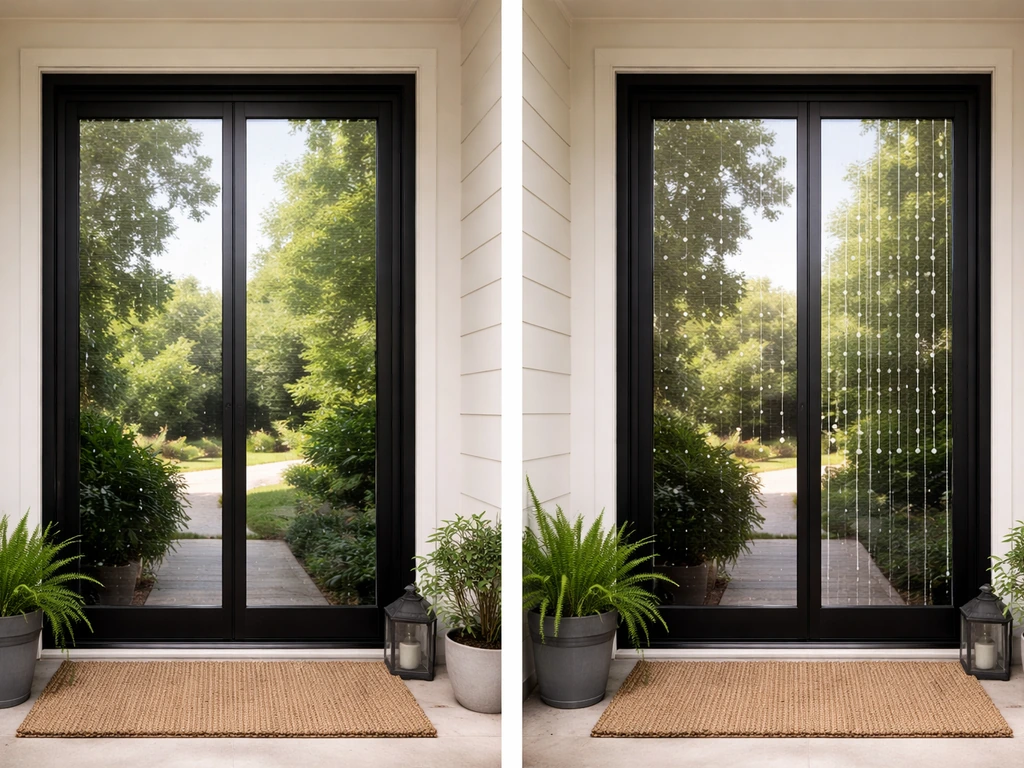
If birds are repeatedly hitting your door, the most practical intervention is breaking up the reflection. Audubon Pennsylvania explains that birds can misperceive reflective building surfaces as habitat and that collisions with reflective surfaces are often fatal, either immediately or later if the injured bird becomes vulnerable break up the reflection.
Audubon recommends using window decals, hanging strings or cords vertically spaced about 4 inches apart, applying exterior screens, or using shutters to make the glass surface visible to approaching birds. The National Park Service also recommends turning off nonessential outdoor lighting at night, particularly during spring and fall migration windows, to reduce disorientation in birds passing through your area.
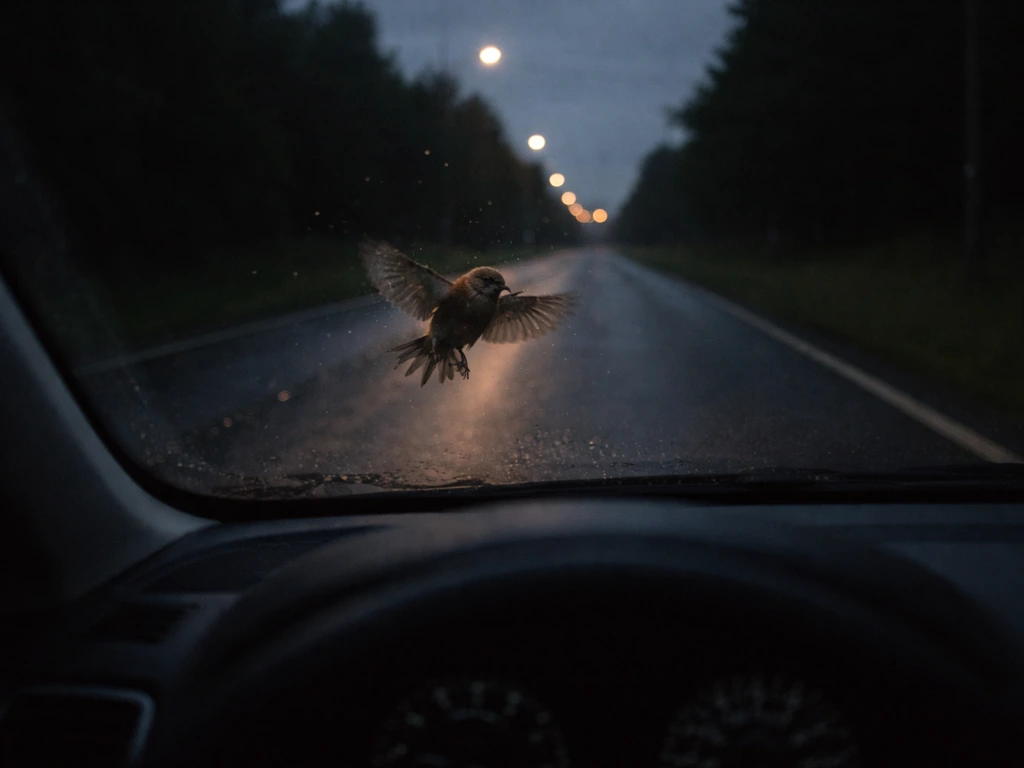
These steps don't diminish the meaning you take from the encounter; they just reduce the chance that another bird gets hurt by the same hazard. If a bird hitting your car is a separate recurring experience in your life, that carries its own practical and symbolic considerations worth exploring, since the movement, speed, and context differ from a stationary threshold encounter. If you are wondering what it means when a bird hits your car, the symbolism often shifts to themes of travel, momentum, and an unexpected interruption along your route.
If you are wondering about the bird flying into your car, the symbolism can depend on the exact moment and how it happened bird hitting your car. If it helps, you can also look at what it means when a bird hits your car, since the movement and timing can change both the practical advice and the symbolism.
People also often ask what it means to hit a bird while driving, and the symbolism can shift depending on how the event happened and how it affected you hit a bird while driving meaning.
FAQ
What should I do if the bird is inside a room but not injured, and it is flying around?
Keep doors and interior traffic to a minimum, then open one exterior door or window and close off other rooms so it has a single exit route. Turn off lights in the rest of the house and, if possible, light the exit area to guide it. Avoid chasing it with hands, since repeated flights can cause exhaustion even if it seems alert.
Can I give a bird water if it looks dehydrated or is panting after impact?
Do not offer water or food yourself. Stunned birds can aspirate or inhale liquid, which can worsen breathing issues. If the bird is not clearly improving within about an hour, contact a licensed wildlife rehabilitator instead of trying to hydrate it.
How can I tell the difference between a routine collision and a serious injury when the bird looks “okay”?
Watch for subtle breathing changes (open-mouth breathing, persistent gasping), coordination problems (stumbling, inability to perch), and eye or head abnormalities (eyes that look closed, droopy or uneven posture). If any of these show up, treat it as urgent even if there is no visible bleeding.
If the bird flies off, should I still worry about internal injuries?
Possibly. Some birds can appear normal and later show delayed decline, which is why you should keep pets and people away from the entry area and take note of where it landed. If you find the bird later injured or unresponsive nearby, contact wildlife rehab.
Is it safe for my pets to investigate the bird if it’s been stunned?
It’s best to prevent contact entirely. Even well-intentioned curiosity can stress the bird, and predators can opportunistically take advantage of vulnerability. Keep cats indoors and supervise dogs, then allow only you or a rehabilitator to handle the situation if it becomes necessary.
What if the bird hits the door repeatedly over several days, but I never see it injured?
Treat it as a hazard problem, not a symbolism-only event. Focus on preventing further strikes by reducing reflections (decals, vertical strings spaced several inches apart, exterior screens, or shutters) and adjusting night lighting. If the same species keeps returning, escalate to a wildlife professional or building manager to confirm the best deterrent placement.
Do I need to disinfect the area after a collision?
At minimum, remove visible droppings safely and wash your hands after cleanup. Avoid handling the bird directly without protection. If blood is present, use disposable gloves and follow basic sanitation practices (cleaning surfaces and laundering any washable items that contacted bodily fluids).
What if I accidentally injured the bird trying to move it?
Stop further handling and place it in a ventilated box only if it is still alive and breathing. Then call a licensed wildlife rehabilitator promptly, especially if you notice a wing, leg, or neck posture that looks wrong. Delicate internal injuries can happen even with seemingly minor pressure.
How long should I wait before calling for help if the bird doesn’t fly away?
A practical rule is to reassess at about one hour. If it has not flown off by then, or if you notice bleeding, odd-angle limb positioning, labored breathing, eyes that won’t open, or unresponsiveness, call a licensed wildlife rehabilitator or local wildlife center right away.
Are there specific times of year or lighting conditions when door strikes are more likely?
Yes. Collisions increase during spring and fall migration periods and around nesting season when some species defend reflections. Nighttime outdoor or indoor lighting can also disorient birds, so reducing nonessential lights during peak migration windows can make a noticeable difference.
If it happens again, should I change anything in my home to prevent repeat strikes?
Yes, and start with the cause: reflective glass. Apply deterrents where the bird approaches (on the outside of windows/doors if possible), space lines or cords so the pattern is visible at bird-flight speed, and keep the exit route consistent if it gets inside. After adjustments, monitor for a few days to confirm the strike rate drops.
Next Articles
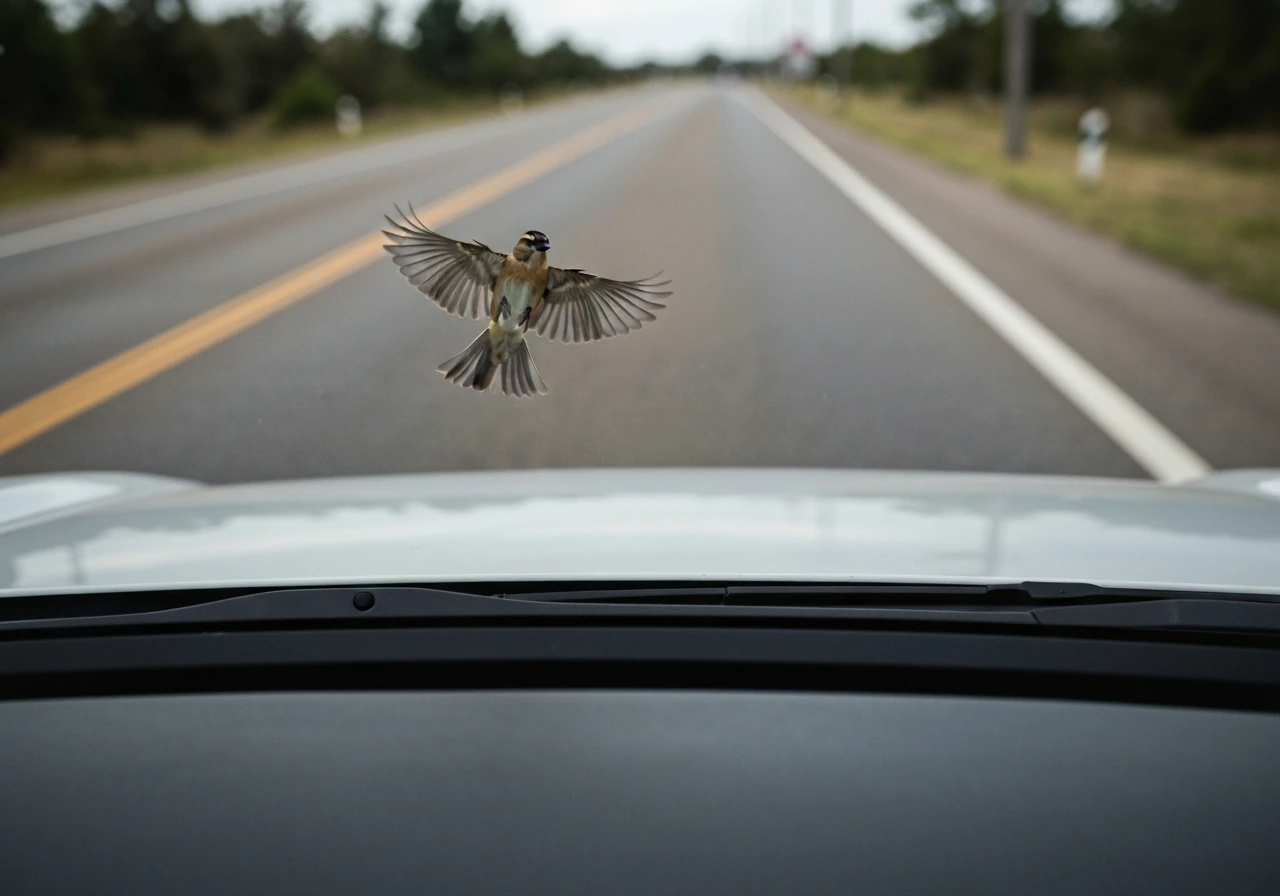
Bird Flying Into Car Meaning: What It Could Mean and Do Now
Bird flying into car meaning explained by scenario, with immediate safety steps and spiritual interpretations to reflect
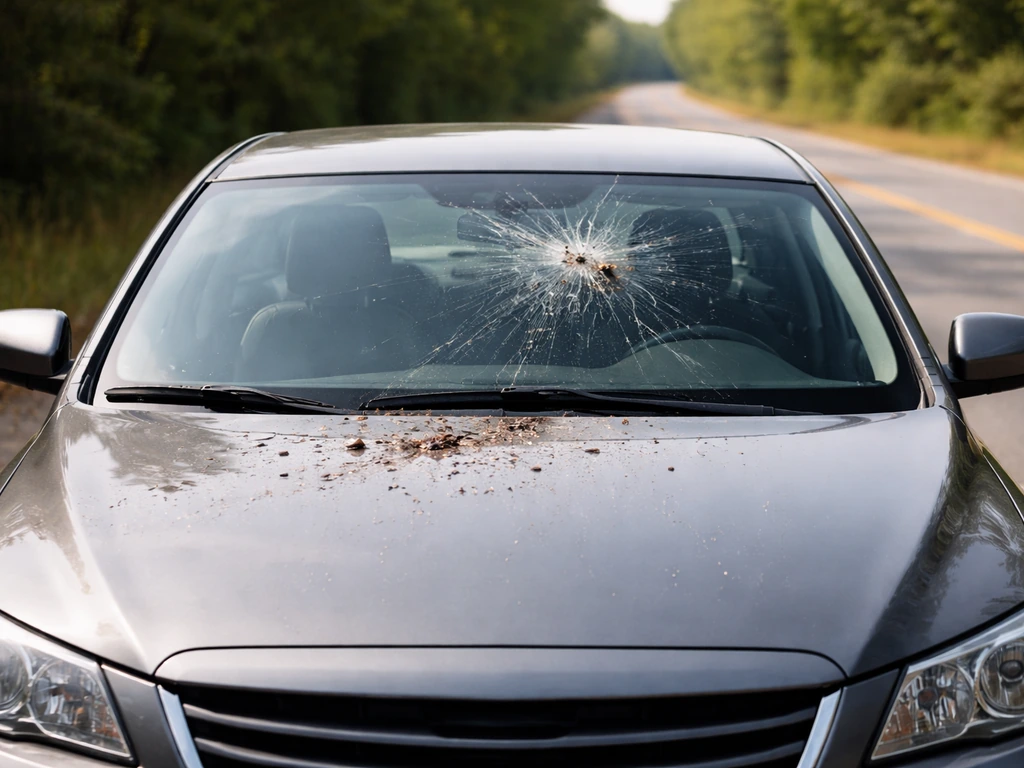
What Does It Mean When a Bird Hits Your Car? Steps and Meanings
Bird hits your car: what to do right away and possible spiritual meanings, plus natural causes behind the collision.
Hit a Bird While Driving Meaning: What to Do and Symbols
Practical steps after you strike a bird while driving, plus respectful spiritual omens, symbols, and reflection tips.