
Bird poop on your car is almost always just biology, a bird perched above your vehicle and let go. But if you're here, you're probably wondering whether there's more to it. Across dozens of cultures and spiritual traditions, bird droppings landing on something you own or travel in have been read as omens of luck, cleansing, redirection, or a nudge to pay attention. Both things can be true at once: it's a natural event, and it can carry meaning if you're open to looking for it. If you're trying to understand getting pooped on by a bird meaning, remember both practical explanations and spiritual symbolism can both fit at once.
Symbolic Meaning of Bird Poop on a Car and What to Do

Maya Hartwell
7 Jun 2026
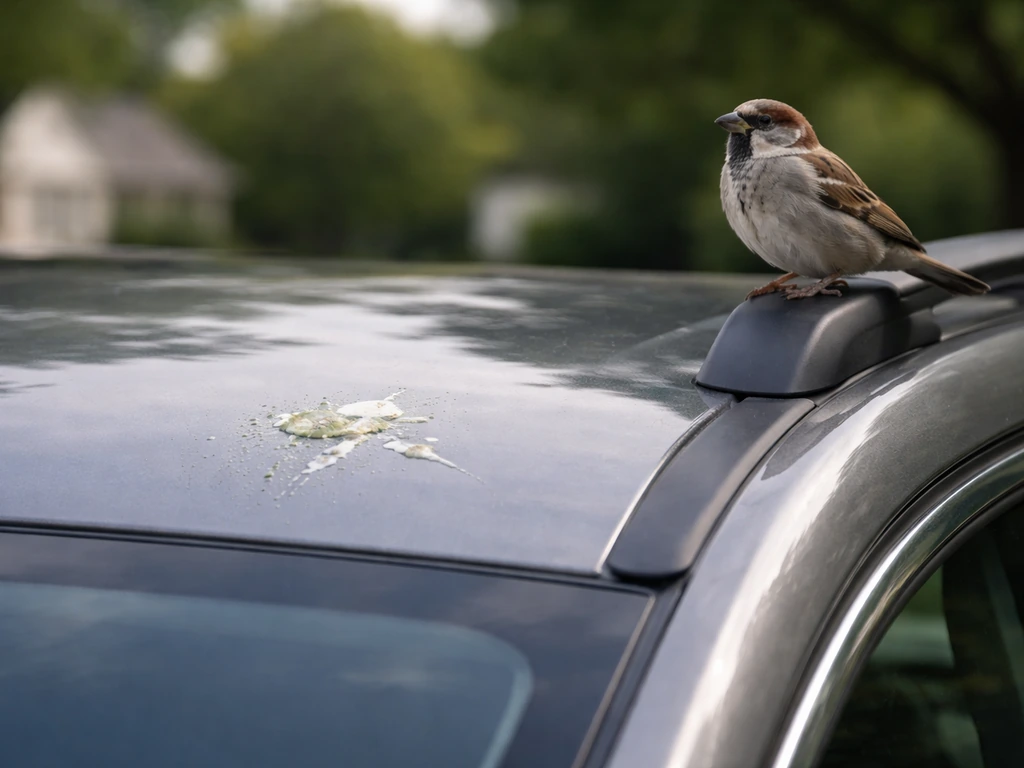
Why it actually happened (the practical reality)
Before diving into symbolism, it helps to know what's going on physically. Birds favor specific perching spots: tree branches, utility wires, lampposts, and road signs. When your car is parked directly under one of those spots, it's simply in the drop zone. Studies on bird behavior confirm that droppings concentrate beneath nesting and roosting areas, so if your car keeps getting hit in the same parking spot, the location is almost certainly the cause, not the car itself.
The season matters too. During nesting periods, birds are far more stationary and use the same perches repeatedly, meaning cars parked nearby accumulate more droppings than at other times of year. If it happened once in a random spot, that's pure chance. If it keeps happening in one place, the perch above is the real story.
What bird poop on a car symbolizes spiritually
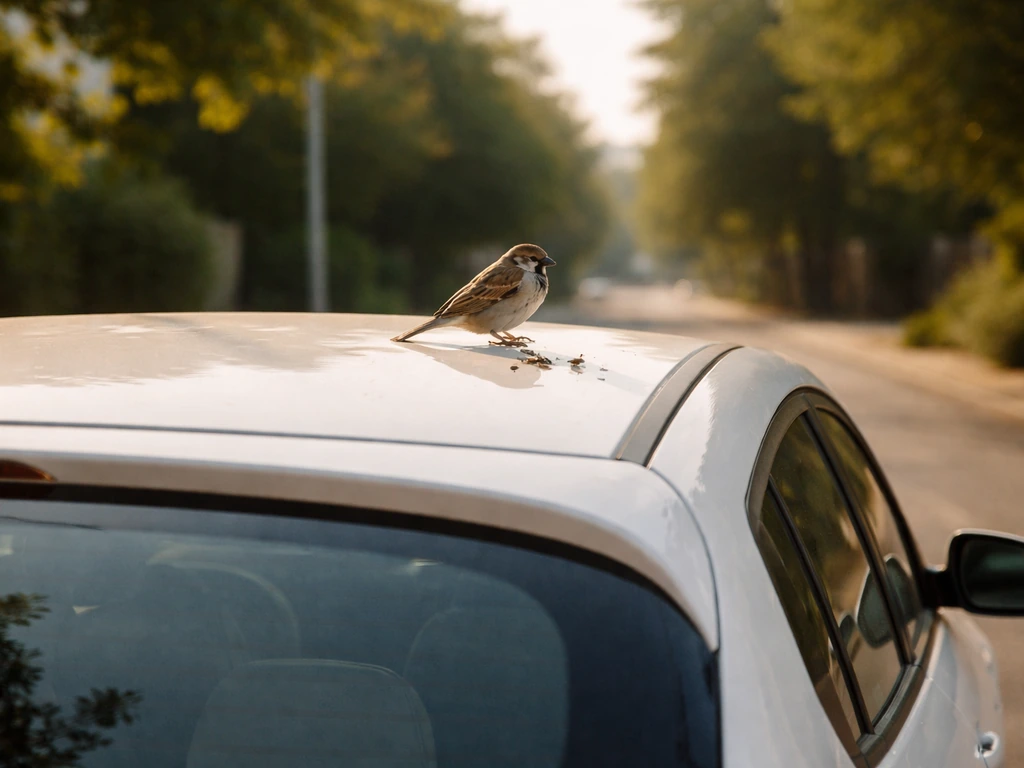
In many folklore traditions, bird droppings landing on something you own, especially a vehicle, are treated as a good omen, specifically one tied to unexpected luck or incoming abundance. The logic, while a little counterintuitive, is ancient: something messy and uninvited arriving from above was read as a blessing delivered from the sky, a gift from the natural world even in unpleasant form. Several Eastern European and Russian folk traditions explicitly count being hit by bird droppings as a sign of financial good fortune coming soon.
Beyond luck, there's a cleansing and releasing theme that shows up across multiple traditions. A car represents movement, direction, and the path you're on in life. Bird droppings landing on it can be interpreted as the universe clearing something off your journey, releasing stagnant energy, marking a transition point, or prompting you to pause before moving forward. Think of it less as a mess and more as a reset.
There's also an awareness angle. Birds occupy a space above us, sky, wind, elevated perspective. When one leaves a mark on your vehicle, some people interpret that as a prompt to look up, slow down, or reconsider the direction you're heading, both literally and figuratively. Your car is how you move through the world. A bird marking it might simply be asking: are you paying attention to where you're going?
Does the type of bird matter?
It can, if you noticed which bird it was. Doves and white birds traditionally carry themes of peace, renewal, and divine communication. Crows and ravens are associated with transformation, mystery, and sharp intelligence. Sparrows connect to humility and simple joy. A large raptor marking your car would be unusual enough to feel striking. Birdzilla notes that common bird associations in biblical-linked interpretations include a dove for peace and renewal, as well as sparrows and eagles for other spiritual themes Most of the time people don't catch the bird in the act. Most of the time people don't catch the bird in the act, but if you did, the species adds a layer of nuance to whatever meaning resonates with you.
Biblical and cultural views on birds and droppings
Birds carry enormous symbolic weight across biblical texts. The most iconic example is Noah's dove returning with an olive branch after the flood, a bird delivering a message of life, hope, and a new beginning. That image became foundational in Christian symbolism, connecting birds to divine communication and God's presence. In Genesis, the Spirit of God moves like a bird over the waters. Eagles appear throughout scripture as symbols of strength and transcendence; sparrows are used to illustrate God's attention to small and overlooked things.
The concept of birds as messengers from the divine is not exclusive to Christianity. In Celtic traditions, birds were seen as spirits traveling between worlds. Indigenous North American traditions across many nations treat specific birds as carriers of spiritual messages or omens about upcoming events. In ancient Rome, augury, the practice of reading bird behavior to interpret divine will, was taken seriously enough to influence military and political decisions. The specific act of droppings landing on property has, in various folk cultures, been read as a cleansing or marking by the spirit world.
It's worth noting that biblical texts don't address bird droppings on cars specifically (for obvious reasons), but the broader symbolic framework of birds as signs and messengers is deeply embedded in the tradition. If you approach life through a biblical lens, it's not a stretch to wonder whether an unexpected bird encounter is worth paying attention to.
The metaphysical angle: signs, synchronicity, and uncanny timing
In Jungian psychology, synchronicity describes meaningful coincidences, events that feel connected not by cause and effect but by significance. Carl Jung proposed that the psyche and the external world can mirror each other in ways that don't fit ordinary logic. A bird dropping landing on your car exactly when you're in the middle of a big decision, a transition, or a moment of doubt is the kind of event people remember and assign meaning to. That's not irrational, it's pattern recognition, which is one of the ways humans make sense of the world.
Metaphysical traditions often frame bird droppings as confirmation signals. If you've been asking for a sign, wrestling with a choice, or feeling stuck, an unexpected mark from a bird can feel like the universe tapping you on the shoulder. If you have the meaning of bird poop on you on your mind, the same open-and-honest approach helps you separate instinctive reactions from useful insight. Some people interpret it as validation that they're on the right path. Others read it as a prompt to reassess. Neither interpretation is wrong, what matters is what it stirs in you.
It's worth keeping Jung's own caveat in mind, though: not every coincidence is meaningful, and over-assigning meaning to random events can actually cloud clear thinking. The healthiest approach is to stay open without forcing significance where there isn't any. If the event genuinely resonates or triggers something useful, a reflection, a decision, a moment of gratitude, that's real value, regardless of whether the bird intended it.
If you're also processing bird poop landing directly on your body rather than your car, that's a distinct encounter with its own set of interpretations worth exploring separately. If you were wondering what it means when bird poop lands on your head, the same themes of practical chance and personal symbolism can apply what it means when bird poop on your head.
How to figure out what it means for you
Context is everything in symbolic interpretation. A one-off event in a parking lot with trees overhead probably leans more practical than spiritual. But certain details can shift the weight toward meaning. Ask yourself these questions:
- Where on the car did it land? The windshield (your view forward), the hood (the engine, the driving force), the roof (above you, overhead messages), or the driver's door (your point of entry) all carry different symbolic weight if you're reading it metaphysically.
- What were you doing or thinking about right before you noticed it? Timing during a moment of stress, decision-making, or unusual emotion makes the event feel more significant.
- Has this happened repeatedly in the same spot, or is this a one-time occurrence? Repetition suggests a perch above your usual parking spot. A single event in an unexpected location feels more notable.
- Did you see the bird? If so, what kind was it, and what direction was it flying?
- What's going on in your life right now? The symbolic meaning you're drawn to often reflects what you actually need to hear.
There's no universal decoder that tells you exactly what a bird dropping on your car means. What matters is whether sitting with the question opens something useful for you. If it does, the meaning is real enough to act on. If it doesn't, let it go and clean your car.
What to do right now: cleaning it and clearing your head
Clean it promptly, this part matters
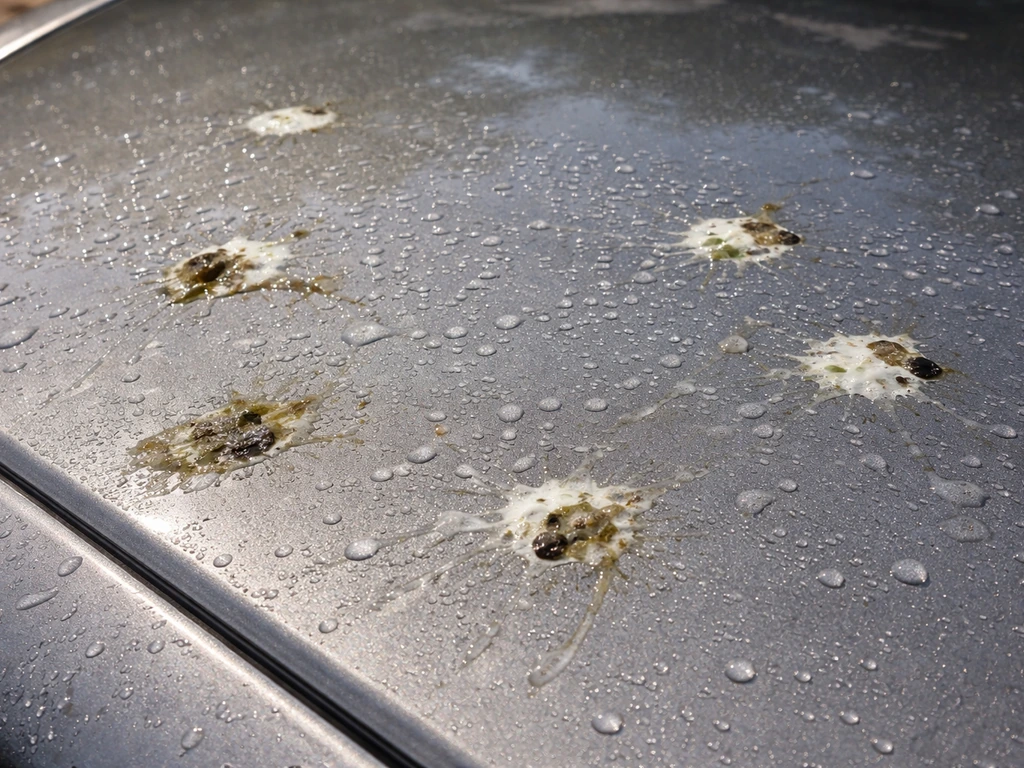
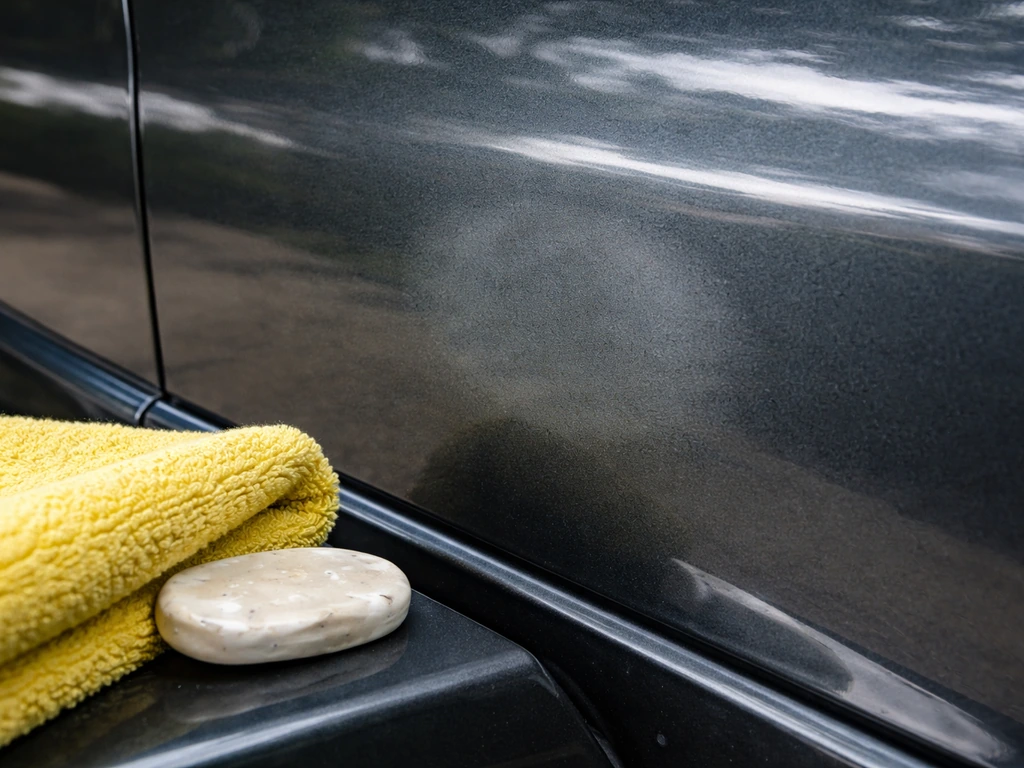
Bird droppings are highly acidic, with a pH typically ranging between 3.5 and 4.5 depending on the bird's diet. That acidity starts attacking your car's clear coat almost immediately. Left to dry, the uric acid in droppings forms hard crystals that can etch a permanent imprint into the paint, sometimes called a 'bird bomb crater' by detailers, even after the dropping itself is removed. Detailing guidance commonly emphasizes that bird droppings can stain and eventually etch paint, so applying an APC to the area is a common recommended approach, such as spraying APC or covering with a microfiber cloth soaked in APC clear coat almost immediately. The longer it sits, the more likely you'll need polishing or professional correction later.
- Spray an all-purpose cleaner (APC) directly onto the dropping. Don't wipe yet — let the cleaner dwell for 30 to 60 seconds to break down the uric acid and soften the solids.
- Use a clean microfiber cloth to gently lift the material. Don't scrub aggressively, as the dried solids can act as an abrasive and scratch the clear coat.
- Repeat if needed, then inspect the area. If you see a dull or hazy imprint left behind after the dropping is gone, that's an etch mark — it may require a polish or clay bar treatment.
- If you don't have APC handy, plain water and a microfiber cloth are your next best option. Avoid paper towels, which can scratch.
- Dispose of the used cloth or paper in an outdoor bin. Wash your hands thoroughly afterward.
If your car is parked under the same tree or wire repeatedly, it's worth moving your parking spot. No spiritual lesson requires repeat paint damage.
Resetting your mindset after the encounter
Once the practical side is handled, give yourself a moment with the experience if it felt significant. Some people find it useful to set a small intention after a bird encounter, a word, a question, or a quiet acknowledgment of whatever meaning felt real. You don't need to build a ritual around it. Even just pausing and asking 'What do I want to take from this?' is enough to turn a random event into something personally useful.
When to actually worry vs. when it's just a sign
Genuine concerns worth taking seriously
| Situation | What to do |
|---|---|
| Paint etching or dull imprint visible after cleaning | Use a detailing clay bar or mild polish; for deep etching, consult a professional detailer |
| Recurring droppings in the same spot | Move your regular parking spot; the perch above is the issue |
| Large volume of droppings (roosting flock situation) | Treat as a hygiene matter — the CDC notes that soil and surfaces heavily contaminated with bird droppings can carry Histoplasma, a fungal pathogen. Use gloves, avoid breathing dust, and double-bag waste for disposal |
| Droppings on hands or face | Wash thoroughly with soap and water immediately; avoid touching eyes or mouth before washing |
| Strong odor or repeated accumulation near air intake areas of your car | Clean promptly and check air filter if smell persists inside the cabin |
When it's just a sign (or simply ordinary)
A single dropping on a car parked under a tree is almost always just a bird doing what birds do. It becomes 'just a sign' in the spiritual sense when it arrives at an unexpected moment, in an unexpected place, or when it genuinely resonates with something you're already processing. You don't have to assign it cosmic significance, and you don't have to dismiss it either. Both responses are valid. The only time it's worth real concern is when there's actual damage to your paint, a genuine hygiene issue, or a recurring roosting problem that needs a practical solution.
If you've been thinking about what it means when a bird leaves its mark directly on you rather than your car, or what it means to encounter bird droppings in a dream, those carry their own distinct layers of interpretation. The car, specifically, tends to symbolize your life direction and journey, which gives this particular encounter its own flavor of meaning worth sitting with, if you're inclined to explore it.
Here's a simple way to decide what to take from it: clean the car first, then ask yourself one honest question, does this event remind me of anything I've been avoiding, hoping for, or needing to notice? If the answer is yes, follow that thread. If the answer is no, you've just got a clean car and a story to tell.
FAQ
How can I tell if the bird poop is likely to etch my car’s paint?
Yes. If you saw the drop land, act sooner rather than later: rinse with water as quickly as possible, then wash gently (microfiber and car-safe soap). Waiting for it to dry increases the chance of paint etching, even if you remove the dropping later.
What’s the safest way to clean bird droppings off my car?
Don’t scrub dry droppings. The hard, crystal residue can behave like abrasive when you rub it while dry. Use a rinse to soften, then clean with light pressure, and if you notice a dull spot or rough texture after cleaning, consider a polish or a professional correction rather than repeated washing.
Why does it happen repeatedly in the same parking lot, and is my car somehow attracting birds?
If you keep getting hit in the same spot, it’s usually a perch above, like a wire, lamppost, sign, or tree branch, not the car “attracting” birds. The practical fix is changing parking position and height, and temporarily avoiding areas directly beneath known roost lines.
Can I use vinegar or other household cleaners to remove bird poop faster?
Avoid home “miracle acids” like vinegar or strong cleaners unless your product is explicitly safe for automotive paint. Instead, use a car wash soap and, if needed, an automotive detailer-safe bird-dropping remover. These are formulated to dissolve uric-acid residue without damaging clear coat or wax coatings.
How do I interpret the symbolic meaning without overthinking it?
If you want to use symbolism, keep it decision-oriented. For example, ask one concrete question like, “What’s the next small step I’ve been delaying?” and then choose an action you can do within 24 to 72 hours. This reduces the risk of turning a random event into a vague, endless search for meaning.
What if I feel annoyed by the bird poop and no spiritual meaning comes up?
If the event didn’t feel meaningful, treat it as a reset, not a command. You can set a brief intention like “I’ll drive carefully and stay present,” then move on. You don’t need to force the event to match a specific life theme to make it useful.
Does a one-time incident mean something different than multiple droppings on the same trip?
Yes, context changes the likely interpretation. A single drop after you parked under open sky with trees nearby is mostly practical. Multiple drops over a short time, or repeated incidents at the same location, point strongly to roosting patterns, and the “sign” angle becomes secondary to solving the location problem.
When should I worry about damage and stop treating it as just a coincidence?
If you have paint damage, look for etching that shows up as a slightly rough or permanently matte spot after washing. For persistent marks, a professional can assess whether polishing will correct it or whether a more involved process is needed. Symbolism aside, this is the point where cost-effective action matters.
Is it normal to feel like the bird poop is a warning about something I did wrong?
Try not to interpret the “message” as blame. Birds are acting on instinct, and most people’s symbolic takeaway is about their own attention or timing, not about something they did to “deserve it.” If the event triggers guilt, reframe toward one practical lesson (clean, change parking spot) and one calm intention.