
A starling in your house almost always got in through an open vent, a gap around a duct, or simply a door or window left open at the wrong moment. It is disoriented, scared, and looking for a way out, and with a few calm, deliberate steps you can usually get it outside within minutes. Once it's gone, the details of how it arrived, how it behaved, and what's been happening in your life lately are exactly what shapes the symbolic meaning many people feel pulled toward in this kind of encounter.
Starling Bird in House Meaning: Symbolic and Practical Guide

Maya Hartwell
17 May 2026
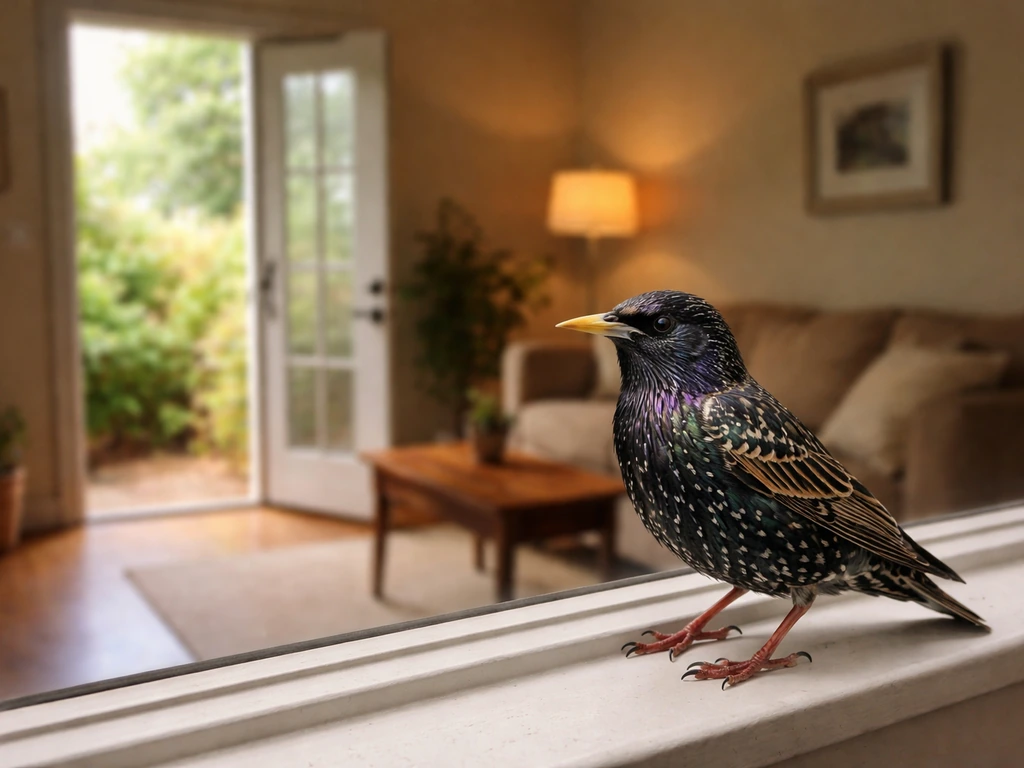
Why a starling ends up inside your house
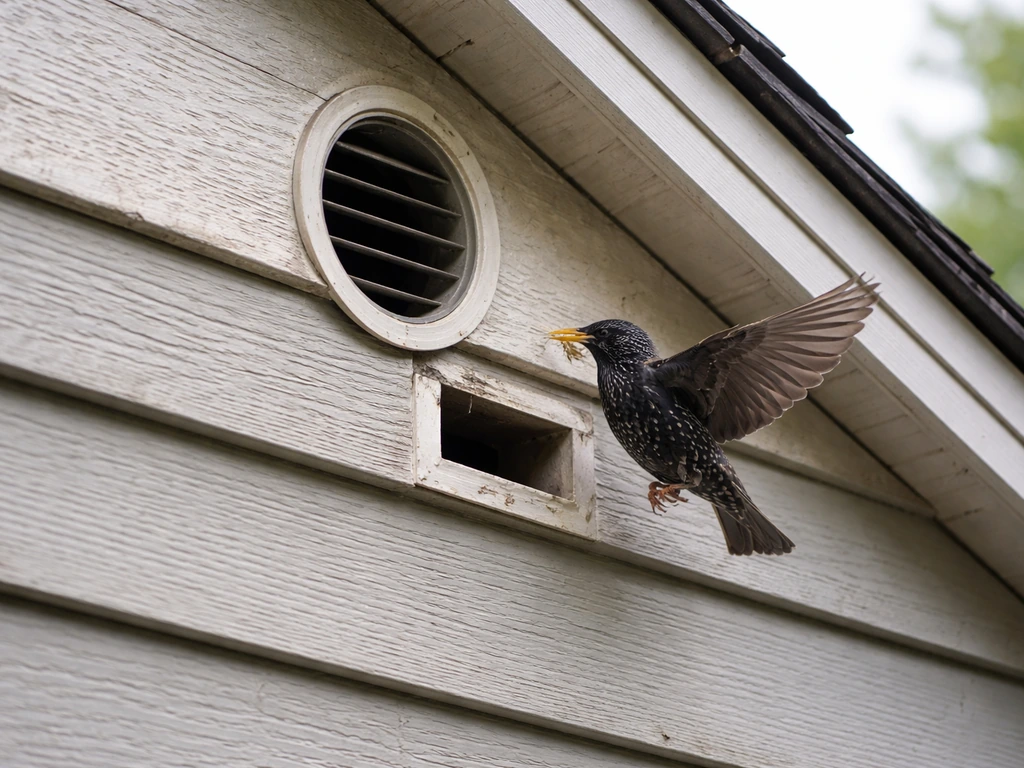
European starlings are cavity-nesting birds. They actively seek out hollow spaces, and the vents, ducts, and gaps in your home's exterior look a lot like natural tree cavities to them. USDA wildlife research identifies building vents and duct openings as among the most common starling entry points into structures. If you've been hearing scratching or chattering sounds near a vent before the bird appeared indoors, nesting activity is probably the explanation.
Outside of nesting season, two other forces push starlings toward buildings: light and migration. During spring and fall migration, artificial lighting, porch lights, landscape lighting, even light visible through windows, disorients birds in flight. The US Fish & Wildlife Service and BirdCast both flag this as a real, documented hazard, with the effect being especially strong on juvenile birds during autumn migration. A bird that appears indoors during those seasons may have been pulled off course by your home's light and stumbled through an open door or window. It's worth knowing that starling incidents tend to cluster in spring (nesting season, roughly March through June) and fall (peak migration, September through November) for exactly these reasons.
Read the situation before you do anything
Not every starling-in-the-house situation is the same, and correctly reading what's happening helps you respond more effectively, and later, interpret the encounter more meaningfully.
- Calm and perched near a window or door: The bird likely flew in recently and is already orienting toward light, which is its instinctive escape signal. This is the easiest situation. Open the window or door nearest to it, step back, and give it a few minutes.
- Panicked and flapping at windows or ceilings: The bird is very stressed. It keeps hitting glass because it sees the light through the window and doesn't understand the barrier. This is the most common and most urgent scenario, and it needs a controlled environment to resolve safely.
- Brief visit, flew back out on its own: If the bird came in and left quickly, the encounter is already over in practical terms. What lingers is the impression it left — and that's where the symbolic layer becomes more relevant.
- Trapped and exhausted: A bird that has been inside for a while and is sitting quietly on the floor is usually not calm — it's spent. Treat this as an urgent welfare situation.
- Stunned or injured near a window: If the bird hit glass on its way in or out and is sitting very still, it may have a concussion. Don't assume it's fine.
How to get a starling out safely, what works and what to skip
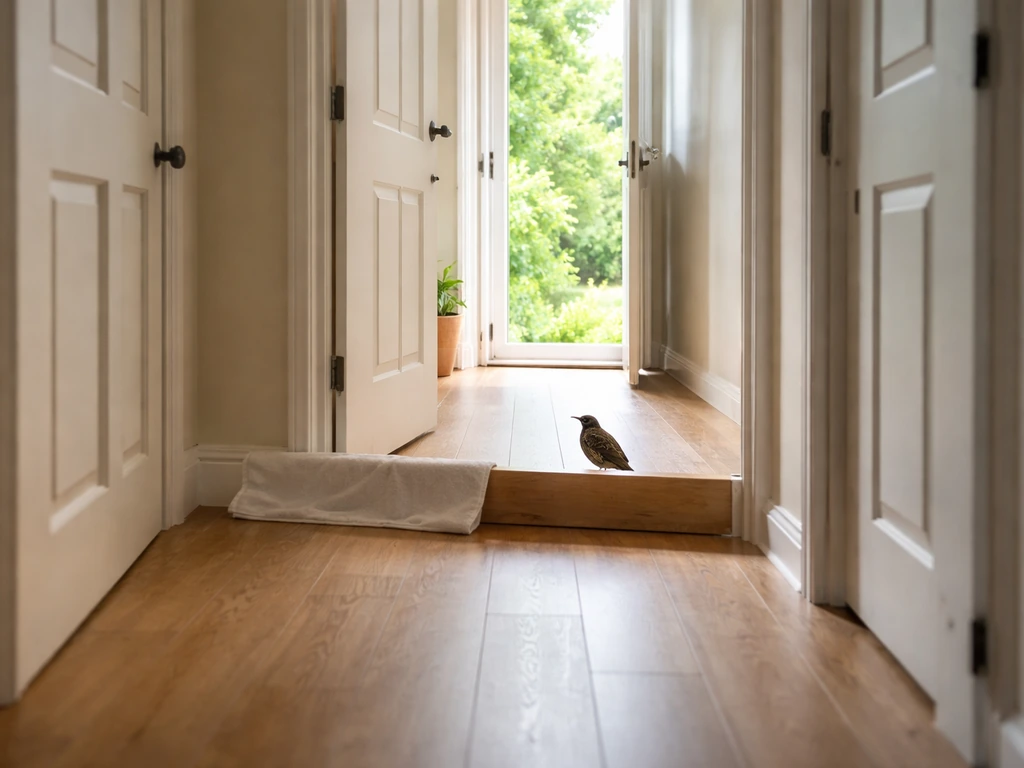
The core strategy is simple: create one obvious, unobstructed exit and remove every competing distraction. Here's how to do that step by step.
- Close every interior door in the room. You want the bird contained in one space so it isn't flying deeper into the house.
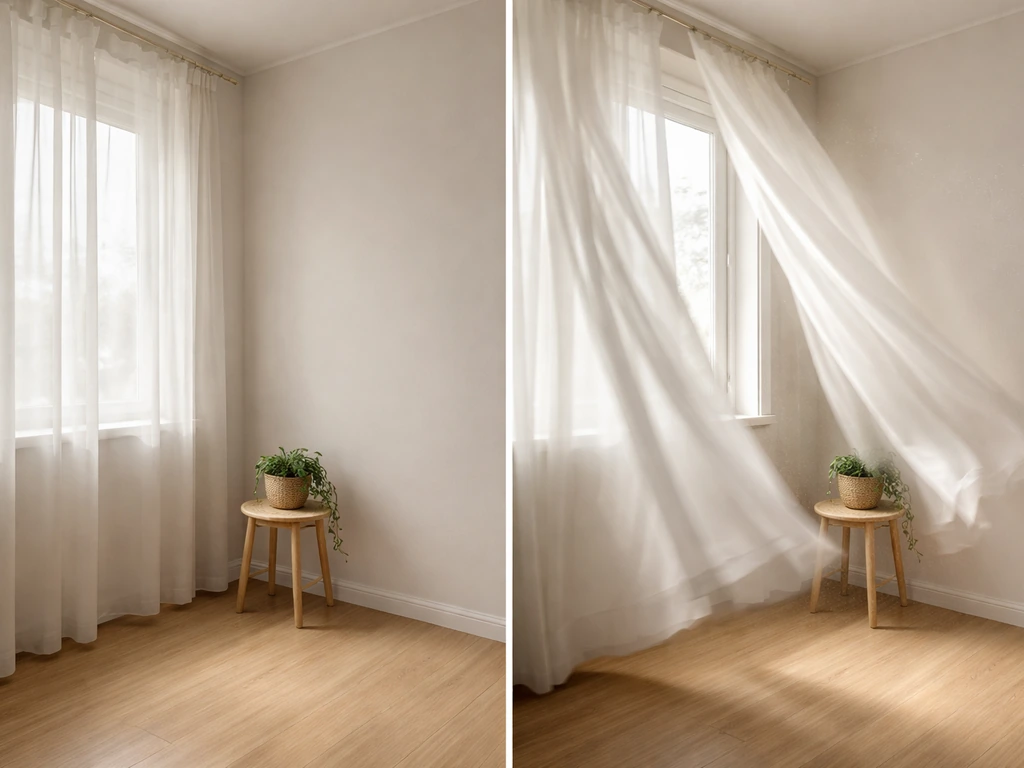
- Cover windows the bird keeps hitting. Use a curtain, sheet, or towel. The bird is chasing light and hitting glass — remove that false signal.
- Open one exterior window or door fully, and remove the screen. Make that single exit as obvious as possible.
- Leave the room or stand very still near the exit. Your presence is stressful. Give the bird a few minutes of quiet.
- If it's stuck high near the ceiling or on a curtain rod, gently encourage it downward using a slow, sweeping motion with your arm or a soft broom held flat — never swing at it. Once lower, it'll find the exit more easily.
- If you need to guide it more actively, use a large blanket or sheet held up gently to create a 'wall' that nudges it toward the open door.
What to avoid: don't chase the bird, don't clap or shout, and don't try to grab it unless it's injured. Rough handling causes serious stress and can injure both of you. If the bird hit a window and is sitting stunned on the floor, place a shoebox with air holes nearby (lined with crumpled paper towels), gently guide or scoop the bird in without squeezing it, close the lid loosely, and keep it somewhere dark, quiet, and away from pets. Check it after an hour. If it's alert and upright, take it outside and open the box. If it doesn't fly or looks injured, contact a local wildlife rehabilitator, don't attempt home treatment.
Once the bird is gone, if it got in through a vent or duct, that's worth addressing. Physical exclusion, wire mesh screening, vent covers with appropriate gaps, is the standard approach recommended by USDA wildlife management guidance to prevent repeat access.
What a starling in the house means spiritually
Starlings carry specific symbolism that's worth separating from the generic 'bird in the house' tradition. Many people search for blank" rel="noopener noreferrer">bird in a house meaning because they want to connect the event to a message or lesson they can apply to their life bird in your house. The general superstition, widely documented in Southern Appalachian folklore, Irish tradition, and across European folk belief, frames any bird entering a home as a potential omen, sometimes tied to an incoming visitor, sometimes (in older tellings) to death or significant change. Whether that reading feels relevant to you depends a lot on which tradition resonates and what the specifics of your encounter looked like.
Starling-specific symbolism tends to cluster around different themes. In spiritual and metaphysical frameworks, starlings are strongly associated with community, communication, and the power of coordinated movement, think of a murmuration, thousands of birds flowing together in perfect sync. An encounter with a starling is often read as a prompt to examine your own social world: Are you communicating clearly? Are you in sync with the people around you, or has something created discord?
The astrology and spiritual symbolism tradition around starlings frames a disruptive or chaotic starling encounter (like a panicked bird flapping around your living room) as potentially reflecting confusion or miscommunication in your current relationships, while a calm or brief visit might be read as a gentle nudge toward connection.
In Celtic and broader European folk traditions, birds entering a home were often seen as crossing a threshold between the natural world and the human one, sometimes carrying a message from the spirit world, an ancestor, or the divine. Starlings, as highly social and vocal birds, weren't typically death omens in the way that a single crow or an owl might be in those traditions. They were more often associated with news arriving, movement, or the arrival of something communal, a shift in the household's social fabric. That framing treats the starling less as a warning and more as a herald.
There isn't a prominent direct starling-in-the-house reading in biblical tradition specifically, but broader scriptural interpretations of birds entering human spaces often frame them as reminders of divine attention to small things, references to God's care for even the smallest creatures (Matthew 10:29–31), or calls to pay attention to the natural world as a channel of spiritual awareness. If a biblical or spiritual-Christian lens resonates with you, a starling's visit might be held as an invitation to notice, not panic, a reminder that even an uninvited guest carries meaning if you choose to look for it.
How the details shape the meaning
The specifics of your encounter matter, in symbolic interpretation, context is almost everything. Here's how different variables tend to shift the reading:
| Detail | Common Symbolic Lean | Worth Reflecting On |
|---|---|---|
| Calm, brief visit — flew in and out | Gentle message or acknowledgment; a fleeting reminder | What were you thinking about in the moment it appeared? |
| Panicked, trapped, flapping at windows | Confusion, communication breakdown, something feeling stuck | Where in your life do you feel like you're hitting a wall? |
| Dead starling found inside | Endings, closure, transition; the close of a chapter | What cycle in your life is completing right now? |
| Repeated visits over days or weeks | Persistent message; something asking for your attention | What have you been avoiding or deferring? |
| Arrives in spring (nesting season) | New beginnings, growth, community forming | What are you building or starting right now? |
| Arrives in autumn (migration) | Transition, letting go, preparing for change | What are you being asked to release? |
| Found near a window (threshold) | Symbolic crossing; message at the boundary | What boundary in your life feels permeable right now? |
| Found deep inside the house (living room, bedroom) | Something entering your inner world, not just your periphery | What feels like it has crossed from the outside world into your private space? |
Alive versus dead is one of the more significant distinctions. A living starling, even a frightened one, carries an energy of movement, possibility, and communication, things in motion. A dead starling found inside the house often gets read through the lens of completion, release, or transition. This isn't automatically dark or negative: many traditions frame the death of a bird that has entered a home as a sign that something old is concluding to make room for something new.
The folklore around whether the bird exits quickly or stays trapped also shapes the reading, in some Southern Appalachian traditions, a bird that finds its way out swiftly is a good omen, while one that stays trapped and cannot leave is the version more associated with difficulty ahead.
Is this natural or a sign? A quick self-check
Here's my honest take: most starlings end up inside because of vents, open windows, and seasonal migration, not because the universe arranged it. And also, both things can be true. A bird can have a completely mundane explanation for how it got in and still land in your life at a moment that feels charged with meaning. The practical and the symbolic aren't competitors.
Ask yourself these grounding questions before deciding how much weight to give the encounter:
- Is it spring or fall? If yes, migration or nesting activity is likely the mechanical cause, and you're not alone — bird-in-house incidents spike in these seasons.
- Was a vent, window, or door open? A clear physical pathway almost always explains the entry.
- Has anything significant happened in your life recently — a relationship shift, a major decision, a loss, or a new beginning? If the encounter landed on top of an already emotionally loaded moment, that's often why it feels like a sign.
- Has this happened before, repeatedly? A one-time encounter leans natural. Repeated incidents with no clear structural cause start to feel harder to explain away.
- What was your immediate gut reaction when the bird appeared? That first instinct — fear, wonder, calm, grief — is often where the personal meaning lives, regardless of what any tradition says.
If your answers point mostly toward normal seasonal behavior plus an open window, you probably have a practical situation with an optional symbolic layer. If your answers point toward an unusual timing, a repeated encounter, or a moment of personal significance, the symbolic reading deserves more of your attention. Both interpretations are valid; neither is mandatory. This is also where the broader question of whether a bird in the house is bad luck, a question with genuinely varied answers across cultures, becomes relevant to sit with on your own terms.
After it leaves: what to do with the experience
Once the starling is gone and the room is calm again, you have a choice about what to do with the moment. You don't have to assign it meaning, but if you felt something, it's worth honoring that.
Some people find it useful to simply pause and acknowledge the encounter, a kind of informal gratitude, for the bird's safe exit, for the reminder that the natural world and the human world are not as separate as we sometimes pretend. If ritual feels right to you, opening a window briefly after the bird has left (even symbolically) and saying a few words of release or welcome, depending on whether the encounter felt like something leaving or arriving, is a low-key way to close the moment intentionally.
Journaling is genuinely useful here, not as a mystical practice but as a thinking tool. Write down what happened factually first: the time of day, the season, where in the house the bird appeared, how it behaved, and how long it stayed. Then shift to the subjective layer. A few prompts worth sitting with:
- What was I thinking or feeling in the hour before the bird arrived?
- Is there a relationship or communication in my life right now that feels out of sync — or one that's been surprisingly harmonious?
- What would I want a starling to be telling me, if it could speak? What would feel most true?
- If this moment is a threshold — something crossing from the outside world into my home — what is it asking me to let in, or let go of?
- What do I want to do differently in the next week as a result of this encounter?
There's no single correct meaning for a starling in the house. Cross-cultural traditions described by the Environmental Literacy Council note that bird-visit meanings can be spiritual messages or connections to the natural or spiritual world, and that interpretations vary by the bird and its behavior cross-cultural traditions note that meanings vary by bird and behavior. What most traditions agree on, and what I think is worth trusting, is that an encounter like this is an invitation to pause.
The bird disrupted your ordinary day. The question is what you do with that disruption. Whether you see it as nature being nature, a message from something larger, or simply a strange and beautiful moment, the starling did something rare: it got your full attention. That alone is worth something.
If you are specifically wondering about a bird in house dream meaning, this same symbolism framework is often applied to dreams too.
FAQ
What does a starling bird in house meaning change if the bird comes in at night versus during the day?
Nighttime visits are more often linked to artificial lighting and disorientation, especially in fall and spring. Daytime visits can still be caused by open doors or window gaps, but if it appears repeatedly at the same time, it can point to a specific entry spot you should seal or cover.
Is it safe to release a starling immediately, or should I wait until it calms down?
If the bird is alert and able to fly, releasing sooner is usually better than leaving it loose for long periods in the home. If it looks sluggish, cannot right itself, or has visible injuries, use a shoebox setup and contact a wildlife rehabilitator rather than “waiting it out” in the room.
What if the starling keeps re-entering after I get it out the first time?
That usually means the exit point is not the real entry point. Look for the most likely access route like a vent, duct seam, or a gap behind a porch light or wall opening. Set up temporary barriers (tape a visible gap, block a loose vent cover) while you arrange proper exclusion materials.
What if the starling is trapped in a specific room, like a bathroom or hallway, and won’t fly out?
Make the exit easy and the rest of the space unattractive. Close interior doors, turn off other lights in that room if possible, and open one direct path outdoors. Avoid chasing, because it increases panic and can lead to more window strikes.
Does the starling species matter for the starling bird in house meaning?
In most homes, “starling in the house” is typically an European starling, which is strongly cavity-seeking and often connected to vent or duct entry. If you can confirm a different bird type, the symbolism and practical prevention steps could shift, but the safest response approach is still to create a single clear exit and reduce stress.
What if I find a dead starling inside, how should I handle the situation practically?
Wear gloves and avoid direct contact. Remove it promptly, bag it securely, and disinfect the area where it was found, especially if there were droppings or a collision with a window. If you notice multiple dead birds, uncommon cluster behavior, or signs of disease, contact a local wildlife authority for guidance.
How can I tell whether this is nesting-season behavior versus migration-season behavior?
Nesting-season timing is commonly late winter through early summer (roughly spring to early summer), and you may hear chattering or scratching near vents before the bird gets inside. Migration-season timing is often spring and fall, when artificial light can pull birds off course, leading to more “stumbled-in” incidents around windows and porches.
Could my house lighting be the main cause, and what’s the quickest fix?
Yes, porch lights, landscape lights, and interior lights near windows can attract and disorient birds. The fastest test is to turn off or shield the nearby lights for a few evenings while you seal openings, then observe whether incidents drop off.
What does it mean symbolically if the bird exits quickly compared with if it stays trapped?
Many people read a swift exit as “movement toward resolution,” while a prolonged struggle is seen as “difficulty or resistance before change.” Practically, a quick exit usually means you provided a clear path, so it is also worth treating this as confirmation that your setup and exclusion plan can work.
Does the starling bird in house meaning differ if the bird lands calmly versus flaps panicked?
A calm or brief visit is often interpreted as a gentler prompt toward communication and community, while a panicked, window-battering bird is frequently read as miscommunication or chaos. Regardless of symbolism, panicked behavior also increases collision risk, so prioritize one direct exit and keep other doors closed.
Can I interpret this as a bad omen, or is that always superstition?
It is not automatically a “bad luck” sign. Many traditions treat a bird entering as an omen in general, but the emotional tone of the encounter and what else is going on in your life often determines whether people frame it as warning, incoming news, or simply an invitation to pay attention.
What’s the best way to prevent future starling entry without harming the bird?
Use physical exclusion: screen vents and openings, install vent covers sized for birds but not oversized gaps, and seal duct or wall penetrations. Avoid blocking exits permanently while the bird is inside, and do your sealing after the area is clear so you do not trap another bird later.
Next Articles
What Is the Superstition About a Bird in Your House
Meaning of an indoor bird superstition plus quick steps to safely remove, interpret signs, and handle dead or injured bi
Bird in House Dream Meaning: Spiritual Messages and Steps
Bird in house dream meaning with spiritual, biblical and psych insights plus steps to journal, cleanse, and act safely t
Is a Bird in the House Bad Luck? What to Do Now
Is a bird in the house bad luck? Get real causes and step-by-step help to safely remove it, plus meaning myths.