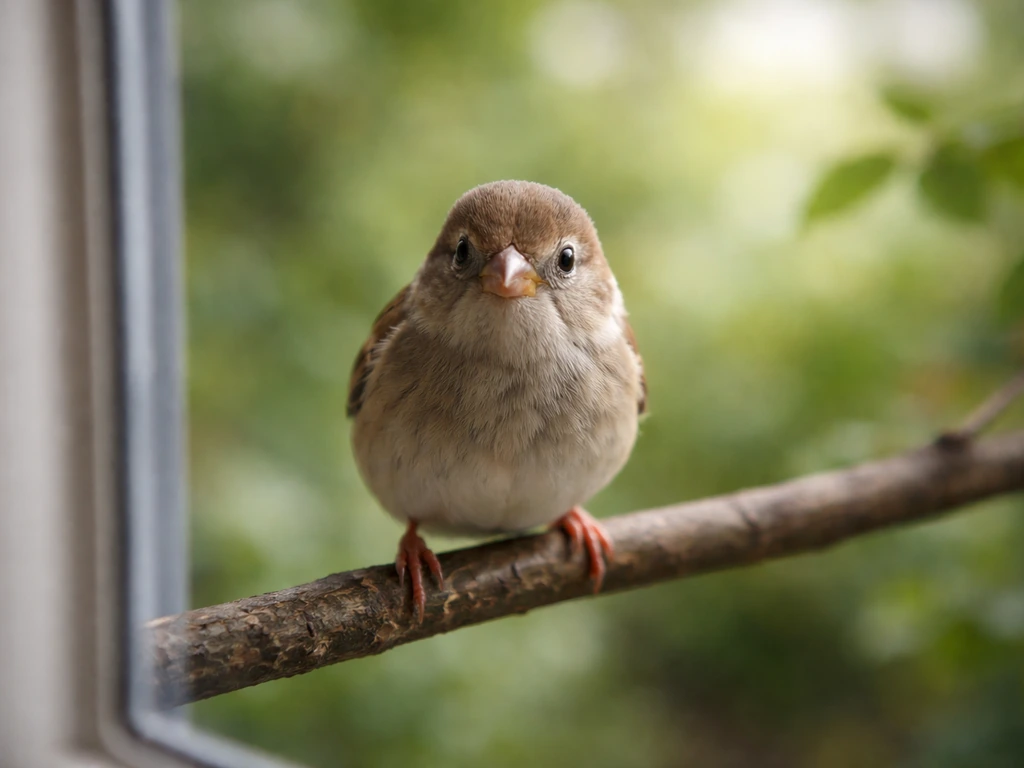
A bird hitting your head is jarring, startling, and, once your heart rate settles, genuinely puzzling. Whether it was a swooping dive-bomb, a brief wing-touch, or a sharp peck, your first instinct is probably to spin around and ask: what just happened, and <a data-article-id="67C19DA5-CB2B-48CA-8561-7D718EBD1AEA">what does it mean?
What Does It Mean When a Bird Attacks Your Head?

Maya Hartwell
18 Apr 2026
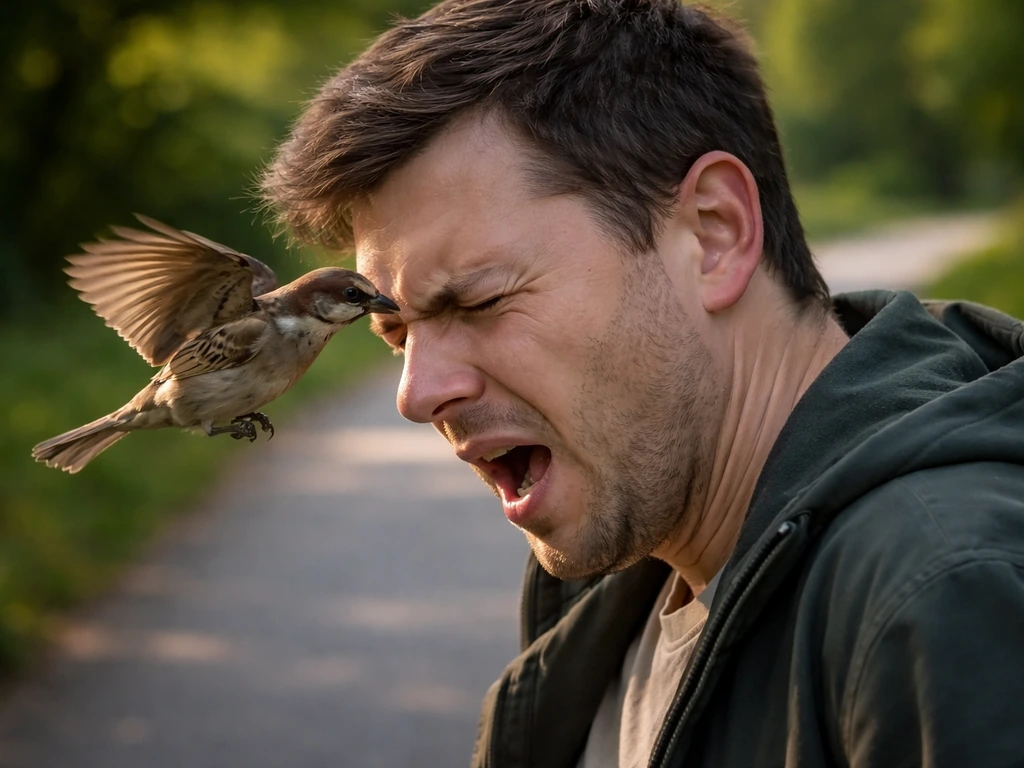
</a> whether it was a swooping dive-bomb, a brief wing-touch, or a sharp peck, your first instinct is probably to spin around and ask: what just happened, and what does it mean <a data-article-id="9481F312-6AAD-4E18-80EC-3DC3DECE46CB">what does it mean when a bird flies into you. The honest answer is: it could be a few very different things, and both the practical and the symbolic explanations matter.
This guide walks through what to do right now, why birds do this, and how to interpret it if you feel the moment carried meaning.
First: Check Yourself for Injury

Before anything else, before the journaling, the symbolism, the bird-watching, make sure you are physically okay. Head and face incidents with birds can range from a feather-light brush to a genuine wound, and the steps you take in the next few minutes matter. If you have a real wound, Harvard Health recommends using direct pressure to help stop bleeding and then acting based on how severe the bleeding is Emergencies and First Aid.
- Move away from the area. If the bird attacked once, it will likely do it again in the same spot. Get clear of its territory before you assess yourself.
- Check for bleeding or broken skin. Run your fingers across your scalp, check your face, and look at your hands for blood. Scalp wounds bleed heavily even when small, so don't panic if you see blood — assess the actual wound size.
- Apply direct pressure if there is bleeding. Use a clean cloth or bandage pressed firmly against the wound. Hold it there for several minutes without lifting to peek.
- Seek medical care promptly if the skin is broken on your face or scalp. Bird talons and beaks can cause puncture wounds that look minor but carry infection risk. A doctor can evaluate whether the wound needs cleaning, closure, or antibiotic treatment.
- Consider your tetanus status. Wounds from bird claws, especially if the bird had been on the ground, are considered dirty wounds. If you haven't had a tetanus booster in the last five years — or don't know when your last one was — mention this to a medical provider.
- Watch for concussion symptoms. If the bird struck your head with any force (some large birds like red-winged blackbirds, mockingbirds, or crows can hit hard), monitor yourself for headache, dizziness, nausea, confusion, or sensitivity to light. These symptoms can appear hours after the incident, not just immediately. If they develop, seek emergency care.
Eye contact with a bird's beak or talon is a separate emergency. If your eye was struck, cover it gently and go to an emergency room rather than waiting. Do not rub or apply pressure to the eye itself.
Why Birds Actually Attack Your Head (The Real-World Reasons)
Most bird head-strikes have a completely explainable behavioral cause. Understanding which one applies to your situation helps you decide both what to do next practically and how to frame the encounter symbolically. Here are the most common reasons:
Nest or Territory Defense
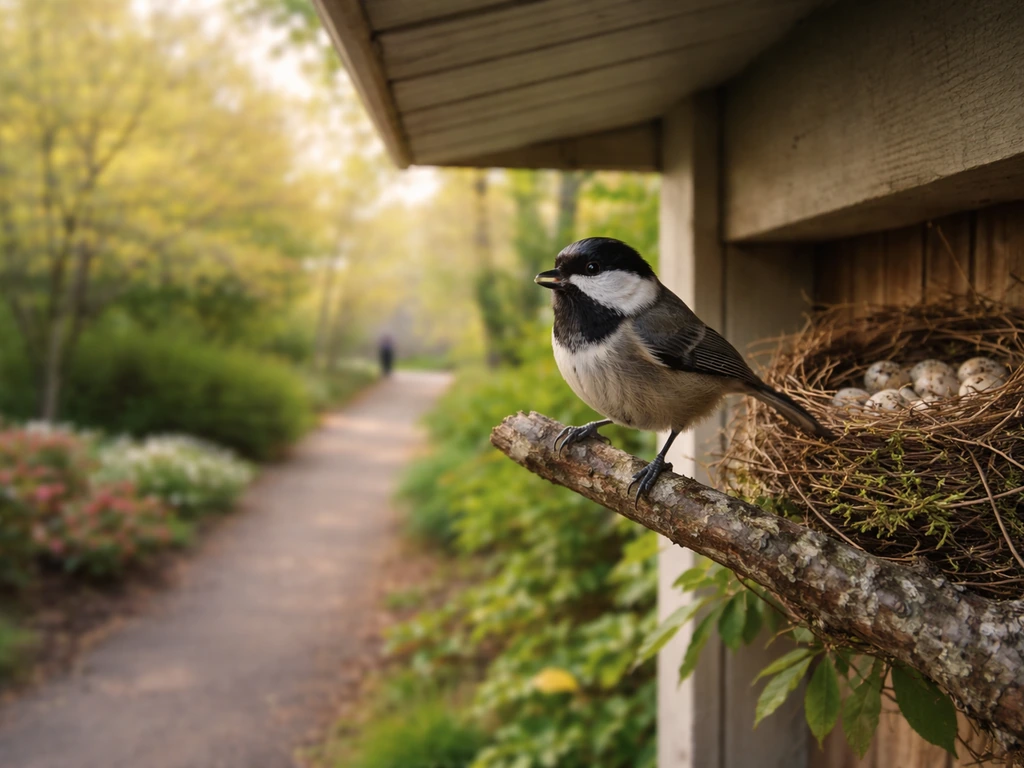
This is by far the most common cause, especially in spring and early summer. Birds like red-winged blackbirds, mockingbirds, crows, magpies, and Australian magpies are legendary for dive-bombing people who pass near their nests. The bird isn't angry at you personally, it perceives you as a threat to its eggs or chicks and is doing exactly what a good parent does: driving off the perceived predator.
The Environmental Literacy Council notes that swooping or dive-bombing is most often linked to perceived threats to a nest, young chicks, or territory, and that fledglings or newly hatched chicks can increase aggressiveness perceived threats to a nest/young/territory. If this happened in a wooded area, near a hedge, or somewhere you'd expect a nest, this explanation almost certainly applies.
Mistaken Identity or Reflections
Some birds (robins, sparrows, and cardinals are common culprits) attack their own reflection, and occasionally a shiny hat, glasses, or hair accessory triggers the same response. The bird sees a competitor and goes in. This is also why birds sometimes fly directly into car mirrors or windows. If you were wearing something shiny or highly reflective, this may be what drew the strike.
Food or Learned Behavior
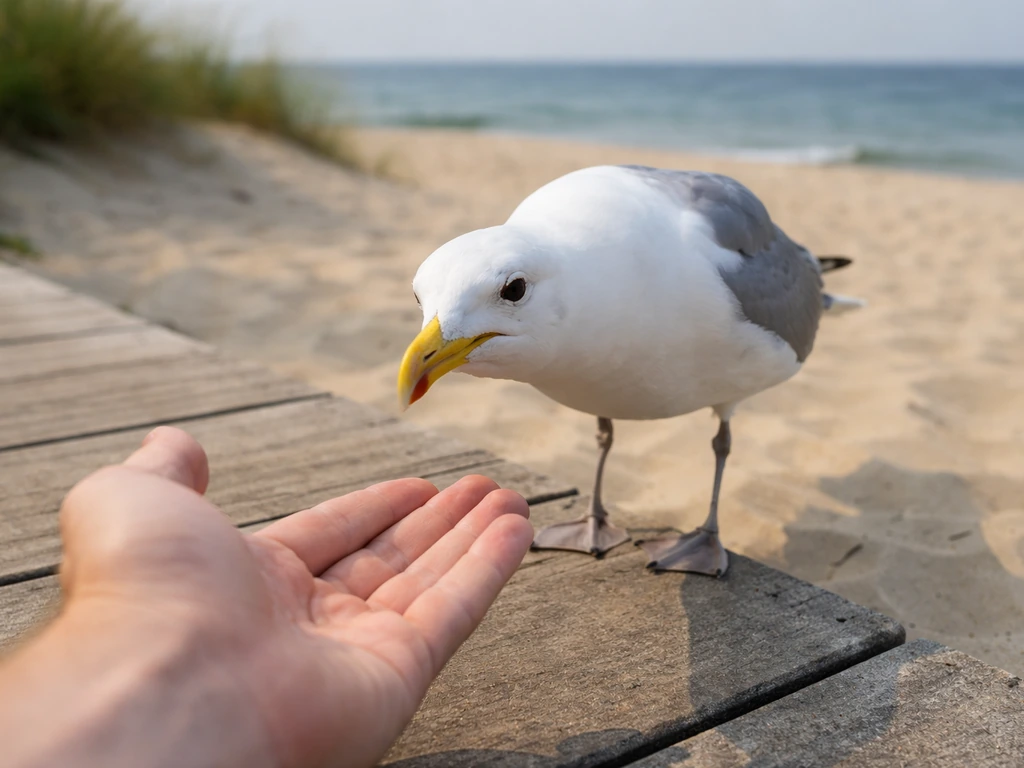
In areas where birds have been hand-fed frequently (parks, boardwalks, tourist areas), some individuals become bold enough to peck at people's heads or hands looking for food. Seagulls at the beach are a classic example. This is an opportunistic behavior, not aggression in the traditional sense.
Illness or Abnormal Behavior
A bird that approaches a person without provocation, acts disoriented, or attacks repeatedly without any obvious nest nearby may be sick. Birds with certain neurological conditions or infections can behave erratically. If the bird seemed wobbly, unsteady, or unusually persistent, keep your distance and consider reporting it to local wildlife authorities. Do not handle the bird.
Defensive Pecking on Accidental Contact
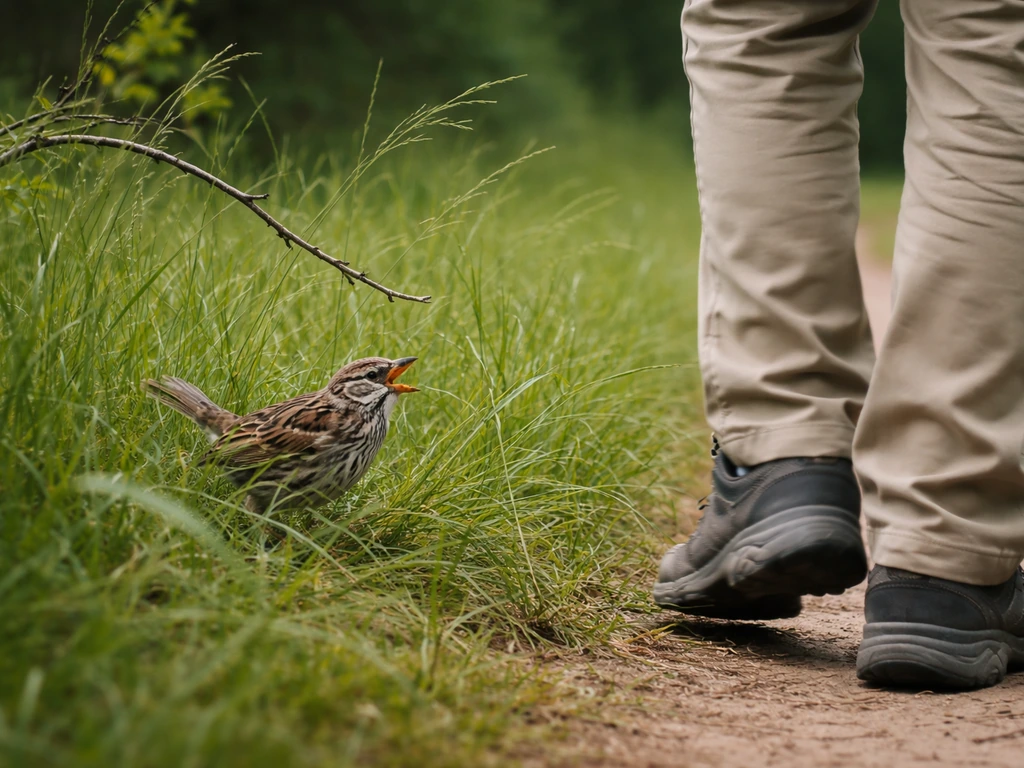
Sometimes you simply walk into a bird's space, through tall grass, near a low-hanging branch, or in an area where a bird was resting. The bird makes contact as part of its startled escape, not as an intentional attack. This explains many "bird touched my head" experiences that feel meaningful but were essentially a collision.
What This Might Mean Spiritually
Once you've confirmed you're physically fine, it's natural, especially if you're drawn to spiritual interpretation, to sit with the question of meaning. Across many traditions, birds are considered messengers between the physical and spiritual realms. Across many traditions, birds are considered messengers between the physical and spiritual realms, and you can also look at it through the lens of what does it mean when a bird sits on you. An encounter that feels sudden, startling, or unusually personal is the kind of moment people have historically stopped to reflect on. Whether or not you assign spiritual weight to it is entirely personal, but here are the interpretive frameworks many people find useful.
In many spiritual traditions, the head is associated with the mind, higher consciousness, and one's connection to the divine or the universe. A bird making contact specifically with your head, rather than your hand or shoulder (which you'd consider if a bird lands on you or sits on you), is interpreted by some as a call to pay attention to your thoughts, your mental patterns, or a decision you've been avoiding. The idea is less about the bird being aggressive and more about what the moment is asking you to wake up to.
Some interpretations read a sudden bird strike as a disruption, something in your current path or thinking that needs to be interrupted. It can feel like a jolt from a comfortable but unhelpful mental loop. Others interpret it as urgency: a message that something in your life needs immediate attention, much the way the bird itself was urgently protecting something it valued.
If the bird made contact and then lingered nearby, watching you, that adds another layer. A bird that stares at you after the encounter is often interpreted as a direct, intentional communication in spiritual traditions, as if confirming the message was delivered. If you want a deeper take on what it means when a bird stares at you, here is a related guide: what does it mean when a bird stares at you. If it struck and immediately flew away, the energy feels more like a passing signal than a sustained one.
Biblical and Folklore Perspectives on Aggressive Bird Encounters
Birds appear throughout biblical scripture as symbols of divine providence, guidance, and sometimes warning. Ravens fed the prophet Elijah in the wilderness (1 Kings 17). Doves signaled peace and God's presence. But birds are also used in the Bible as agents of correction and attention, in Ecclesiastes 10:20, the text warns that 'a bird of the air will carry your voice,' suggesting birds as carriers of important, even secret, information.
In many Christian folk traditions, an unusual or aggressive bird encounter near a home or person was seen as a sign to pray, to examine one's conscience, or to pay closer attention to one's spiritual life. It was rarely interpreted as a curse, but more as a nudge toward awareness or preparation.
Celtic folklore holds birds in especially high regard as messengers from the otherworld. The Celts paid close attention to which bird appeared and how it behaved. A crow striking near your head, for instance, was associated with the Morrigan, a figure connected to transformation, fate, and sometimes imminent change. This wasn't considered evil, but it was taken seriously as a sign that something significant was approaching or shifting in one's life.
In various Indigenous North American traditions, birds serve as spirit helpers and messengers. An unexpected, physical contact with a bird, especially one that feels intentional, is often seen as a direct communication from the spirit world or from an ancestor. The appropriate response in many of these traditions is gratitude, reflection, and listening rather than fear.
Japanese and East Asian folklore similarly treats unexpected animal encounters as omens worth decoding. Crows (karasu) in particular are deeply symbolic in Japanese culture, associated with divine guidance (the three-legged crow, Yatagarasu, is a solar symbol) as much as with death and transition. A crow interaction would be taken seriously but not necessarily negatively.
Across European folklore broadly, a bird that strikes a person's head was sometimes read as a warning: pay attention to where you are going, literally and figuratively. Some traditions connected it to news arriving soon, or to a need to look upward, to seek guidance from something larger than your immediate situation.
What the Bird Type and Behavior Tell You (Metaphysical Variables)
If you're working within a symbolic or metaphysical framework, the specific bird matters a great deal. So does the behavior, a gentle brush is different from a repeated, aggressive dive-bomb. Here's a quick guide to variables worth considering:
| Bird Type | Common Symbolic Associations | Possible Message in a Head-Strike |
|---|---|---|
| Crow or Raven | Transformation, intelligence, the mystical, ancestral messages | A major change is coming; pay close attention to your current path |
| Red-winged Blackbird | Aggression in defense of what matters, boundaries, protection | You or someone around you needs to set clearer boundaries |
| Mockingbird | Authenticity, voice, communication | Are you speaking your truth, or mimicking others? |
| Magpie | Duality, luck (good and bad), news arriving | Something new is on its way — stay alert |
| Robin | Renewal, new beginnings, the arrival of a fresh chapter | Something in your life is beginning again |
| Blue Jay | Boldness, clarity, speaking up, fearlessness | You may need to be bolder or more direct in a current situation |
| Hawk or Falcon | Vision, focus, higher perspective, messages from spirit | Expand your view; you may be too focused on small details |
| Owl (rare daytime attack) | Wisdom, the hidden, transition, the unseen | Something hidden in your life needs to be brought into the light |
| Seagull | Freedom, resourcefulness, adaptability | You may be clinging to something that no longer serves you |
Behavior matters just as much as species. A single brief strike that felt almost accidental is interpreted differently than a bird that circled and dove at you repeatedly. Repeated contact suggests urgency in the symbolic reading, something that really is asking for your attention rather than a passing signal. If the bird made physical contact and then perched somewhere nearby and watched you (similar to what people experience when a bird stares at them), that sustained presence is often read as confirmation that the encounter was intentional in some meaningful way.
Color also plays a role in many metaphysical traditions. A jet-black bird carries different energy than a red-and-black one, a speckled brown one, or an iridescent blue. If the bird's coloring struck you in the moment, trust that instinct and factor it into your reflection. Many traditions associate red with passion, urgency, or life force; black with mystery and deep transformation; white with purity and spiritual communication; and blue with clarity, truth, and higher guidance.
It's also worth noting what you were doing or thinking about right before the strike happened. Many people who take symbolic encounters seriously notice that the most meaningful ones occur at moments of transition, decision, or emotional intensity. If you were mid-thought about a major life question and a bird suddenly made contact with your head, that timing itself is part of the message in a symbolic reading.
How to Process This and Move Forward
Whether you're treating this as a purely practical event, a symbolic message, or both, there are concrete steps worth taking in the hours after it happens. The goal is to ground yourself, gather what's useful, and then decide what (if anything) you want to carry forward from the experience.
Immediately After (Practical)

- Clean any wound with soap and water, even if it looks minor. Flush thoroughly for several minutes.
- Document what happened while it's fresh: the location, time of day, what bird it was (or your best description), what it did, and how you were feeling or what you were thinking about beforehand.
- Note the bird's behavior after the strike. Did it fly away immediately? Did it return? Did it watch you?
- If the wound is beyond a minor scratch, or if the bird seemed sick, contact a medical provider and consider wildlife authorities respectively.
For Symbolic Reflection
- Find a quiet moment later in the day and journal what you remember: the sensory details, your emotional reaction, and any thoughts or images that came to mind immediately after.
- Ask yourself: What was I thinking about or dealing with in the days leading up to this? Is there a connection between that and any of the symbolic themes associated with the bird?
- Consider whether the encounter felt like a warning, an interruption, a greeting, or simply a collision. Your gut reading of the energy matters in symbolic interpretation.
- If the bird type resonates with a particular tradition meaningful to you — Celtic, biblical, Indigenous, East Asian — explore that tradition's specific lore around that bird.
- Sit with open questions rather than forcing a definitive meaning. Many people find that the 'answer' surfaces in the days following the encounter, not in the moment itself.
One grounding practice worth trying: after you've journaled, go back outside (away from the area where the bird struck) and simply observe birds for a few minutes. Notice what appears, what draws your attention, and how the encounter now sits in you compared to the adrenaline of the original moment. This kind of grounding helps separate fear-response from genuine intuition, and often makes the symbolic reading clearer.
Ultimately, a bird attacking your head is one of those experiences that holds room for multiple truths at once: it was almost certainly a territorial parent protecting its nest, and it may also have been the universe tapping you on the head at exactly the right moment. Both can be true. You get to decide which lens you carry forward, and what you choose to do with it.
FAQ
How can I tell if the bird strike was a nest defense versus a reflection or food-seeking behavior?
A nest-defense strike usually happens repeatedly in the same area you walked near, often at a time when eggs or chicks would be present. Reflection-related pecks tend to target shiny surfaces or your face where glasses, a watch, or a glossy hat catches light. Food-seeking behavior is more common in busy public spaces and often escalates to hands or head-feeding attempts rather than repeated aerial dives.
What should I do right after a bird hits my head if I’m not sure whether I’m injured?
Check for symptoms beyond surface marks, especially confusion, worsening headache, dizziness, nausea, blurred or double vision, or vomiting. If any of those show up, treat it like a head injury and seek urgent medical care rather than focusing on meaning. If you only have a light feather touch, wash the area with clean water and mild soap.
Can a bird strike my eye even if it only brushed my head, and what is the safest response?
Yes, a quick hop forward can put talons or beaks near the eye even during what seems like a head brush. If the eye itself was struck or you have pain, redness that worsens, light sensitivity, or vision changes, cover the eye gently and get urgent evaluation. Avoid rubbing, and don’t use contact lenses until you’re cleared.
What if the bird touched my head but I also have a small cut or broke skin, do I need medical attention?
Consider medical advice if the beak or talons broke skin, even lightly, because you may need a tetanus update. Clean with running water, apply gentle antiseptic, and monitor for increasing redness, swelling, warmth, pus, or fever over the next 1 to 3 days.
Is it normal to feel shaken or interpret it spiritually right after, and how do I avoid overreading?
It’s normal to feel meaning because adrenaline makes the moment feel personal. A practical way to prevent overreading is to write two lists after you calm down, what happened (facts like location, behavior, and duration) and what it could mean symbolically (possible themes), then wait a day before deciding which interpretation to keep.
Should I report the bird if it was aggressive, and when is handling or approaching the bird a bad idea?
Report only if the bird seemed ill, acted disoriented, approached without fear repeatedly, or was persistent in a way that suggests neurological trouble. Do not try to capture or move it, especially near nests or if it could be defending rapidly. Contact local wildlife services for guidance.
What if the bird attacked more than once, does that change the practical and symbolic interpretation?
Practically, repeated attacks without a nearby nest raise the likelihood of a reflective trigger, bold habituation to people, or illness. Symbolically, repetition is often read as urgency, but you should still prioritize safety, because repeated behavior often has a clear environmental cause.
Does the specific bird species matter, or is the behavior more important?
Behavior usually matters more for real-world decisions, because dive-bomb patterns and triggers tell you how to avoid it next time. Species can matter for symbolism if you like that framework, but for safety, focus on whether it was defending, reacting to reflection, or acting food-motivated.
What can I do to prevent another head strike the next time I’m in the same area?
If it was near vegetation or likely nesting spots, change your path and avoid walking directly under low branches. If reflection seems involved, cover or adjust glossy items like sunglasses, watch faces, or shiny hats. If it was a feeding-begging situation, don’t feed birds and keep a little distance from areas where they cluster.
What should I watch for in the following hours that would indicate the encounter was more than a harmless touch?
Watch for signs of head injury (worsening headache, confusion, trouble walking, repeated vomiting), eye problems (pain, worsening redness, vision changes), and skin infection (increasing swelling, heat, pus, fever). If any appear, seek medical care. If none appear and symptoms stay mild, it’s usually reasonable to move from emergency steps to grounding and reflection.
Next Article
What Does It Mean When a Bird Stares at You? Meaning
Bird eye contact reasons and how to tell calm curiosity from nesting or danger, plus respectful spiritual symbolism.