The phrase 'blank" rel="noopener noreferrer">like a dog with a bird at your door' comes from Phoebe Bridgers' 2020 song 'Moon Song,' and it means intense, almost helpless devotion: waiting loyally, fixated, ready to deliver yourself to someone even when the relationship costs you. In published lyrics reproductions for Phoebe Bridgers' “Moon Song,” the phrase appears exactly as “like a dog with a bird at your door.” blank" rel="noopener noreferrer">'like a dog with a bird at your door'. In conversation today, people use it to describe that feeling of being unable to look away, unable to stop waiting, locked in eager attention on something or someone. But if you landed here because an actual bird showed up at your door and your instincts lit up like a dog on alert, that reaction is worth paying attention to too. Both readings matter, and this guide covers them both.
Like a Dog With a Bird at Your Door Meaning and What to Do
Where the phrase comes from and how it's used today
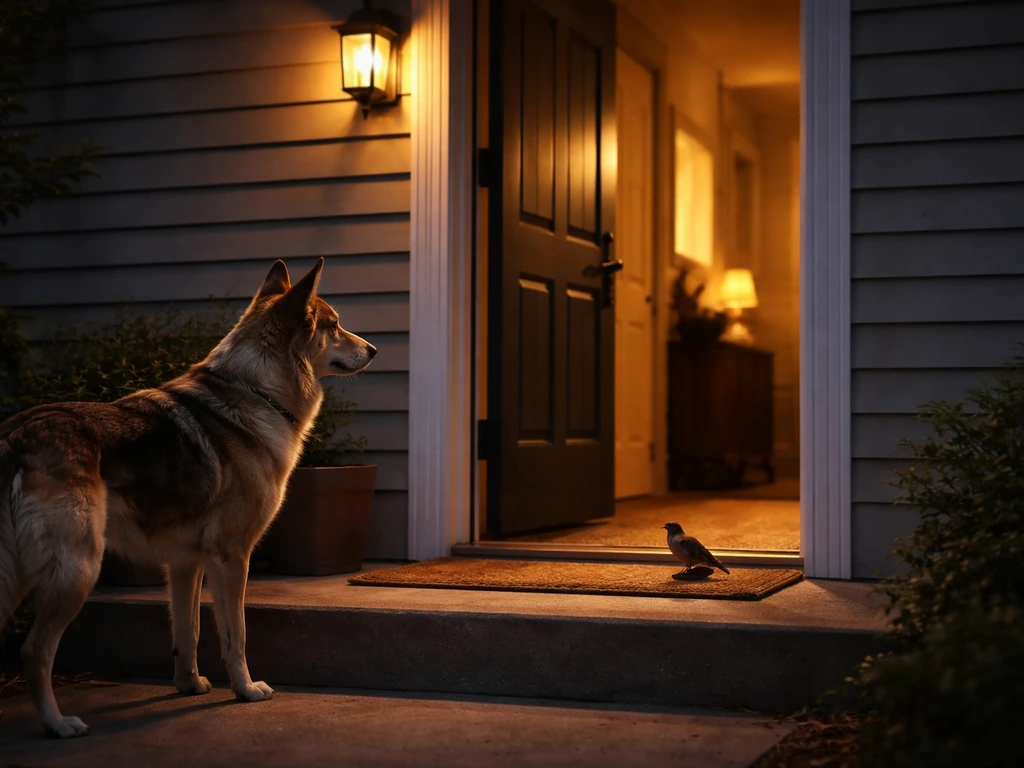
Despite sounding like an old folk proverb, 'like a dog with a bird at your door' does not have a documented history as a traditional English idiom. There's no clear earliest print date, no grandmother's kitchen proverb collection, no old folklore dictionary entry. What there is: a Phoebe Bridgers lyric from 'Moon Song' on her 2020 album 'Punisher,' in which the speaker describes waiting for the next time the other person wants them, helplessly devoted despite pain. That image, a dog standing alert at a threshold with a bird in its mouth, ready to offer it up, is the source most people are actually drawing from when they use the phrase now.
When someone says you're acting 'like a dog with a bird at your door,' they almost always mean one of two things: you're intensely fixated on something you can't ignore, or you're the loyal, eager one in a dynamic where you'd wait forever for someone who may not meet you halfway. The image works because dogs are single-minded when they've caught something. They don't wander off. They hold the prize and wait. That's the emotional core of the phrase in modern usage.
The literal scene: what's actually happening when a dog reacts to a bird at your door
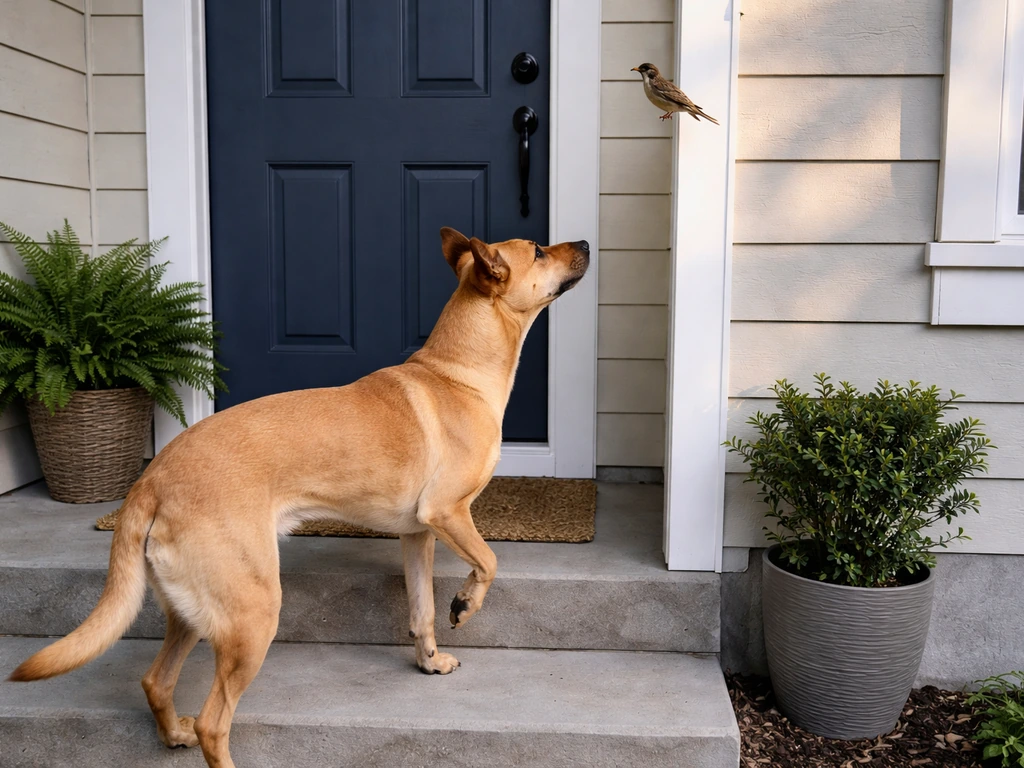
Picture it plainly: a bird lands at or near your front door, and your dog freezes, fixes its gaze, maybe whines or barks or paws at the glass. In the phrase, the bird at the door is treated as if it has purpose, which is a kind of personification a bird. The dog isn't confused. It's locked in. That behavior, the total alert stillness followed by urgency, is exactly what the phrase is evoking. Dogs respond to birds near a threshold with a specific kind of heightened attention because the doorway represents the boundary between inside and outside, safe and unknown. The bird at the threshold triggers the dog's guarding instinct and its hunting instinct at the same time.
What makes this image so resonant is that the door is a liminal space, a crossing point. Across nearly every spiritual and folk tradition, the threshold of a home carries symbolic weight. So when a bird appears there, and especially when something (a dog, a person, your own gut) signals 'pay attention,' that reaction is culturally and symbolically loaded in ways that go well beyond animal behavior.
The figurative meaning: urgency, fixation, and loyalty to a fault
In figurative use, the phrase zeroes in on three qualities: urgency, fixation, and a kind of devotion that doesn't know when to quit. If someone describes themselves this way, they're usually admitting they can't stop thinking about something or someone. If someone uses it to describe you, they're pointing out that you're in that state of locked-in attention, possibly to your own detriment. The bird in the image is the thing being offered, held out, presented at the threshold. The door is the barrier between you and whatever you want. The dog is the part of you that just waits.
In conversation, context changes the tone. Sometimes it's affectionate ('you're so devoted, you'd wait all day'). Sometimes it's a gentle warning ('you're pouring yourself into something that isn't opening the door'). The emotional undercurrent from Bridgers' original lyric keeps the phrase tinged with longing and a little bit of heartache, even when people use it casually.
What a bird at the door means spiritually across belief traditions
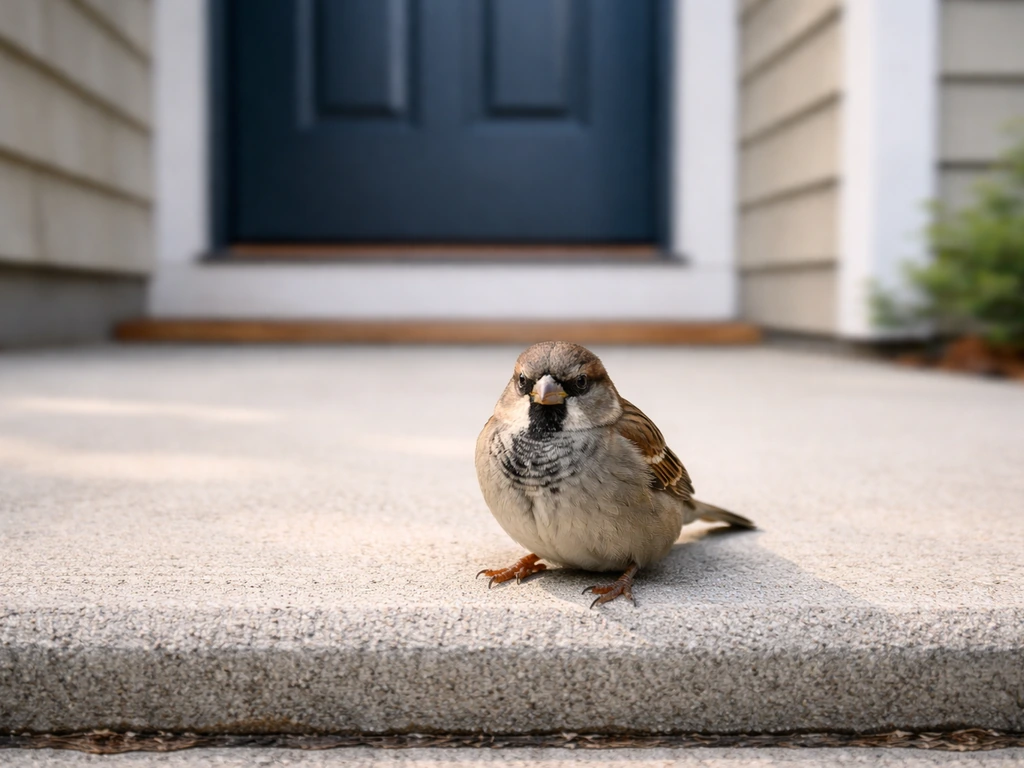
If you're here because a real bird appeared at your door and you felt that alert, almost electric sense that it meant something, you're in good company. If you are wondering, “bird on doorstep” is often shorthand for messages, timing, or a shift happening right at your boundary bird on doorstep meaning. If you are looking for the bird on my balcony meaning, start by noting the details and the feelings you had in the moment a real bird appeared at your door. Bird encounters at the threshold of a home are taken seriously across a striking range of traditions. If you want the bird at front door meaning in everyday terms, start by noticing whether it feels like a message, a warning, or simply a coincidence. The front door is widely understood as more than an entrance: it's the point where the outside world meets your private life, where messages are received, where energy enters. A bird choosing that spot is, in many frameworks, choosing deliberately.
Biblical and Christian symbolism
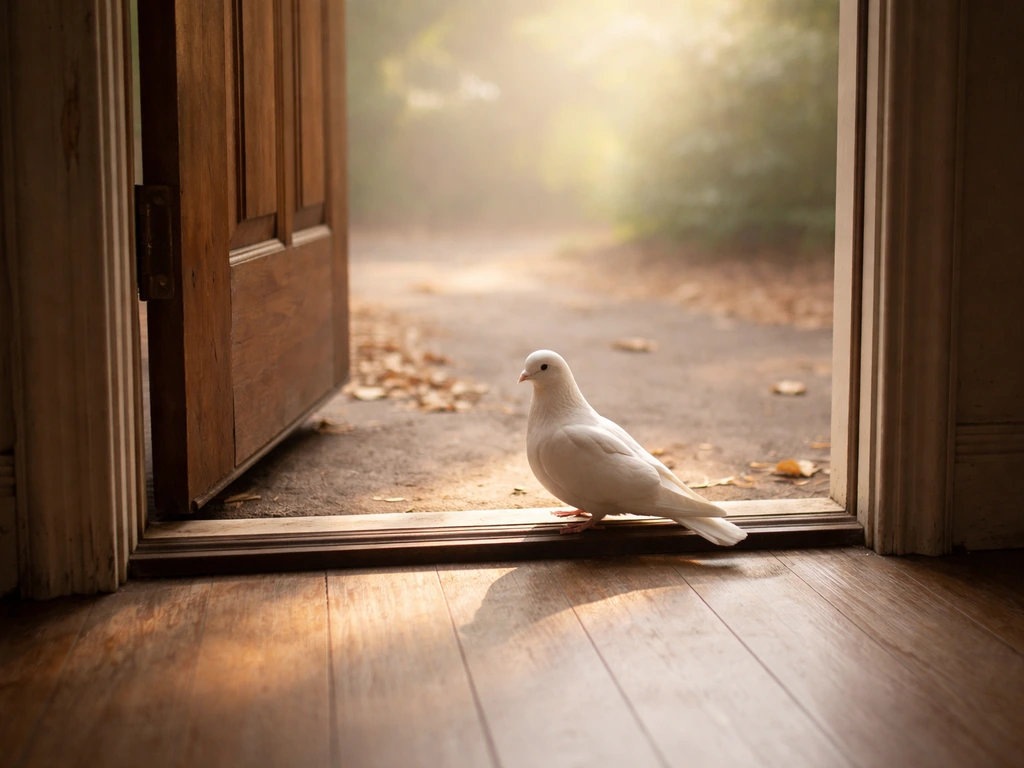
In biblical tradition, birds frequently carry divine messages. The dove returning to Noah signals hope and new beginnings. Ravens feed the prophet Elijah in the wilderness. Sparrows are cited as proof of divine care for small things. A bird appearing at your door in this framework can be read as a reminder that you are being watched over, that provision is near, or that a period of waiting (very much like a dog at a threshold) is about to shift. The threshold symbolism in scripture is also notable: doorposts were marked with protective signs, and passages across thresholds often marked spiritual transitions.
Celtic and folk traditions
In Celtic and broader European folk belief, a bird at the door was taken as a direct message from the spirit world or from departed loved ones. Robins in particular were believed to carry messages from ancestors. A bird pecking at or hovering near the front door was sometimes read as a warning of change or as an announcement of news arriving soon, not necessarily bad news, but news that would require you to act. Some Irish folk traditions held that to turn a bird away from your threshold was to refuse a blessing.
Indigenous and Eastern perspectives
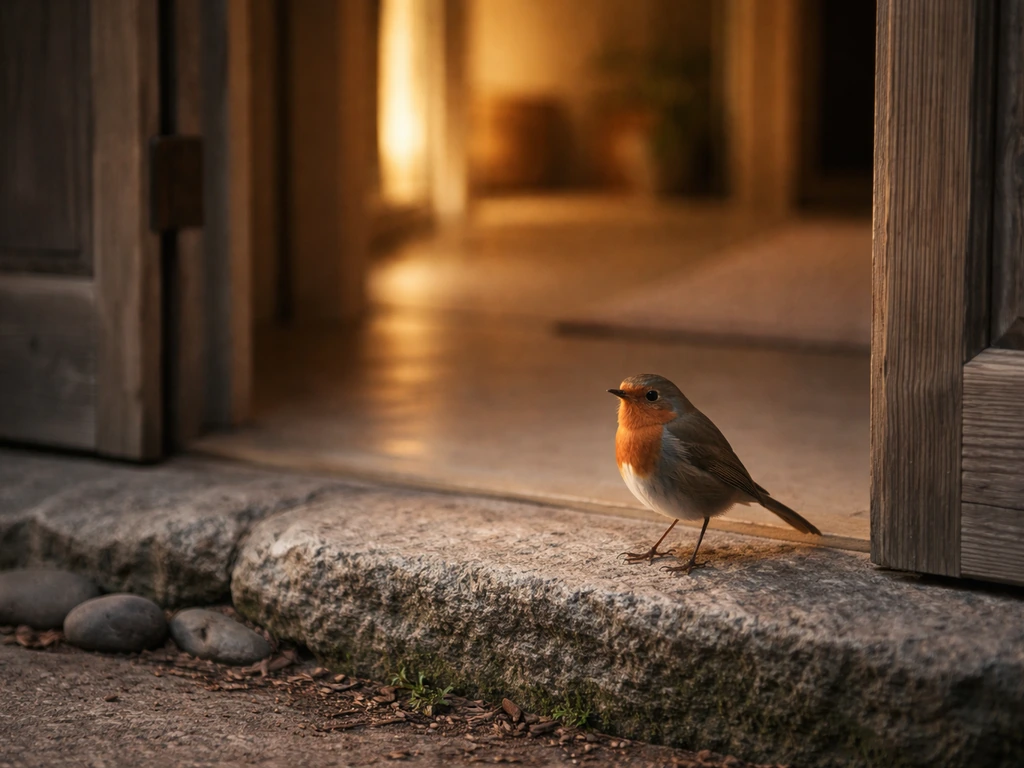
Many Indigenous North American traditions treat bird appearances as communications from spirit guides or ancestors. The specific meaning depends heavily on the bird species and the direction it came from. In several Eastern traditions, including Chinese folk belief, a bird arriving at the front door is considered an auspicious sign, often tied to good fortune, an important visitor, or a shift in household energy. The front door in feng shui is the 'mouth of qi,' where energy enters the home, so a bird pausing there is interpreted as a signal about what energy is arriving.
Metaphysical and modern spiritual frameworks
In broadly metaphysical interpretations, birds are seen as messengers operating at a higher frequency. A bird at your door in this context is often read as a prompt to pay attention, to notice what's on the threshold of your life right now, what's waiting to enter or be released. The urgency of the 'dog with a bird' image maps onto this beautifully: something is being presented to you at your threshold, and the question is whether you'll open the door.
What to do right now: practical steps when a bird is at your door
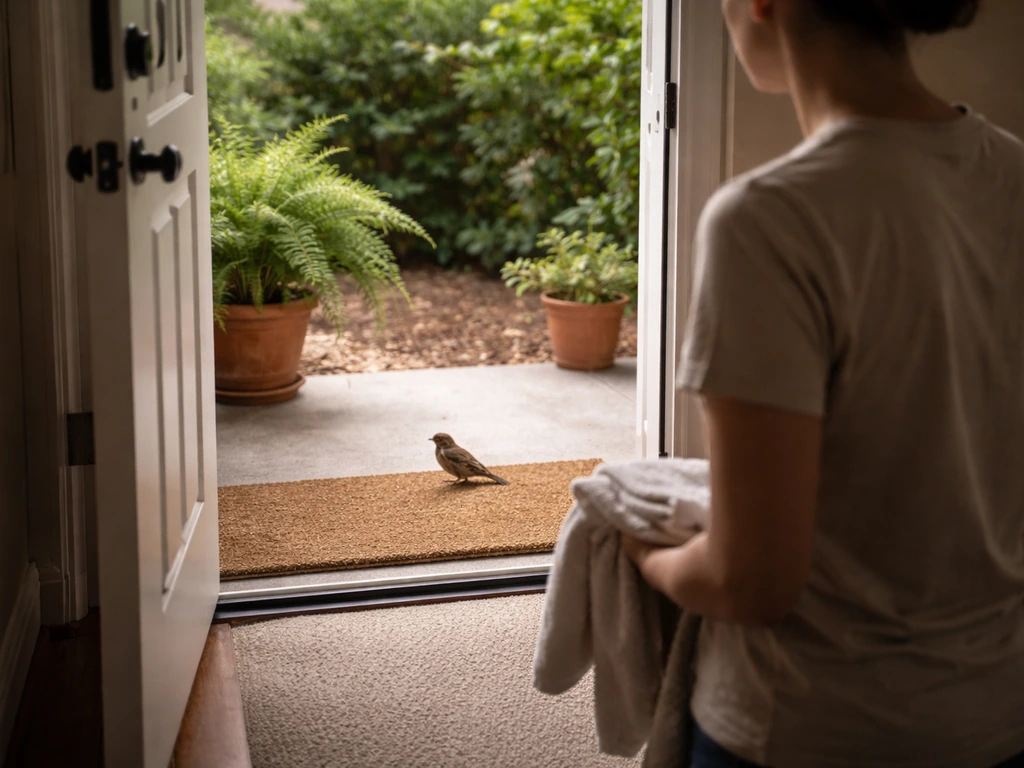
Whatever your spiritual read on the situation, there are practical steps worth taking first. The bird's condition, behavior, and species all matter, both for its safety and for accurate interpretation later.
- Observe before you act. Watch the bird from a slight distance for 5 to 10 minutes. Is it moving normally? Standing still because it's stunned (common after window strikes) or because it's injured? A healthy bird will typically reorient and fly away once it feels safe.
- Check for injury. If the bird is on its side, unable to stand, or has visible wounds, it needs help. Contact a licensed wildlife rehabilitator in your area, do not attempt to treat it yourself. In the US, you can find local rehabilitators through the National Wildlife Rehabilitators Association.
- Give it a safe exit if it's entered your space. If the bird has come inside through an open door, close interior doors, turn off lights in the room, and open the widest exterior exit you have. Birds move toward light, so block interior light sources and let natural light guide it out.
- Keep pets indoors. A dog or cat near the bird will stress it, possibly to the point of death from shock, and may injure it even without intent. Keep animals away until the bird has left.
- Clean any droppings safely. Bird droppings at thresholds can carry Salmonella and Histoplasma spores. Wear gloves and a mask, dampen the droppings with a water-and-bleach solution (1 part bleach to 9 parts water) before wiping, and wash your hands thoroughly after.
- Record the details. Note the species if you can identify it, the time of day, what the bird was doing (perching, pecking, flying into the door repeatedly), and anything that felt significant. These details will matter if you're trying to interpret the encounter spiritually.
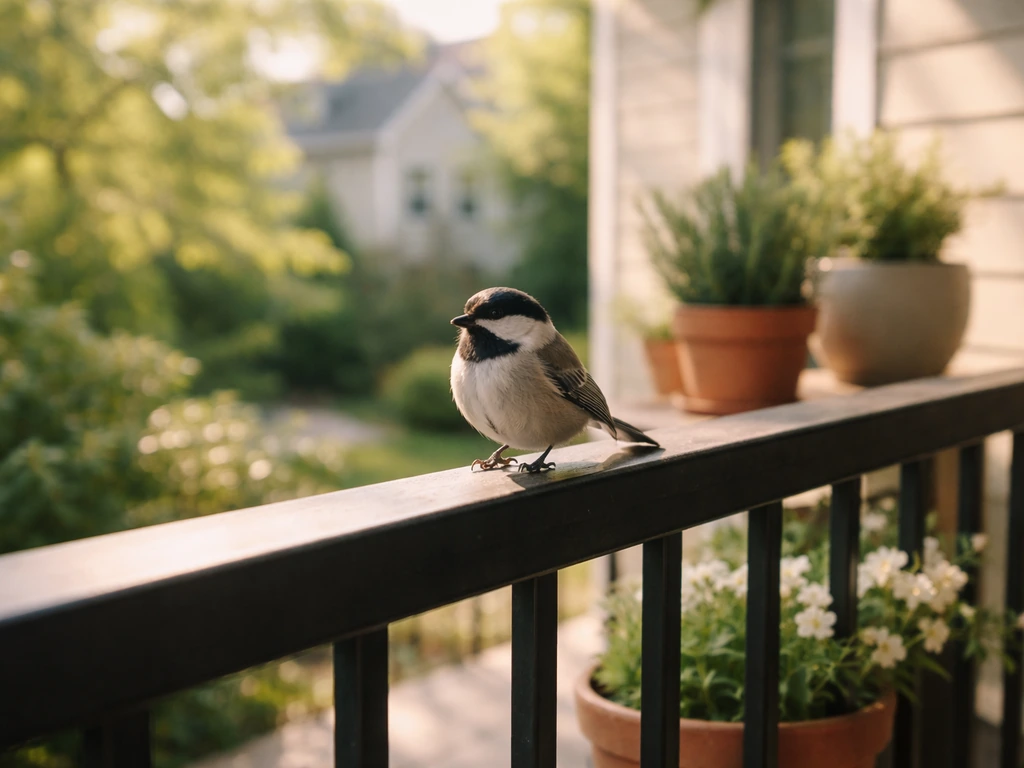
A bird at the front door is different in character from a bird on the roof or a bird on the porch in terms of symbolic weight, but the practical response is the same in all cases: observe first, ensure safety, then reflect. If you mean a different scene, like a bird on the roof, the meaning can shift based on the specific setting and symbolism. A bird on the porch is often interpreted similarly, but the porch setting can suggest a more casual or transitional kind of message bird on porch meaning.
Is this a message or just a bird being a bird? How to tell
This is the question most people are actually trying to answer. Here's how I'd approach it: start with the most grounded explanation and work outward from there. Birds appear at doors for entirely natural reasons: food sources nearby, a reflection in the glass they're responding to, a draft of warm air, or simple territorial behavior (especially in spring, when birds repeatedly fly at windows thinking they see a rival). If the behavior has a clear natural explanation, that's your first layer.
But natural cause and spiritual meaning don't cancel each other out. Many traditions hold that spirit uses the natural world as its medium. The more useful question isn't 'is this supernatural?' but 'does this encounter feel significant to me, and what might I take from it?' Ask yourself:
- Did this encounter arrive at a moment of personal significance, a decision you're weighing, grief, a transition?
- Is the bird species one that carries meaning in your own cultural or spiritual background?
- Did the encounter feel different from ordinary background noise? Did it stop you?
- Has this happened more than once in a short period?
If you answered yes to more than one of those, sitting with the encounter and exploring its potential meaning is a reasonable and worthwhile thing to do. If the bird was clearly disoriented after a window strike and flew off once it recovered, that's probably not a message so much as a moment of shared vulnerability, which has its own small meaning if you want to find one.
Common variations and how context changes the meaning
The phrase and the literal encounter both shift depending on context. Here's a quick breakdown of the most common variations and what they typically signal:
| Variation or Context | Likely Meaning or Interpretation |
|---|---|
| Someone says this phrase about you in conversation | You're being described as intensely devoted, fixated, or eagerly waiting, often with an undercurrent of concern that you're giving more than you're receiving |
| You use the phrase to describe yourself | Self-awareness of your own fixation or longing, often with a mix of pride and self-deprecation |
| A bird is at your front door, healthy and active | In spiritual frameworks: a message arriving, energy shifting, news on its way. Worth noting the species and your current life circumstances |
| A bird repeatedly flies at your door or window | Territorially driven in spring/summer; spiritually interpreted in many traditions as persistence, a message demanding your attention |
| A bird is at your door and injured or still | Practically: it needs help. Symbolically: in some traditions, a stunned or dying bird near the threshold carries a heavier message about transition or endings |
| A bird at the door after a loss or major life event | Across Celtic, Indigenous, and metaphysical traditions, this is frequently interpreted as a visitation or reassurance from a departed loved one |
| A bird on the doorstep vs. at the front door | Both carry threshold symbolism, but a bird on the doorstep is often read as a more direct 'at your door' message than one flying past or landing briefly on a nearby branch |
The species matters too. A robin at the door carries different traditional associations than a crow, a dove, or an owl. If you know what kind of bird appeared, that detail alone can sharpen the interpretation considerably in any tradition you're working within.
Bringing it together: what are you actually being called to notice?
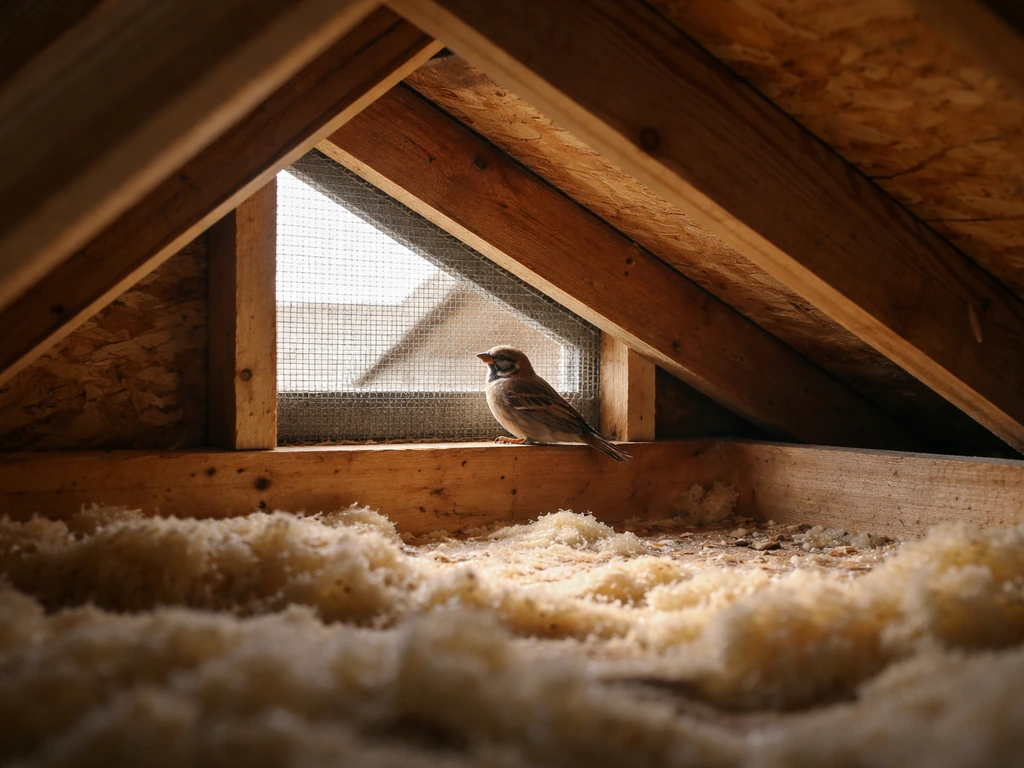
Whether you came here because someone used this phrase about you, because you've been sitting with your own 'dog at the door' feeling of longing or fixation, or because a real bird just appeared at your threshold and your gut said 'this means something,' the underlying thread is the same: something is being presented to you at a boundary. If you are specifically wondering about the bird-in-attic meaning, that’s another related door-threshold angle to explore bird in attic meaning. The threshold is the key. In Bridgers' lyric, in dog behavior, in nearly every spiritual tradition that pays attention to birds, the doorway is where waiting turns into arrival, where the outside meets the inside, where a message either gets received or gets turned away.
So what's at your threshold right now? What have you been waiting at the door for? And what would it mean, practically or spiritually, to open it? Those are the questions worth sitting with after an encounter like this, whatever form it took.
FAQ
What does “like a dog with a bird at your door” mean when it is said in a good mood versus a warning?
Use the phrase when the core is “locked-in attention,” not just excitement. If it describes you watching for a text, waiting on a person who is unreliable, or repeatedly replaying the same thought, that fits. If you are simply busy or hopeful, other wording is usually more accurate.
How can I tell whether the phrase is calling me the loyal one or the fixated one in a relationship?
If you’re being described as “the dog,” it often implies you are the one chasing, waiting, or over-investing. If you hear it about “the other person,” it usually points to someone who is not showing up on the same timeline. A quick check is to look for mismatch in effort, consistency, and emotional cost.
When does this phrase stop being poetic devotion and start describing unhealthy fixation?
It can mean unhealthy attachment when the “door” never opens, you keep shrinking your needs to stay available, or you’re ignoring red flags. If you catch yourself waiting while actively getting hurt, it helps to treat it like a boundary problem, not a romantic destiny (for example, reduce access, set a time limit, or pause contact).
Is the phrase always about love or devotion, or can it be used for obsession with anything?
There are two common misreads: assuming it is always romantic, and assuming it is always flattering. In many conversations it lands as “you can’t disengage,” which can be neutral, affectionate, or critical depending on tone and whether the person using it knows you well.
What should I say back if someone tells me I’m “like a dog with a bird at your door”?
If someone says you are acting like that, ask one clarification question: “What part do you mean, the waiting or the fixated attention?” Then respond with specifics (what you did, what you expected, what the outcome was) instead of debating the imagery.
How can I interpret a real bird at my door without forcing a supernatural meaning?
Yes, but do it carefully. If you want a “message” read, confirm the natural triggers first (mirror reflections, food nearby, territorial behavior, drafts, warm air). Only then decide what the experience means to you, so you do not ignore obvious safety or behavioral explanations.
What practical steps should I take during a real bird-at-the-door moment?
Prioritize safety: keep pets inside, avoid sudden door opening if the bird looks stunned, and do not handle it unless you are trained. If it appears injured or keeps hitting windows, contact local wildlife help. If it seems healthy and just paused there, observe then let it leave on its own.
How do I know whether the bird encounter is likely coincidence or something meaningful?
Look for patterns. One brief appearance after a window strike may be coincidence. Repeated visits at similar times, particular weather, or consistent behavior toward a specific window or glass reflection suggests a natural cause you can correct (change lighting, cover reflective surfaces, adjust feeders).
Does the bird’s species matter more than its behavior and condition?
Species can shift the “symbolic” overlay, but in practice the behavior and condition are usually more informative. A disoriented bird needs help, regardless of whether you read crows as caution or doves as reassurance.
What is a healthy next step when I recognize that “waiting at the door” feeling in myself?
If someone used the phrase about you, ask yourself what you are waiting to receive and what you are offering while you wait. If your “waiting” is mostly passive, it may help to convert it into action that improves your situation (set a plan, communicate once, then reassess).