Finding a dead bird in front of your house stops you in your tracks. Whether it's on your front path, your lawn, or just outside your door, that still, feathered form demands your attention in a way that feels significant. And honestly, it is worth paying attention to, on at least two levels: the very practical (is this a health concern, and what do you do with it?) and the symbolic (what might this mean?). Let's take both seriously.
Dead Bird in Front of House Meaning: Practical and Spiritual

Maya Hartwell
6 Apr 2026
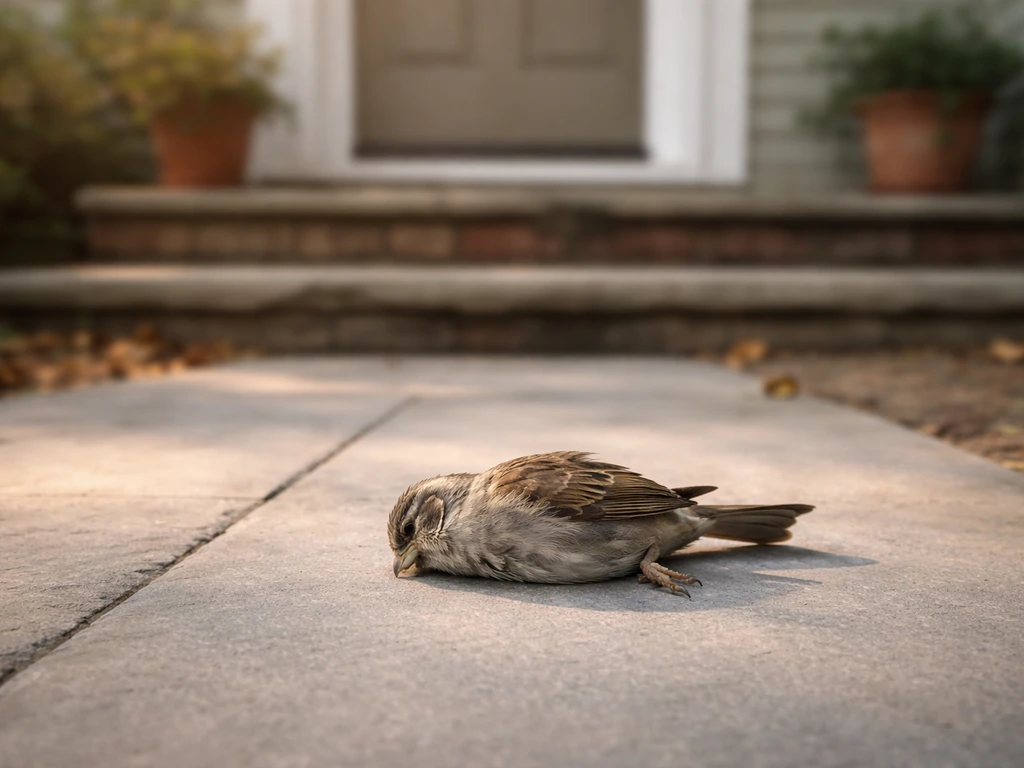
What a dead bird near your house likely means right now
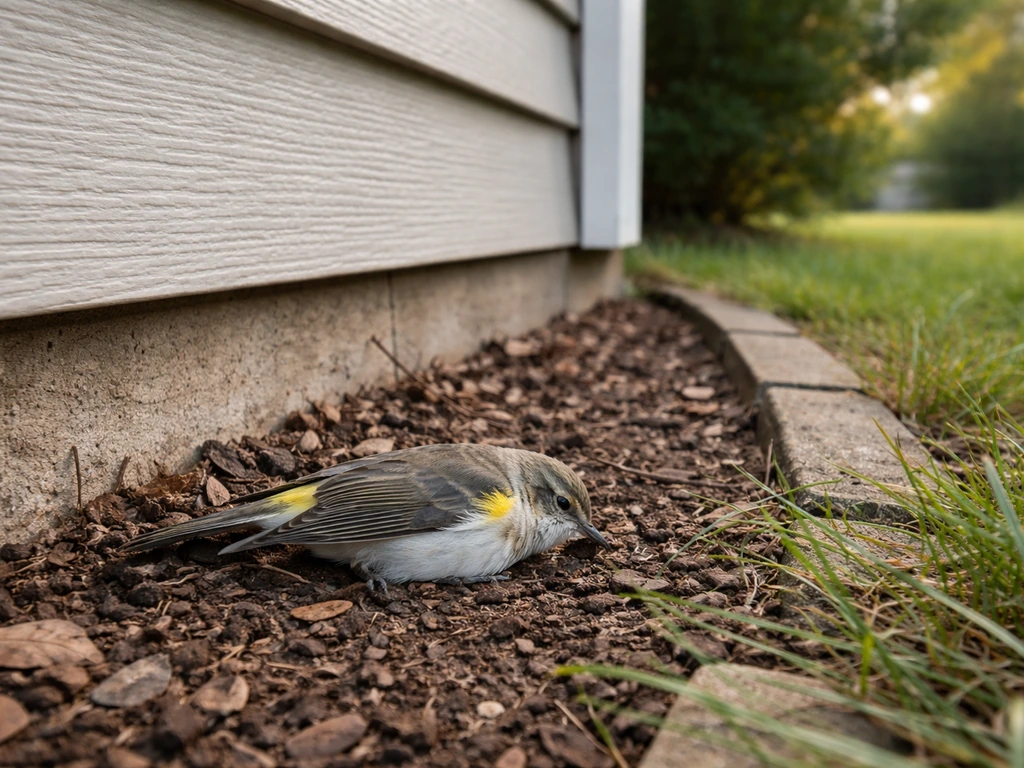
On a purely natural level, a dead bird near your home most often means a bird died from a collision, predation, exposure, or illness in a spot that happened to be near your property. Birds die all the time; they just usually die out of our sight. When one ends up right in front of your house, it catches our attention partly because it's so close to our personal space.
On a spiritual level, many traditions treat a dead bird near the home as a transitional symbol: an ending that clears the way for something new, a message from the spirit world delivered at your threshold, or a prompt to pay attention to changes unfolding in your life. Neither interpretation cancels the other. You can take the practical steps first, then sit with the symbolic meaning afterward.
Why the bird may have died there: natural causes to check first
Before you dive into symbolic interpretation, take a quick look at the scene. The physical context tells you a lot. Window strikes are one of the most common causes. Studies estimate that collisions with windows kill more than 1 billion birds annually in the U.S., the majority of them at homes and low-rise buildings. If you have a large window or glass door near where the bird was found, look for a smudge, feather imprint, or impact mark on the glass. Birds can die instantly from the collision or survive it briefly before dying nearby.
Other common natural causes include predation (a cat, hawk, or other animal may have dropped the bird), exposure during severe weather, starvation during migration, or illness. If the bird looks physically intact and you're near a reflective window, a window strike is the most likely culprit. If there are puncture wounds, missing feathers, or the bird is partially eaten, predation is more probable.
One thing to watch for: birds showing neurological signs before death (tremoring, walking in circles, head tilts, inability to stand) can indicate highly pathogenic avian influenza (HPAI). If you witnessed the bird acting that way, or if you find multiple dead birds in the same area, treat the situation with more caution and report it rather than handling it yourself.
Health and safety steps before you touch anything
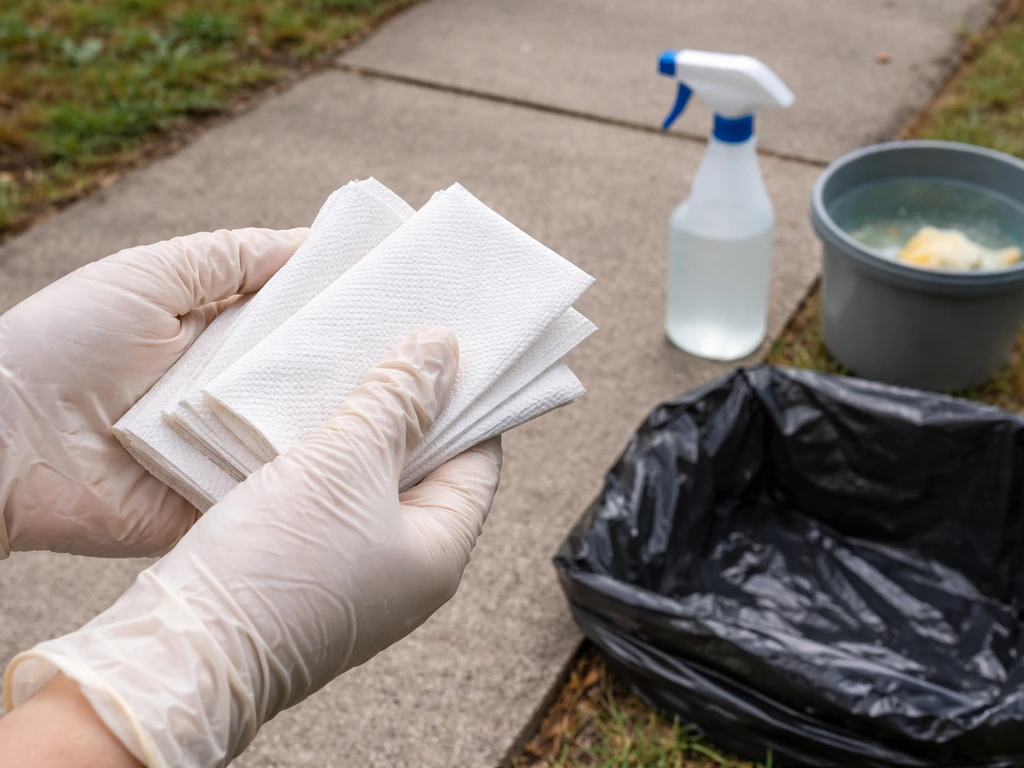
This is important: do not pick up a dead bird with your bare hands. The CDC recommends avoiding direct contact with dead birds and their feces, feathers, or surrounding surfaces without proper protection. For most people finding a single dead bird, that means wearing disposable gloves, using a plastic bag to invert over your hand as you pick it up, or using a shovel or tongs to move it. If you have them available, an N95 mask and eye protection are worth using, especially if the bird looks diseased rather than simply injured.
Canada's public health guidance specifically recommends a bleach dilution (roughly 3 tablespoons of bleach in 2 liters of water) for disinfecting tools, surfaces, and footwear after contact. The CDC advises cleaning with soap and water first to remove visible dirt, then disinfecting with an EPA-approved disinfectant effective against influenza A viruses. Wash your hands thoroughly with soap and water after the whole process, even if you wore gloves.
For disposal of a small number of birds (fewer than five), most local guidance recommends double-bagging the bird in sealed plastic bags and placing it in your regular trash. Check your local regulations, because some areas have specific instructions. If you're in the U.S., you can contact your local animal control, state wildlife agency, or local health department, especially if you suspect West Nile Virus or avian influenza. The U.S. Fish and Wildlife Service recommends reporting bird die-offs (multiple birds) to your state wildlife management agency immediately. In the UK, you can report dead wild birds to Defra online or by calling 03459 33 55 77. In Canada, Environment and Climate Change Canada advises reporting sick or dead wild birds to the appropriate wildlife authority right away.
What the location says: outside, near, or inside your house
Location matters enormously in symbolic interpretation. The threshold of a home, the yard, the porch, the doorstep, and the interior all carry different energetic weight across traditions. Here's how most spiritual and folkloric frameworks distinguish between them.
Dead bird directly in front of the house or on the front path
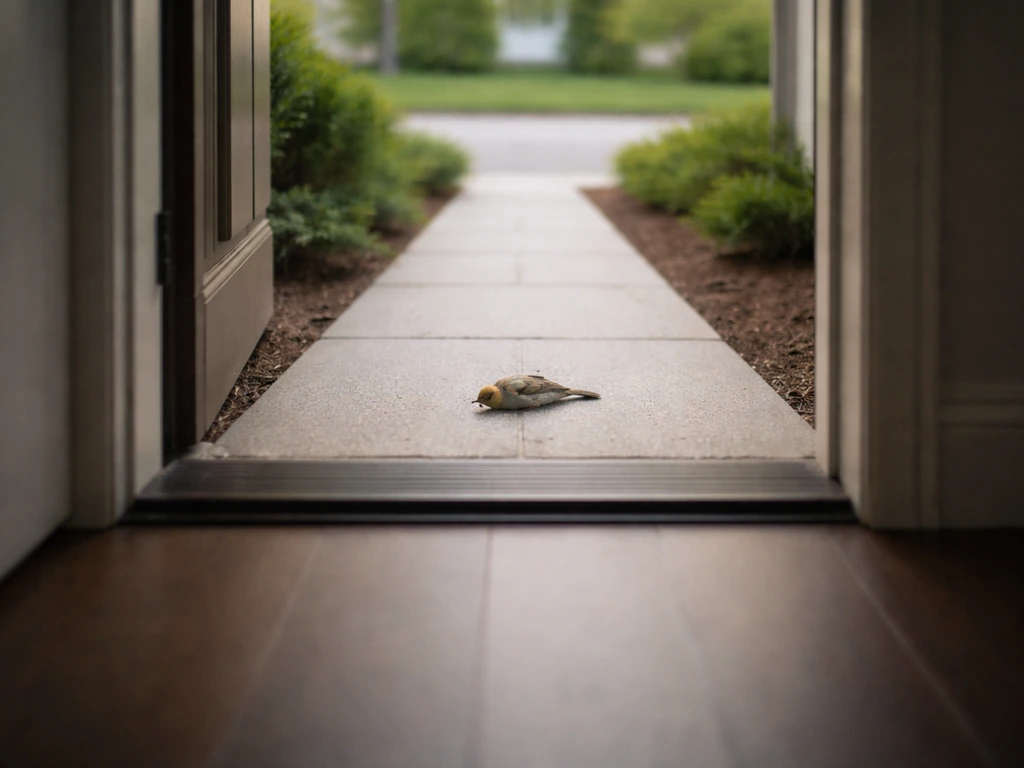
A bird found directly in front of the house, on the front path or front lawn, is symbolically at the boundary between your private world and the outside one. Many traditions read this as a message directed specifically at the household: a warning to pay attention, a sign of transition, or an announcement that something in your life is ending so something new can begin. Celtic and European folk traditions often associated birds found at the front of the home with news arriving, either a visitor, a message, or a significant life change on its way. The bird has, in a sense, come to your door.
Dead bird near the house but not at the entrance
A bird found in your yard but not right at the door is typically interpreted as something happening in your general life sphere rather than being directed at your personal threshold. Many readers find this framing helpful when thinking about what a dead bird in your yard might signify: is it a message about your home life, your family, or your relationship to your personal space? The distance from your entrance suggests the message is broader, less immediate, more about your environment than your doorway.
Dead bird on the porch or doorstep
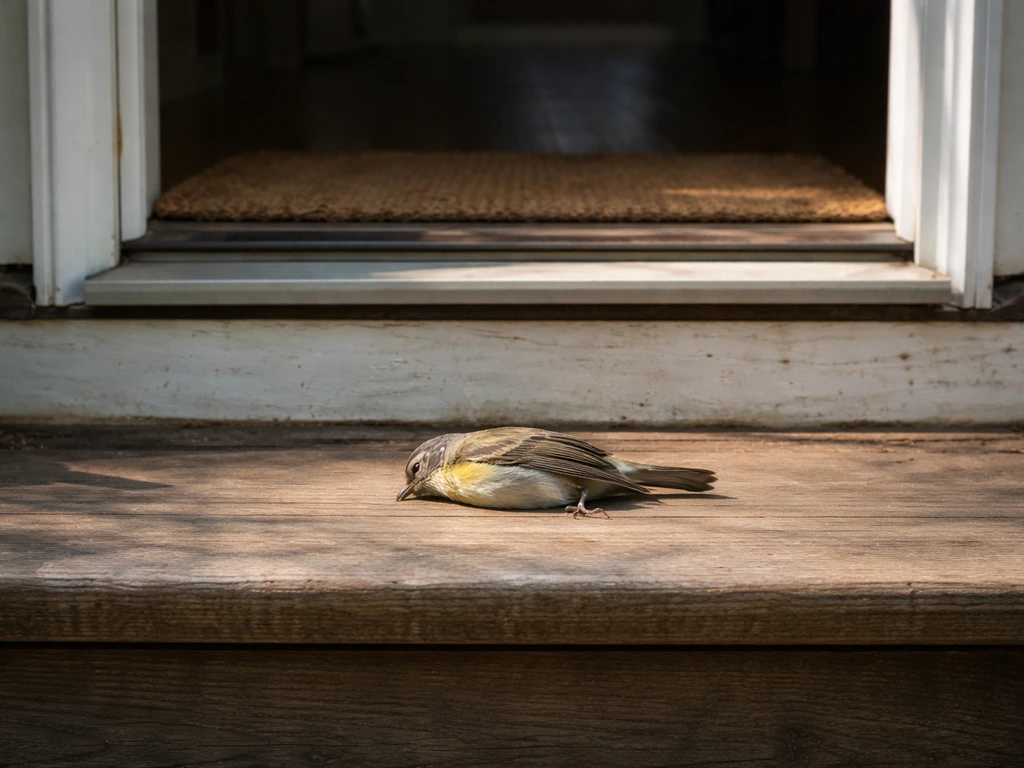
Finding a bird at the transition point of your home, the porch or doorstep, is considered especially significant in many traditions because of the symbolic weight of thresholds. A threshold is neither fully inside nor fully outside; it's the between-space. This placement is often read as a message being delivered directly to you, something you're meant to notice and respond to. If you've been wrestling with a decision or wondering whether to open a new chapter, many people find that the symbolism of a dead bird on your doorstep speaks to exactly that kind of threshold moment in their own lives. Similarly, a dead bird on the porch carries a slightly softer version of that message: still close, still personal, but with the porch acting as a semi-sheltered, semi-public space.
Dead bird found inside the house
A bird that somehow dies inside your home, through an open window, trapped in a chimney, or caught by a pet and brought inside, is almost universally treated as the most significant variation across folk and spiritual traditions. It's often interpreted as a more urgent or intimate message, one that has crossed fully into your personal and protected space. Practically, it also raises sanitation concerns more immediately, since the bird has been in your living environment.
Spiritual, biblical, and folklore interpretations

Dead birds carry layered meaning across cultures and traditions. There's no single definitive answer, but there are patterns that show up again and again.
| Tradition / Framework | General Interpretation | Tone |
|---|---|---|
| Biblical / Christian folklore | Sparrows are watched over by God (Matthew 10:29); a dead bird can represent God's awareness of even small losses, or a prompt to reflect on mortality and trust | Reflective, not ominous |
| European / Celtic folklore | A bird at the threshold often signals incoming news, a visitor, or a life transition; some traditions link specific birds (e.g., robins, crows) to messages from the dead | Messenger symbolism |
| Indigenous / Native American traditions | Many nations view birds as spirit messengers; a dead bird near the home may signal that an ancestor or spirit is trying to communicate | Ceremonial, respectful |
| Eastern / metaphysical traditions | Death symbolizes transformation and rebirth; a dead bird outside the home can mean old energy is leaving, making room for renewal | Positive transformation |
| General omen tradition | A dead bird near the home is sometimes read as a warning to attend to something you've been ignoring, or as a sign of coming change (not necessarily negative) | Cautionary, transitional |
The species of bird can shift the interpretation further. A dead crow near the home is often seen in European and American folklore as an especially potent omen of change or the need to examine shadow aspects of your life. A dead dove tends to be associated with the loss of peace or a relationship change. A dead sparrow might be read through a biblical lens as a reminder of divine attention even in small things. A dead hummingbird near a home, though rarer, is often interpreted as a message to slow down or that something joyful has run its course.
It's also worth noting that not every tradition treats dead birds as bad omens. In many metaphysical frameworks, a bird's death near your home is a signal of transformation rather than loss, the end of one cycle and the clearing of energy for the next. If you find yourself drawn to the symbolic layer of this experience, you might also explore what happens when birds visit you in sleep: a <a data-article-id="626D3B0E-B12B-4BC7-A1CB-46C833985A85">dead bird appearing in a dream</a> is often interpreted as processing a real-life ending or transformation at a deeper, subconscious level.
What to do next: practical, spiritual, and reflective steps
Once the practical steps are handled (bird safely removed, hands washed, area cleaned), you have a choice about how to proceed symbolically. Here's a straightforward sequence that works across belief systems.
Cleansing and protection rituals
If you work within a spiritual or energetic framework, many traditions suggest clearing the space where the bird was found. Burning sage, palo santo, or incense near the area (with windows open) is a common practice in metaphysical and indigenous-inspired traditions for releasing stagnant or heavy energy. Sprinkling salt at your threshold or doorway is a widely practiced protective act across European folk traditions. If you're coming from a Christian background, a simple prayer of blessing over your home and family takes about thirty seconds and costs nothing. You don't need to be deeply committed to any of these practices for them to feel meaningful; intention matters more than ritual perfection.
Reflection questions worth sitting with
The most useful thing you can do after the practical steps is ask yourself a few honest questions. These aren't about predicting the future; they're about using the moment as a prompt for self-awareness.
- Is something in my life currently ending or winding down? Am I resisting that, or moving with it?
- Have I been ignoring something that needs my attention, in my home, my relationships, or my work?
- Does this feel like a warning, a release, or simply a natural event? What does my gut say?
- If this were a message, who or what might be sending it, and what would the message be?
- What would it mean to treat this as a transition point rather than a bad omen?
When to actually seek help
On the practical side, contact your local animal control or wildlife agency if you find more than one dead bird in the same area, if the bird showed neurological symptoms before dying, or if you're in an area with a known avian influenza outbreak. If you're in the U.S. and have concerns about West Nile Virus or bird flu, the DC Department of Health's West Nile Virus Call Center (202-535-2323) is one example of a local resource; most states have equivalent reporting lines. Don't hesitate to make that call. It helps wildlife surveillance programs and gives you peace of mind.
On the spiritual side, if the encounter has stirred something deeper, consider talking to a trusted person in your faith community, a spiritual director, or a counselor if it's connected to grief or anxiety. A single dead bird doesn't require a crisis response, but if it's triggering something bigger, that's worth honoring.
The bottom line: a dead bird in front of your house is most often a natural event with a poignant symbolic layer. If you also want to compare this waking omen with your inner world, you can read more about dead bird dream meaning and how it is often interpreted alongside real-life symbolism. Handle the physical reality carefully and respectfully, then decide how much meaning you want to draw from it. Both responses, the practical and the reflective, are completely valid. The fact that you stopped to ask the question suggests you're the kind of person who doesn't want to walk past it without understanding it. That instinct is worth trusting.
FAQ
If the dead bird is fresh, should I assume it is safe to touch and clean right away?
Freshness does not equal safety. Birds can carry pathogens even when they look otherwise normal, so use gloves, avoid contact with feathers or feces, and disinfect the area afterward. If you noticed neurological symptoms, find multiple birds, or there is an outbreak in your area, prioritize reporting and avoid handling beyond carefully removing it.
What if I have pets or small children, and the bird is still there when I notice it?
Treat it as a “high priority cleanup.” Keep pets and kids away immediately, pick it up with protection (gloves, ideally mask and eye protection), and dispose of it in sealed bags. Also check your yard or porch for other remains, since scavenging animals may move material around.
Does the meaning change if the bird is on my porch step versus directly on the front path?
Many traditions treat both as threshold-adjacent, but step or doorstep placement is usually read as more directly “to you,” because it is closer to the exact point of entry. A front path or lawn placement is often interpreted as broader or environmental (something shifting around your home rather than a very personal message).
How can I tell whether it was a window collision versus something else if there are no obvious marks?
Look for contextual clues rather than only damage. Window strikes often leave a nearby feather scatter or dusting and can happen in a short distance from the glass, especially for large windows and glass doors. Predation is more likely if you see missing chunks of body, puncture or tear marks, or the remains look partially eaten. If you are unsure, clean and remove it carefully, then keep an eye out for other birds nearby.
What should I do if there are multiple dead birds on different sides of my yard, not just the front?
Multiple locations can still indicate a local risk, not just a coincidence. Photograph the scene quickly, avoid handling, and contact your local animal control or wildlife agency for guidance. If it is in an area with known avian influenza or West Nile concerns, reporting becomes more important than trying to interpret the “symbolic” layer.
Is it okay to bury a single dead bird or should it go straight to trash?
Some local regulations discourage backyard burial or require specific handling, especially if disease is suspected. For fewer than five birds, many areas permit double-bagging for regular trash, but check local rules first. If the bird looks diseased, acted neurologically, or you suspect West Nile or avian influenza, follow local authority instructions instead.
What is the best way to disinfect after pickup without damaging surfaces?
First remove dirt with soap and water, then disinfect with a product that is effective for influenza A viruses if avian influenza is a concern. Use appropriate dilution and contact time per label directions. For porous surfaces like some soil or mulch, consider whether replacement or deeper cleaning is needed, because disinfection is less reliable on porous material.
Can I just sweep the bird and feathers away to avoid contact with gloves?
Sweeping can create aerosolized dust and increases cross-contamination if you then track debris indoors. Gloved pickup and controlled disposal (bagging directly) is safer. If you must sweep, dampen lightly to reduce dust, then disinfect the area afterward and wash hands thoroughly.
How should I handle it spiritually without ignoring health risks?
Use a two-step approach. Take care of sanitation and reporting first, then do any symbolic practice in a clean, safe space. If the bird is in your living area, prioritize cleaning and ventilation before any ritual work, so you do not mix spiritual practice with an unresolved contamination concern.
Does the species of bird always indicate a specific message?
Species can influence folk interpretations, but it is not a reliable “forecast.” If you cannot identify the bird confidently, focus on the placement and the practical context (window, pet predation, weather). If identification matters because of reporting, photograph it (including size and markings) before removing it.
What if I find a dead bird inside my home after it got in through an open window or a pet brought it in?
That scenario is higher risk for immediate sanitation concerns because there may be droppings or feathers inside living space. Ventilate, wear protective gear, and disinfect the exact contact areas. If you notice multiple birds in a short period, illness signs, or unusual behavior, report it rather than assuming it is only “one-off” tragedy.
Should I report every dead bird to public health or wildlife agencies?
Not always. For a single bird with no signs of widespread die-off and no neurological symptoms, many jurisdictions treat it as a routine cleanup. Report sooner if you find more than one dead bird in the same area, if birds look diseased, if there is known local outbreak activity, or if you are in doubt about avian influenza or West Nile concerns.
Next Articles
Dead Bird on Doorstep Meaning: Practical and Spiritual Guide
Dead bird on doorstep meaning, practical cleanup steps and spiritual omens plus questions to find the right fit.
Dead Bird on Porch Meaning: Practical Causes and Spiritual Interpretations
Learn the dead bird on porch meaning, practical causes, safe cleanup steps, and spiritual interpretations by location.
Why Is My Bird Flapping Its Wings at Me? Causes and What to Do
Understand why your bird flaps wings at you and what to do, from hormones and stress to attention and warnings.