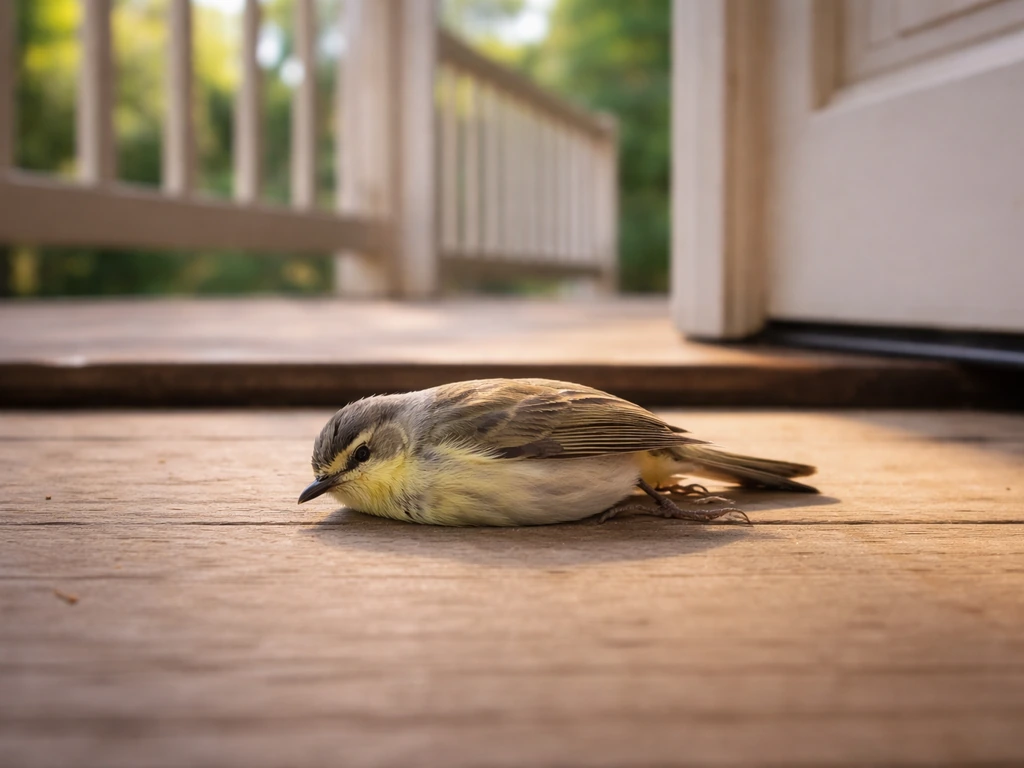
Finding a dead bird on your porch, in front of your door, or on your balcony is almost always a natural event with a straightforward explanation. Window strikes, predator activity, illness, and exposure to harsh weather are the most common causes. That said, for a lot of people, there's a second layer to this moment: the feeling that it means something. Both of those things can be true at the same time, and this guide walks you through both sides, starting with what likely happened and what to do right now, then moving into what cultures and spiritual traditions have made of this kind of encounter.
Dead Bird on Porch Meaning: Practical Causes and Spiritual Interpretations

Maya Hartwell
4 Apr 2026
Why there's probably a dead bird on your porch right now
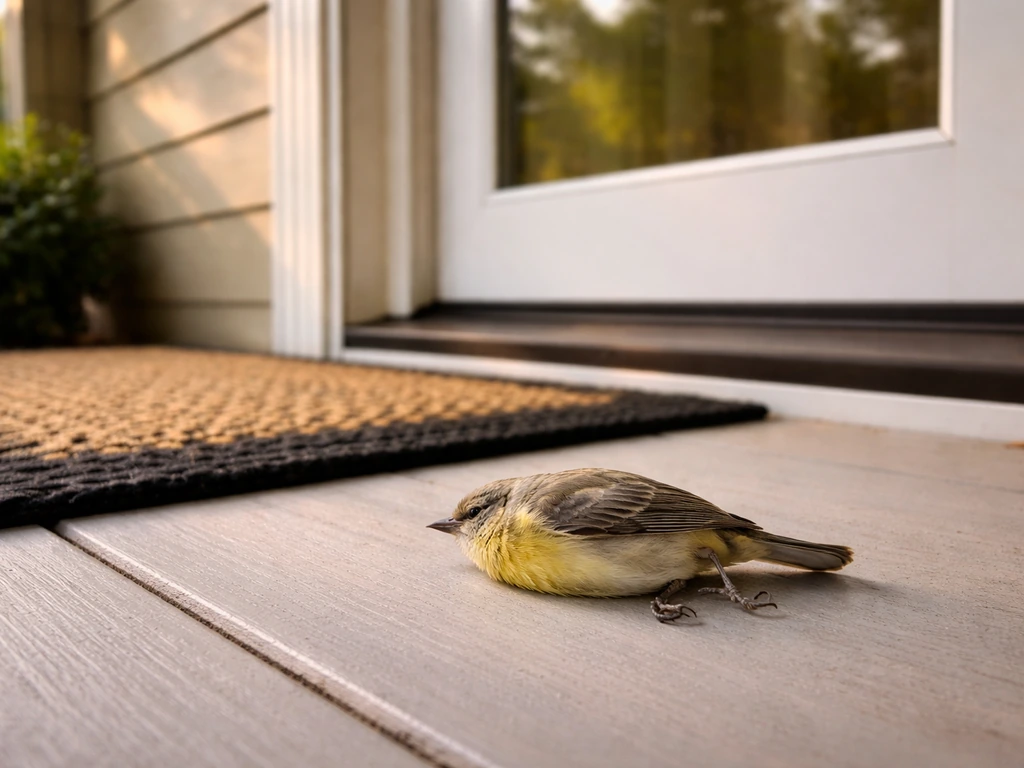
Most dead birds found near homes got there through one of a handful of predictable causes. Understanding which one applies to your situation helps you respond correctly and, for those who lean spiritual, gives you a more grounded starting point for interpretation.
- Window strikes: This is the single most common cause. Birds cannot perceive glass as a barrier and fly into windows at full speed. Mass Audubon notes that a window collision is almost always fatal because birds travel fast enough that the impact is typically deadly. Look for feather smudges, body dust imprints, or small feathers stuck to nearby glass as evidence.
- Predator drop: Cats, hawks, and other predators sometimes carry prey onto a porch or drop it near an entrance. If you have outdoor cats or see hawks in your area, this is a likely explanation, especially if the bird shows obvious wounds or missing feathers.
- Illness or disease: Birds that are sick from avian influenza, West Nile virus, or other pathogens often seek sheltered, low-activity spots. A porch overhang or covered entrance fits that description. A bird that appears to have died without trauma and in a tucked position may have been ill.
- Weather and exposure: During cold snaps, heat waves, or severe storms, small birds that are already weakened can die from exposure. Porches offer partial shelter but are not immune to the elements.
- Old age or exhaustion during migration: Migratory birds push themselves hard, and some simply run out of energy. Finding a dead warbler or sparrow on a porch during spring or fall migration is not unusual.
How to clean it up safely
Before you do anything else, blank" rel="noopener noreferrer">do not touch the bird with bare hands. Any wild bird can carry disease, and direct contact should be avoided regardless of how healthy the bird looks. CDC guidance also specifies wearing disposable impermeable gloves, placing the bird directly into a plastic bag, avoiding contamination of eyes, skin, or mucous membranes, and washing hands afterward with soap and water blank" rel="noopener noreferrer">Any wild bird can carry disease, and direct contact should be avoided regardless of how healthy the bird looks.. Here is the step-by-step process based on public health guidance.
- Put on disposable impermeable gloves before touching anything. If you don't have gloves, invert a plastic bag over your hand to use as a barrier.
- If the bird is in a wet area where splashing is possible, add eye protection (goggles or glasses) and a surgical mask or N95 respirator.
- Place the bird directly into a plastic bag, then seal it. Double-bag the carcass, especially if avian influenza is a concern in your region or if the bird shows signs of severe illness.
- Seal the outer bag securely with a tie or zip closure and place it in your regular trash.
- Discard your gloves and mask inside the trash bag before sealing it. If you used goggles, disinfect them per the manufacturer's directions.
- Wash your hands thoroughly with soap and water immediately after. If soap and water aren't available, use an alcohol-based hand sanitizer as a temporary measure, but follow up with proper handwashing as soon as possible.
- Avoid touching your face with gloved or unwashed hands at any point during the process.
- Clean the area where the bird was found. Remove visible debris first, then apply an EPA-registered disinfectant, following the label directions exactly. Some disinfectants, including bleach-based products, require a pre-cleaning step to remove organic material before disinfecting.
If you have pets, keep them away from the area until it's cleaned. Canada's H5N1 guidance specifically recommends keeping dogs and cats away from sick or dead wildlife and any contaminated surfaces. Children should also stay clear until cleanup is complete.
Does the location on your property actually change the meaning?
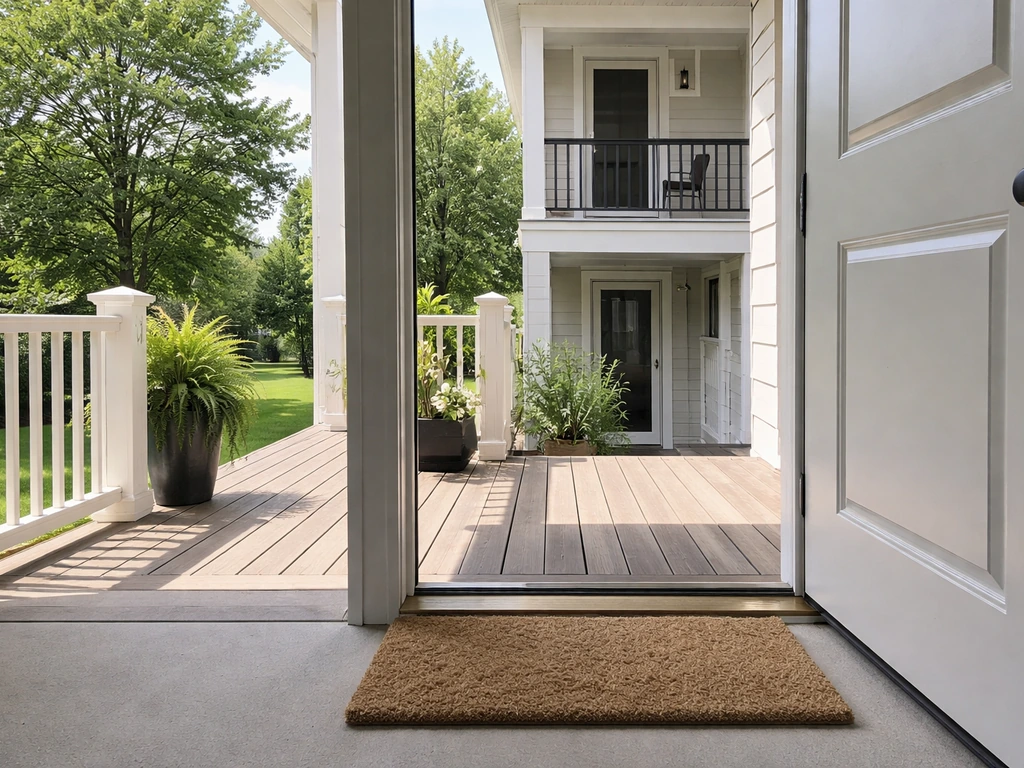
In practical terms, location mostly tells you about access and exposure. A front porch is more exposed to both bird traffic and predators than a back porch. A balcony on an upper floor is more likely to be a window-strike zone or a site of exposure-related death. But in symbolic traditions, location matters quite a bit more.
The front door and threshold area carry the heaviest symbolic weight in almost every tradition. The doorway is classically understood as a liminal space, the boundary between the outer world and the private interior of the home. Finding a dead bird directly in front of your door or on a doorstep is the placement most associated with messages, transitions, or omens in folklore. If you're curious about that specific placement, there's a dedicated look at dead bird on doorstep meaning that goes deeper into the threshold symbolism tied to that exact spot.
The front porch more broadly is seen as an extension of the home's energy outward, a welcoming space that faces the world. In many folk traditions, something found on the front porch is read as a message directed at the household, arriving at the outer edge of your personal space. The back porch, by contrast, is more private and inward-facing, sometimes interpreted as relating to personal life, family matters, or things that aren't meant for public view. A balcony, especially on an upper floor, occupies an elevated, transitional space between the domestic and the sky, and some metaphysical traditions read that height as amplifying the significance of bird encounters.
| Location | Practical notes | Symbolic framing |
|---|---|---|
| Front door / doorstep | High bird traffic near glass panels; predator drop common | Threshold symbolism; message at the boundary between worlds |
| Front porch | Exposed to weather, predators, and window glass on facade | Directed at the household; arrival at the outer edge of home energy |
| Back porch | More sheltered; sometimes a refuge for sick birds | Private, inward-facing; may relate to personal or family matters |
| Balcony (upper floor) | Elevated glass exposure; window strikes very likely | Transitional, sky-adjacent space; some traditions amplify meaning at height |
Species, condition, and what the clues are actually telling you
The state of the bird and where exactly it landed can narrow things down quickly. If you see feather smudges, body dust imprints, or a greasy outline on a nearby window, you're almost certainly looking at a window strike. Audubon recommends checking within about 6 to 8 feet of the glass for evidence including feathers and dead or injured birds. A bird found right below a window is the clearest signal.
If the bird has puncture wounds, a broken neck, or missing feathers, predation is the likely cause. A bird that looks otherwise intact, possibly with its eyes closed and positioned as if it settled down, is more consistent with illness, exhaustion, or exposure. A bird with no obvious cause of death and found in warm months during active West Nile season in your region may warrant reporting for surveillance testing, which some state health departments actively request.
Species also matters. Songbirds and most migratory birds are protected under federal law, specifically the Migratory Bird Treaty Act administered by the U.S. Fish and Wildlife Service. You can legally remove and dispose of a dead protected bird for sanitation purposes, but you should not collect feathers, eggs, or nests. If there's any question about a rare or protected species, contact your local wildlife agency before doing anything.
On the symbolic side, species carry their own long-standing associations. A dead crow or raven is traditionally associated with transformation and the spirit world in Celtic and Indigenous traditions. A dead dove is read in many Christian-influenced cultures as a particularly weighty sign, given the dove's association with the Holy Spirit and peace. A small sparrow connects to Biblical passages about divine awareness of even the smallest creatures. None of these interpretations is more correct than another, but knowing the species gives you a richer starting point if you're leaning into the symbolic side.
What spiritual and cultural traditions say about this
Across a wide range of cultures, a dead bird appearing at the entrance to a home has been read as a meaningful sign. The interpretations vary, but several consistent themes emerge: endings and transitions, warnings or protection, the presence of a spiritual messenger, or the close of a cycle. Here's how different traditions approach it.
Biblical and Christian perspectives
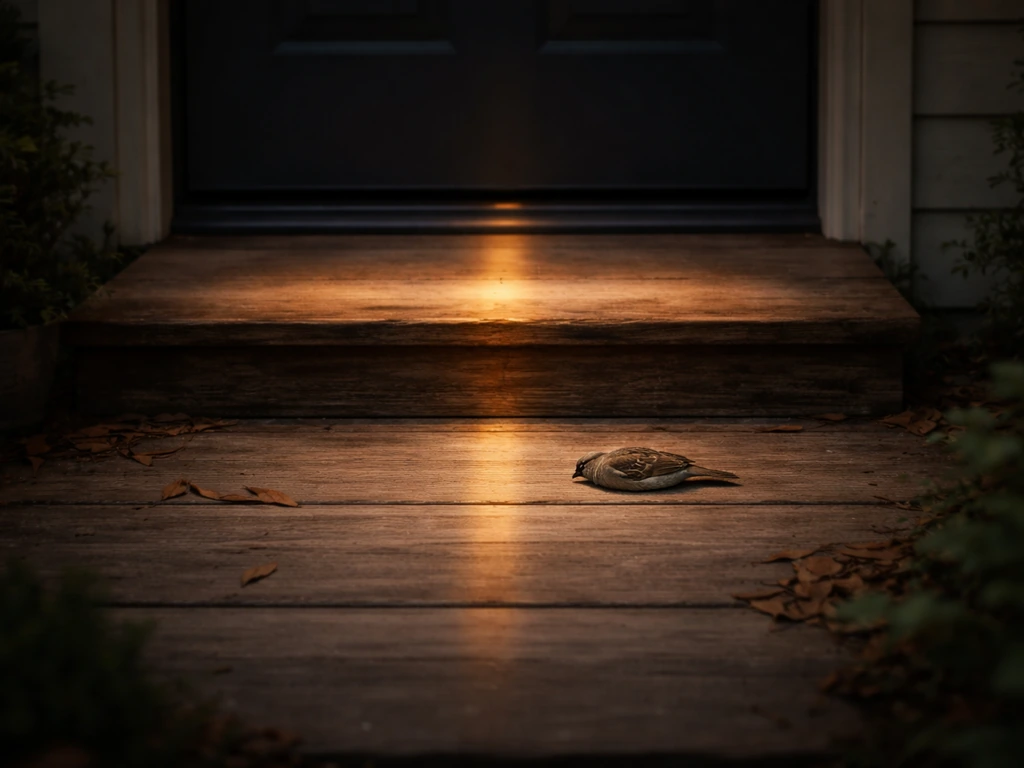
In Christian tradition, birds are often understood as messengers or symbols of the soul. The death of a bird at your threshold can be read as a reminder of mortality and the fragility of life, but also as a call to spiritual awareness. Some interpretations frame it as a sign that God is close, drawing on the Matthew 10:29 passage noting that not one sparrow falls to the ground apart from the Father's will. This does not make the event ominous so much as spiritually significant: a moment to pay attention.
Folklore and omens
European and American folk traditions have long associated a dead bird near the home's entrance with coming change, sometimes difficult change. In older English folklore, a bird hitting a window and dying was seen as a warning of news to come, often related to illness or death in the family. Celtic traditions connected birds closely to the spirit world, treating them as potential carriers of messages from those who had passed. Whether you read this as superstition or as a symbolic language that earlier cultures used to process grief and uncertainty, the pattern of the entrance as a charged space is remarkably consistent.
Metaphysical and New Age frameworks
In contemporary metaphysical practice, a dead bird at the home's entrance is often interpreted as a signal that something in your life is ending to make room for something new. The entrance of the home represents incoming energy, so a bird that has died there might symbolize the close of a chapter before a fresh start. Some practitioners read it as a protection sign: the bird absorbed or deflected a negative energy directed at the home. Others see it as a prompt to examine what you're ready to release. These readings are not mutually exclusive, and many people find personal resonance in sitting with the question rather than demanding a single answer.
Eastern traditions
In some East Asian traditions, birds at the home carry messages about family fortune, and the death of a bird near the entrance can be read as a signal to be attentive to family health or relationships. Feng shui perspectives tend to view the front of the home as the mouth of energy for the household, making any disruption there, including a dead bird, worth noticing and clearing both physically and energetically. Smudging the area, burning incense, or performing a brief cleansing ritual after the physical cleanup is a common recommendation in these frameworks.
It's worth noting that this kind of encounter doesn't exist in isolation. If you're drawn to the symbolic dimension, it helps to consider the broader context of where birds show up in your life. Someone who has been dreaming about dead birds recently and then finds one on the porch may feel the two events amplify each other symbolically. The timing, the species, and your own emotional state at the moment of discovery are all part of how meaning gets constructed.
When to call for help and what to watch for going forward
A single dead bird on your porch, once cleaned up safely, is usually the end of the story. But there are situations where you should take additional steps.
- Multiple birds in the same area: If you find five or more dead or dying birds in close proximity, the Minnesota DNR recommends contacting local wildlife authorities, as clusters can indicate disease outbreaks or poisoning. Connecticut surveillance guidance also suggests reporting when you see a pattern across a few days.
- Ongoing pattern beneath the same window: If you're finding birds repeatedly in the same spot, window strikes are almost certainly the cause. Audubon notes that birds are more likely to be found near the same windows repeatedly. Bird-friendly window film, exterior netting, or screens are practical solutions. Collision data can also be submitted to resources like iNaturalist or NYC Audubon's dBird database.
- Signs the bird may have been ill: If the bird shows neurological symptoms before death (spinning, seizures, difficulty standing) or if avian influenza is active in your region, contact your state health department. South Carolina DPH, for example, runs a dead-bird submission workflow for West Nile testing. Check your state's public health department for local options.
- Protected or rare species: If you suspect the bird might be a protected species and the death looks suspicious (possible poisoning, trapping), report it to the U.S. Fish and Wildlife Service, which maintains a process for reporting potential violations of the Migratory Bird Treaty Act.
- Injured birds that are still alive: If the bird is alive but stunned, contact a licensed wildlife rehabilitator before handling it. Tennessee TWRA and similar agencies in most states maintain directories of permitted rehabilitators. Do not attempt to feed or house an injured wild bird without guidance.
If you're noticing dead birds showing up in multiple spots around your property, not just the porch, it's worth thinking about the full picture. A look at dead bird in yard meaning covers the practical and symbolic dimensions of birds found on your broader property, which can offer useful context when the porch find doesn't feel like the whole story.
Pulling the practical and the symbolic together
Here's the honest summary: finding a dead bird on your porch is probably a window strike, a predator, a sick bird seeking shelter, or a weather casualty. Clean it up carefully, check the area for signs of why it happened, and take steps to prevent a repeat if you can identify the cause. That's the practical closure.
The symbolic layer is something you get to decide for yourself. If this moment feels like more than a random event, you're in good company across a very long span of human history. The entrance to a home has always been a charged space, a place where the outside world meets your private life. A death occurring right at that boundary, whatever its biological cause, has struck people across cultures as worth pausing over. What might this moment be asking you to notice, release, or prepare for? That's not a question anyone can answer for you, but it's a reasonable one to sit with.
Some people find it helpful to think about the full geography of the encounter. A dead bird specifically in front of the house, rather than on the porch or in the yard, carries its own distinct symbolic framing. If that's closer to what you found, the interpretation of a dead bird in front of house explores how that placement is read across different traditions and what it might mean for the energy of your home's facing side.
Whatever you take from this, give yourself permission to hold both the practical and the meaningful at once. Clean up safely, observe whether the pattern continues, and reflect on what, if anything, this moment is speaking to in your life right now.
FAQ
What should I do if I cannot tell whether it was a window strike, predator, or illness?
If you cannot identify the cause (for example, the bird looks intact and there are no obvious predator signs or window smudges), take a few photos, note the exact spot, and contact your local wildlife agency or animal control. This is especially important if several birds have died nearby, or if you notice symptoms in other birds (lethargy, abnormal behavior), because some jurisdictions run surveillance for disease outbreaks.
How should I clean up safely without spreading germs or leaving residue?
Wear disposable gloves if possible, use paper towels to pick up the remains, and double-bag before placing in outdoor trash. Avoid sweeping or vacuuming dry debris indoors, since dust can spread contaminants. Also disinfect any surface the bird touched, including the doormat area and nearby railing.
Does seeing more than one dead bird change the meaning or what I should do?
Yes. A dead bird near the entry can be purely coincidental, but if multiple days and locations on your property have the same pattern (porch, walkway, windows), it often points to a practical driver you can reduce, like reflective glass, nearby shrubs that predators use, or repeated congregation near feeders. Tracking dates, times, and locations for 1 to 2 weeks can reveal whether it is an isolated event or a recurring hazard.
What practical changes can I make to prevent future window strikes?
Consider moving bird feeders and water sources away from glass, and adjust your window treatments so they reduce reflections (for example, close blinds at peak bird activity, add exterior screens, or apply a visible window marker). Since many strikes happen within a short distance of the glass, also check and mitigate windows that birds frequently fly toward.
Can I take the feathers or keep the bird as a souvenir?
In most places you are allowed to remove a dead bird for sanitation, but protected species protections still apply. If the bird appears to be a raptor, unusual species, or something you cannot confidently identify, do not collect it for keepsakes (feathers, “souvenirs,” or display). Contact a wildlife hotline to confirm the correct disposal steps.
What if the bird is alive or appears stunned when I find it?
If you discover it because you heard it hit, and the bird is still alive but injured or stunned, that is different from a dead-bird finding. Minimize handling, keep pets and children away, and contact a wildlife rehabilitator. Attempting to feed or hydrate wild birds often worsens their condition.
How do I balance spiritual meaning with making smart, safe decisions?
Even if you prefer symbolic interpretations, grounding your next step in the practical cause reduces unnecessary anxiety. A helpful approach is to ask two questions: (1) What physical explanation fits what I see (window damage, predator clues, season and illness signals)? (2) If I still want meaning, what life change fits my current situation, regardless of whether it is “good” or “bad” luck?
Does it matter if the bird was on the porch vs right by the door vs on the balcony?
Yes, placement can be a deciding factor for both practical and symbolic reasons. Practically, a balcony or upper-floor area can be more linked to window strikes or exposure to harsh weather patterns. Symbolically, many people read threshold placement (right by the door) as more “direct” than a bird several feet away, but you can still treat the biological cause as the primary driver.
Next Article
Why Is My Bird Flapping Its Wings at Me? Causes and What to Do
Understand why your bird flaps wings at you and what to do, from hormones and stress to attention and warnings.