A bird flying into your car is most often caused by one of a few very natural, explainable things: the bird saw a reflection in your window or side mirror and thought it was open sky or a competitor, it was startled into your path, or it was disoriented by low visibility conditions. That's the practical answer. But if you're here, you're probably also wondering whether it means something, and honestly, across dozens of spiritual, biblical, and folkloric traditions, a sudden bird encounter like this is treated as a moment worth paying attention to. Both things can be true at once. Here's everything you need to know, starting with what to do right now.
Meaning of a Bird Flying Into Your Car and What to Do

Maya Hartwell
19 May 2026
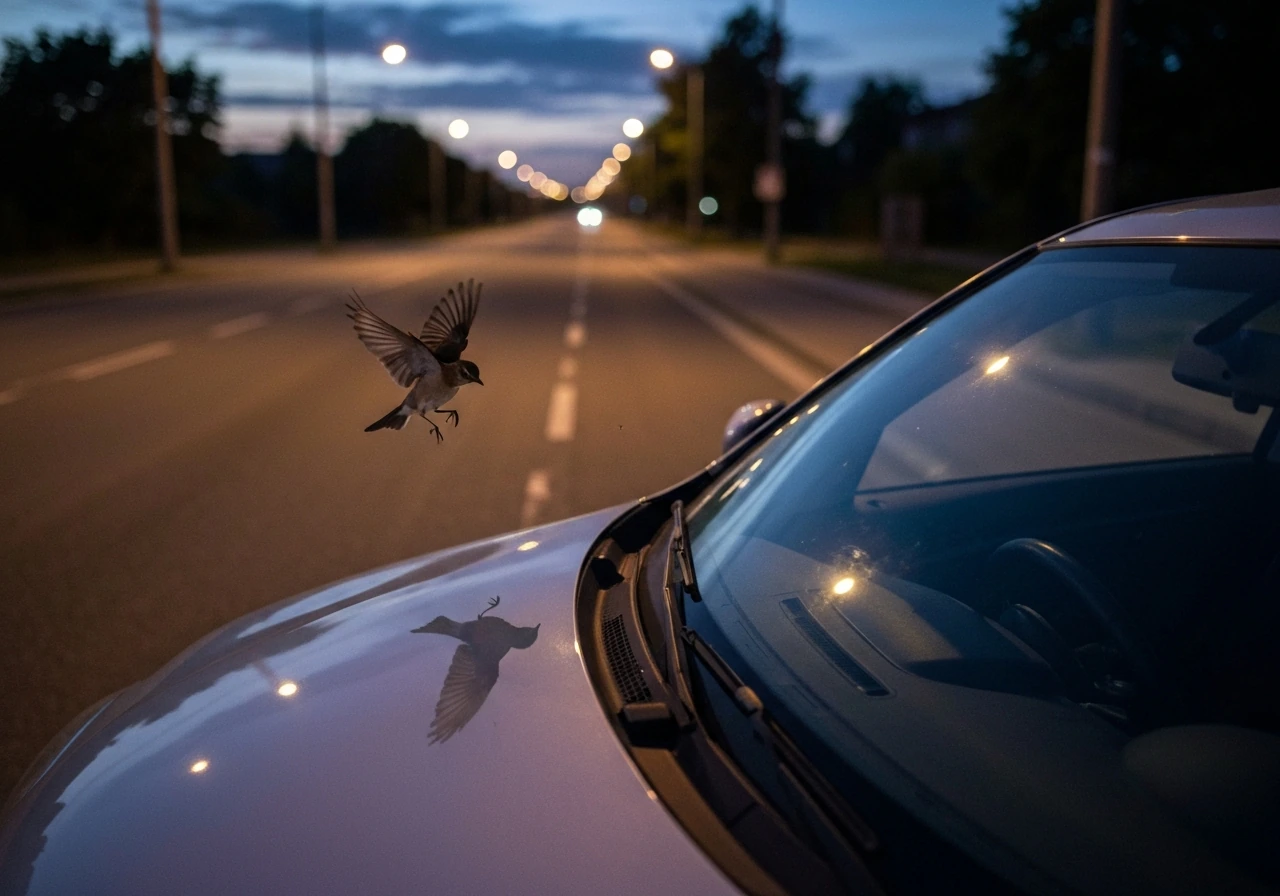
Why a Bird Flies Into a Car in the First Place
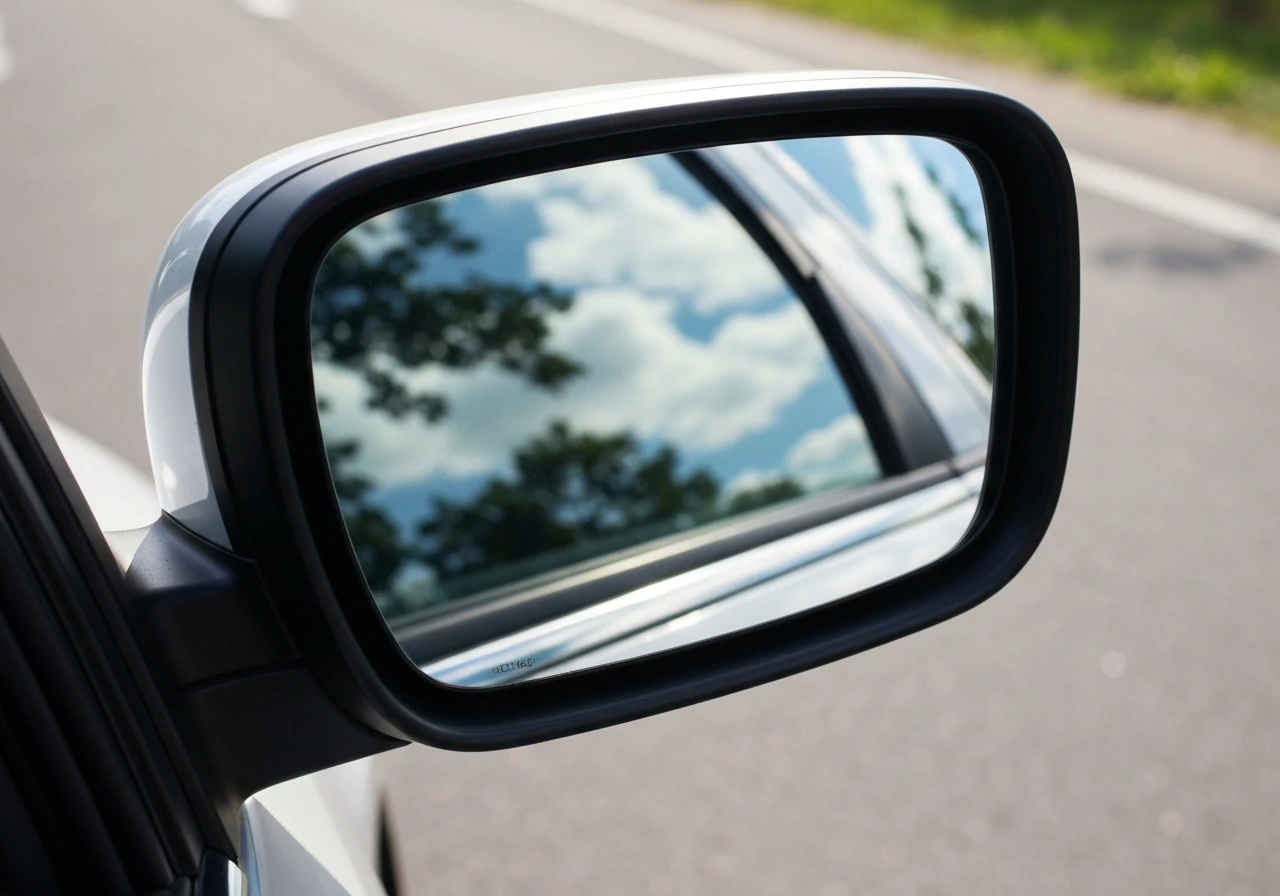
Birds don't have a concept of glass, mirror coatings, or car paint. What they see is what the surface reflects, and car surfaces are surprisingly deceptive. A side mirror or window reflecting trees, sky, or nearby vegetation looks, to a bird, exactly like open space or natural habitat. Cornell Lab's research on bird-window strikes confirms that reflective surfaces are a leading cause of collision injuries, because birds genuinely cannot tell the difference between a reflection and the real thing.
There are a few specific scenarios that make it happen more often. During breeding season, some birds (robins and cardinals are notorious for this) see their own reflection in a car window or mirror and interpret it as a territorial intruder. They fly at the reflection aggressively and collide. Other birds simply get startled by a moving vehicle and panic into an unexpected flight path, directly into the car. Low-light conditions, early morning fog, or overcast weather also reduce a bird's ability to judge space and distance accurately, which is why you might notice this happening more at dawn or dusk. Bright headlights at night can disrupt nocturnal orientation, especially for migratory birds.
- Reflective surfaces (windows, mirrors, paint) look like open sky or habitat to a bird
- Territorial birds attack their own reflection during breeding season
- Startled birds panic and fly directly into a moving vehicle's path
- Reduced visibility from weather, fog, or darkness increases collision risk
- Bright headlights can disorient migratory birds flying at night
- Parked cars near dense vegetation or feeders are prime collision spots
What to Do Right Now
If you're still at the scene or just got home, here's the order of operations. Your first priority is your own safety and the bird's safety, in that order.
If You Were Driving When It Happened
If a bird struck your car while you were moving, pull over safely before doing anything else. Check that it's safe to stop, turn on your hazard lights, and only then look for the bird. Don't swerve or brake hard mid-traffic to avoid a bird. Your safety and your passengers' safety come first.
Checking on the Bird
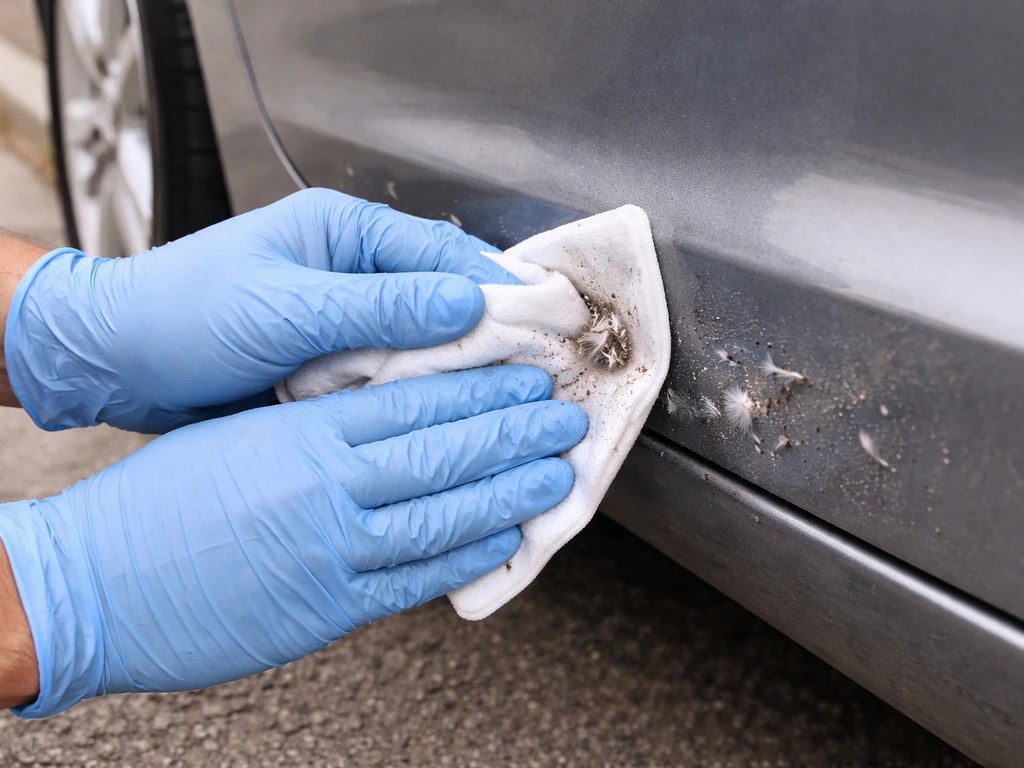
Approach the bird slowly and quietly. If it's on the ground near your car, crouch down and observe before touching it. A stunned bird may just need a few minutes. Do not pick it up immediately with bare hands. Birds can carry salmonella, avian influenza, and external parasites in their feathers and droppings, so use gloves if you have them, or a clean cloth. Never put a stunned bird in a closed bag or container without ventilation.
Cleanup After a Strike
If the bird left droppings, feathers, or blood on your car, clean it up with gloves on and wash your hands thoroughly afterward. Use a disinfectant safe for car surfaces. Feathers can carry mites, and dried droppings are a contamination risk if you touch your face. Dispose of any feathers or debris in a sealed bag rather than leaving them loose.
If the Bird Is Injured: Rescue vs. Calling for Help
This is where a lot of people feel stuck. You want to help, but you're not sure what's safe or effective. Here's a straightforward breakdown.
The bird is stunned but alive
A stunned bird sitting quietly on the ground is not necessarily critically injured. Place it gently in a small cardboard box with air holes, lined with a clean cloth or paper towel. Keep it somewhere dark, quiet, and warm (room temperature, not hot). Do not offer food or water. Check on it every 15 to 20 minutes. Many birds recover from a stun and can be released within 30 to 60 minutes. When you open the box, do it outdoors in a safe area and let the bird leave on its own terms.
The bird is visibly injured
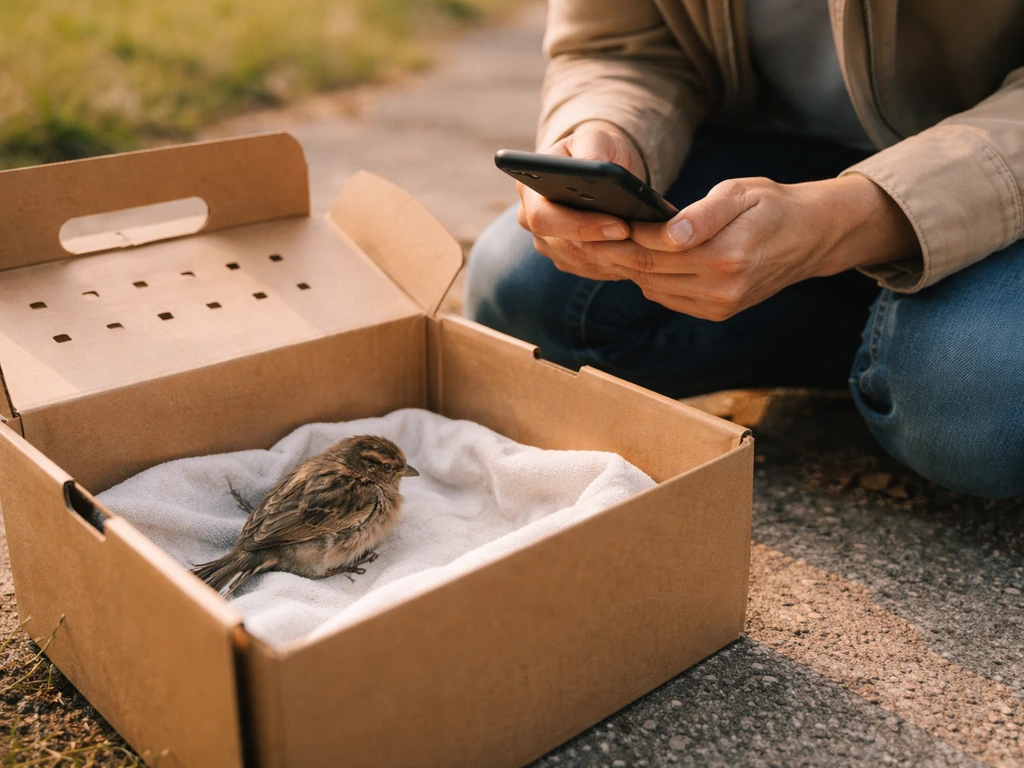
If the bird has a visibly broken wing, is bleeding, cannot hold its head up, or is still motionless after an hour, it needs professional help. In the United States, contact your nearest licensed wildlife rehabilitator. The USFWS (U.S. Fish and Wildlife Service) website and the National Wildlife Rehabilitators Association both have locator tools. In the UK, contact the RSPCA or your local wildlife rescue. In Canada, check with your provincial wildlife authority. Do not attempt to splint a wing or administer any medication yourself.
What not to do
- Don't give the bird food or water unless instructed by a rehabilitator
- Don't keep a wild bird as a pet, even temporarily beyond the recovery window
- Don't handle it bare-handed if you can avoid it
- Don't place it in a sealed plastic bag or airtight box
- Don't attempt to medicate or treat injuries yourself
- Don't leave it on the ground near traffic, pets, or in direct sun
The Spiritual and Symbolic Meaning of a Bird Hitting Your Car
Once you've handled the practical side, it's completely natural to sit with the experience and ask: what was that about? Bird encounters, especially sudden and jarring ones, have carried meaning across cultures for thousands of years. A bird hitting your car isn't exactly an ancient scenario, but the underlying symbolism people draw on is very old. The way most traditions read it: a sudden, unexpected bird encounter is a disruption of your ordinary moment, and disruptions are often interpreted as messages asking you to pay attention. If you are wondering whether a bird strike on your car counts as the same kind of sign, the answer is that many people treat these encounters similarly a sudden, unexpected bird encounter.
The most common symbolic themes associated with a bird flying into your car include: a sudden call for awareness or a wake-up moment, a sign of change or transition approaching, a message connected to freedom (either you're being called toward it, or something is holding you back), a need to slow down or reconsider a current direction, or the idea that spiritual guidance is trying to get your attention in an unmistakable way. The physical force of the encounter, something literally colliding with your path, is part of what gives it symbolic weight in so many traditions.
It's worth noting that closely related encounters carry their own specific layers of meaning. A bird that hits your car while you're driving is a different experience from one that lands on your car, and both are distinct from a bird that flies directly into your home. The context shapes the interpretation, which is why personal reflection matters so much here.
Good Omen or Bad Omen? How to Read It Without Fear
The honest answer is: it depends on the tradition, and more importantly, on you. Western folklore has historically labeled sudden bird collisions as bad omens, sometimes as warnings of death or misfortune. But that interpretation is far from universal, and even within the traditions that hold it, the emphasis is usually on the warning function, meaning it's information, not a sentence. A warning that gets your attention is arguably more useful than silence.
In many indigenous and Eastern traditions, an unexpected bird encounter is more neutral or even positive: a messenger arriving with urgency. The collision isn't the point; the interruption is. Think of it less as a verdict and more as a knock on the door. Whether the news is good or bad depends entirely on what you do with it and what's happening in your life at the moment it occurs. Fear-based omen reading tends to loop back into itself and doesn't give you much to work with. The more grounded approach is to treat it as a prompt for reflection, not a prophecy.
If your immediate instinct after the encounter was worry or dread, that emotional response is worth noting, but it's also worth questioning. Our nervous systems are wired to interpret sudden impacts as threats. The fear response doesn't automatically mean the event was ominous; it means it was startling. Give yourself some space before deciding what the moment meant.
Questions to Ask to Make It Personal
The most meaningful interpretation of any bird encounter is the one that connects to your actual life. Here are the questions worth sitting with:
- What species was the bird? Different birds carry different symbolic weight across cultures. A cardinal, a crow, a hawk, a sparrow, and a dove each bring their own associations.
- What time of day did it happen? Dawn encounters often symbolize new beginnings; dusk encounters are more commonly associated with endings, transitions, or reflection.
- Where were you going, and what were you thinking about? An encounter during a period of decision-making, grief, change, or excitement often feels more loaded than one during a routine errand.
- How did the bird behave? Did it hit and fall, hit and fly off immediately, or land near you and linger? A bird that recovers and flies away carries different energy than one that doesn't.
- Have you had other bird encounters recently? A single event can be coincidence. A pattern, especially involving the same species, tends to feel more significant across almost every interpretive tradition.
- What was your gut feeling in the moment? Your immediate emotional response before you started analyzing is often the most honest signal.
How Different Belief Traditions Read This Encounter
Spiritual and Angelic Symbolism

In spiritual and New Age frameworks, birds are frequently understood as messengers from the spirit realm, or as carriers of energy between the physical and non-physical worlds. A bird that collides with your car, especially if it survives and flies away, is often read as an urgent spiritual message: something is trying to get through to you. The force of the encounter mirrors the urgency of the message. Some practitioners would ask you to consider what you were thinking or praying about in the moments before it happened.
Biblical and Christian Themes
In biblical tradition, birds carry significant meaning as symbols of God's care, guidance, and awareness. Matthew 10:29 notes that not a single sparrow falls without God's knowledge. This framing is comforting rather than ominous: the event is seen within a context of divine attention, not abandonment. Birds in scripture also act as messengers (the dove in Genesis, the raven sent by Noah) and as symbols of the Holy Spirit. Within this lens, a bird encounter is less about omen and more about presence: a reminder that you are seen and that the moment has meaning within a larger story.
Folklore and Traditional Omens
Folklore traditions vary enormously by region and culture, but a few patterns appear broadly. In Celtic and British folk tradition, certain birds (crows, ravens, owls) hitting a vehicle or home were historically read as death omens or as warnings of significant change. In contrast, a robin or wren making contact was sometimes considered lucky. Native American traditions treat bird encounters as deeply contextual, with the meaning depending heavily on the tribe's specific relationship to that species, the direction of flight, and the circumstances of the encounter. It's always worth researching the specific lore around the species you saw.
Metaphysical and Energy-Based Interpretations
In metaphysical frameworks, a bird hitting your car is often interpreted through the lens of energy and vibration. The idea is that certain events are drawn into your experience when they're energetically resonant with where you are. A collision, in this reading, can symbolize a collision of energies in your own life: two paths, two decisions, two aspects of yourself coming into sudden, unavoidable contact. The invitation is to look at what in your life might be heading for an impact you've been trying not to see.
| Belief Lens | Core Interpretation | Emotional Tone |
|---|---|---|
| Spiritual/Angelic | Urgent message from the spirit realm or a loved one in spirit | Meaningful, wake-up call |
| Biblical/Christian | Divine awareness; God's care present in even small events | Comforting, purposeful |
| Folklore/Celtic | Omen of change, warning, or transition; species-dependent | Cautionary, contextual |
| Native American/Indigenous | Messenger encounter; meaning is tribe- and species-specific | Reverent, contextual |
| Metaphysical/Energy | Collision of energies; something in your life needs attention | Reflective, introspective |
Your Next Steps After the Encounter
You don't have to choose between the practical explanation and the symbolic one. Both can hold space at the same time. The bird hit your car because of reflective surfaces and flight physics. And it happened on a specific day, at a specific moment in your life, involving a specific species, in a way that felt significant to you. The meaning you make of it is yours to define.
If the bird needed help and you got it to a rehabilitator, that act itself carries something. You showed up for a creature in distress. If the bird flew away immediately, note the direction. If it lingered before leaving, sit with that image. Write down what happened in as much detail as you remember, including your emotional state before and after. The clarity often comes a few days later, once you've had space to reflect.
And if this isn't the first time something like this has happened to you recently, that's worth taking seriously regardless of your belief system. Patterns of bird encounters, whether they involve birds hitting windows, landing near you, or following your car, tend to stick in the memory for a reason. Trust that instinct enough to at least ask the question: what might this be pointing me toward?
FAQ
Should I keep driving if a bird hits my car but seems unhurt?
No. Pull over when it is safe and hazard lights on, even if the bird looks calm, because a bird can appear steady then fly off in a dangerous direction. Also check windows and mirrors for a second bird that may be stunned nearby.
What if the bird hits the windshield or stays on the glass and won’t move?
Do not spray water or try to shake it off. Turn off hazards only after you are safely parked, approach slowly, and gently block traffic while you assess. If it cannot stand, is motionless, bleeding, or cannot hold its head up, contact a licensed wildlife rehabilitator or rescue rather than trying to handle it longer.
Can I give the bird water, food, or a warm bottle to help it recover faster?
Avoid food and water. For short recovery, focus on warmth and calm, room temperature, dark, and quiet. Offering food or drink can increase choking and aspiration risk if the bird is stunned or has difficulty swallowing.
Is it safe to put the stunned bird in my car to “keep it warm”?
Only in a very limited emergency and only if the bird is in a ventilated container with stable room-temperature conditions. Heat buildup happens fast in parked cars, and stress worsens. If you can, keep it at a stable indoor temperature and transport it to a rehabilitator if it does not improve.
What should I do if the bird flew away immediately after the strike?
Check for secondary impacts first, then note details you can still observe, like the direction it flew and whether it appeared to regain normal flight. Those observations can help with both practical reporting (where to look for another stunned bird) and personal reflection later.
How do I clean bird droppings and feathers without damaging my car surfaces?
Use gloves and choose a disinfectant safe for automotive surfaces. Start with gentle removal to avoid smearing into paint, then wipe and rinse as directed by the product label. Avoid harsh solvents on tinted windows or waxed paint, and wash your hands thoroughly afterward.
What if I already touched the bird, feathers, or droppings bare-handed?
Wash your hands immediately with soap and water, and avoid touching your face until you do. If you got material on clothes, launder them separately if possible. If you have cuts on your hands, cover them before any contact next time.
Do certain birds require different handling or have higher safety concerns?
Yes. Birds of prey, waterfowl, and birds that are wet or covered in debris can be harder to safely restrain and may be more stressed. If you do not know the species, treat it as potentially hazardous, avoid bare-hand contact, and contact wildlife help if there is bleeding, inability to stand, or prolonged motionlessness.
Should I call a wildlife rehabilitator only if the bird is seriously injured?
Call if you see bleeding, a broken wing, inability to hold the head up, or no improvement after about an hour. It is also reasonable to call sooner if the bird looks tangled, soaked, or repeatedly tries to fly and fails, since those signs can indicate injuries beyond a simple stun.
What if the bird hit while I was driving, and I’m worried about traffic or my own responsibility?
Prioritize safe stopping, do not brake hard or swerve. If you cannot safely stop, you can still do a quick look from a safe position and then drive to a secure area. If there is significant damage or the bird is in an unsafe lane, contact local non-emergency services for guidance.
Does it matter whether the bird hit a mirror, window, or landed on the car?
It can. A strike into reflective surfaces often points to the bird mistaking a reflection for open space. If the bird only landed or followed you, it may be a different behavior pattern, and you will get more accurate personal meaning if you separate those contexts rather than treating them as identical.
How can I reduce fear and decide on a meaningful interpretation without spiraling?
Try a simple 3-step check: confirm facts (what happened and the bird’s condition), name your immediate emotion (startle or dread), then ask what action it suggests within your real life, like slowing down, checking a plan, or reaching out to someone. If you cannot find an actionable link, treat it as a prompt for awareness rather than a prediction.
What details should I write down so the reflection is more accurate later?
Record the species if you can, time of day, weather or lighting, where on the vehicle it hit, whether it survived and which direction it flew, and your emotional state before and after. Add any ongoing situation you were thinking about in the minutes leading up to it, since that often makes the symbolism clearer.
Next Articles
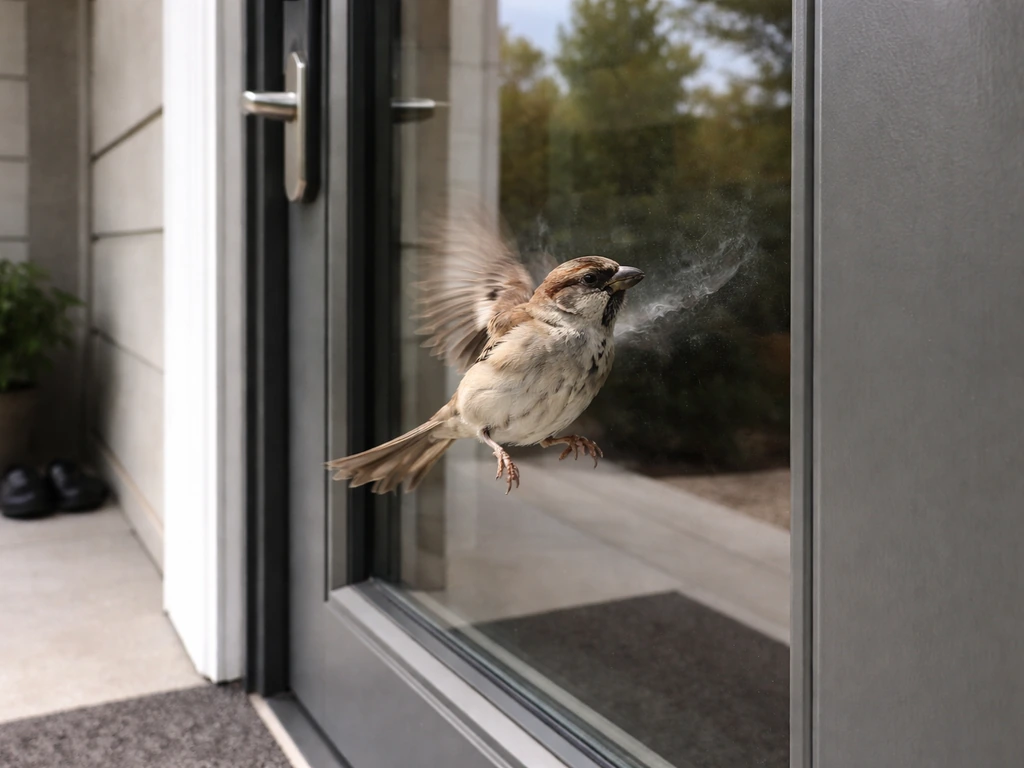
What Does It Mean When a Bird Hits Your Door?
What a bird hitting your door means spiritually and why collisions happen, plus safe steps and next actions.
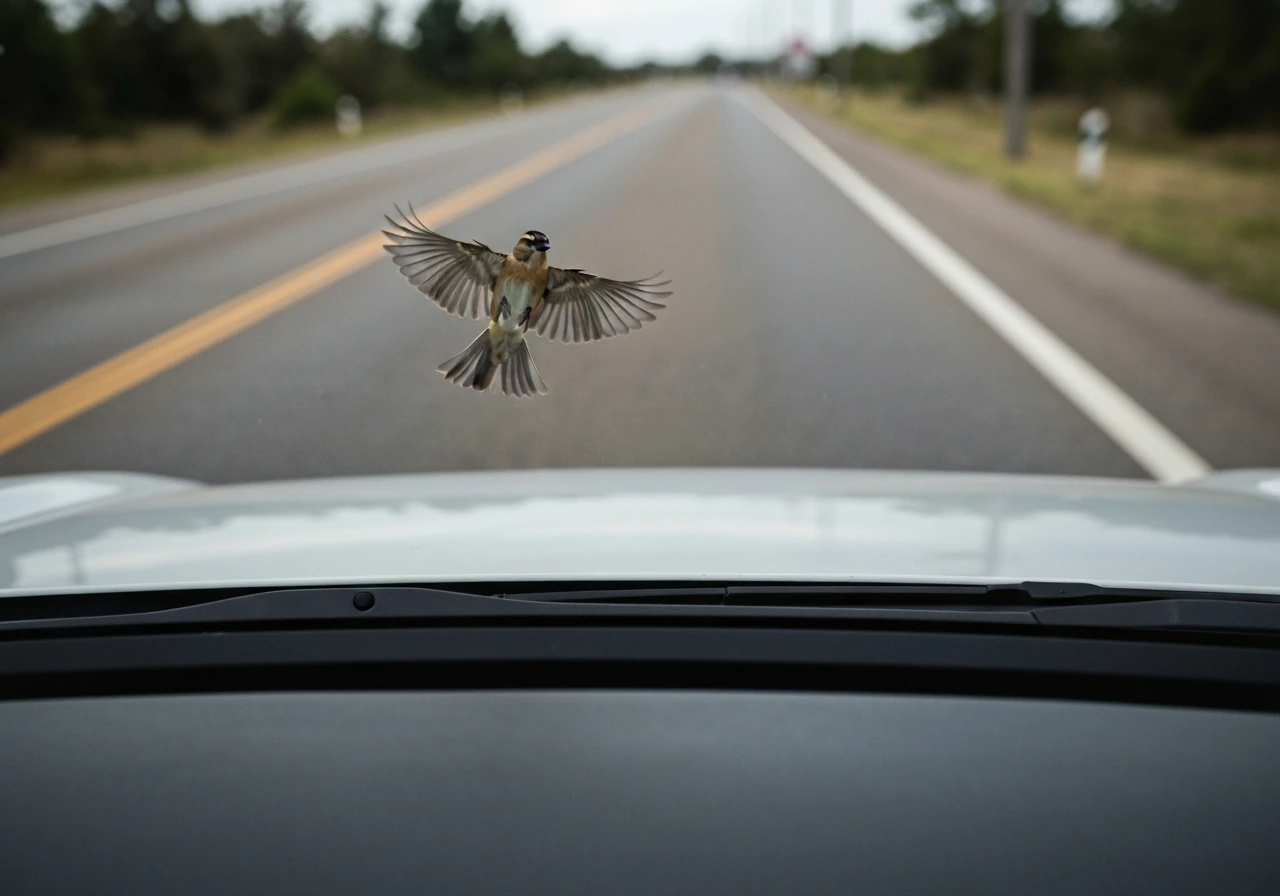
Bird Flying Into Car Meaning: What It Could Mean and Do Now
Bird flying into car meaning explained by scenario, with immediate safety steps and spiritual interpretations to reflect
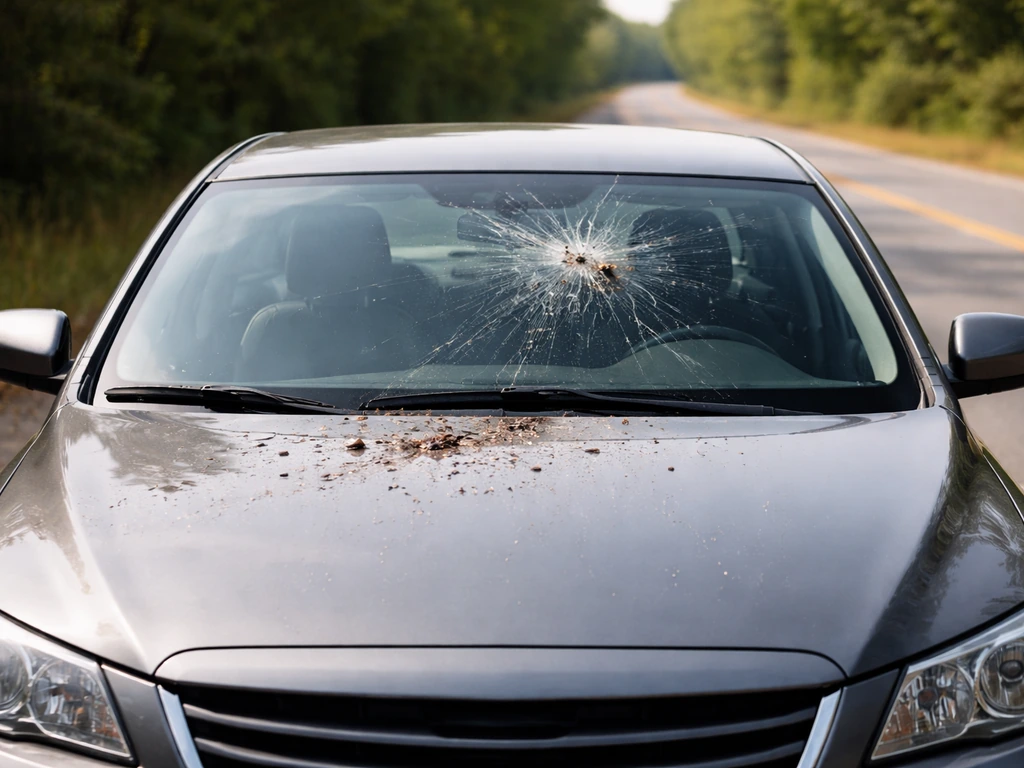
What Does It Mean When a Bird Hits Your Car? Steps and Meanings
Bird hits your car: what to do right away and possible spiritual meanings, plus natural causes behind the collision.