If you hear scratching, fluttering, or tapping coming from inside your wall, there is a real chance a bird has gotten trapped in there, and your first move should be to stay calm, keep pets and kids away from that wall section, and listen carefully before doing anything else. Most birds in walls are alive, disoriented, and exhausted, and acting quickly but gently gives them the best chance of getting out safely.
I Think There’s a Bird in My Wall: Day-Of Guide

Maya Hartwell
23 May 2026
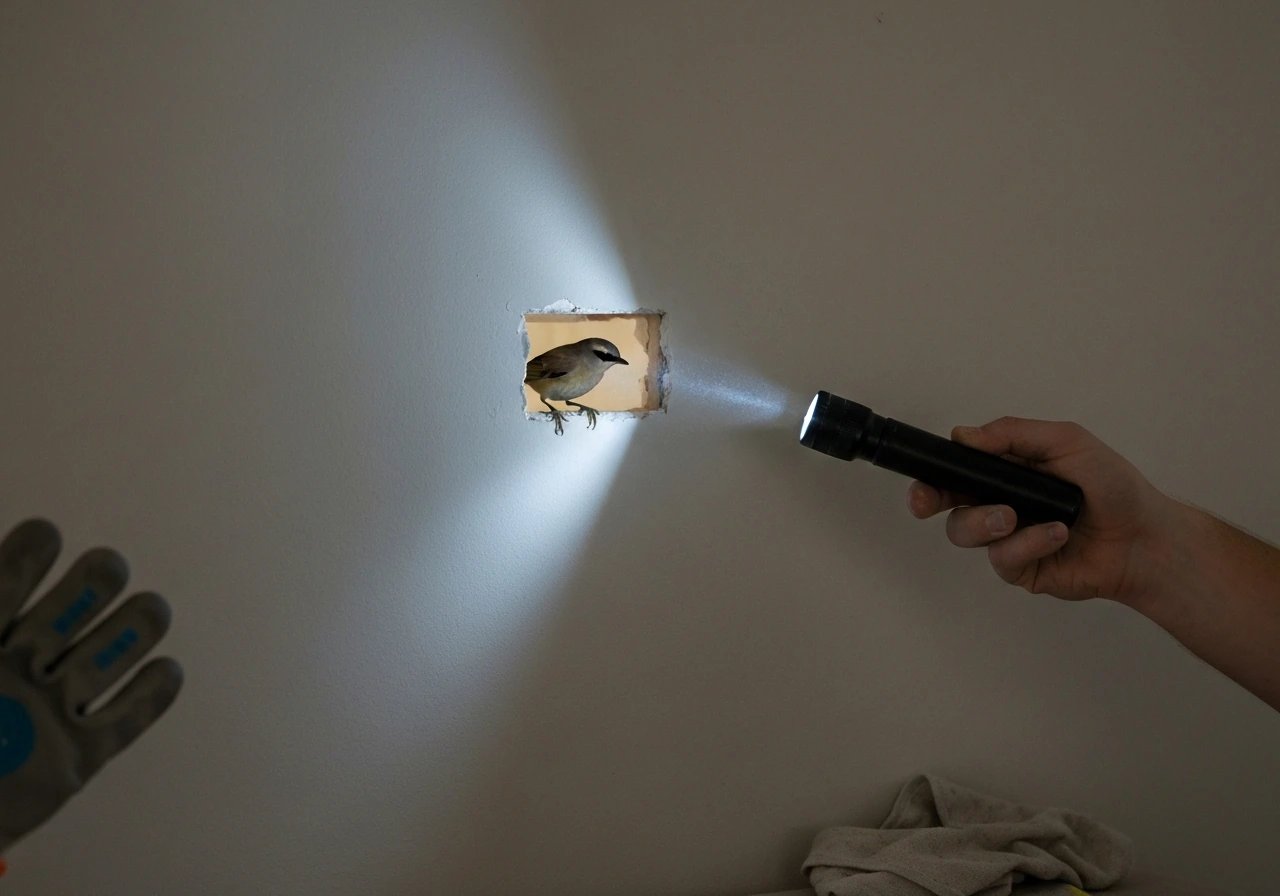
Quick safety check: do this first
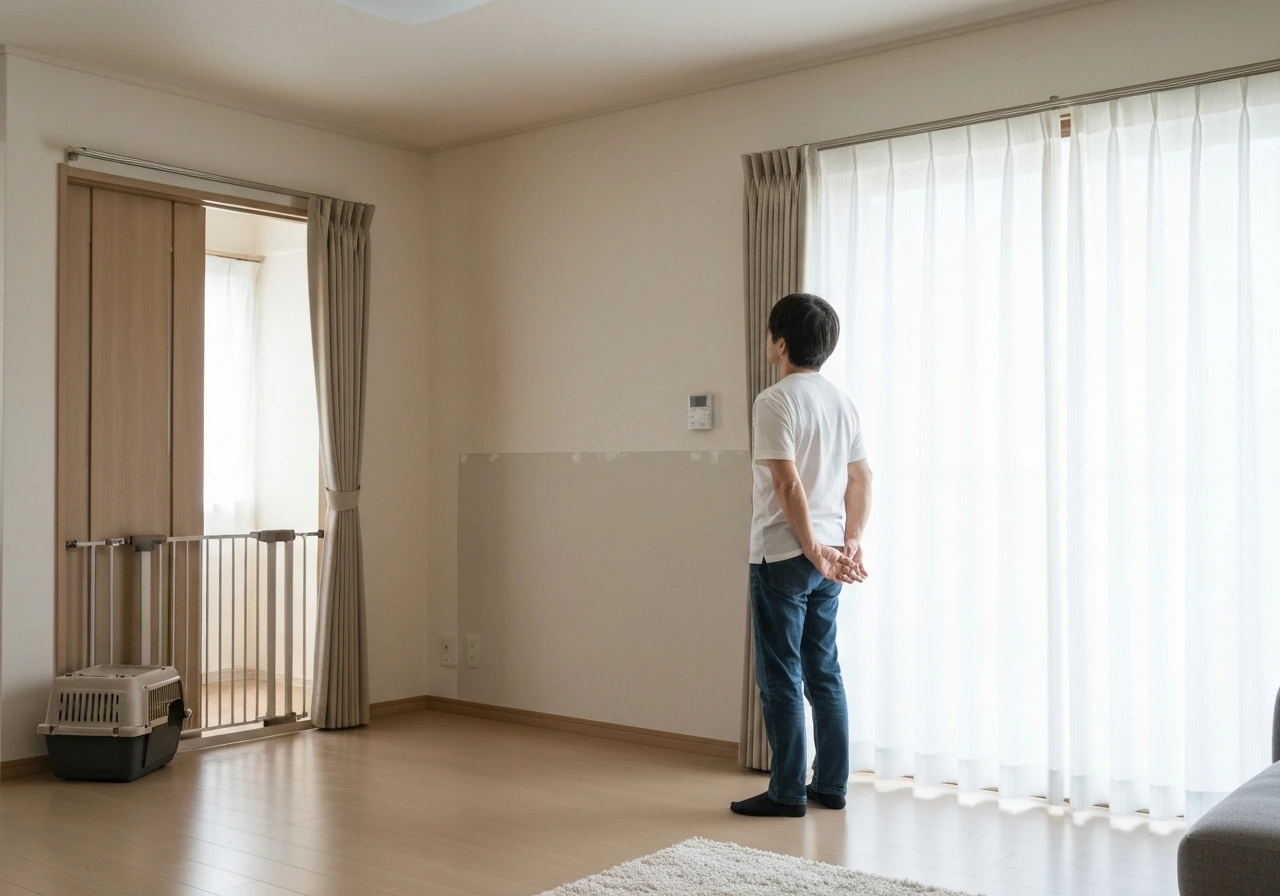
Before you touch anything or start pulling at drywall, run through a fast safety check. A bird thrashing inside a wall cavity can dislodge insulation, debris, or even chew through wiring in desperation (though that is more of a rodent behavior). The main risks right now are: a panicked animal that injures itself, structural disturbance that makes the problem worse, and you or your kids getting too close to a section of wall where something is actively moving. If you are dealing with a similar situation in your attic instead of inside a wall, see how did a bird get in my attic for the likely entry points and next steps.
- Keep pets in another room. A dog or cat pawing at the wall will stress the animal further and can cause real damage to your drywall.
- Turn off any loud music, TVs, or appliances near that wall. Sound reduction matters a lot for a trapped, stressed bird.
- Do not bang on the wall to 'see if it responds.' This is instinctive but counterproductive.
- If you smell something burning near outlets or see scorch marks, call an electrician before doing anything else. That is unlikely to be bird-related, but rule it out.
- If you have young children, keep them away from the area until you have a clearer picture of what is happening.
Is it actually a bird? How to tell for sure
Walls carry sound in weird ways, and what you are hearing might not be a bird at all. Before committing to a bird-specific plan, spend a few minutes doing some basic detective work. Timing and sound quality are your two best clues.
| Animal | Sound | Active Time | Other Clues |
|---|---|---|---|
| Bird | Fluttering, soft scratching, occasional chirping or tapping | Daytime, especially morning | Stops at night; frantic bursts of movement |
| Squirrel | Heavier scratching, rolling/gnawing sounds, sometimes chattering | Morning and late afternoon | Acorn or nut debris near entry points |
| Bat | High-pitched squeaking, scratching, soft scrabbling | Dusk and night only | Guano near vents or soffits; may smell musky |
| Mouse/Rat | Constant low scratching, gnawing on hard material | Mostly nighttime | Droppings along baseboards; grease marks on wall |
| Insect colony (wasps, etc.) | Buzzing, papery rustling | Daytime | Visible entry point near roofline or window frame; faint buzzing |
A bird is almost always a daytime event. If the sounds stop entirely at night and pick back up at sunrise, that is a very strong indicator you are dealing with a bird rather than a rodent or bat. Birds also produce that distinctive flutter, a rapid soft beating that sounds nothing like the hard gnawing of a mouse. If you hear intermittent flapping followed by silence, then more flapping, that is a tired, trapped bird trying to find a way out.
Finding where it got in: step by step
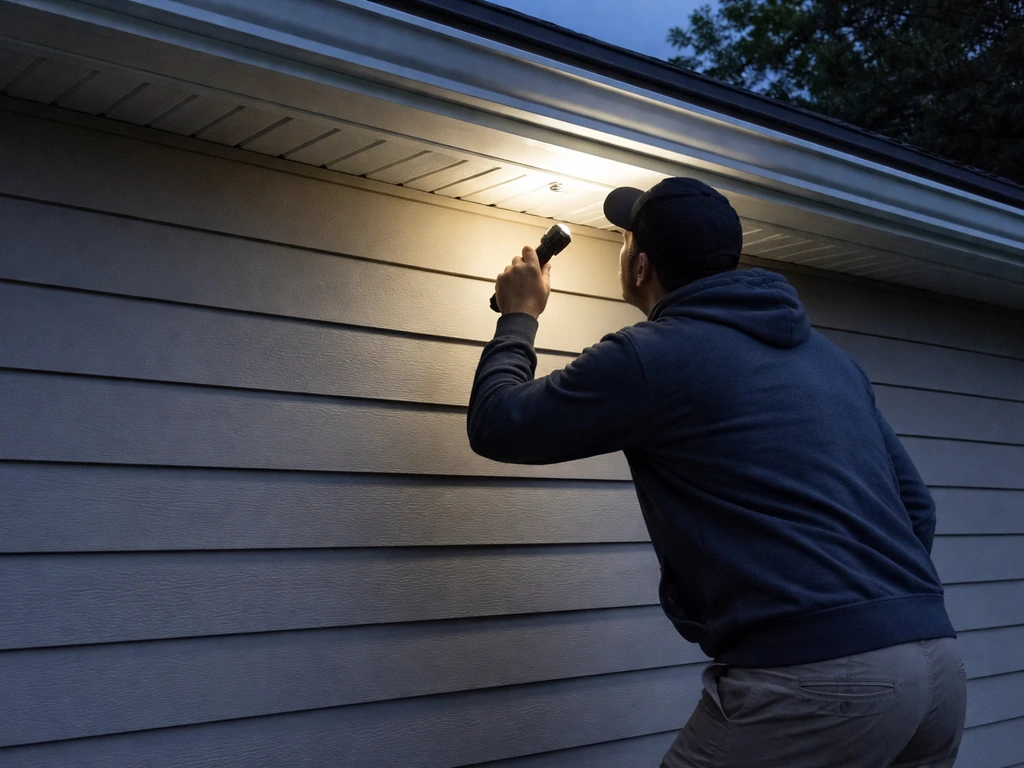
The most useful thing you can do right now is find the entry point, because that is also likely the exit point. Birds rarely get into wall cavities through magic. They enter through specific structural gaps, and identifying those gaps is the key to both removal and prevention. The same question of how did a bird get in my house often comes down to finding the entry point and closing the gaps so it cannot happen again.
- Go outside and do a visual walk around the perimeter of your home. Look up at the roofline, soffits, fascia boards, and any ventilation covers. You are looking for gaps larger than half an inch.
- Check dryer vents, bathroom exhaust vents, and attic vents. These are the most common bird entry points. Vent covers that are rusted, missing, or bent open are immediate suspects.
- Look at the area directly behind where you hear the sound. If the noise is in a first-floor wall, check for basement-level gaps, low vents, or gaps where utility pipes enter the foundation.
- Check where wiring, plumbing, or HVAC ducts pass through exterior walls. Gaps around these penetrations are often large enough for a small bird.
- Look at corners where two walls meet the roofline. Soffit returns (the inside corners under the eaves) commonly have gaps that birds discover.
- If you have a chimney, check the cap. A missing or damaged chimney cap is a very common way birds end up inside structures. This scenario has a lot in common with a bird in a chimney situation.
- Take a flashlight and check your attic if safe to do so. If a bird entered through the attic, it may have fallen down into a wall cavity from there.
Once you find the likely entry point, do not seal it yet. You want that opening available as an exit route until the bird is out. Mark it with tape or a sticky note so you remember where it is.
How to remove a bird humanely
The goal here is to make the wall cavity an unpleasant dead end and the outside world an obvious, easy escape. You cannot physically reach into a sealed wall to grab a bird, and you should not try to. Here is a process that works.
- Darken the room nearest the wall where the bird is trapped. Close blinds, turn off interior lights. Birds are naturally drawn toward light, so reducing light inside encourages movement toward the outside opening.
- If the entry point is accessible, make sure it is completely unobstructed. Remove any mesh, partial blockage, or debris from that vent or gap so the bird has a clear exit path.
- Keep the home as quiet as possible for 30 to 60 minutes and then check whether the sounds have stopped. Many birds find their own way out once there is a clear exit and no disturbance.
- If the bird is still trapped after a few hours, you can try placing a bright light source (a work lamp or even your phone flashlight) near the known entry point from the outside. This gives the bird a beacon to aim for.
- If you can confirm the bird is in a section of wall cavity that connects to an interior room (such as behind a removable baseboard or near a cold air return), you may be able to open that access point, darken the room, and let the bird fly out into the house, then guide it to an open window or door.
What not to do
- Do not spray chemicals, repellents, or anything into the wall cavity. These will not help and may harm the bird or create a ventilation hazard.
- Do not permanently seal the entry point until you are confident the bird has exited. Sealing a live bird inside a wall is a welfare problem and will create an odor problem within days.
- Do not cut a large hole in drywall without a plan. Opening the wall releases the bird into the house, which is only useful if you are ready to guide it back outside. Have windows and doors open before you do this.
- Do not leave food or water inside the wall cavity. This does not help and may attract other animals.
- Do not use noise to try to drive the bird toward the exit. Loud sounds cause panic, which leads to injury.
When to stop DIYing and call a professional
Most bird-in-wall situations resolve within 24 hours if the exit point is clear. But there are situations where you genuinely need professional help, and recognizing them early saves you money, stress, and a much bigger mess.
- The sounds have continued for more than 24 to 48 hours without stopping. At this point the bird may be injured, exhausted, or in a cavity with no accessible exit.
- You hear sounds but cannot find any plausible entry point. This means the gap is hidden or structural, and a wildlife professional or contractor needs to assess it.
- You are hearing multiple birds or recurring sounds after removal. This suggests a nesting site inside your wall, which is a more complex situation requiring professional exclusion work.
- The affected wall contains electrical wiring and you are not comfortable working near it.
- The bird appears to have died inside the wall. You will need to locate and remove it quickly to avoid odor and health issues, and this almost always requires cutting into the wall in the right spot.
- You suspect the entry point involves structural damage (rotted fascia, collapsed soffit, damaged chimney) that needs repair beyond a simple vent cover.
- You discover it is not a bird but bats. Bat removal is federally regulated in many states and must be handled by a licensed wildlife professional, especially during maternity season (generally May through August).
Wildlife control professionals can perform an exclusion inspection, identify all entry points, remove the animal humanely, and seal gaps properly. Pest control companies handle the cleanup and infestation side. If you need structural repair, a contractor or roofer may also be part of the solution. These calls are worth making early rather than after the problem compounds.
Health risks, cleanup, and odors
Once the bird is out, you are not completely done. Even a single bird trapped for a short time can leave droppings, feathers, and debris inside a wall cavity, and depending on how long it was there, you may notice an odor. This section is not meant to alarm you, because a brief bird visit is a low-level risk, but it is worth handling cleanup correctly.
The actual risks
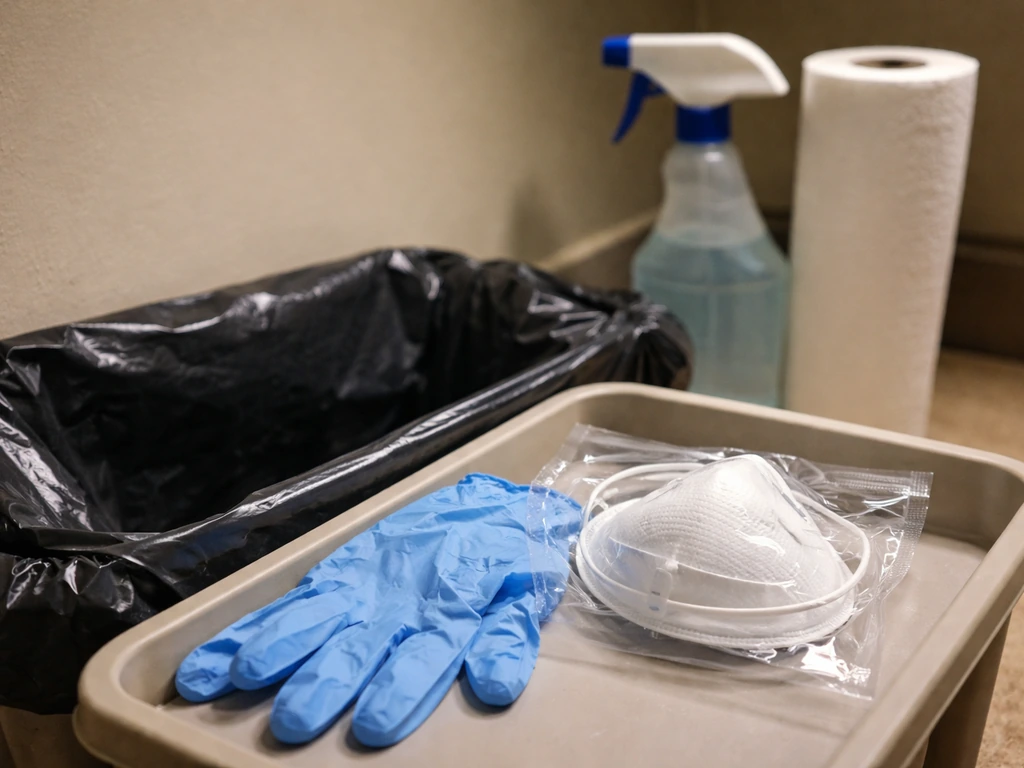
Bird droppings can carry Histoplasma capsulatum, the fungal spore behind histoplasmosis, especially when droppings accumulate over time in enclosed spaces. CDC/NIOSH guidance emphasizes preventing bird and bat droppings from accumulating and avoiding practices that aerosolize dust, such as shoveling or sweeping dry, dusty material, and instead spraying to reduce aerosolized material avoid practices that aerosolize dust. Psittacosis (also called parrot fever) is a bacterial infection transmittable from bird droppings and respiratory secretions. For a single trapped bird, the risk is relatively low, but proper cleanup technique matters regardless. Droppings can also attract secondary pests like mites or beetles.
How to clean up safely
- Wear disposable gloves and an N95 respirator mask before handling any droppings or contaminated material. The CDC and NIOSH recommend N95 filtering facepiece respirators when cleaning bird or bat droppings in enclosed or dusty spaces.
- Never dry-sweep or vacuum up dry droppings. This aerosolizes particles, which is exactly how you inhale what you do not want to inhale.
- Lightly wet the droppings with water or a diluted disinfectant spray first. This reduces dust and makes them much safer to handle.
- Use paper towels or disposable rags to wipe up the material. Seal everything in a plastic bag before disposing of it.
- Wipe the surface down with a disinfectant appropriate for the material (wood, drywall, metal vent cover).
- Wash your hands thoroughly after removing gloves.
- Ventilate the space well by opening windows or running exhaust fans during and after cleanup.
If the bird was trapped for more than a few days and there is a substantial accumulation of droppings inside a wall cavity, or if you or anyone in your household is immunocompromised, call a professional remediation service. For most short-duration situations, the above steps are sufficient. CDC/NIOSH recommends using respiratory protection such as N95 filtering facepiece respirators as part of PPE when cleaning up large accumulations of bird or bat droppings where dust or aerosolization risk exists.
What about odor?
If you smell something musty or faintly sour coming from the wall, that is usually the droppings or damp feathers. If you smell something distinctly putrid, especially after sounds have completely stopped, there is a possibility the bird has died inside the wall. In that case you will need to locate and remove it, which typically means cutting into the drywall. An enzymatic odor eliminator (not just a masking spray) will help once the source material is removed.
What it might mean: the spiritual and symbolic side
If you are someone who pays attention to signs and synchronicities, the experience of hearing a bird inside your wall is hard to dismiss as just a strange inconvenience. If you are wondering, “is there a bird in my chimney,” the same instincts apply: confirm the sound source first before you start pulling at anything. Something about it feels pointed, like the universe placed a creature between the seen and unseen parts of your home for a reason. Many spiritual traditions have something to say about birds appearing in unusual or boundary-crossing ways, and the wall itself is a rich symbol: a threshold between inside and outside, between what is known and what is hidden. Some people also wonder about the bird coming down the chimney meaning, especially when it feels like a sign bird coming down chimney meaning.
Themes that show up across traditions
In many folklore traditions, a bird that appears in an unusual or unexpected place, especially inside a structure, is seen as a messenger. The specific meaning varies widely by culture, but common themes include: a message from the spirit world or from an ancestor, a warning that something needs your attention, or a sign of change approaching the household. In Celtic tradition, birds are often seen as souls or intermediaries between the living and the dead. A bird caught between walls, unable to pass through, could symbolize a message or soul that is struggling to get through to you.
In biblical and Christian folk tradition, birds inside homes carry mixed symbolism. Doves represent peace and divine presence, while a frantic or lost bird can signal spiritual unrest or a household in need of prayer and realignment. Psalm 84 famously describes the sparrow finding a home near God's altar, and some readers interpret any unusual bird visit as a nudge toward sanctuary or reflection. What is the thing in your own life that feels trapped or hidden right now, knocking to be heard?
In Eastern and metaphysical frameworks, the wall represents the boundary between your conscious awareness and your subconscious, or between your public life and your private inner world. A bird in the wall, making noise but invisible, is a compelling image for something you have been ignoring or suppressing: a creative impulse, an unaddressed grief, a message from your own intuition. The fact that you can hear it but not see it is the point. If you are dealing with the specific case of hearing a bird in your chimney, the safety steps and exit strategy can be a bit different i can hear a bird in my chimney.
Some Indigenous North American traditions treat bird appearances, especially in the home or in liminal spaces, as communications from spirit guides or ancestors who want to be acknowledged. The appropriate response in many of these traditions is gratitude: thanking the bird for its message, whether or not you fully understand what the message is.
The symbolism of the wall itself
It is worth sitting with the image for a moment: a living thing, a creature of sky and freedom, trapped inside the structure of your home, between the walls you built or inherited. That tension, between freedom and confinement, between the wild and the domestic, shows up in human life in many ways. Is there something in your life that feels similarly boxed in? A desire, a conversation, a part of yourself that has been walled off? The bird's insistence, that scratching and fluttering, might be asking you to look at what you have sealed up.
After it is resolved: how to sit with what happened
Once the bird is gone and your wall is patched and sealed, you might feel a surprising mix of relief and something harder to name. That is worth paying attention to. Here are a few ways to close out this experience, whether you take a practical lens, a spiritual one, or both.
- Notice what happens next. In the days following an unusual bird event, many people report seeing birds more frequently, or in meaningful configurations, or having vivid dreams involving birds or flight. This is worth writing down if journaling is part of your practice.
- If a bird visits your yard or window shortly after the wall incident, some traditions would interpret this as confirmation that the message has been delivered and acknowledged.
- If the experience felt significant, you might take a few minutes to sit quietly and ask yourself: what was the bird trying to get through to me? You do not have to have a definitive answer. The question itself is often the practice.
- If prayer or ritual is meaningful to you, consider offering a short prayer of thanks: for the bird's safe exit, for your own attentiveness, and for whatever guidance the encounter was meant to carry.
- Practically, do a full home walk with fresh eyes. Seal the entry point, check other vulnerable gaps, and treat this as an invitation to know your home better. Awareness and attentiveness are their own form of care.
A bird in the wall is genuinely disruptive. It is also genuinely strange, and strange things have a way of opening us up if we let them. You handled it. You listened. You found a way through. That is not a bad metaphor for a lot of things.
FAQ
How can I tell if the sounds are from a bird versus a squirrel, mouse, or bat?
Bird sounds usually show a pattern tied to daylight, fluttering that sounds like light rapid beating, and pauses with intermittent re-flutters. Mice tend to gnaw continuously, bats often create high, squeaky screeches and may be active at dusk into the night, and squirrels typically move with heavier, thudding motions and repeated scampering. If the animal is actively repositioning insulation or you hear sustained hard chewing, consider rodent or bat and plan differently.
What should I do if I cannot find the entry point, but I still hear tapping?
If you cannot locate a likely gap, avoid sealing any suspicious cracks you discover, and focus on narrowing the location using where the sound is loudest and which wall stud bays are closest. Mark the approximate area and keep the opening strategy in mind, then consider a wildlife exclusion inspection sooner, since professionals can use camera scopes and entry-point mapping to find hidden access routes.
Is it ever safe to open electrical outlets or cut drywall myself?
Generally, do not cut drywall or remove electrical components while the animal is still moving, because thrashing can dislodge insulation, debris, and potentially damage wiring. If you must open a small access area, do it only near the identified exit point and ensure power is off to nearby circuits if you suspect wiring in the cavity. If the sounds stop and you suspect a dead bird, professional help is often worth it to reduce the risk of spreading contamination or creating larger structural repairs.
Should I leave the exit opening open indefinitely until I’m sure the bird is gone?
Keep the likely exit route available until you have a clear “silent” period, then continue monitoring for at least a full day. Once sounds have stopped and you have confirmed there is no renewed fluttering or scratching, you can seal. Sealing too early is a common mistake that can trap the bird again.
What if the bird makes noise but I can’t tell which room wall it’s in?
Sound travels through studs and empty cavities, so the loudest point may not be directly above the entry gap. Use a simple method: press a hand against the wall and listen from different adjacent rooms at different corners, then compare which area changes the sound most. If you still cannot isolate the cavity, a pro inspection can prevent unnecessary cutting and repeated wall opening.
Do I need to clean right away, or can I wait after the bird is gone?
Wait until the animal is fully removed, then clean promptly while the droppings are still accessible and before they dry and fragment into dust. Plan to wear protective gear for cleanup, especially if there are visible droppings, and avoid sweeping dry debris. If cleanup requires major drywall removal or there is heavy accumulation, remediation support is safer.
What signs mean the bird is likely dead in the wall?
A distinct, putrid odor, especially after all movement and fluttering have stopped, is a key indicator. Musty or sour smells also suggest damp material like feathers or droppings, but putrid is more concerning for decay. If you smell it quickly and cannot find fresh entry/exit activity, treat it as a “source location” problem that may require careful access.
If I seal the entry point, will the bird automatically leave?
Not safely. Sealing blocks the exit route the bird is using, so it may continue thrashing inside the cavity or die there. The safer approach is to identify the entry, leave it accessible as an exit, and only seal after you confirm the bird is out and the area remains quiet.
How do I prevent it from happening again after removal?
Prevention is about sealing the exact structural gaps, not just covering the sound location. After you find the entry, close gaps around penetrations like vents, soffits, chimney-adjacent gaps, damaged screens, eaves, or broken flashing. If the entry point involves exterior roofline or siding failure, coordinate sealing with a roofer or siding contractor so the repair holds against weather.
Could my pets be at risk while the bird is in the wall?
Yes, mainly from getting close to the wall section and startling the animal, which can cause more thrashing or injury. Keep pets away from the specific wall area and prevent repeated “checking” by closing doors or using barriers. Also watch for sudden behavior changes in pets, since they may fixate on noises and damage drywall trying to investigate.
When should I call professional help instead of trying to DIY?
Call early if sounds persist beyond about a day with no obvious exit, if you suspect multiple entry points, if you hear evidence of heavy thrashing, or if access would require cutting significant drywall. It is especially important if anyone in the household is immunocompromised, if there is likely substantial droppings accumulation, or if the sound source is near wiring, plumbing, or HVAC components.