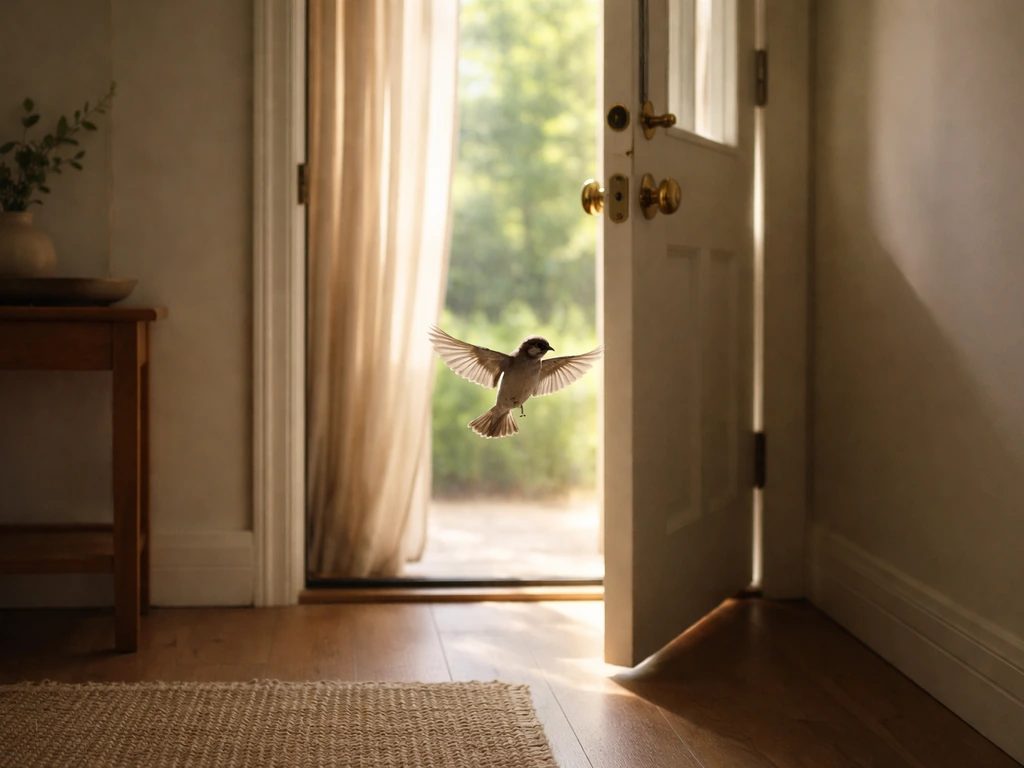
A bird flying into your house means one of two things, or possibly both at once: there is a perfectly logical, natural explanation for why it happened, and there may also be a layer of meaning worth sitting with. Which one matters more depends entirely on you. This guide covers both sides completely, starting with what to do right now to get the bird safely back outside, then moving into the symbolic and spiritual interpretations that people across many cultures have drawn from this experience.
Bird Flying in the House Meaning and What to Do Now

Maya Hartwell
3 Apr 2026
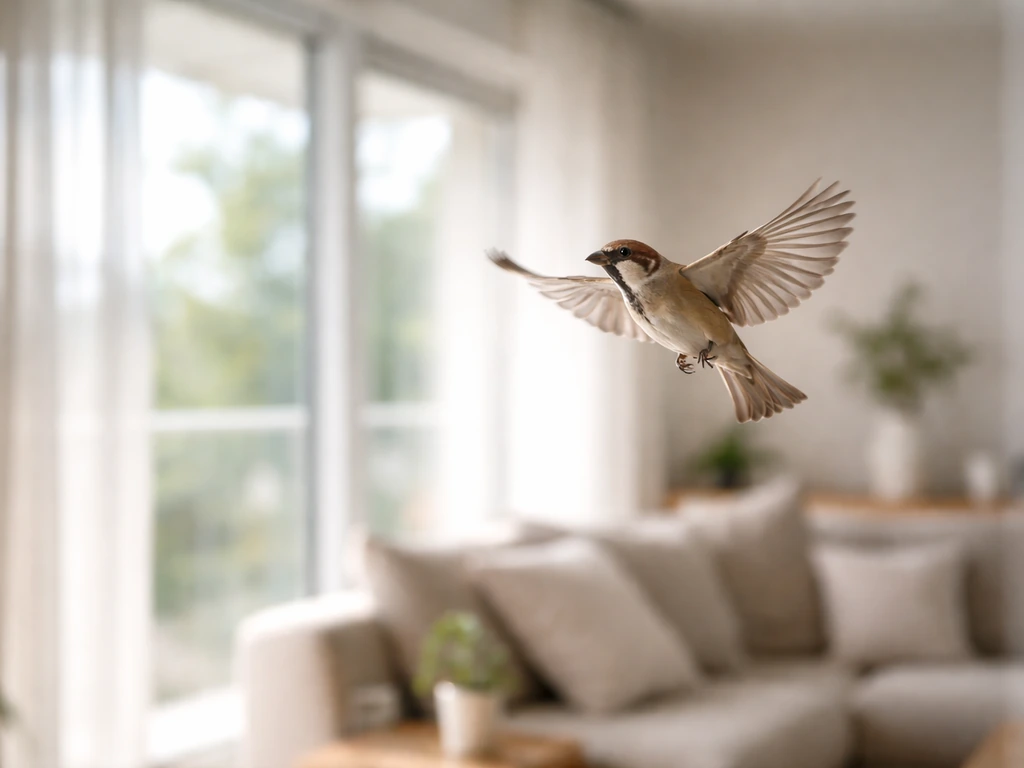
Why a Bird Actually Flies Into Your House
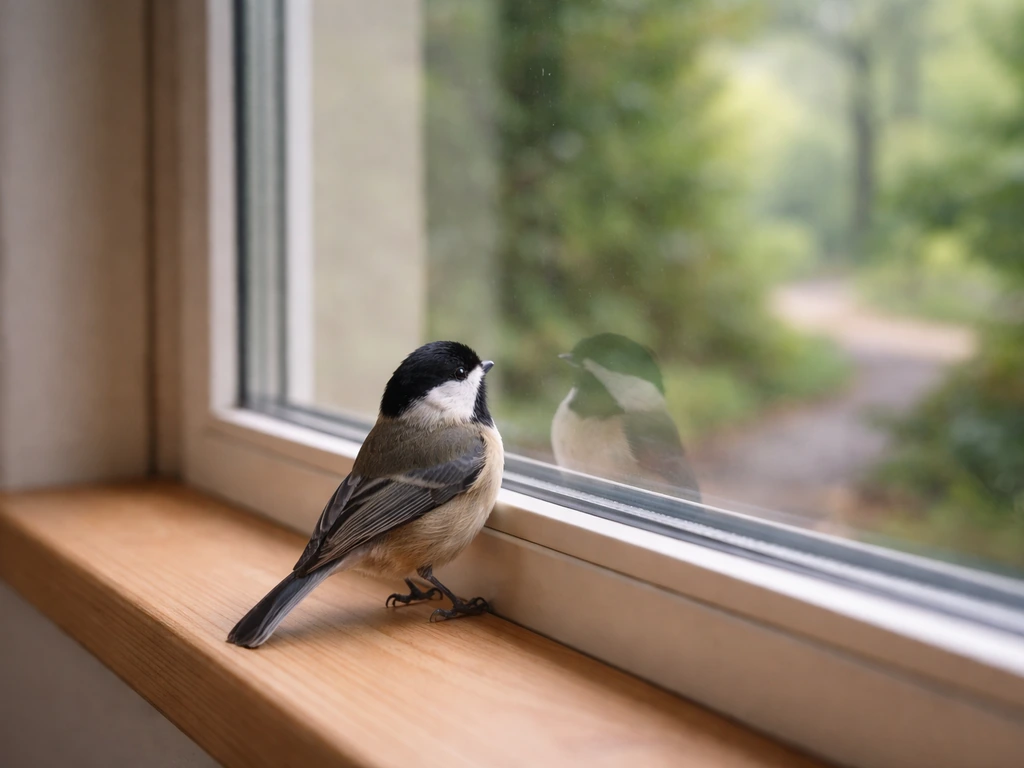
Before anything else, it helps to understand why this happens in the first place. Birds do not fly indoors on purpose, and in most cases, there is a simple environmental explanation behind it.
The most common cause is disorientation from reflections. A bird sees the vegetation reflected in your window glass and reads it as open, flyable space. It is not flying toward your house, it is flying toward what looks like sky or trees. Window collisions increase when birds are also drawn in by interior lights at night, since light spill can attract migrating birds and pull them off course. Research from the U.S. Fish and Wildlife Service confirms that turning off unnecessary indoor lights during spring and fall migration, and using curtains or blinds to block light spill, meaningfully reduces this kind of collision.
Other common reasons a bird ends up inside your home include: an open door or window the bird flew through while foraging, a gust of wind that carried a smaller bird across your threshold, a bird actively searching for a nesting site in late winter or early spring, or a bird that was being chased by a predator and took the nearest shelter it could find. Sometimes birds attack their own reflections in windows, mistaking themselves for a territorial rival, and end up crashing through or into the glass in the process.
None of these explanations are mysterious. They are just birds being birds, navigating a world full of glass and artificial light that did not exist when their instincts were calibrated. That said, the fact that it is explainable does not automatically strip it of meaning. More on that shortly.
Get the Bird Back Outside Safely: Do This First
If there is a live bird inside your home right now, this section is your priority. The good news is that most birds can be guided back out without much drama if you act calmly and methodically.
If the bird is flying around freely
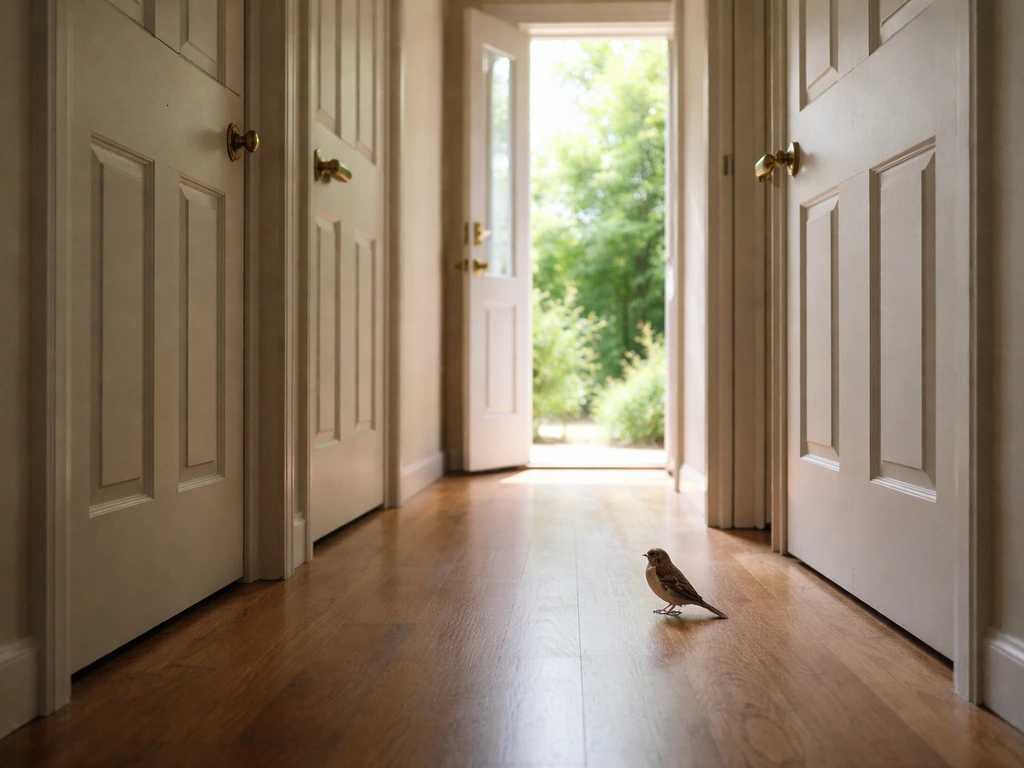
- Close off interior doors to confine the bird to one room. The fewer spaces it can reach, the less stressed it becomes and the easier it is to guide it out.
- Open one large exit: a door or wide window that faces outside. Remove screens if you can.
- Close or cover all other windows and glass surfaces in that room to eliminate confusing reflections.
- Turn off interior lights and let natural daylight draw the bird toward the open exit.
- Stay calm, move slowly, and give the bird space. Chasing it causes it to panic and tire itself out.
- Keep pets and children out of the room entirely. A stressed bird can injure itself trying to escape a perceived threat.
- If the bird is perched and not moving toward the exit after several minutes, you can gently use a large towel or a broom held horizontally (not swung at it) to calmly herd it toward the opening.
If the bird hit a window and is stunned or grounded
Window strike situations are more serious and need different handling. A bird lying on its back, fluttering weakly, or sitting very still after hitting glass may look like it is just stunned, but window strikes can be fatal even when a bird initially seems okay. Do not assume it will walk it off. Place the bird in a cardboard box with a lid or a towel draped over the top, put the box in a quiet, dark, cool location away from pets and children, and contact a licensed wildlife rehabilitator as soon as possible. Audubon is clear that window-collision birds often need professional care including anti-inflammatory medication, not a few minutes of rest and a release.
One firm rule across every wildlife organization: do not offer food or water to an injured or stunned bird unless a licensed rehabilitator specifically tells you to. The Northwoods Wildlife Center, Best Friends Animal Society, Aiken Audubon, and Tristate Bird all agree on this. Well-meaning feeding can actually cause serious harm to a bird that is already in shock.
The Spiritual Meaning of a Bird Flying Indoors
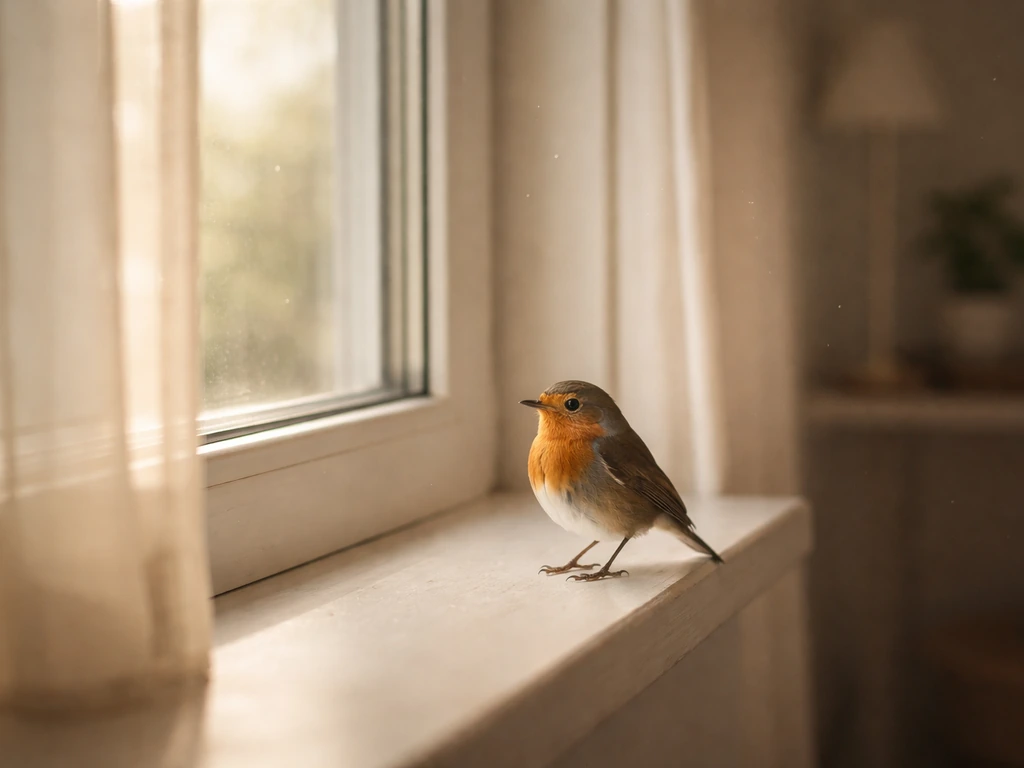
Once the bird is safe, or if you are here primarily for the meaning side of this experience, let's talk about what different traditions make of this event. And honestly, this is where things get interesting, because interpretations vary widely depending on where you look.
The most widely held modern spiritual interpretation is that a bird entering your home carries a message. In many metaphysical frameworks, birds are seen as messengers between the earthly and spiritual realms, intermediaries who move between worlds the way they move between earth and sky. Under this lens, what it means when a bird flies into your home is less about the intrusion and more about what you were doing, thinking, or going through in the moments before it happened. Synchronicity, the idea that meaningful coincidences carry personal significance, is a useful framework here. Did the bird arrive during a conversation about change? A moment of grief? A decision you were wrestling with? That context matters.
Biblically-influenced traditions sometimes read an unexpected animal visitor as a form of divine communication, a nudge from something larger than yourself to pay attention. Birds appear throughout scripture as symbols of the spirit, of God's provision, and of heavenly messengers. Whether or not you read the Bible literally, that symbolic lineage is part of why so many people feel something significant when a bird crosses into domestic space.
Celtic and broader European folklore has a more mixed relationship with indoor birds. Some traditions welcomed certain birds as signs of good fortune or arriving news. Others treated an unexpected bird indoors as an omen worth noticing. The specific meaning often depended on the bird's behavior: did it fly in and quickly out, suggesting a swift message delivered and gone? Or did it circle repeatedly, suggesting something unresolved?
Common Omens, Messages, and Symbolic Reads
The symbolic meaning of a bird flying into your house tends to cluster around a few recurring themes across traditions. Here is a practical breakdown of what people most commonly associate with this event and what those interpretations actually mean in practice.
| Symbolic Read | What It Might Suggest | Tradition / Lens |
|---|---|---|
| Change or transition incoming | Something in your life is shifting; the bird signals movement | General spiritual / metaphysical |
| A message from a departed loved one | The bird represents a soul or spiritual presence checking in | Many folk traditions, Indigenous beliefs |
| Good news arriving | A visitor or positive development is on its way | Some European folklore |
| A warning or call to attention | Something in your life or home needs addressing soon | Various omens traditions |
| A reminder of freedom | You may be feeling confined; the bird prompts reflection on liberation | Symbolic / Jungian lens |
| Death or loss omen | One of the oldest and most widespread superstitions around birds indoors | Western folklore, widely noted by Snopes |
That last entry, the death omen reading, is the one that makes people most anxious. It is also the one with the longest folk history. The belief that a bird flying into the house signals death is one of the most persistent superstitions in Western culture, documented widely and noted by fact-checking sources like Snopes as a deeply embedded piece of folklore. Worth knowing: it is not universally held, and many cultures read the same event as neutral or positive. Context and culture shape interpretation enormously.
Whether you find comfort, warning, or simply curiosity in any of these reads, none of them require you to abandon practical thinking. You can believe a bird is a messenger and still call a wildlife rehabilitator if it needs help.
How the Details Change the Meaning
Not all bird-in-the-house situations read the same way, spiritually or practically. The details shift things considerably, and this is one area where the older omen traditions were actually quite sophisticated. The Lunheng, a classical Chinese philosophical text, treats bird omens as highly context-specific: the species matters, the behavior matters, the timing matters. That is not a bad interpretive framework even by modern standards.
Species
A crow flying indoors carries very different traditional weight than a sparrow or a hummingbird. Crows and ravens have long been associated with prophecy, death, and the otherworld in Celtic, Norse, and many Indigenous traditions. Doves carry peace and spiritual presence. Sparrows are often linked to community, simplicity, or the everyday sacred. A red cardinal is widely seen in American folk spirituality as a visit from someone who has passed. The species alone can give you a meaningful thread to pull.
Behavior once inside
A bird that flies calmly through and exits quickly reads very differently from one that crashes repeatedly into windows, circles in panic, or perches and sits still watching you. The panicked window-crasher is almost certainly just terrified and disoriented. The one that lands near you and seems unbothered? That is the one people tend to assign deeper meaning to, and honestly, it is harder to dismiss.
Timing and what was happening in your life
Timing is everything in synchronicity. A bird appearing on the day of a funeral, a diagnosis, or a major life decision carries more interpretive weight for most people than one that shows up on a random Tuesday. If you are asking whether a bird flying into your house is good luck, the honest answer is: it depends on your tradition and your timing. Some people receive the same event as a blessing; others as a warning. Your own gut read matters here.
Window hits vs. deliberate entry
There is a meaningful distinction between a bird that crashes into a window (almost always a case of reflection confusion) and one that simply flies through an open door or window into your living space. The former is more likely a navigational accident. The latter, especially if the bird seems calm or directed, is the scenario that tends to feel more intentional to people and carries more symbolic weight in most traditions. If you noticed a bird that seemed to be hovering or repeatedly approaching your home before entering, that kind of persistent behavior at your house is worth considering separately as a sign or message.
Cultural background
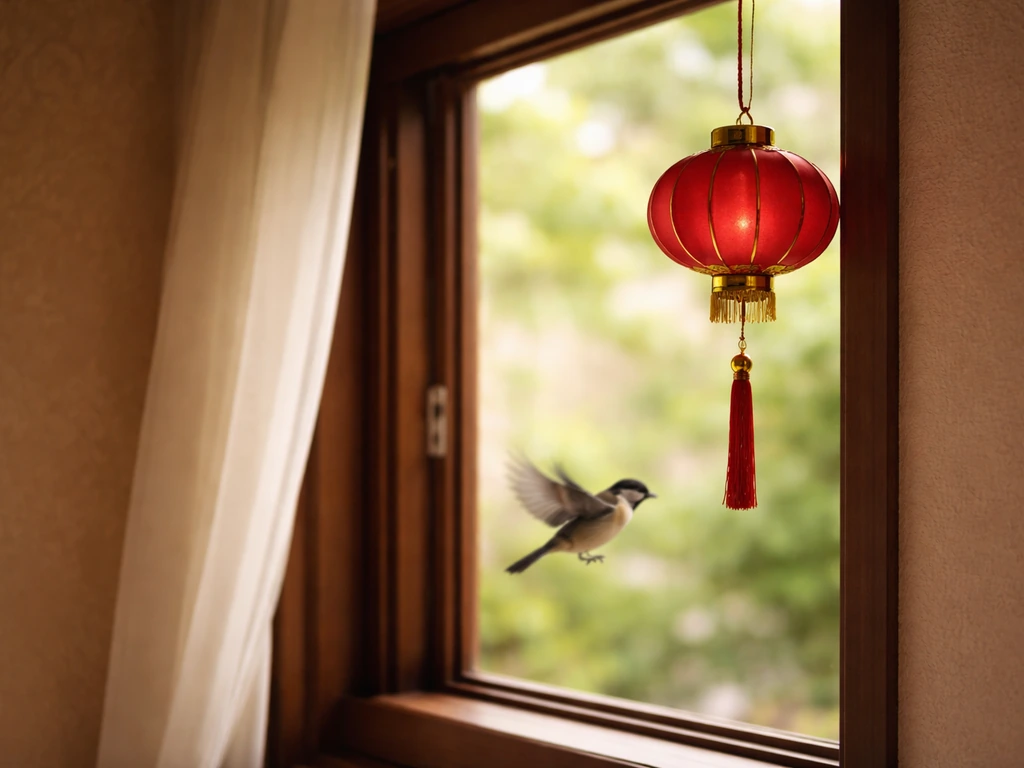
Where you come from shapes what you take from this. The Chinese interpretation of a bird flying into the house draws on a very specific omen tradition, including the idea found in classical texts that certain birds entering your space were signals to act, relocate, or pay attention to your household's energy. That is a very different frame than the Christian-influenced Western reading of a divine messenger, or the Indigenous understanding of the bird as a living relative bringing ancestral knowledge.
After the Bird Leaves: Reflection, Journaling, and Patterns
Once the situation is resolved, the real meaning-making begins. If this event felt significant to you, spend a few minutes with it while it is fresh. What was happening in your life in the days leading up to this? What were you thinking about when the bird arrived? What was your first emotional reaction, before your analytical mind stepped in? That first feeling is often the most honest signal.
Journaling this kind of encounter is genuinely useful, not because writing it down makes it more real, but because it gives you a record to return to. If a bird flies into your house once, it could be coincidence. If it happens three times in two months, especially around similar life circumstances, that pattern becomes harder to dismiss regardless of your worldview. Keeping a log of when, what species, what was happening in your life, and how it felt creates the data you need to assess whether you are tracking something meaningful.
Also worth doing: a quick check of the entry point afterward. If the bird came in through a specific window or door, check whether there are reflective surfaces or interior lights that might be attracting birds. Making your home less of a navigational hazard for wildlife is a kindness to future visitors, feathered or otherwise.
When to Call for Help
If the bird inside your home appears injured, is unable to fly, is lying on its side, has visible wounds, or struck a window hard enough that you heard the impact, treat it as a wildlife emergency. Contact a licensed wildlife rehabilitator in your area as soon as possible. The U.S. Fish and Wildlife Service, Audubon, and most state wildlife agencies (like Florida's FWC) all recommend finding a licensed facility rather than attempting home care. Rehabilitation beyond basic transport legally requires a wildlife rehabilitation permit in most states.
To find a rehabilitator near you, search for your state's wildlife agency website, or use the Wildlife Rehabilitators directory. If you reach a voicemail, leave your contact details, the bird's condition, and the approximate location where you found it. Follow any instructions the outgoing message provides. If no rehabilitator is reachable during business hours, contact your nearest state wildlife regional office.
While you are waiting for guidance: box the bird quietly, keep it warm and dark, keep pets and kids away, and do not attempt to feed or give it water. That is the best thing you can do until a professional takes over.
One last thought: you do not have to choose between the practical and the meaningful here. Getting a bird safely back outside and sitting with what its visit might have meant are not mutually exclusive. In fact, caring for the bird well, taking it seriously as a living creature, is itself a kind of respect for whatever drew it to your door. Whether that was a thermal current, a reflection, or something you cannot quite explain, you responded with attention. That matters.
FAQ
Why does a bird keep flying into the same window even after I opened a door?
Usually it is because the bird thinks the reflections or outdoor light patterns are open sky or trees. Use this quick check: shut off interior lights in the room, close curtains/blinds on nearby windows, and open one door or window toward the bird’s outside direction so there is a clear, unreflected exit path.
How can I tell if the bird is only stunned or actually injured from a window strike?
If you hear a crash, find broken feathers, or the bird is on the ground unable to fly properly, treat it as a possible window-strike injury even if it seems alert. Window impacts can damage internal tissues, so contact a wildlife rehabilitator rather than waiting for it to “shake it off.”
Can I give the bird water or food while I wait for help?
Do not offer food or water unless a licensed rehabilitator tells you to. Shock and stress can cause birds to aspirate liquid or eat improperly, and some foods can be harmful. The safest “help” while waiting is quiet containment (box with lid or towel cover), warmth, and minimal handling.
Is it ever okay to touch or move the bird if it is panicking?
Yes, but it depends on the bird and the situation. If the bird is actively panicking, you can reduce the danger by closing interior doors so it has fewer rooms to slam into and by blocking other reflective surfaces. Avoid chasing, grabbing, or forcing it with your hands.
What should I change in my home after this happens once to prevent it happening again?
If the bird is already outside, do a brief home “prevention pass.” After the situation resolves, check for reflective angles (mirrors, shiny decor, glass furniture), and keep nighttime lights minimized during peak migration periods. Add curtains or blinds to the most-used windows during those times.
How do I separate a meaningful message from anxiety or coincidence?
The “meaning” side is usually most reliable when you look at details you can actually confirm, not just fear-based outcomes. Focus on measurable context (time of day, bird species, whether it crashed or entered calmly, what was happening in your life emotionally right before).
What should I write down if I want to assess whether the event is a pattern?
Journaling is most useful if you track specifics each time, not just impressions. Record date and time, species (or best guess), where it entered and exited, behavior (circling, calm flight, repeated crashes), and your strongest emotion in the first 60 seconds.
Do different behaviors (calm flight versus repeated circling) change the likely interpretation?
Yes. A bird that flies calmly through and exits quickly often feels different from one that circles repeatedly, perches, or lands near you. For interpretation, the highest-value distinction is behavior plus persistence: calm and directed often gets read as a “message,” frantic and repetitive crashing is more consistent with distress and disorientation.
What if more than one bird ends up inside, or I find a second bird later?
If you have multiple birds indoors, treat it as an urgent pattern to correct immediately. Increase the “exit clarity” by turning off lights, opening one exterior path, and closing off other rooms. If any bird shows injury signs, contact a rehabilitator for each affected bird, since one injury can mask in others.
If I interpret it as a warning, what should I actually do instead of panicking?
In most cases, it is not a direct sign that something will happen to you. Many traditions treat these events as cues to pay attention to your current inner state or life transition rather than as a prediction you cannot act on. If the message increases dread, ground it by focusing on what practical step you can take today (reducing window hazards, seeking closure on a decision, talking to someone).
Next Article
Meaning of Bird Flying Into House: Practical and Spiritual Guide
Learn practical steps and spiritual meanings of a bird flying into your house, plus safe next actions.