A bird on your doorstep most commonly signals one of two things: a natural behavior (seeking shelter, food, or picking a fight with its own reflection) or, if you're drawn to symbolic interpretation, a message related to transition, news, or spiritual attention. Neither reading cancels the other out. The honest answer is that you can hold both at the same time, check the practical box first, and then sit with whatever meaning feels true for you.
Bird on Doorstep Meaning: Spiritual, Symbolic and Practical

Maya Hartwell
2 Jun 2026
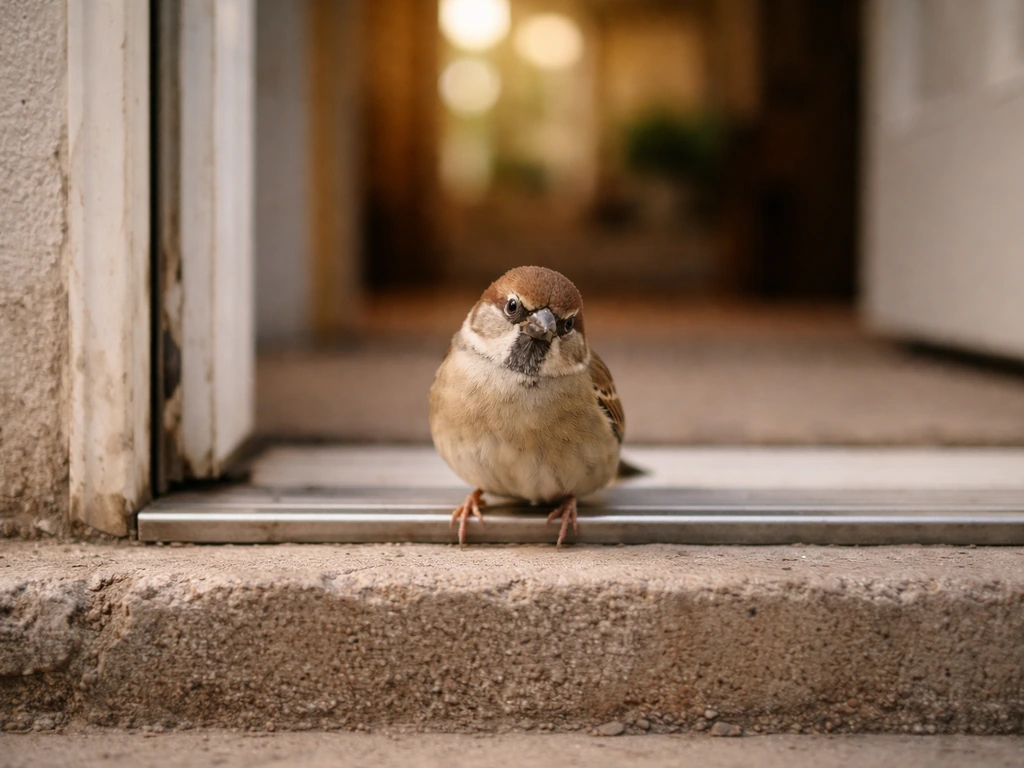
What people usually mean when they say 'a bird on the doorstep'
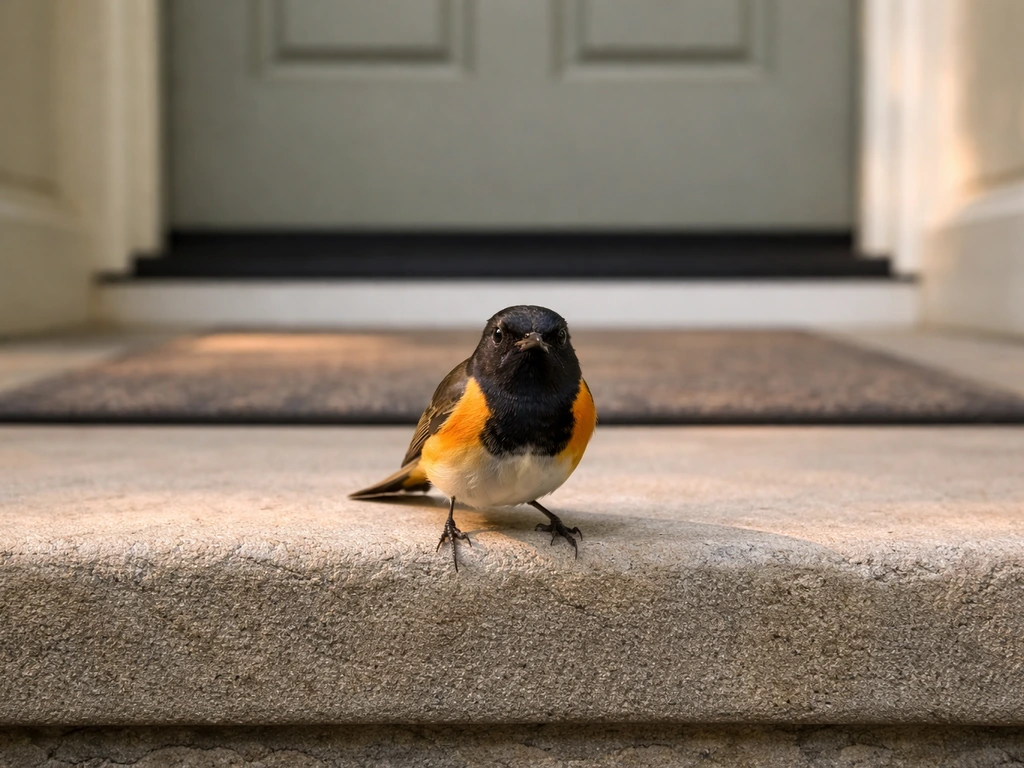
When someone searches this phrase, they've usually just had a moment that felt a little charged. The bird didn't just fly past. It landed, stayed, looked at them, or kept coming back. The doorstep specifically matters because the threshold of a home carries deep symbolic weight across almost every culture. Doors represent boundaries between your private world and the outside, between the known and the unknown. A bird pausing at that exact spot hits differently than one sitting on a random branch.
Historically, humans have read meaning into bird behavior for thousands of years. The formal practice is called ornithomancy, the art of taking omens from birds' movements, cries, and positioning. Ancient Romans, Greeks, Celts, and indigenous cultures across the Americas and Africa all developed frameworks for what birds signal. So when you feel like that bird was trying to tell you something, you're tapping into one of humanity's oldest instincts. That's worth taking seriously, even if it also turns out the bird just wanted your dry porch out of the rain.
Natural explanations worth ruling out first
Before diving into what the bird might mean, it pays to understand why birds actually end up on doorsteps. These explanations don't erase the symbolic layer, but they help you respond correctly and avoid making the situation worse. If you want a quick way to interpret the moment without going straight to symbolism, you can also consider the like a dog with a bird at your door meaning angle as an adjacent way people compare signs.
- Reflection and territory: Your door, glass panel, or sidelight window may be acting like a mirror. Birds, especially robins, cardinals, and sparrows, will see their own reflection and interpret it as a rival intruding on their territory. They'll return obsessively to confront the 'intruder,' which looks a lot like a repeated, intentional visit.
- Nesting and shelter: Covered doorsteps, eaves, and ledges are prime real estate. Rock pigeons in particular are known to nest on sheltered building ledges, and once they claim a spot they defend it hard. Swallows also target entry areas. If the bird is circling, carrying material, or returning daily, nesting is a strong candidate.
- Food and foraging: Insects gather near light sources at night, which also draws birds to doorstep areas in the morning. Spiders in corners, beetles in the threshold crack, or seed spilled nearby can all anchor a bird to your entry.
- Weather and warmth: A covered doorstep offers protection from wind, rain, and cold. Birds will use any overhang in a storm. This is especially common in late fall through early spring.
- Seasonal migration: If you're seeing unusual species, a migratory bird may simply be resting during a long journey. They look for safe, quiet surfaces and a doorstep fits the bill.
- Juvenile birds learning to fly: In late spring and summer, fledglings often end up on the ground or low ledges. They look lost and helpless but typically aren't. Their parents are nearby and watching.
Spiritual and omen readings by context
If the natural explanations don't fully account for what you experienced, or if you're drawn to find meaning in the encounter regardless, context matters enormously. The same bird can carry very different symbolism depending on when it appears, how it behaves, and what's happening in your life right now. Some people also search “bird on my balcony meaning,” and the same context based approach helps you interpret what the visit might be highlighting for you.
Morning vs. evening appearances
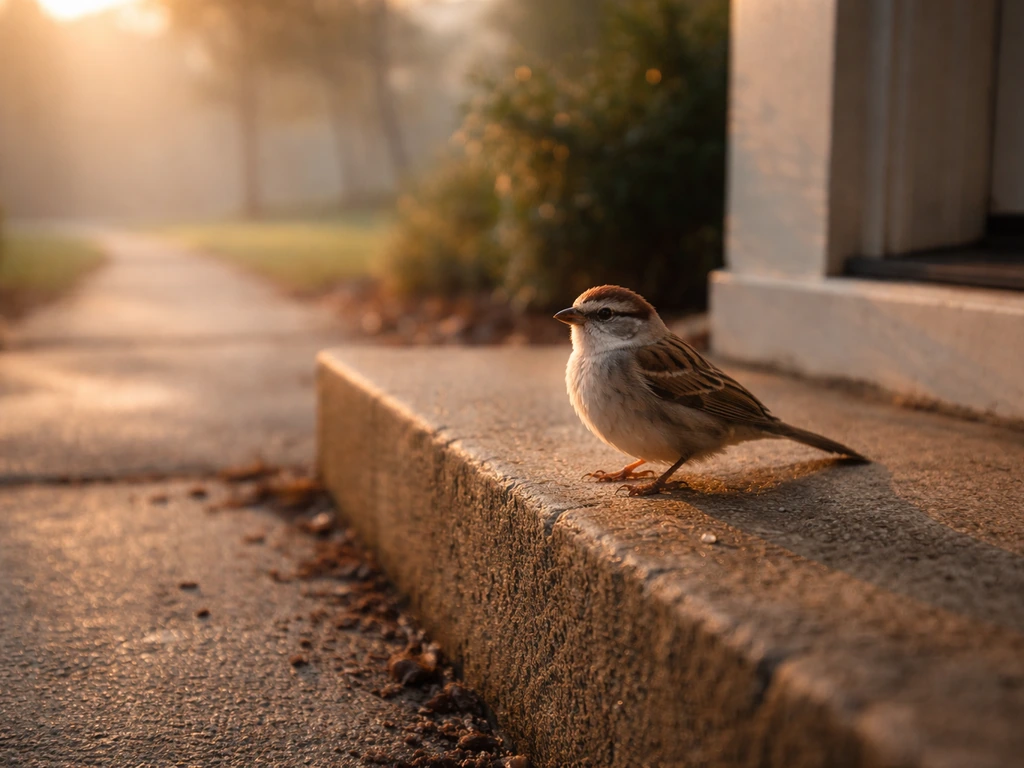
A bird appearing at sunrise or early morning is broadly associated with new beginnings, incoming news, or a prompt to pay attention to what you're starting. Many folk traditions treat a morning bird at the door as a herald, something arriving before the day unfolds to set its tone. An evening or dusk appearance leans more toward reflection, endings, or the completion of a cycle. Night-visiting birds, owls being the most obvious example, carry associations with the unseen, intuition, and in some traditions, warnings or ancestral contact.
One-time visit vs. repeated appearances
A single visit is often read as a message passing through: notice this, acknowledge this moment. Repeated returns (especially when the natural explanations like reflections have been ruled out) are treated more seriously in most omen traditions. Multiple cultures, from Celtic to Eastern European to various Indigenous American frameworks, treat a bird that keeps coming back as persistent spiritual communication, as though something or someone is trying to get your attention. If it keeps returning after you've addressed the practical causes, that's when many people find it useful to sit with the question: what am I not addressing in my own life right now?
Timing around major life events
Context is everything here. A bird on the doorstep shortly after someone close to you has died is one of the most universally reported and emotionally resonant encounters people write about. Across Christianity, Celtic tradition, and many Indigenous beliefs, birds have long served as intermediaries between the living and the dead, carrying messages or simply accompanying the grieving as a form of comfort.
Across Christianity, Celtic tradition, and many Indigenous beliefs, birds have long served as intermediaries between the living and the dead, carrying messages or simply accompanying the grieving as a form of comfort bird on the roof meaning. Similarly, a bird appearing before a major decision, a move, a new job, or a relationship change is often interpreted as a sign of blessing or a prompt to proceed with courage.
There's no single authoritative meaning, but the personal resonance you feel in the moment is worth trusting as data.
What different birds on the doorstep tend to symbolize
Species matters. Different birds carry distinct symbolic reputations built up across centuries and cultures. Here's a practical breakdown of the most common doorstep visitors and their associated meanings.
| Bird / Category | Common Natural Reason for Doorstep Visit | Symbolic / Folklore Associations |
|---|---|---|
| Robin | Territorial reflection-fighting, early spring nesting surveys | New beginnings, incoming good news, renewal; in Celtic and British folklore, robins carry messages from the dead |
| Sparrow | Foraging, shelter, aggressive nesting competition near structures | Community, simplicity, persistence; in some traditions humility and finding joy in small things; repeated visits can signal a call to tend your relationships |
| Dove or Pigeon | Nesting on ledges, territorial defense of nest site, disorientation | Peace, love, divine blessing; doves appear in Biblical tradition as signs of the Holy Spirit and God's covenant; a pigeon may carry the same general energy of peace and home |
| Crow or Raven | Intelligence and curiosity, food-seeking, investigating shiny objects | Transformation, magic, the thinning of the veil; in many Indigenous traditions crows are messengers or tricksters; in Celtic lore ravens signal change or warning; not inherently bad omens despite reputation |
| Cardinal | Males frequently fight reflections in windows and glass doors | In American folk tradition, cardinals are widely associated with deceased loved ones visiting; also vitality, passion, and spiritual presence |
| Swallow | Nesting under eaves and ledges near entry points | Good luck, protection of the home, safe travel and return; swallows at your door are considered highly auspicious in European and many Eastern traditions |
| Finch / Small songbird | Foraging insects near door lights, resting during migration | Joy, positivity, creativity; associated with lightness and singing your own truth in many symbolic frameworks |
| Owl | Rare daytime visitor; nighttime if door has a light | Wisdom, the unseen, psychic sensitivity; in some traditions a warning or ancestral presence; context matters more with owls than any other species |
Worth noting: the bird's behavior often matters as much as its species. A bird that makes direct eye contact, lingers calmly, or shows unusual stillness is reported more often as feeling meaningful than one that's clearly panicked or frantically pecking at glass. The frantic one is almost certainly dealing with a reflection. The calm, watchful one is the encounter most people find hard to explain away.
What to do right now: practical steps and what to observe
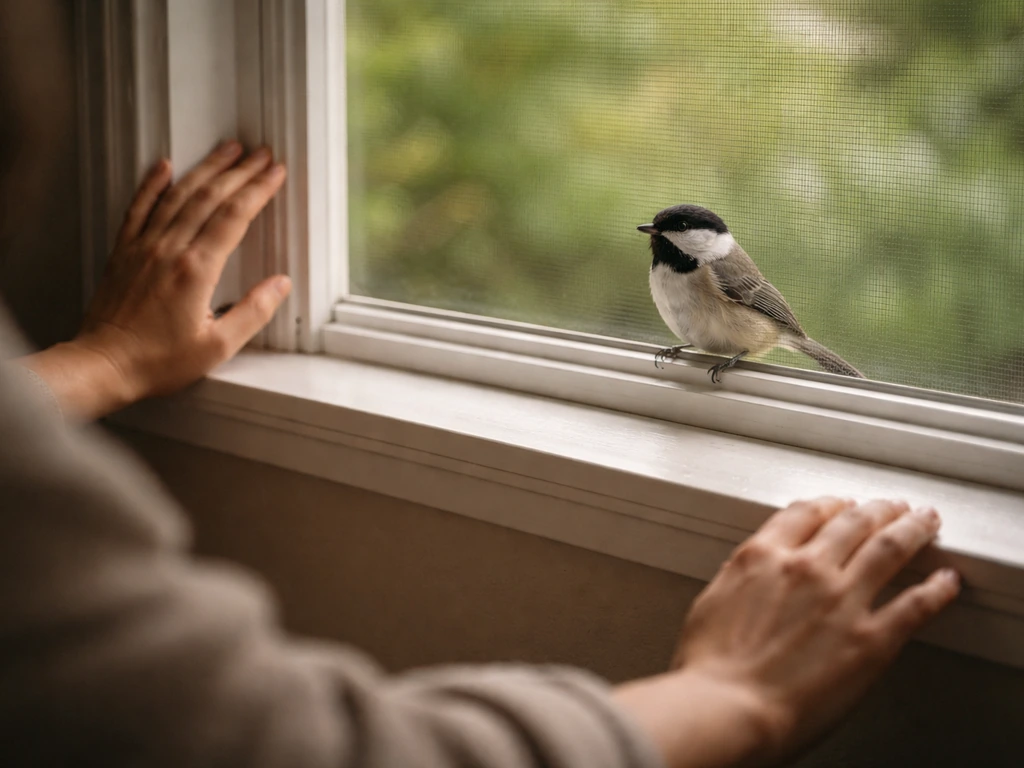
Whether you're reading this as a spiritual sign or a practical puzzle, these steps help you respond well without making things worse.
- Observe without disturbing. Before doing anything, watch from a distance or through the window. Note the bird's species, behavior, and whether it seems alert and mobile or lethargic and still. This shapes everything else.
- Check for reflective surfaces. Look at your door, glass panels, sidelights, or any window near the entry. If the bird is pecking at or repeatedly approaching a glass surface, reflection is almost certainly the cause. Cover the exterior surface with window film, tape, or decals spaced no more than 2 to 4 inches apart to break up the mirror effect.
- Look for signs of nesting activity. If the bird is carrying material, circling the eave, or returning at predictable intervals without glass-pecking behavior, it may be scoping a nest site. Decide now whether you're comfortable with that and act before a nest is established if you're not.
- Note the time, date, and any recent life events in your life. If you're treating this as a potential sign, write down the details while they're fresh. Was there a dream the night before? Did someone you know just pass away? Are you in the middle of a decision? The context you bring to the encounter shapes its meaning.
- Clean up any droppings safely. Use paper towels and wear gloves. Wet the droppings before wiping to avoid spreading dried particles into the air. Wash your hands thoroughly afterward. Don't sweep dry droppings, as this raises dust that can carry pathogens.
- Remove any unintentional food sources. Check for insects attracted to porch lights, spilled birdseed, or open garbage near the door. Eliminating these reduces the chance of repeated visits if you'd rather not encourage them.
- If the bird is simply resting, give it space. A healthy bird will move on. Shooing it aggressively or trying to pick it up is rarely necessary and often counterproductive.
If the bird looks injured or is behaving strangely
A bird that can't fly, is lying on its side, has a drooping wing, or seems completely unaware of your presence needs a different response than a healthy visitor. Here's how to handle it well.
Window strikes: the most common cause of a stunned bird on a doorstep
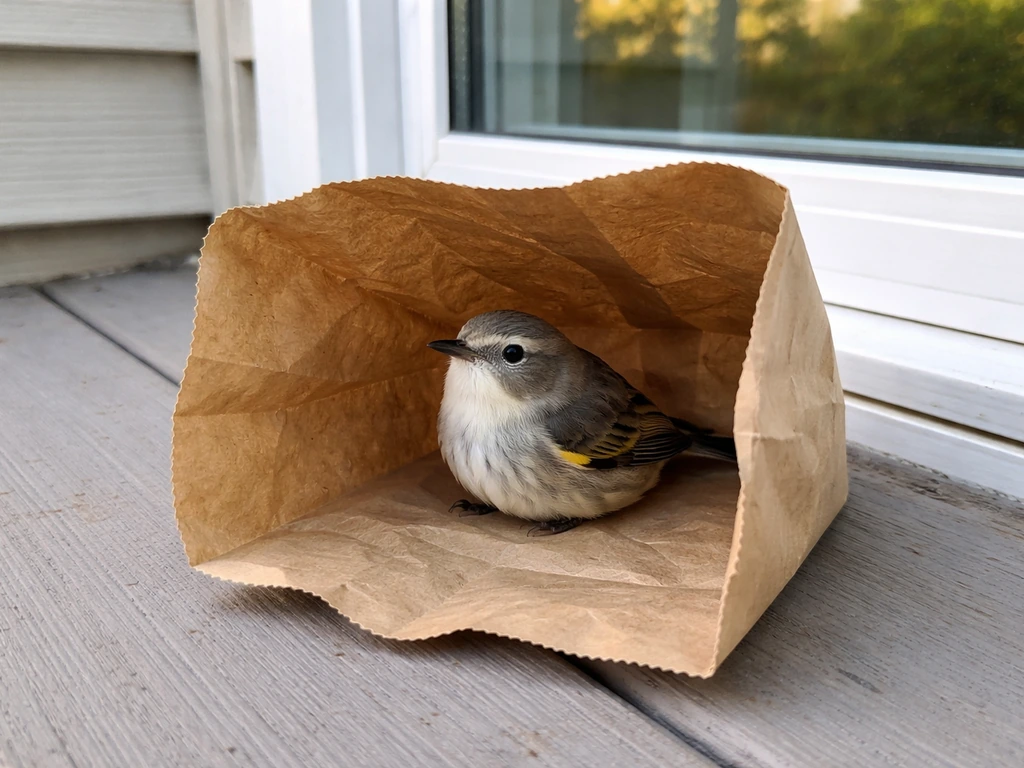
If a bird flew into your door or nearby glass, it may be stunned rather than fatally injured. Audubon also notes that window decals can help prevent window collisions, but they work best when placed closely together, about 2 to 4 inches apart window strikes.
Don't assume it's fine just because it's upright. Gently place the bird in a paper bag or small cardboard box with air holes. Keep it in a warm, dark, quiet room away from pets and children. Do not offer food or water, and do not attempt any first aid beyond containment.
Contact a licensed wildlife rehabilitator as soon as possible. If it's nighttime and no rehabilitation center is open, keep the bird in the dark container until morning, then take it to a rescue facility first thing. [Many birds that appear to recover from window strikes still have internal injuries that require professional care. ](https://www.
audubon. org/debs-park/about-us/what-do-if-you-find-injured-or-orphaned-bird)
Telling an injured bird from a fledgling
Season matters here. From September through mid-May, a bird on the ground that can't fly is very likely injured and needs help. In late spring and summer, a grounded bird with a short tail and some downy feathers is probably a fledgling, not an orphan. Its parents are nearby and feeding it even when you can't see them. Leave it alone. Keep cats, dogs, and curious kids away from the area so the parents can continue their work. If you're genuinely unsure, call a wildlife rehabilitator before you pick the bird up. More baby birds are 'rescued' unnecessarily than are actually in danger.
Who to call
The U.S. Fish and Wildlife Service, your state's wildlife agency, and organizations like the Humane Society can all point you to a licensed wildlife rehabilitator in your area. The USFW recommends calling a professional for the safety of the bird, yourself, and your household. Do not attempt to keep or care for a wild bird on your own, as it's often illegal and rarely in the bird's best interest.
How to work with the meaning if it feels significant
If after checking the practical boxes the encounter still feels like it carries a message, here are some grounded ways to engage with that without overcomplicating it.
Journaling the encounter
Write it down in as much detail as you can: the species, the time, what the bird did, how long it stayed, and how you felt in the moment. Then write freely about what's happening in your life right now. Look for any overlap without forcing it. Sometimes the act of writing surfaces something you already knew but hadn't consciously acknowledged. The bird becomes a prompt rather than a prediction.
Prayer, ritual, or simple acknowledgment
If you come from a spiritual or religious tradition, this is a natural moment to offer a brief prayer of gratitude or openness. Many traditions treat encounters like this as an invitation to pause and listen. You don't need an elaborate ritual. Some people simply stand at the doorstep, take a slow breath, and say something like: 'I'm paying attention. Thank you.' That acknowledgment, whatever form it takes in your tradition, closes the loop on the encounter and signals that you received whatever was being offered.
Life-action prompts to consider
Different spiritual frameworks offer different interpretive keys, but most of them converge on a few questions worth asking after a meaningful bird encounter at your threshold.
- Is there a transition or decision in your life that you've been avoiding or delaying? The doorstep as a threshold is a strong symbol for 'it's time to cross over into something new.'
- Is there a relationship, a creative project, or a commitment that needs your attention? Many doorstep bird traditions point inward, toward what you've been leaving on the step rather than bringing inside.
- If you've recently lost someone, allow yourself to simply receive the comfort without needing to explain it. Whether it's biology, coincidence, or something more, the feeling of being accompanied matters.
- If the bird appeared in a difficult period, consider it a prompt to check your own resilience. Many traditions frame birds at the door as reminders that you have resources available to you, inner or external, that you haven't yet used.
A bird on your doorstep connects to a wider family of encounters that people find meaningful: birds on the porch, on the roof, at the front door specifically, or even in protected indoor spaces like attics. If you saw a bird in an attic, the bird in attic meaning is often interpreted as a message about what has been hidden or left unresolved indoors.
If you are specifically wondering about the bird at front door meaning, it helps to consider both the context of the visit and your own emotional response to it at the front door. If you want to compare meanings, the bird on the porch meaning is similar but can feel more about welcome, comfort, or staying in your home space bird on porch meaning.
Each location adds a slightly different symbolic flavor, but the core question remains the same across all of them. What is this bird, in this place, at this moment in my life, asking me to notice? You get to decide what answer fits.
If you're wondering what a similar moment is supposed to mean, you can also look up the phrase "like a dog with a bird at your door meaning" and compare it to what feels true in your situation.
FAQ
If I think the bird on my doorstep is a spiritual sign, how do I avoid treating it like a guarantee?
Yes, and the safest way to handle it is to treat “meaning” as a reflection prompt, not a prediction. If the bird looks healthy but appears repeatedly, focus on what you can change right now (a decision deadline, an unresolved conversation, or a habit you keep postponing), and avoid making big life moves based only on the encounter.
What should I check first if I want a real explanation, not just symbolism?
Look for a practical pattern first: time of day, weather (rain or wind increases doorstep seeking), and whether the bird is acting like it is defending its space. If it repeatedly targets windows or glass near the door, reflection behavior is the likeliest cause, and the “message” should be framed as an opportunity to reduce hazards rather than a warning about your future.
Could my yard or door setup be causing the bird to show up?
Don’t assume the bird chose your doorstep intentionally. Cats, dogs, and small predators can push birds to nearby cover, and porch areas can accidentally mimic nesting ledges or sheltered corners. A quick scan for hazards (loose netting, gaps, aggressive pets, reflective surfaces) can change the situation more than any interpretation.
Does the bird’s species matter more than what it does?
Species can be a helpful lens, but behavior is usually the deciding factor. If the bird is calm, alert, and making eye contact, many people interpret it as a “pause and pay attention” cue. If it is frantic, repeated pecking at glass is often driven by reflections, and the most useful “meaning” is to address the obstacle (cover windows, adjust lighting at night).
What if the bird seems unwell or won’t fly away, should I still try to interpret the sign?
If the bird is injured or grounded, interpreting it spiritually is optional, but acting correctly is not. Contain it safely (air holes, warm dark quiet place), keep children and pets away, and contact a licensed wildlife rehabilitator. This prevents suffering and also reduces legal and safety risks.
A bird hit my door or window and flew off later, is it still worth getting help?
For window strikes, the bird can look upright yet have internal injuries. Use the containment steps anyway, and do not feed or water it. If it is nighttime and you cannot reach help immediately, keep it dark and quiet until morning, then take it to a rescue or rehabilitator.
How can I tell when a grounded baby bird is actually fine?
If you find a fledgling (usually small with some down, a short tail, and no obvious severe injury in warm months), many times it is being cared for nearby. The best response is to keep pets away and monitor from a short distance, or call a rehabilitator if you truly cannot determine whether a parent is present.
How do I apply “transition” symbolism to something actionable in real life?
If you want to use the “transition” idea in your own way, pair it with a concrete check-in: what is changing in the next 2 to 6 weeks, and where are you hesitating? Then translate that into one small action (send the message, confirm the appointment, declutter the space you plan to move). That keeps the encounter grounded.
What does it mean if the same bird keeps coming back to my doorstep?
Yes. If the bird lands, stays, and keeps returning, many omen traditions treat that as persistence. Practically, it can also mean the same food source or threat is present. The best approach is to both (1) remove the practical trigger (food, reflective angles, nearby threats) and (2) ask what you are consistently avoiding.
How do I interpret it if I just moved or changed something around my front door?
Re-check the context you likely missed: was there a recent weather event, a new light on the porch at night, a new reflection source (carport mirror, shiny planter), or a change to the entryway? These details often explain “charged” encounters without canceling your personal feeling about them.
Next Articles
Like a Dog With a Bird at Your Door Meaning and What to Do
Meaning of like a dog with a bird at your door, plus spiritual take and practical steps if a bird is outside.
Bird at Front Door Meaning: Practical and Spiritual Guide
What a bird at your front door means spiritually and practically, plus safety steps and how to prevent repeats.
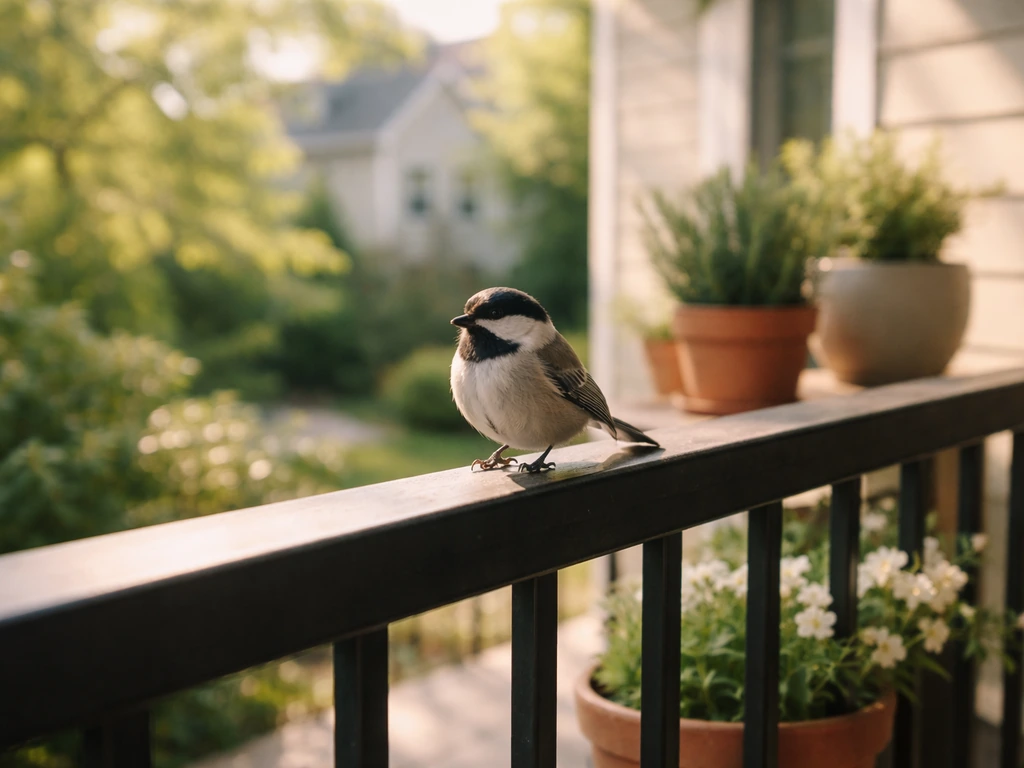
Bird on My Balcony Meaning: Natural Reasons and Spiritual Signs
Bird on your balcony meaning explained with natural causes, spiritual symbolism, and practical steps to help or deter sa